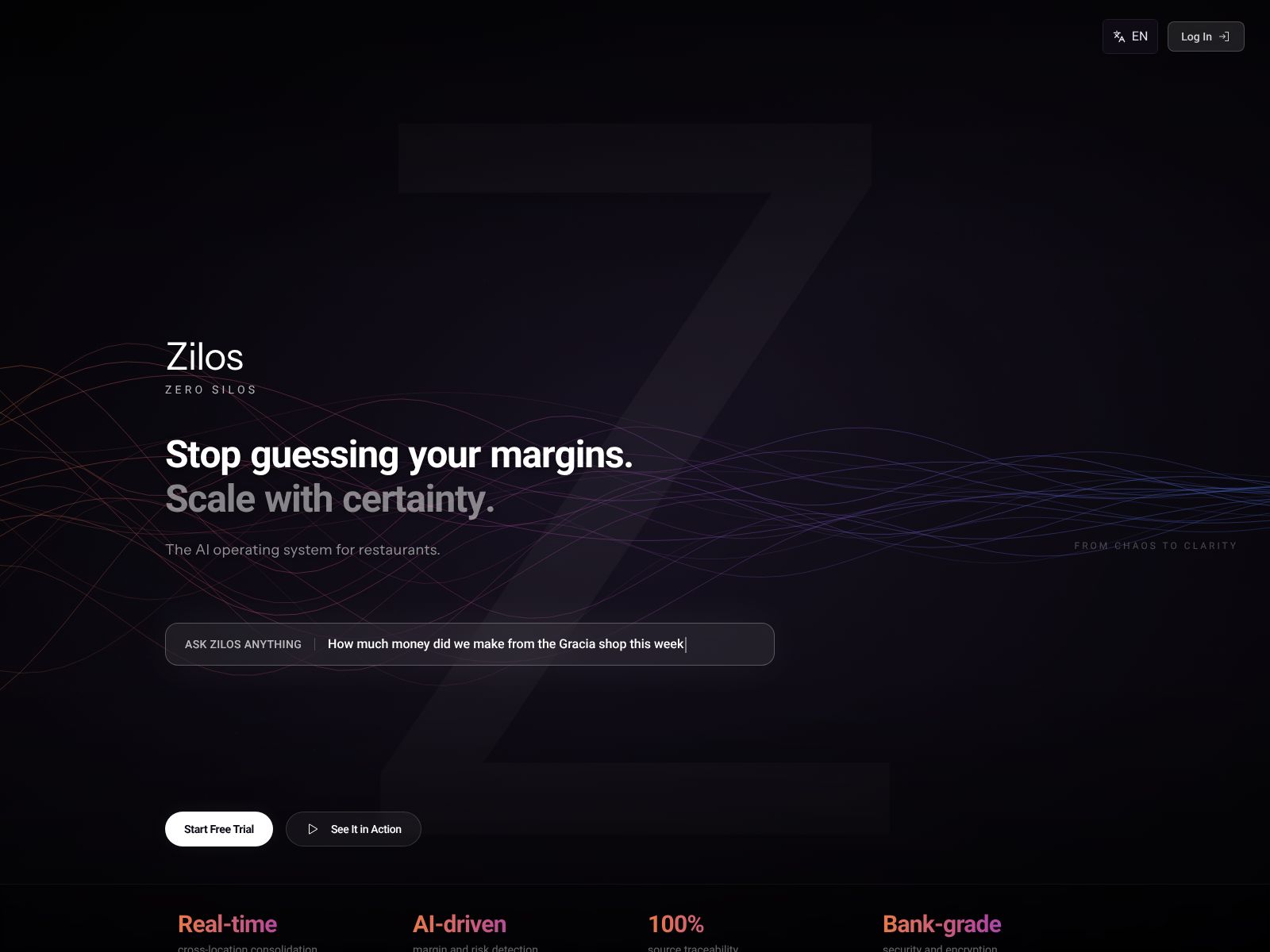
Zilos AI Review (Features, Pricing, & Alternatives)
If you’re running a restaurant, you’re probably juggling point-of-sale numbers, labor schedules, delivery app dashboards, food costs, and guest demand that changes by the hour. Margins are tight, and every small decision compounds across your locations. Zilos AI steps into that chaos with one clear promise: turn your fragmented restaurant data into real-time profit intelligence and AI-driven actions you can trust. In this review, I’ll walk you through what Zilos AI does, how it works, who it’s best for, what to consider on pricing, and the top alternatives worth comparing.
By the end, you should have a practical understanding of whether Zilos AI belongs in your tech stack, what outcomes to expect, and how to evaluate it alongside other platforms targeting the same goals.
What Does Zilos AI Do?
Zilos AI helps restaurants make more money with less guesswork. It pulls your key data together (like sales, labor, inventory, and channel performance), shows you where profit is leaking, and then recommends or automates actions to fix it—location by location, shift by shift.
Why This Matters Now
Most restaurant teams are stuck in spreadsheet purgatory. You pull POS reports at night, check delivery dashboards in the morning, manually compare food cost variances on Mondays, and hope managers follow the plan. The problem is two-fold:
- Data is fragmented and often delayed, so decisions arrive after the damage is done.
- Even when insights are clear, it’s hard to turn them into consistent actions across multiple stores and teams.
Zilos AI aims to change this dynamic by unifying your data and connecting it directly to daily operational decisions—so you’re not only seeing what’s off, but also nudged (or automated) into doing the right next thing to improve margins.
Zilos AI Features
At its core, Zilos AI positions itself as an AI operating system for restaurants—an orchestration layer that pulls data together, turns it into profit intelligence, and closes the loop with actions. Here’s how that breaks down in practice.
1) Unified Data Layer for Restaurants
The biggest unlock is often the most invisible one: data plumbing. Zilos AI brings key data sources into one place and keeps them synchronized. While the exact integration list can change, think about the common categories your operation depends on:
- POS data (sales, item-level mix, checks, discounts, comps)
- Labor and scheduling data (hours, roles, wages, clock-ins)
- Inventory and recipe data (purchase costs, usage, waste, theoretical vs. actual)
- Third-party delivery channels (menu availability, pricing, promotions, order mix)
- Marketing and guest demand signals (campaigns, local events, foot traffic indicators)
- Basic financial metrics (prime cost, COGS, contribution margin)
Instead of logging into five systems and reconciling them manually, you get a single, consistent model of your operation that updates in real time or near real time. This is the foundation for everything else Zilos AI does.
2) Real-Time Profit Intelligence
Once your data is unified, Zilos AI surfaces the signals that matter most for margin. You get clear answers to questions like:
- Which items are driving profit vs. just volume?
- Where are we leaking margin because of waste, voids, discounts, or over-portioning?
- What’s our prime cost doing this week, and which locations are off plan?
- Are we staffed correctly for projected demand today and tonight?
- Which channels are profitable right now, and which need a pricing or promo adjustment?
The point is to cut through noise. Zilos AI focuses on a small set of actionable metrics for each role—owners, ops leaders, GMs, kitchen managers—so each person sees what they can influence today to protect margin tomorrow.
3) Forecasting You Can Use
Forecasts only help if they’re accurate enough and easy to act on. Zilos AI applies machine learning to predict demand at the level that actually matters to operations: by location, by day, and often by hour. With better forecasts, you can:
- Staff to demand without overscheduling or risking guest experience
- Prep smarter to reduce waste and avoid 86’ing popular items
- Adjust delivery menus, promos, or lead times during peaks
- Plan purchasing with tighter control on inventory turns
The practical win here is not just better accuracy—it’s the workflow. Zilos AI ties forecasts directly to labor and prep guidance so your teams have a clear plan to follow.
4) Menu and Mix Optimization
A profitable menu is more than a list of top sellers. Zilos AI helps you view your menu as a portfolio: contribution margin, elasticity, attachment patterns, and operational complexity all factor into your best moves. Expect support for tasks like:
- Identifying high-volume, low-margin items that need price, portion, or recipe reviews
- Spotting items that drive profitable attachments and deserve extra promotion
- Flagging SKUs with volatile costs or high waste for substitution or specials
- Aligning menu changes with kitchen capacity and speed of service
Over time, these incremental menu improvements add up—and Zilos AI tracks impact so you can see the gains.
5) Labor Planning and Productivity
Labor is one of your largest controllable costs. Zilos AI supports smarter scheduling and shift management by connecting demand forecasts to role-by-role guidance. That might look like:
- Recommended staffing levels by hour and station
- Alerts when actual traffic diverges from plan so you can adjust on the fly
- Visibility into labor cost as a percentage of sales in real time
- Insights into productivity by role or time period
The goal is balance: protect guest experience without overspending on labor. Zilos AI helps you hold that line with data instead of gut feel.
6) Inventory, Waste, and COGS Controls
Zilos AI connects purchasing, usage, and sales so you can spot COGS issues faster. It supports workflows such as:
- Comparing theoretical vs. actual usage to highlight waste or over-portioning
- Flagging low stock for high-margin items to prevent lost sales
- Surfacing supplier cost changes that undercut item-level margin
- Tightening par levels based on demand patterns
You get out of reactive mode, with fewer end-of-week surprises and more mid-week corrections.
7) Delivery and Channel Profitability
Third-party orders can be a lifeline and a margin risk. Zilos AI helps you see channel performance clearly across marketplaces and your owned channels. Practical use cases include:
- Understanding contribution margin by channel, including fees and promotions
- Optimizing delivery menus to highlight profitable items
- Adjusting prices or promos based on real-time demand and costs
- Monitoring prep times, order accuracy, and cancellations
If delivery is a big part of your business, these insights are essential to keep growth aligned with profit.
8) AI-Driven Actions and Automations
This is where Zilos AI aims to stand out. It’s not just analytics; it’s action. Depending on your stack and permissions, capabilities may include:
- Proactive alerts to managers with suggested fixes (e.g., adjust prep, swap items, tweak staffing)
- Automated updates to digital menus or channel availability based on inventory thresholds
- Suggested price or promo changes for specific items or time windows
- Daily operating plans pushed to each location with clear priorities
You stay in control of what gets automated vs. approved. The aim is to close the loop from “insight” to “action” as fast as possible, with consistency across locations.
9) Multi-Unit Visibility and Benchmarking
For operators with several locations, seeing the forest and the trees at once is hard. Zilos AI gives you roll-up dashboards and drill-down views so you can:
- Benchmark locations on key KPIs (prime cost, speed, waste, margin)
- Spot outliers quickly and share best practices
- Run standardized playbooks but adjust for local demand
- Track impact of initiatives across the whole portfolio
This helps you scale what works without recreating the wheel at every store.
10) Role-Based Experience and Collaboration
The right person needs the right signal at the right time. Zilos AI is designed for different roles:
- Owners and finance: margin trends, variance drivers, ROI
- Ops leaders: cross-location benchmarks, initiatives, compliance
- GMs: daily plan, staffing, inventory exceptions, waste alerts
- Kitchen managers: prep guidance, 86 risk, recipe adherence
Clear handoffs and shared views reduce miscommunication and improve follow-through.
Who Is Zilos AI Best For?
Zilos AI is built for operators who want to move from reactive reporting to proactive, AI-assisted operations. It’s a strong fit if you:
- Run multi-location concepts (QSR, fast casual, casual dining, ghost kitchens)
- Manage complex channel mixes (on-prem, curbside, marketplace delivery, direct online)
- Have enough data volume to benefit from forecasting and automation
- Want to standardize playbooks but keep local flexibility
- Care deeply about margin improvement and operational consistency
Single-location operators can still benefit, but the biggest ROI often appears as you scale across locations and shifts.
Zilos AI Pricing: What to Expect
Most restaurant intelligence platforms price based on a few common factors, and Zilos AI is likely similar. While specific pricing isn’t listed publicly, you can expect a custom quote influenced by:
- Number of locations and expected users
- Which modules and automations you enable
- Data integration scope and any custom work
- Implementation and training requirements
- Support and success plan (e.g., standard vs. premium)
Here’s a simple way to frame value as you discuss pricing:
- Quantify waste reduction opportunities (theoretical vs. actual usage)
- Estimate labor optimization (fewer overstaffed hours, fewer call-ins)
- Model menu mix improvements (shift volume to higher-margin items)
- Account for reduced stockouts and fewer lost sales
- Consider time saved by your team moving from manual reporting to automated insights
Ask the Zilos AI team for a value model based on your actual historical data. That gives you a realistic ROI picture and helps set targets for the first 90 days.
Implementation and Onboarding
Getting value quickly depends on clean data and clear roles. A practical onboarding flow typically includes:
- Discovery: confirm goals, metrics, and key workflows you want to improve
- Integrations: connect POS, labor, inventory, and channel systems
- Validation: spot-check data accuracy and mapping (items, recipes, SKUs, roles)
- Configuration: set KPIs, thresholds, automations, and permissions
- Pilot: roll out to a few locations, measure impact, gather feedback
- Scale: expand across locations, standardize playbooks, iterate
Plan for some change management. Zilos AI can simplify life for your team, but it’s still a behavior shift—especially as you introduce automations. Clear training, role-based dashboards, and quick wins help adoption.
Strengths and Trade-Offs
Based on Zilos AI’s positioning and category best practices, here’s how to think about strengths and considerations:
- Strengths
- Unified data foundation designed specifically for restaurants
- Focus on profit intelligence, not just reporting
- Action-oriented workflows and automations to close the loop
- Useful at both the corporate and store levels
- Considerations
- Impact depends on quality and completeness of your data
- Multi-system integrations can add time to onboarding
- Automations require clear governance to maintain trust
- Change management is key; set expectations and train teams
Zilos AI Top Competitors
If you’re evaluating Zilos AI, you’ll want to compare it with a few adjacent and overlapping platforms. Each has a different center of gravity—some go deep on accounting, some on inventory, others on analytics or pricing. Here are leading options to consider:
1) Restaurant365
Focus: All-in-one accounting, inventory, scheduling, and operations for restaurants.
- Strengths: Deep accounting and back-office capabilities; widely adopted
- Consider if: You want a single system of record for finance and ops
- Compare to Zilos AI: Zilos emphasizes AI-driven profit actions; R365 is a robust operational ERP with analytics
2) MarginEdge
Focus: Invoice processing, recipe/plate costing, daily P&L, and operational insights.
- Strengths: Fast invoice capture, clean plate costing, practical daily views
- Consider if: You want quick visibility into COGS and recipe performance
- Compare to Zilos AI: MarginEdge is strong on COGS and daily control; Zilos focuses on unified intelligence and automation across more levers
3) Tenzo
Focus: Restaurant analytics and forecasting pulling data from POS, labor, and inventory.
- Strengths: Solid dashboards, demand forecasting, mobile-friendly insights
- Consider if: You want cross-system analytics with quick deployment
- Compare to Zilos AI: Tenzo is analytics-first; Zilos positions on AI-driven decisions and actions
4) 5-Out
Focus: AI forecasting to optimize labor and purchasing.
- Strengths: Forecast accuracy and simplicity
- Consider if: Your top priority is demand planning
- Compare to Zilos AI: 5-Out narrows in on forecasting; Zilos includes forecasting as part of a broader profit OS
5) ClearCOGS
Focus: Predictive ordering and prep to reduce waste and stockouts.
- Strengths: Clear use cases, straightforward ROI on waste reduction
- Consider if: Waste and prep accuracy are your main issues
- Compare to Zilos AI: ClearCOGS specializes in predictive prep; Zilos spans multiple profit levers
6) Juicer and Sauce Pricing
Focus: Dynamic pricing and offer optimization for restaurants and delivery channels.
- Strengths: Data-driven price testing and channel strategies
- Consider if: You’re ready to adjust prices based on demand and costs
- Compare to Zilos AI: Pricing is one lever within Zilos; these tools go deeper into price experimentation
7) Toast, Square, Lightspeed, and Oracle MICROS
Focus: POS with analytics, integrations, and some operational tooling.
- Strengths: Strong POS, expanding analytics and partner ecosystems
- Consider if: You want to stay within your POS vendor’s ecosystem
- Compare to Zilos AI: POS analytics are improving, but Zilos focuses on unifying data across systems and acting on it
8) SynergySuite and Similar Inventory Suites
Focus: Inventory management, purchasing, and recipe control.
- Strengths: Deep inventory workflows, vendor management
- Consider if: You need rigorous inventory discipline
- Compare to Zilos AI: Inventory is one component; Zilos balances inventory with labor, menu, and channel actions
How to Choose Between Them
Your best choice depends on your current stack and the gap you want to close first. A few quick heuristics:
- If accounting and back-office consolidation is priority one, start with Restaurant365.
- If you want a better handle on COGS and daily P&L, look at MarginEdge.
- If forecasting is your main pain, compare Tenzo and 5-Out.
- If waste is your top issue, evaluate ClearCOGS.
- If price experimentation is a core strategy, consider Juicer or Sauce.
- If you need a platform that unifies data and drives cross-functional actions to improve margin, put Zilos AI on your shortlist.
Security, Data Ownership, and Governance
Any time you centralize operational data and turn on automations, good governance matters. As you evaluate Zilos AI or any competitor, confirm:
- Data access and control: who can see and do what, down to roles and locations
- Audit trails for changes, approvals, and automations
- Data retention and portability policies
- Compliance standards (ask vendors to share current certifications and practices)
- Sandbox vs. production workflows for testing changes safely
Strong controls build trust for your team and keep operations stable as you scale automations.
Questions to Ask the Zilos AI Team
To make your evaluation faster and more useful, use these prompts:
- Which integrations are turnkey for my POS, labor, inventory, and channels?
- What are typical implementation timelines for a business like mine?
- What data quality issues derail projects, and how do you help address them?
- Which automations do most customers turn on first, and what guardrails exist?
- How do you measure ROI in the first 90 days and beyond?
- What does the role-based experience look like for GMs vs. corporate?
- How are forecasts and recommendations explained so managers trust them?
- What training and ongoing success support do you provide?
A Practical 90-Day Plan with Zilos AI
If you decide to move forward, align your team around a simple, high-impact roadmap:
- Week 1–2: Connect core systems, validate mappings, and baseline key KPIs (prime cost, COGS variance, labor cost, waste, stockouts).
- Week 3–4: Turn on role-based dashboards and alerts for a pilot group (2–5 locations). Focus on 2–3 metrics that move the needle.
- Week 5–6: Enable guided labor planning and prep suggestions based on forecasts. Track adherence and outcomes daily.
- Week 7–8: Run a targeted menu mix improvement—promote 2–3 higher-margin items and de-emphasize 1–2 low-margin items.
- Week 9–10: Introduce light automations with approvals (e.g., inventory-based menu availability, alert-driven staffing nudges).
- Week 11–12: Review impact vs. baseline, capture manager feedback, decide which automations to scale across locations.
This cadence helps you prove value early and build momentum without overwhelming your team.
What Results Should You Expect?
Outcomes vary by concept and starting point, but the most common wins from platforms like Zilos AI include:
- Fewer costly surprises thanks to real-time margin visibility
- Lower food waste and tighter theoretical vs. actual usage
- Better staffing alignment with demand and improved labor efficiency
- Higher contribution margin from smarter menu and channel decisions
- Consistent execution across locations with role-based workflows
- Time saved by managers who no longer live inside spreadsheets
The key is focus: pick a few metrics to improve, align your team, and let the system drive daily behavior.
Buyer’s Checklist
Before you sign, make sure you’re set up for success:
- We’ve documented our core data sources and who owns each integration.
- We’ve listed our top 3 margin priorities for the next quarter.
- We know which automations we’re comfortable piloting first.
- We’ve assigned internal champions at corporate and store levels.
- We’ve scheduled training and set expectations for adoption.
- We have a clear 90-day ROI target and review cadence.
Pros and Cons Summary
- Pros
- Purpose-built for restaurants, not generic BI
- Balances analytics with AI-driven actions and automations
- Supports both strategic and day-to-day operational decisions
- Designed for multi-location consistency with local flexibility
- Cons
- Requires clean data and alignment across systems
- Change management effort is necessary for sustained impact
- Custom pricing means a sales process to scope needs
Verdict: Is Zilos AI Worth It?
If your team spends hours each week stitching together reports and still reacts late to margin issues, Zilos AI is worth a serious look. It’s built to unify the data you already have, highlight the most important levers, and help your managers turn insights into consistent action. That combination—profit intelligence plus AI-driven decisions—can compound into meaningful gains, especially across multiple locations.
If you already have solid accounting and inventory systems but lack a profit “brain” that orchestrates daily action, Zilos AI fills that gap nicely. If you’re still standardizing basic workflows, start there first or choose a suite that solves your most urgent back-office need, then circle back to AI-driven optimization.
Wrapping Up
Zilos AI positions itself as the AI operating system for restaurants, and that focus shows. By unifying fragmented data and delivering real-time profit intelligence with AI-driven actions, it helps you protect margin, reduce waste, and run tighter shifts across locations.
As you evaluate, anchor the conversation in your top margin goals: labor alignment, COGS discipline, menu mix, or channel profitability. Ask for an ROI model based on your data, start with a pilot, and scale what works. Whether you choose Zilos AI or a competitor, the right system should make your team’s day simpler, your decisions faster, and your margins healthier.
To learn more or see how it connects to your stack, visit Zilos AI at their website and request a tailored walkthrough. With the right plan and adoption, you can move from chasing yesterday’s numbers to confidently steering today’s profit.