




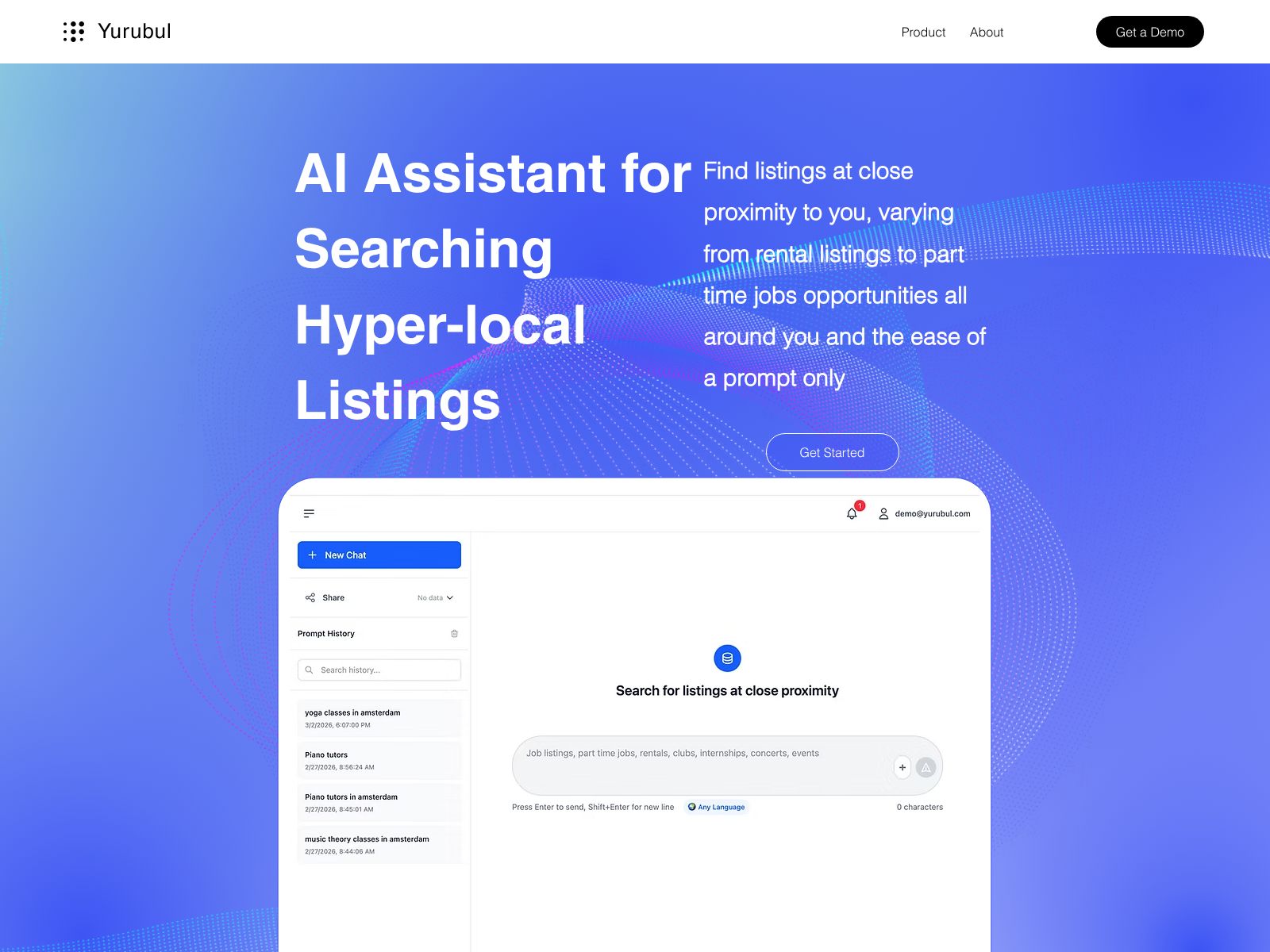
If you’ve ever bounced between a dozen apps to find a nearby room to rent, a part-time shift, or a quick local opportunity, you know how scattered the local search experience can feel. YURUBUL aims to pull those results into one place, centered on what’s closest to you and what you actually need—without the clutter. In this review, I’ll walk you through what YURUBUL is, how it works, the features that matter, where it stands out, where it might still be growing, and which alternatives to consider. By the end, you’ll know if it’s worth adding to your daily search toolkit.
YURUBUL helps you find nearby listings—like rental options and part-time job opportunities—using a simple, prompt-based search. You tell it what you’re looking for in plain language, and it focuses on results around you.
Below are the kinds of capabilities you can expect from a proximity-first listing platform built around prompts. Exact options can evolve over time, so think of this as a practical guide to how you’ll likely use YURUBUL—and what to look for as you try it.
YURUBUL centers your search on what’s nearby. Instead of trawling through national or city-wide feeds, you narrow in on your neighborhood and surrounding areas. This saves time and helps you focus on what’s actually realistic for your day-to-day life—short commutes, easy visits, and local logistics that work.
Rather than wrestling with dozens of dropdowns, you use natural language. Type exactly what you want: “2-bedroom near transit,” “evening retail shifts within 5 miles,” or “furnished room, flexible lease.” This style of search is intuitive if you’re used to chatting with an assistant or typing into a search bar. It’s especially helpful when you’re not sure which filter to use or you want to combine several needs in one go.
Most tools handle either housing or jobs, but not both in one place. YURUBUL’s focus on “listings around you” spans at least rental options and part-time work, which lets you solve two common local needs without swapping platforms. If you’re settling into a new area or juggling classes, being able to search both with the same workflow is a big plus.
After you run a prompt, you’ll want to fine-tune results. The most useful filters in a local-first context typically include:
The goal is to cut to the listings most compatible with your timeframe, budget, and daily routine.
For local decisions, a map is more than a nice-to-have. It helps you visualize commute times, transit access, and day-to-day errands. YURUBUL’s approach centers proximity, so expect a clean way to scan results spatially as well as in a simple list, with essentials like price, location, and key attributes surfaced up front.
When you click a result, you should quickly see what you need to decide if it’s worth pursuing. For rentals, that’s price, deposit (if any), size, lease terms, neighborhood, and photos. For part-time roles, that’s pay rate, schedule, location, requirements, and application instructions. Look for a layout that keeps you from scrolling endlessly just to confirm the basics.
If you’re listing a room or hiring for part-time roles, simplicity matters. A short form, a few photos, clear instructions, and quick publishing reduce friction. A proximity-first audience also means your posting is seen by people nearby who are ready to take action, instead of getting buried in a global feed.
Good listing platforms make it easy to reach the poster in a channel they prefer—whether that’s a website application link, email, phone, or in-app messaging if provided. Expect clear call-to-action buttons, not scavenger hunts for contact details.
Local markets move fast. Having the ability to save a search like “room under $800 within 2 miles” or “weekend shifts near zip code 00000” and then receive alerts can help you beat the rush. If YURUBUL offers this, turn it on for your must-have queries to catch fresh listings quickly.
No marketplace is perfect, but smart safety practices reduce friction and risk. Tools that help you report suspicious listings, clarify what’s verified (if anything), and educate users about safe meetups and payments all make a difference. As with any local listing, take standard precautions: verify details, meet in public places when possible, and avoid sharing sensitive information early in the process.
Local discovery usually happens on the go, often on your phone in between classes or shifts. A mobile-friendly site or app makes it easier to run quick prompts, check new matches, and contact posters without waiting to get to a computer.
Because YURUBUL centers on proximity, you’ll likely be asked to share a location or enter an area manually. It’s helpful when you can set a custom radius, adjust precision (e.g., city vs. exact address), and review any location permissions you’ve granted. That balance keeps you in control while still surfacing what’s near you.
At the time of writing, YURUBUL’s detailed pricing isn’t publicly listed on its homepage. From a user perspective, browsing local listings is typically free on platforms like this. Posting may be free, freemium, or paid depending on category and region, and some marketplaces introduce optional paid boosts for visibility over time.
Here’s how to think about costs as you try it:
Because pricing can change as a platform grows, check the site directly or any pricing/help pages for the most current details. If you don’t see them, reach out through the site’s contact or support link before posting a time-sensitive opening.
Here are some popular alternatives you might compare with YURUBUL, especially if you’re weighing reach, depth, and focus. Each has strengths, but none combine “prompt-based search” with a proximity-first mindset across rentals and part-time jobs in exactly the same way.
Good for: Broad local classifieds, including rentals and casual job posts. Huge user base means lots of volume. However, quality varies widely, job posts can be inconsistent, and search isn’t tailored to nuanced local needs. You’ll do more manual filtering and deal with mixed reliability.
Good for: Classic city-by-city listings covering housing and gigs. It’s been around forever, so people know it. The downsides are familiar too: variable quality, limited modern filtering, and a text-heavy interface that hasn’t kept pace with more streamlined, prompt-friendly design.
Good for: Mainstream job search with strong reach and employer tools. Great if you want a broad sweep of part-time roles. It’s not designed for rental discovery, and you’ll often dig through listings to find truly local, flexible shifts in the exact radius you want.
Good for: Aggregated job postings from around the web with useful filters. Strong if you need a wide net for part-time roles. As with most job boards, you’ll need to fine-tune location settings, and it won’t help with rentals in the same interface.
Good for: Professional roles and part-time opportunities in certain sectors. Helpful networking features and easy applications. Less effective for hyperlocal service jobs or casual shifts, and it doesn’t handle housing.
Good for: Deep rental inventory, strong filtering, and polished listing experiences. Excellent if your focus is only housing. Not for jobs, and some platforms prioritize larger property managers over small, hyperlocal posts.
Good for: Neighborhood-level conversations and classifieds. You can sometimes find local gigs or rental sublets here. The flip side is noise—community chatter, ads, and less structured search make it harder to run targeted, prompt-based queries.
Good for: In some countries, these are the dominant local marketplaces, covering rentals, jobs, and more. Quality and safety vary by region. Search is more traditional, and you’ll rely more on manual filters than prompt-driven refining.
If your priority is maximum inventory for one category (e.g., long-term rentals at scale or corporate jobs), a specialized portal could complement YURUBUL. But for everyday local discovery, YURUBUL’s simplicity is the point.
Start specific. If you get too few results, broaden one dimension at a time—raise the price cap slightly, widen the radius by a mile, or loosen schedule requirements.
Is YURUBUL free?
Browsing is typically free on platforms like this. Posting may be free or paid depending on category and visibility options. Check the site directly for current details.
Do I need to share my exact location?
You can usually set an area or radius manually if you prefer not to share precise location data. Adjust to what feels comfortable and still useful.
How reliable are listings?
As with any marketplace, quality can vary. Read carefully, verify details, and use reporting tools if something seems suspicious.
Can I post as a small landlord or local business?
Yes—YURUBUL is built for nearby discovery, which is ideal for small, local posts. Prepare clear photos, details, and contact instructions for faster responses.
YURUBUL’s promise is simple: find nearby listings—rentals and part-time jobs—fast, with the ease of a single prompt. If you’re tired of hopping between separate apps and wrestling with clunky filters, the proximity-first, plain-language approach is refreshing. It helps you turn “what I need, near me” into a short list you can act on today.
Like any growing marketplace, coverage can vary by region, and features will evolve. But the foundation is strong: a focused, streamlined way to handle two of the most common local needs in one place. If that sounds like your daily reality, it’s worth giving YURUBUL a try. Head over to yurubul.com, type a prompt that matches your life, and see what pops up. With a little specificity—and a few smart tweaks—you might find your next room, your next shift, or both, right around the corner.
