VCTR04AI Review (Features, Pricing, & Alternatives)
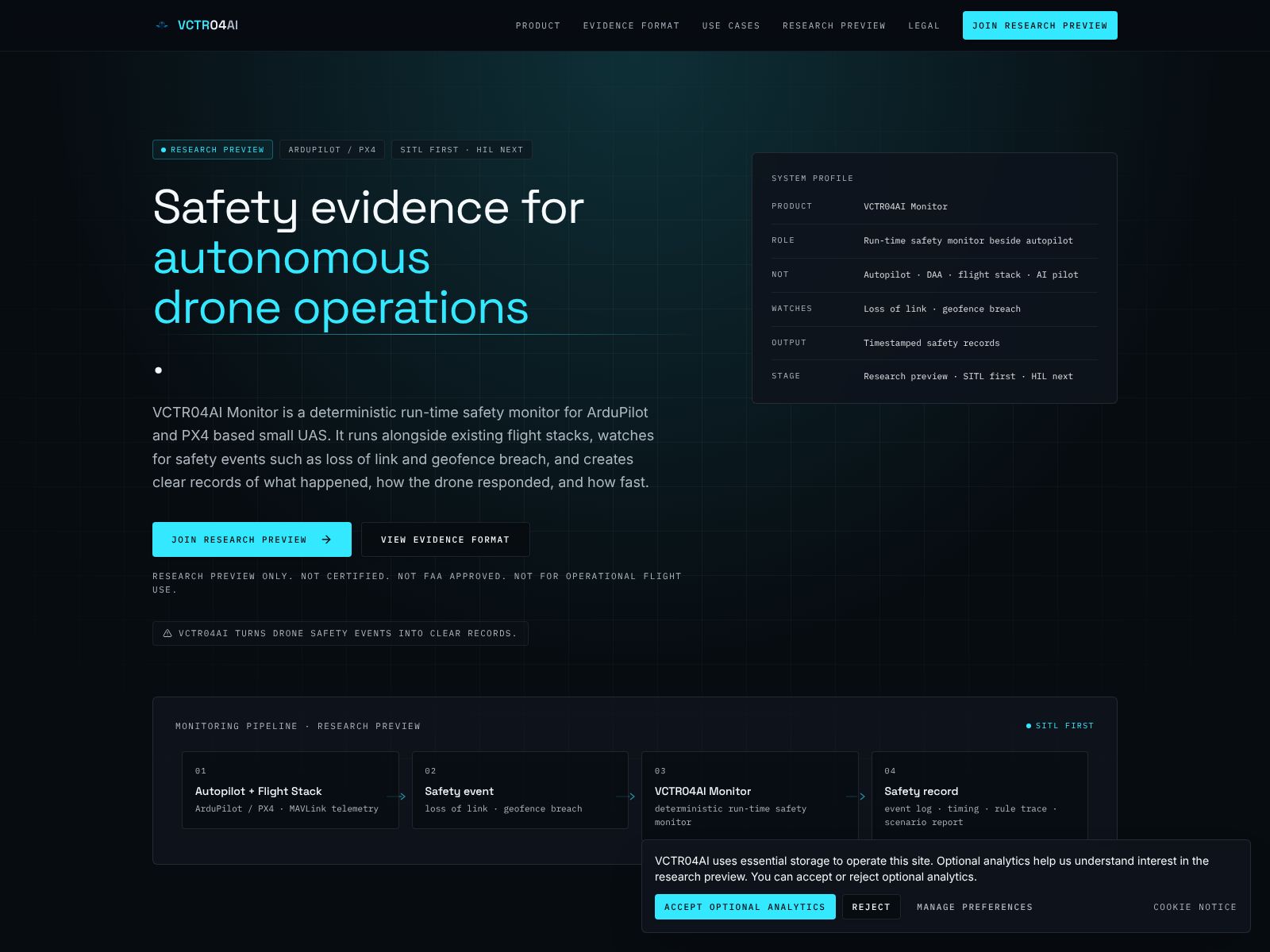
If you fly small uncrewed aircraft systems (sUAS) on ArduPilot or PX4 and you’re thinking about beyond visual line of sight (BVLOS) operations, you already know the challenge: you must prove your aircraft will behave safely and predictably when things go wrong. VCTR04AI is a research-preview project aiming to make that proof simpler. It sits alongside your existing flight stack and focuses on two of the most scrutinized failure cases—loss of link and geofence breaches—while producing the artifacts regulators, safety teams, and engineering leadership ask for: bounded safety-action logs, worst-case latency records, rule-traceability records, and scenario test evidence.
In this review, I’ll walk you through what VCTR04AI does, how it might fit into your stack, its core features, who it’s for, limitations to keep in mind, pricing notes, top alternatives and complements, and some practical advice on evaluating it. By the end, you’ll have a clear sense of where it could help your team reduce BVLOS risk and how to approach a pilot.
What does VCTR04AI do?
VCTR04AI is a safety monitor that runs next to ArduPilot or PX4. It watches for link loss and geofence violations and documents how your drone responds. It produces clear, bounded logs and evidence you can review later to show what happened and how fast the system reacted.
Why this matters for BVLOS and enterprise drone ops
Whether you fly inspection, delivery, mapping, or security missions, your regulators and customers care less about your nominal path and more about your off-nominal behavior. What happens if the control link drops? What if the aircraft drifts toward a no-fly area or a boundary? Can you show—with data—that your mitigation triggers quickly, follows a defined rule, and stays within a safety envelope?
Most open-source flight stacks already provide failsafes. But for BVLOS or higher-consequence operations, you often need additional, deterministic assurance and auditable evidence outside the main control loop. That’s the niche VCTR04AI is targeting: a companion, deterministic run-time monitor that provides bounded behavior and proof you can hand to a safety case reviewer.
How VCTR04AI works at a glance
- It runs alongside, not inside, your ArduPilot/PX4 flight stack.
- It focuses first on two scenarios: loss of link and geofence breaches.
- It monitors telemetry, evaluates rules deterministically, and records outcomes.
- It generates artifacts you can store and review: safety-action logs, worst-case latency, rule-traceability, and scenario test evidence.
You keep flying with ArduPilot or PX4 as usual. VCTR04AI observes, evaluates, and documents how safety rules would or did apply. The word “deterministic” here is important: for each monitored scenario, the system aims to produce strictly bounded and repeatable decisions with documented timing guarantees, so you can reason about worst-case behavior.
Important caveat: VCTR04AI is a research-preview. It is not certified, FAA-approved, or cleared for operational aircraft use. Treat it as a tool for R&D, simulation, and offline/flight-test evidence development—not as a production safety device.
VCTR04AI Features
Based on the publicly available description, these are the core ideas you can expect from VCTR04AI’s feature set today:
- Deterministic run-time safety monitoring
- Watches for loss-of-link and geofence-breach events in real time.
- Uses clear, rule-based logic to evaluate state and potential safety actions.
- Focuses on strict, bounded behavior rather than probabilistic outcomes.
- Side-by-side operation with ArduPilot/PX4
- Runs as a companion safety monitor rather than modifying your flight stack.
- Lets you keep your existing autopilot settings while adding extra assurance and observability.
- Bounded safety-action logs
- Produces logs that document what safety action was selected (or would have been selected) and within what bounds.
- Helps you prove to internal reviewers or regulators that the response is predictable.
- Worst-case latency records
- Captures timing data that shows how long it took for a safety rule to trigger and for the action to be issued or recorded.
- Supports safety cases that require evidence of timing guarantees (for example, “response within X milliseconds”).
- Rule-traceability records
- Links observed behavior back to the specific rule that drove the decision.
- Makes audits easier by mapping “what happened” to “why it happened.”
- Scenario test evidence for BVLOS-oriented workflows
- Facilitates building a library of test runs—simulation and flight tests—that demonstrate behavior across edge cases.
- Creates artifacts you can include in an internal safety review or BVLOS application package.
All of these features are aimed at giving you both run-time assurance and offline evidence. Together, they support a practical loop: define safety rules, test them in sim and controlled flights, capture results, and use the evidence to refine procedures and satisfy review gates.
Where VCTR04AI fits in your stack
If you already fly ArduPilot or PX4, you’re halfway there. VCTR04AI is designed to sit next to your existing stack as a companion monitor. In a typical workflow, you would:
- Define your safety envelope and rules for loss-of-link and geofence scenarios.
- Run VCTR04AI in simulation (SITL) to evaluate timing and behavior under controlled conditions.
- Conduct tethered or tightly controlled flight tests to compare monitor outputs with your autopilot’s built-in failsafes.
- Review logs, latency records, and rule-traceability reports after each run.
- Iterate until your team is comfortable with the evidence for both nominal and edge cases.
Because VCTR04AI is not a replacement for your autopilot, you keep full access to ArduPilot/PX4 settings and existing failsafes. The monitor adds another layer of observability—and, depending on your integration approach, a path to enforce or recommend safety actions in a deterministic, well-documented way. If you choose to keep it purely observational during early testing, you still gain valuable evidence without changing control behavior.
Who VCTR04AI is for
- BVLOS-oriented operators: If your roadmap includes BVLOS, you’ll need to show your mitigations are predictable and timely. VCTR04AI’s artifacts are meant to help you do exactly that for two common risk scenarios.
- Systems integrators: If you build platforms around ArduPilot/PX4 and package them for customers, you can use VCTR04AI to strengthen your safety story with consistent logs and traceability.
- R&D teams and safety engineers: If your focus is developing and validating safety cases before seeking operational approvals, a research-preview monitor that runs in parallel is a useful lab tool.
- Compliance and QA leaders: If you need evidence that ties results back to explicit rules and timing guarantees, VCTR04AI is aimed at producing that paperwork for you.
Important limitations and caveats
- Research preview only: VCTR04AI states clearly that it is not certified, FAA-approved, or cleared for operational aircraft use. Treat it as an R&D tool, not as a production safeguard.
- Scenario scope: The initial focus is on loss-of-link and geofence-breach cases. Those are critical, but not exhaustive. You’ll still need to address other hazards (power issues, navigation faults, sensor failures, DAA, and more) through separate mitigations.
- Not a sense-and-avoid system: VCTR04AI is not a detect-and-avoid sensor suite. It won’t identify non-cooperative aircraft or dynamically reroute for traffic. It’s a rule-based safety monitor focused on specific state-driven scenarios.
- Integration and validation effort: Even with a companion architecture, you must plan time to integrate, simulate, flight-test, and review evidence—and to ensure your procedures reflect what the monitor reports.
Practical benefits you can expect
- Cleaner safety evidence: Instead of piecing together logs from multiple tools, you get bounded logs, latency data, and traceability in one place.
- Deterministic behavior for key risks: It’s easier to write a strong safety case when you can show strict, repeatable responses and known worst-case timing.
- Fewer surprises during reviews: Auditors and internal safety boards want rule coverage and traceability. VCTR04AI is designed to give you that structure.
- Better test coverage: With scenario test evidence, you can gradually expand your edge cases and document the outcomes as you go.
Evaluating VCTR04AI: a suggested approach
If you’re curious, here’s a simple, low-risk way to start:
- Define two or three loss-of-link cases (e.g., gradual RSSI fade, abrupt link drop at various altitudes) and one or two geofence breach cases (e.g., boundary drift with wind, intentional encroachment during a test corridor).
- Run SITL with your standard ArduPilot/PX4 configurations. Capture how the autopilot alone behaves.
- Add VCTR04AI as a side-by-side monitor. Re-run the same scenarios and compare logs, worst-case latency, and rule-traceability between runs.
- Document differences, especially timing and decision consistency under heavy telemetry noise or CPU load.
- Move to tightly controlled field tests (tethered or with hard geofences and emergency procedures). Repeat the scenarios and collect combined evidence.
- Aggregate artifacts into a safety case folder. Review with your compliance lead and update SOPs to reflect new insights.
What about performance and resource use?
Deterministic monitors live and die by timing guarantees and predictable resource use. While detailed performance metrics are not publicly documented at the time of writing, the presence of “worst-case latency records” suggests VCTR04AI is explicitly instrumented to document timing. As you evaluate it, pay close attention to:
- CPU and memory footprint under expected mission loads.
- Jitter under worst-case conditions (noisy telemetry, high message rates, concurrent logging).
- Data path dependencies (how telemetry arrives, how geofences are represented, and how quickly state updates propagate).
- Impact on your overall software safety case (e.g., how you validate the monitor itself and bound its failure modes).
Safety culture and documentation
Tools don’t replace process. If you adopt VCTR04AI, plan to update your documentation, including:
- Rule definitions and rationale for loss-of-link and geofence scenarios.
- Test matrices that map scenarios to expected outcomes and timing bounds.
- Evidence review checklists for each flight test or simulator run.
- Version control and configuration management for rulesets and monitor updates.
- Training for your flight crew and safety engineers on interpreting rule-traceability and logs.
Pricing
VCTR04AI is currently described as a research-preview project. Pricing is not publicly listed, and the system is not certified for operational aircraft use. If you’re interested, assume an evaluation-style engagement. Reach out directly via the official site at vctr04ai.com to discuss access, licensing approach, and support expectations for R&D work.
As you scope budget, account for:
- Time for integration, simulation, and flight testing.
- Internal documentation updates to reflect new evidence artifacts.
- Potential customizations or support, if offered.
VCTR04AI Top Competitors
VCTR04AI focuses on deterministic run-time monitoring for two high-impact scenarios. There isn’t a one-to-one “same product” competitor widely marketed today, but you do have alternatives and complements that can address parts of the same safety story. Consider these options as you compare:
- Built-in ArduPilot/PX4 failsafes
- Both ArduPilot and PX4 provide native geofencing and link-loss actions (e.g., Return-to-Launch, Land, Hold), plus related logging.
- Pros: Free, tightly integrated, well-documented behaviors.
- Cons: Evidence and traceability might require additional tooling to reach BVLOS-level auditability; deterministic timing guarantees and separate rule-traceability records are not typically packaged as a single, formal artifact set.
- Auterion enterprise PX4 stack (including Skynode-based solutions)
- Auterion offers enterprise-grade tooling around PX4, including mission software and fleet tooling that support geofencing and operations at scale.
- Pros: Commercial support, integrated software-hardware options, mature mission workflows.
- Cons: May not deliver the same style of stand-alone deterministic monitor and traceability artifacts emphasized by VCTR04AI; focus is broader than just run-time assurance.
- Iris Automation Casia (onboard detect-and-avoid)
- Vision-based DAA systems help satisfy BVLOS risk mitigations related to air risk.
- Pros: Addresses see-and-avoid requirements you’ll encounter in BVLOS approvals.
- Cons: Complementary rather than overlapping with VCTR04AI; not a rules-based run-time monitor for geofence and link-loss behavior.
- uAvionix ecosystem for BVLOS enablers (e.g., C2 radios, ADS-B devices)
- Communications and cooperative surveillance solutions that underpin safe BVLOS ops.
- Pros: Hardware enablers for C2 and situational awareness.
- Cons: Not a substitute for a deterministic safety monitor; these address different parts of the safety case.
- UTM/airspace platforms (ANRA, Altitude Angel, Aloft)
- Airspace management, strategic deconfliction, and geofencing services at the operational planning level.
- Pros: Crucial for airspace compliance and mission authorization.
- Cons: Focus on planning and airspace data rather than on-aircraft, deterministic run-time monitoring and bounded action logging.
- ModalAI VOXL and companion-compute approaches
- Build-your-own companion applications on a compute board to monitor state, enforce rules, and log artifacts.
- Pros: Highly flexible, integrates well with PX4 ecosystems.
- Cons: You must design, implement, validate, and document your own deterministic monitoring framework and artifacts.
If you’re deciding between “do nothing,” “rely only on autopilot failsafes,” “buy enterprise tooling,” or “build your own monitor,” VCTR04AI slots into the middle: a specialized, side-by-side run-time safety monitor designed to produce BVLOS-oriented evidence for two foundational risk scenarios.
Pros and cons summary
Pros
- Designed for deterministic, bounded behavior on link loss and geofence breaches.
- Generates the exact artifacts safety reviewers ask for: logs, worst-case latency, and rule-traceability.
- Side-by-side architecture respects your existing ArduPilot/PX4 setup.
- Useful for building scenario test evidence ahead of BVLOS applications.
Cons
- Research preview; not certified or cleared for operational use.
- Narrow initial scope (loss-of-link, geofence) means you still need additional mitigations for a complete safety case.
- Integration and validation effort is still required to translate artifacts into a formal safety case.
Common questions you might have
- Can I use VCTR04AI on production aircraft today?
- No. It’s not certified or approved for operational use. Treat it as an R&D tool.
- Does it replace ArduPilot/PX4 failsafes?
- No. It runs alongside your stack. You should keep and tune your autopilot failsafes regardless.
- Will it help me get BVLOS approval?
- It won’t guarantee approval, but the artifacts it generates are the type of evidence BVLOS reviewers often request. It can strengthen your package when used with other mitigations.
- What about detect-and-avoid?
- VCTR04AI is not a DAA system. Pair it with DAA solutions if your concept of operations requires them.
Example use cases to test
- Inspection corridor with tight lateral geofence
- Simulate gust-induced drift toward a boundary. Confirm the monitor flags the breach trajectory early and records a bounded response and timing.
- Suburban delivery trial with intermittent C2
- Inject intermittent link drops in SITL and then in a controlled field test. Verify response latency stays inside your limit under both clean and noisy telemetry.
- Linear asset patrol over mixed terrain
- Use complex, multi-segment geofences. Validate that traceability logs clearly link which rule fired and why at each boundary interaction.
What to ask the VCTR04AI team
- Interfaces and data sources
- Which telemetry streams are consumed? How are geofences represented and updated?
- Timing and determinism
- What timing guarantees are documented? How are worst-case latencies measured and bounded?
- Rule configuration and validation
- How do we define, version, and test rules? Is there a recommended process for traceability management?
- Simulation and test harness
- What’s the recommended SITL setup? Any sample scenarios or checklists to accelerate evaluation?
- Artifacts and export
- In what formats are logs, latency records, and traceability reports exported? How easily can they be integrated into our internal safety documentation?
- Roadmap and scope expansion
- Are there plans to expand beyond loss-of-link and geofence? If so, which scenarios are next and how will determinism be preserved?
Who should pilot it first within your team
- Flight software engineers to integrate and verify telemetry paths.
- Safety engineers to define rules, review artifacts, and align outcomes with your safety case structure.
- Test engineers to construct SITL and controlled flight test matrices.
- Compliance/QA to evaluate whether the evidence outputs meet your audit requirements.
How to judge success
- Evidence quality: Are safety-action logs, worst-case latency, and rule-traceability outputs clear, consistent, and complete?
- Determinism under stress: Do outcomes remain bounded with consistent timing when you introduce noise and load?
- Coverage and clarity: Do the rule-traceability records make it easy to explain behavior to an external reviewer?
- Process fit: Can you plug the artifacts into your existing documentation and release processes without heavy rework?
Security and reliability considerations
Any companion safety tool should be evaluated for its impact on system reliability:
- Isolation: How independent is the monitor from the control loop? What happens if the monitor fails or stalls?
- Data validation: What checks exist against malformed telemetry, GPS anomalies, or stale geofence data?
- Clock and sync: How are timestamps aligned to ensure accurate worst-case latency measurement?
- Logging resilience: What happens if storage is full or I/O is slow—are latency records still accurate and are safety decisions unaffected?
Roadmap wish list (what would be valuable next)
To be clear, the following are suggestions rather than announced features. If VCTR04AI continues to mature, the most valuable areas to expand might include:
- Broader scenario coverage (navigation anomalies, sensor failures, preflight rule checks, battery contingency thresholds).
- First-class SITL scenario packs to accelerate evidence generation for common BVLOS concepts of operations.
- Schema for evidence artifacts that aligns cleanly with typical regulatory submission structures.
- Lightweight dashboards to browse logs, traceability graphs, and timing histograms.
- Hooks for integrating with enterprise data lakes or safety case management tools.
When not to use VCTR04AI
- Operational missions requiring certified equipment today: It’s research-preview and not cleared for operational aircraft use.
- Purely hobby flights without BVLOS ambitions: Your built-in autopilot failsafes may be enough for casual flying.
- Scenarios where detect-and-avoid is the primary gap: You’ll need DAA-specific sensors and algorithms.
Wrapping Up
VCTR04AI is a focused attempt to make run-time assurance and safety evidence simpler for teams building BVLOS-capable operations on ArduPilot or PX4. By zeroing in on loss-of-link and geofence-breach scenarios, it promises deterministic behavior, bounded safety-action logs, worst-case latency records, rule-traceability, and scenario test evidence you can carry into safety reviews. That’s a practical, much-needed slice of the BVLOS puzzle.
The big caveat is also the most important: VCTR04AI is a research-preview and not certified for operational aircraft. Treat it as an R&D and validation tool. Start in simulation, graduate to controlled field tests, and see whether its artifacts fit cleanly into your safety case process. If they do, you’ll have a stronger story for internal reviewers and, ultimately, a more confident path toward BVLOS applications.
To learn more or inquire about access, visit vctr04ai.com. If your team is serious about BVLOS, you’ll appreciate anything that turns “we think it’s safe” into “here’s the bounded, repeatable evidence.” That’s exactly the gap VCTR04AI is aiming to close.