TonersCart Private Limited Review (Features, Pricing, & Alternatives)
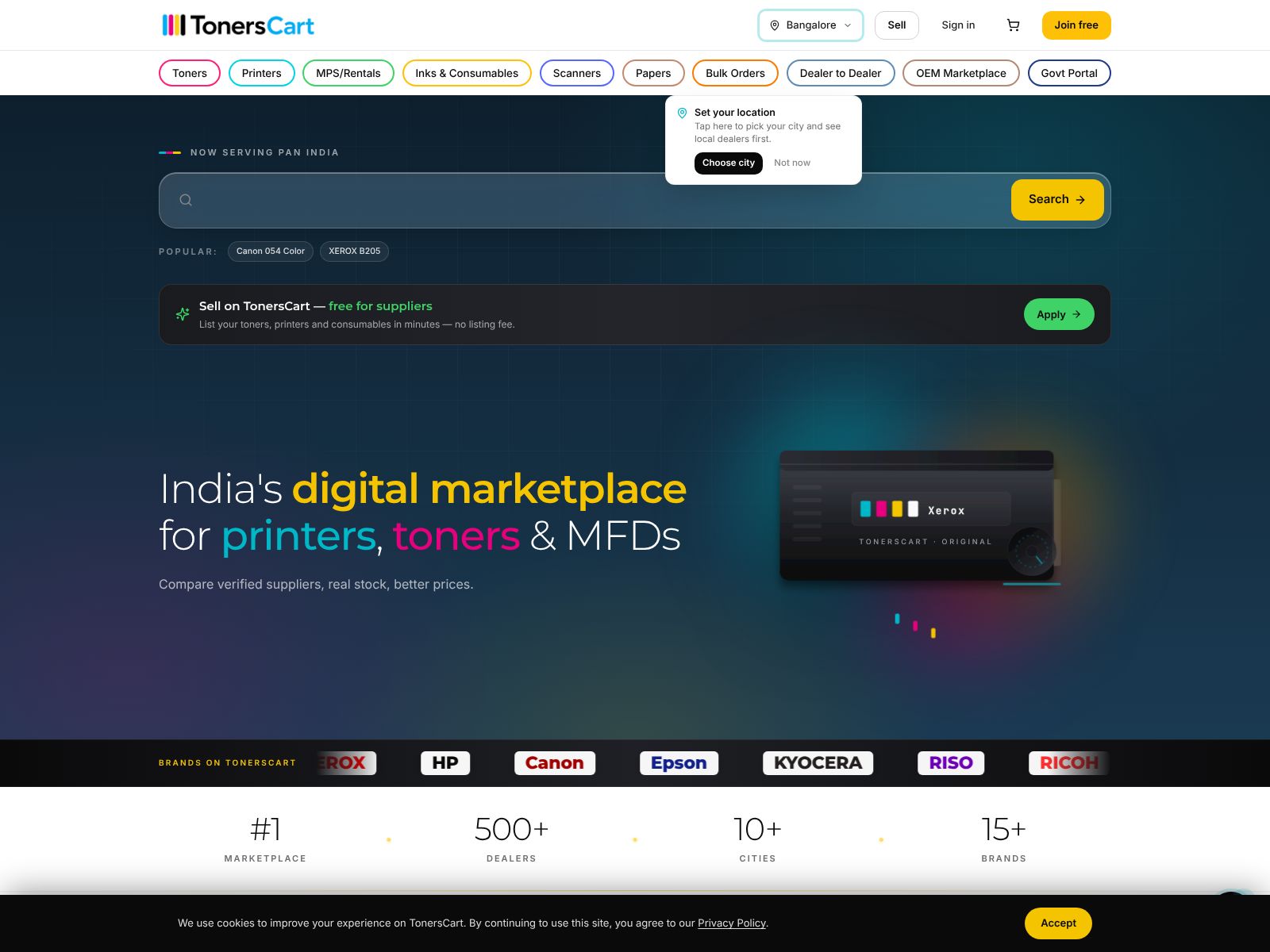
If your team buys printers, toner cartridges, inks, papers, or scanners, you’ve probably felt the pain of a fragmented, opaque market: uncertain stock, unclear pricing, and invoices that slow down compliance. TonersCart Private Limited steps in to fix exactly that. Positioned as India’s first dedicated online marketplace for print hardware and consumables, TonersCart connects you with verified dealers, shows real stock from real suppliers, and routes GST-compliant invoices directly from sellers. Beyond the marketplace, the company also offers Managed Print Services (MPS)—a pay-per-page rental model—for government departments, corporates, and institutions that want predictable costs without upfront capital expenditure.
In this review, I’ll walk you through what TonersCart does, its core features, how the pricing typically works, and the top alternatives you can compare it against. By the end, you’ll know whether TonersCart fits your procurement workflow and how to evaluate it next to other options in India.
What does TonersCart Private Limited do?
TonersCart is an online marketplace where you can buy printers, toner cartridges, inks, papers, consumables, and scanners from verified dealers across India. It brings pricing and stock transparency to a market that’s traditionally been offline and fragmented. Every order is fulfilled by a seller, and the GST-compliant invoice is issued directly by that seller to you.
Beyond one-off purchases, TonersCart also offers Managed Print Services (MPS)—a pay-per-page model that includes printers, consumables, and maintenance, so you don’t have to buy printers upfront. They manage the print infrastructure end-to-end while you pay for actual usage.
TonersCart Private Limited Features
To make your evaluation easier, let’s split TonersCart’s offering into two parts: the marketplace for buying products, and Managed Print Services for running print operations under a rental-style, per-page plan.
Marketplace: Printers, Toners, Inks, Papers, and Scanners
The marketplace is designed to make procurement faster, more transparent, and fully compliant. Here’s what stands out:
- Category focus on print: Unlike general e-commerce sites, TonersCart concentrates on printers, toner cartridges, inks, papers, consumables, and scanners—so you shop a specialist catalog curated for printing and document hardware.
- Verified dealers: Sellers on the platform are verified, which helps reduce the risk of counterfeit or incompatible supplies and builds trust in the source.
- Real stock from real suppliers: Listings reflect actual stock availability from verified sellers, giving you better visibility before you raise a PO.
- Transparent pricing: You can compare competitive prices from multiple sellers. It’s a market-style view where the best price, brand match, or shipping option can guide your choice.
- GST-compliant invoicing: The invoice is handled directly by the seller, simplifying your compliance and audit trail.
- Nationwide reach: The platform connects buyers and dealers across India, making it easier for distributed teams and multi-branch organizations to procure consistently.
Who benefits most from the marketplace?
- Procurement and finance teams looking to standardize and document their buying process with GST-ready invoices.
- IT and admin teams responsible for stocking multi-brand toner and ink across many devices.
- SMBs and institutions with frequent but varied print needs who value selection and verifiable stock.
Managed Print Services (MPS/Rentals): Pay Per Page
If your organization prints at scale—or simply wants predictable costs and less operational burden—MPS can be a strong fit. TonersCart’s MPS offering covers:
- End-to-end infrastructure: Printers and MFPs, consumables, and ongoing maintenance are included under one pay-per-page model.
- No upfront capex: You don’t buy the hardware; you pay for usage, which can make budgeting and approvals easier.
- Service and uptime: The provider owns maintenance and support, so device uptime and response times become a contractual obligation rather than a best effort.
- Scalability: As your print footprint grows or contracts, the model flexes with your needs, avoiding stranded assets.
Who benefits most from MPS?
- Government departments and public sector units with strict compliance and audit needs.
- Corporates that want to control costs, standardize devices, and minimize downtime.
- Educational, healthcare, and financial institutions with distributed locations and heavy print volumes.
How pricing typically works
While exact prices vary by seller and by contract, here’s how to think about costs on TonersCart:
- Marketplace pricing: Each product is listed by one or more verified sellers. Prices are set by the sellers and can vary based on stock, brand, location, and demand. You can choose the offer that best fits your budget and timeline. Shipping, taxes, and GST invoicing are handled by the seller as part of the checkout process.
- MPS pricing: Managed Print Services are usually quoted as a per-page rate, with separate rates for monochrome and color. Your quote can depend on expected print volumes, device mix, SLA requirements, on-site service coverage, and contract length. There may be minimum monthly volumes and overage rates. Because usage and support needs differ widely by organization, pricing is typically tailored after a discovery call and site assessment.
Tip: For both marketplace and MPS, ask for a breakdown of unit costs, taxes, shipping/service regions, SLAs, and any surcharges. If you’re comparing multiple quotes, normalize them to total cost of ownership over 12–36 months so you can compare apples to apples.
Why a dedicated print marketplace matters
Print procurement often suffers from three problems: inconsistent availability, brand-specific silos, and uneven pricing. A focused marketplace can address all three:
- Availability: Because TonersCart aggregates verified sellers, it increases your chances of finding the exact cartridge or paper spec you need, even for older devices.
- Brand breadth: Instead of hopping between many brand portals or distributors, you can compare across brands in one place.
- Pricing clarity: Competing offers create transparent price discovery, which can help you control spend.
What to verify during evaluation
Before you commit significant spend, consider running a quick pilot order and confirming:
- Seller responsiveness and delivery timelines for your locations.
- Invoice accuracy (GST details, line items, serial numbers where relevant).
- Packaging quality and authenticity of consumables.
- Return/replacement processes for DOA items and compatibility issues.
For MPS, request these details upfront:
- Device list and brands included; whether models are new or refurbished.
- On-site response times, preventive maintenance schedules, and uptime targets.
- Metering and reporting processes for page counts; how billing disputes are resolved.
- Consumable replenishment triggers and spare parts coverage.
- Security and data handling for MFP hard drives (wipe policies on device return).
Key advantages at a glance
- Specialized catalog for print and scanning hardware/consumables.
- Verified dealers with real stock listings to reduce procurement friction.
- GST-compliant invoicing from sellers for clean audits.
- Optional MPS to shift capex to opex with per-page billing.
- Nationwide buyer–seller network to support distributed organizations.
Potential trade-offs to consider
- Seller-by-seller variability: Delivery times, return policies, and support quality can differ by seller (as with any marketplace). Vet your preferred sellers and standardize on a shortlist.
- Contract diligence for MPS: Per-page models are powerful, but you’ll want to negotiate SLAs, device standards, and exit terms clearly before rollout.
- Change management: Moving from ad-hoc buying to a structured marketplace or from capex to MPS can require internal policy updates and user training.
TonersCart Private Limited Top Competitors
When you compare TonersCart with alternatives, think in two tracks: 1) buying supplies and devices through marketplaces or distributors, and 2) outsourcing print operations through Managed Print Services. Here are notable options to consider in India:
For buying printers, toner/ink, papers, and scanners
- Amazon Business (India): Broad selection, GST invoicing, and familiar procurement workflows. Strong for general office supplies, though not dedicated solely to print.
- Flipkart: Large marketplace with competitive pricing and frequent deals. Good selection but mixed specialization for enterprise buyers.
- Moglix: B2B commerce platform focused on industrial and office supplies. Offers GST invoices and enterprise-friendly features.
- IndiaMART: Primarily a B2B directory and lead-generation platform connecting you to suppliers. Useful for sourcing, though transactions may happen off-platform.
- IndustryBuying: B2B platform for industrial and office categories, including printers and consumables.
- Authorized brand partners and local distributors: Many OEMs (HP, Canon, Epson, Brother, Ricoh, Xerox, Kyocera, Konica Minolta) sell via authorized partners. This can be reliable for brand-specific purchases, though multi-brand comparisons may take more time.
- Cartridge World (India): Retail and service network for cartridges and related services; useful for localized needs, though coverage varies by city.
For Managed Print Services (pay-per-page)
- HP Managed Print Services: Global MPS with device standardization, security features, analytics, and SLAs through HP and partners.
- Xerox Managed Print Services: Mature MPS ecosystem with multi-brand support, assessment tools, and service coverage for enterprises.
- Canon Managed Document Services (MDS): End-to-end solutions around Canon devices, process optimization, and managed workflows.
- Ricoh Managed Services: Known for enterprise-grade MFPs and managed solutions, including document workflows.
- Konica Minolta and Kyocera MPS offerings: Strong in A3/A4 enterprise MFPs with managed contracts via partners.
- Regional MPS providers and system integrators: Local specialists can be competitive on price and service agility, especially for city-centric deployments.
How TonersCart differs
- Focus: TonersCart specializes in the print category as a marketplace, while many alternatives are general B2B marketplaces or single-brand ecosystems.
- Dealer network: It aggregates verified dealers and shows real stock, aiming to reduce discovery time and availability risk.
- MPS plus marketplace: The combination lets you choose between owning devices and outsourcing print infrastructure under one roof.
Pricing: How to benchmark TonersCart against alternatives
Here’s a simple way to structure your cost comparison:
- For marketplace orders:
- Compare unit prices across at least three sellers for your top 20 SKUs.
- Include shipping, taxes, and any payment gateway or handling fees in your total.
- Confirm GST details and invoice timelines to avoid month-end surprises.
- For MPS contracts:
- Request both mono and color per-page rates and any minimum monthly volume.
- Ask for device lists and whether models are new, refurbished, or mixed.
- Clarify onsite response times, preventive maintenance, and uptime targets.
- Model a 12–36 month total cost, including any installation fees and mid-term refreshes.
You don’t need exact published pricing to run a clear comparison. A structured RFP and a one-month pilot at two locations can surface the true operational differences between providers.
Who should use TonersCart?
- SMBs and mid-market companies needing reliable, GST-compliant procurement of multi-brand print supplies with less back-and-forth.
- Enterprises with distributed branches that want consistent sourcing and verifiable stock across cities.
- Institutions (education, healthcare, BFSI) that either buy in bulk or want to shift to pay-per-page for predictable costs.
- Government departments that require clean audits and rigorous invoicing backed by verified sellers.
Implementation tips and best practices
To make the most of TonersCart, consider these quick wins:
- Standardize SKUs: Build a canonical list of approved printers and consumables so buyers can quickly select the correct products.
- Shortlist sellers: After initial orders, identify the top two or three sellers per category based on speed, accuracy, and support.
- Set reorder points: Track usage and set reorder thresholds for toners and inks to avoid emergency buys at premium prices.
- Pilot MPS where it matters: Don’t move everything to MPS at once. Start with two to three locations and compare uptime, user satisfaction, and per-page costs.
- Control color printing: If you roll out MPS, implement user-level controls or policies to reduce unnecessary color prints and keep per-page costs down.
Service, support, and compliance
- Support: For marketplace orders, support typically involves the seller and the platform. Clarify who you contact for delivery issues, returns, or invoice corrections.
- Compliance: Ensure your company name, GSTIN, and shipping/billing details are accurate within your buyer profile so invoices are cut correctly.
- Documentation: Keep invoices, delivery challans, and serial/lot details organized for audits—especially when buying high volumes of consumables.
Risks and how to mitigate them
- Counterfeit risks: Buying from verified dealers reduces risk, but you should still inspect packaging, holograms, and print quality. Keep photos and lot numbers for warranty claims.
- Compatibility issues: Cross-check printer model compatibility before ordering. For bulk orders, test a single unit first.
- Contract lock-in: For MPS, negotiate fair exit clauses and device handback terms. Avoid long lock-ins without performance-based triggers.
- Geographic coverage: If you operate in remote locations, validate delivery times and on-site service reach during your pilot.
Real-world scenarios where TonersCart fits well
- Multi-brand environment: Your floors have HP, Canon, and Brother devices. You need a one-stop marketplace to source genuine consumables across brands without chasing five vendors.
- Quarter-end crunch: Finance wants GST-perfect invoices and clear supplier details. The marketplace flow ensures every order’s documentation is audit-ready.
- Rapid branch rollout: You’re opening three branches in different cities. You can place standardized orders through a common marketplace rather than building local vendor relationships from scratch.
- Capex freeze: Your company has paused hardware purchases. An MPS pilot lets you add devices and pay per page without capital outlay.
FAQs
Is TonersCart only for large enterprises?
No. It serves SMBs, enterprises, and institutions. The marketplace suits any size; MPS is best if you want predictable costs and minimal maintenance overhead.
Can I buy OEM and compatible supplies?
The marketplace spans many brands and product types via verified sellers. Always check the listing details and seller rating, and confirm compatibility with your exact printer model.
Who issues the invoice?
The GST-compliant invoice is issued directly by the seller who fulfills your order. This is helpful for compliance and audits.
Where is TonersCart based?
The company is headquartered in Bangalore, India, and was founded in 2026.
How to get started
- Marketplace pilot:
- Create a buyer account and complete your GST and address details.
- Order a small batch of your top 5–10 consumables from different sellers.
- Evaluate delivery time, packaging, invoice accuracy, and product authenticity.
- Shortlist preferred sellers for future orders.
- MPS discovery:
- List your device fleet, average monthly volumes (mono/color), and pain points (downtime, cost overruns).
- Request a per-page quote with SLAs and device standards.
- Pilot in one or two locations for 60–90 days and compare against your baseline costs.
Why choose TonersCart over a general marketplace?
If your print environment is simple and your team already shops on a general marketplace, you may be fine. But if you want tighter control over print spend, ready access to specific SKUs, cleaner invoices for audits, and the option to upgrade to per-page MPS later, a specialist platform like TonersCart is worth a look. Its emphasis on verified dealers, real stock visibility, and category focus can reduce procurement friction and downtime in ways a broad marketplace may not.
Wrapping Up
TonersCart Private Limited brings focus and transparency to print procurement in India. On the marketplace side, you get access to verified dealers, real stock, competitive prices, and GST-compliant invoices that keep finance and compliance teams happy. On the operations side, the Managed Print Services offering shifts you from capex-heavy purchases to a predictable per-page model with end-to-end support.
If your organization wrestles with scattered suppliers, inconsistent pricing, or too much time spent hunting for the right cartridges, TonersCart’s specialist marketplace can help you standardize and speed up buying. And if you’re ready to professionalize your print operations, an MPS pilot can test whether pay-per-page economics and service SLAs reduce your total cost and downtime.
Next steps:
- Run a small marketplace pilot to validate delivery speed, invoice quality, and product authenticity.
- Request an MPS assessment if you’re considering pay-per-page, and compare total costs over 12–36 months.
- Benchmark against a couple of alternatives—such as a general marketplace and a brand-led MPS—to see which approach fits your scale and compliance needs.
To explore further or start a pilot, visit TonersCart at tonerscart.com. If your goal is fewer vendor headaches, cleaner audits, and predictable print costs, this is a platform you’ll want on your shortlist.