Ternavex Review & Overview (Features, Pricing, & Alternatives)
If you manage field-heavy operations—like insurance claims, construction, restoration, inspections, or property services—you know how hard it is to coordinate people, tasks, data, and systems in the real world. Jobs change by the hour, documentation must be accurate, and your team needs to move quickly while staying compliant and consistent. Ternavex is building an AI-powered operations platform to make that work simpler, smarter, and more connected.
In this review, you’ll learn what Ternavex does in plain language, where it shines, what to consider, how it fits into your tech stack, and which alternatives you might compare. By the end, you should have a grounded view of whether Ternavex is a fit for your organization and how to evaluate it.
What does Ternavex do?
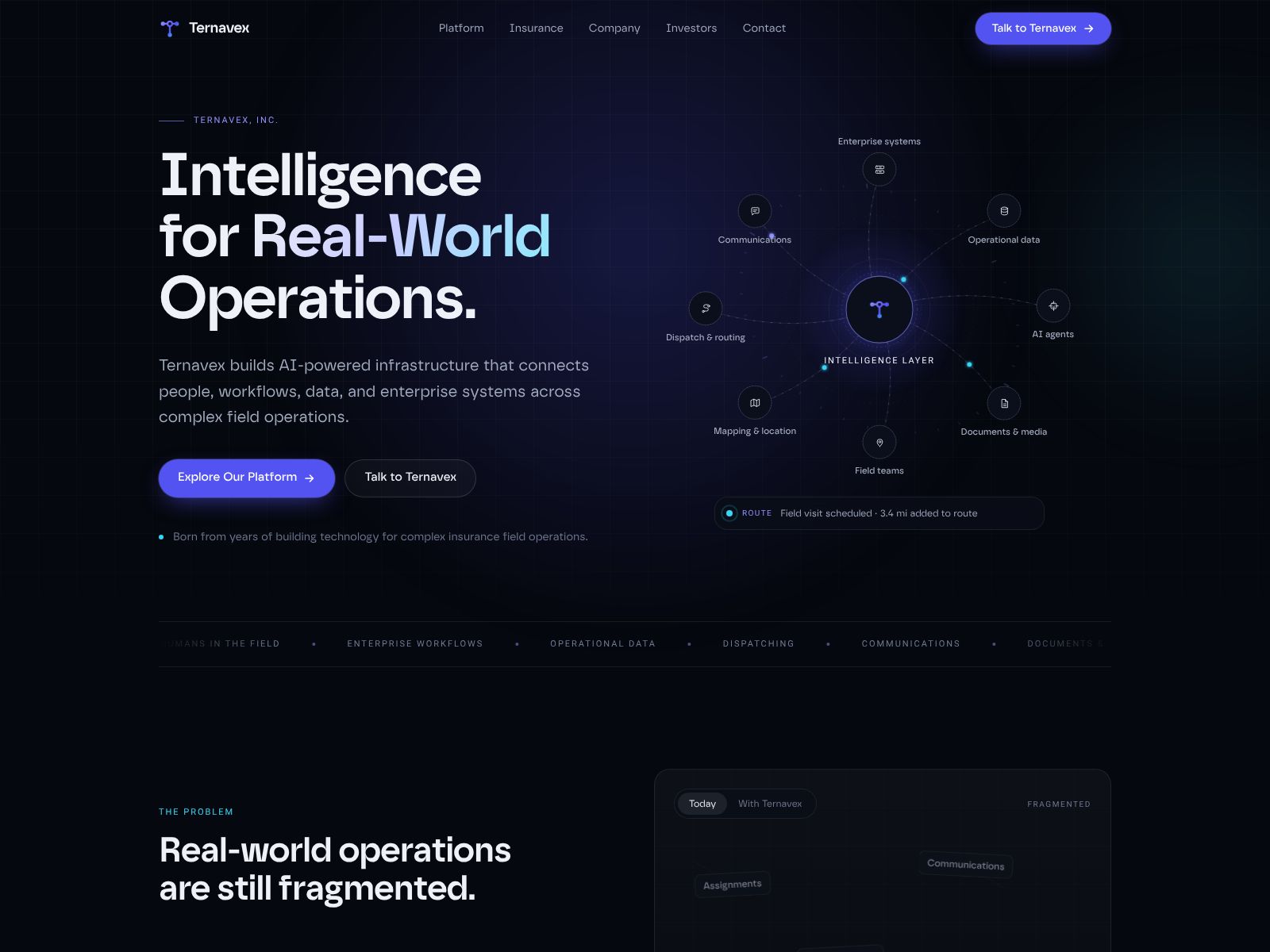
Ternavex connects your people, workflows, data, and enterprise systems so you can coordinate complex field work more intelligently with help from AI.
Who is Ternavex for?
Ternavex was born inside the insurance claims world and is already used for claims management, field assignments, routing and dispatch, property documentation and sketching, communications, automation, and integrations. If you’re a carrier, independent adjusting firm, or vendor network, Ternavex is built with you in mind. The company is also expanding into similar industries—construction, restoration, property services, and inspections—where teams coordinate jobs in the physical world and need reliable, data-driven workflows.
Ternavex products at a glance
- Adjuster X: Insurance-focused workflows for handling and coordinating claims-related work.
- Route X: Tools for routing and dispatch—assign the right person to the right job and sequence travel efficiently.
- Sketch X: Property documentation and sketching for consistent, structured field capture.
- Career X: Talent and workforce capabilities to support staffing, placements, and team capacity.
- Shared AI & Workflow Infrastructure: The underlying platform that ties everything together—people, data, tasks, and enterprise integrations—so AI agents can assist across the full operation.
Ternavex features
Here’s a closer look at what you can expect from Ternavex’s platform and product suite, based on the company’s stated focus and portfolio.
-
Claims management workflows
Coordinate claims from intake through field work and documentation. Standardize how your teams capture information, move cases through steps, and collaborate with partners. Ternavex’s insurance roots mean the platform reflects real claims complexity and timing pressures.
-
Field assignments, routing, and dispatch
Use Route X to match jobs with the right people and sequence routes intelligently. This helps reduce drive time, balance workloads, and improve your on-time performance. You can bring data together—location, skills, priorities—to make better dispatch decisions quickly.
-
Property documentation and sketching
Sketch X supports structured, consistent property capture and sketching so your documentation is complete and usable downstream. This cuts down on rework and speeds up review cycles. When documentation is standardized, it becomes easier to automate follow-on steps.
-
Communications
Coordinate communications among adjusters, field staff, managers, vendors, and customers. Keep messages, updates, and case context in one place so your team isn’t chasing information across inboxes and apps.
-
Automation and AI assistance
Ternavex’s platform is designed for AI agents that help with operational decisions and repetitive tasks. Examples include triaging work, summarizing field notes, validating documentation against checklists, and prompting next best actions. Automation reduces manual effort and keeps quality consistent at scale.
-
Enterprise integrations
Connect Ternavex to your core systems so work and data flow end to end. In insurance, that often means policy, claims, vendor management, and reporting systems. In adjacent industries, it can include project management, estimating, CRM, or ERP tools. The goal is to replace swivel-chair work with straight-through processes.
-
Operational visibility
Because people, tasks, and data live on one platform, you can see where work is, what’s blocked, and how performance is trending. This helps leaders make better resourcing decisions and spot opportunities to optimize cycle times and costs.
How Ternavex fits into your operation
Ternavex is best thought of as an “intelligent operations fabric” for real-world work. It doesn’t try to replace every system you already use. Instead, it connects to those systems, orchestrates the work between them, and helps teams capture, standardize, and use the data that often gets lost along the way. The result is fewer manual handoffs, cleaner data, and faster execution.
What makes Ternavex different
- Built from real adjuster experience: The platform grew out of Adjuster X and years inside insurance operations, which shows in how workflows are structured for field reality, not just back-office flowcharts.
- Vertical first, horizontal future: Starting with insurance gives Ternavex depth where complexity is high. From there, the same AI and workflow fabric extends to construction, restoration, inspections, and property services.
- Portfolio approach: With Adjuster X, Route X, Sketch X, and Career X, Ternavex covers the key pieces of field-heavy work and ties them together under one AI-enabled platform.
- AI in the loop: Rather than bolt-on automation, Ternavex is built so AI agents can assist directly inside your workflows and data model. That’s the foundation for increasingly autonomous operations, with people still in control.
Use cases and benefits
-
Insurance carriers and IA firms
Standardize how claims move through intake, assignment, field documentation, and review. Use routing and dispatch to reduce drive time and handle surge events. Improve documentation quality with structured capture and sketches. Coordinate communications and reduce back-and-forth. Feed clean data to your core systems and analytics.
-
Construction and restoration teams
Assign crews and subcontractors, plan routes to multiple job sites, and document progress with consistent field data. Keep project steps moving with workflow automation and make it easier to coordinate with insurance stakeholders when relevant.
-
Property services and inspections
Plan visits, route teams efficiently, and create standardized inspection packages. Reduce rework and improve time to deliverables by embedding checklists, templates, and AI-assisted QA directly into the workflow.
Implementation and onboarding considerations
Rolling out an operations platform touches people, process, and data. Plan for:
- Process mapping: Document your current workflows and define the target state you want inside Ternavex. Remove non-essential steps before you automate.
- Integrations: Prioritize connections to your policy/claims systems (for insurance), CRM, project tools, and reporting stack. Start with read/write needs that remove the most manual effort.
- Data standards: Align on field data schemas, naming, and mandatory inputs so your AI and automation have high-quality signals.
- Change management: Train teams on new workflows and why they matter. Focus early wins on routing, documentation quality, or cycle-time reductions to build momentum.
- Pilots and proof points: Start with a limited region, line of business, or team. Measure baseline metrics and track results—drive time, touch time, rework, first-pass yield, and customer experience.
Pricing: what to expect
Ternavex does not publicly list pricing at the time of writing. Like most enterprise operations platforms, costs typically depend on scope, number of users, volume of work (e.g., claims or jobs), modules you adopt (e.g., Route X, Sketch X), and integration complexity. Expect a discussion-based quote. When you evaluate total cost of ownership, include:
- Licenses and modules: Which products (Adjuster X, Route X, Sketch X, Career X) you plan to deploy.
- Implementation: Process design, integration work, data migration, and training.
- Change management: Time and resources to roll out new workflows.
- Ongoing usage: User seats, transaction volume, and support tier.
- Savings and ROI: Reduced drive time, fewer manual touches, faster cycle times, lower rework, and better capacity management during surge events.
Tip: Ask for a pilot-based commercial option that ties part of the cost to measurable outcomes. This aligns incentives and helps you prove value before broad rollout.
Strengths
- Deep insurance DNA: Years of development inside Adjuster X mean the workflows match real adjuster needs and field realities.
- End-to-end view of operations: From assignment and routing to documentation and communications, the portfolio covers core operational moments and unifies them under a single platform.
- AI-enabled workflow fabric: Designed so AI agents can assist across the operation—triage, checklists, summarization, nudges—and learn from your data.
- Integration-first posture: Focus on tying into enterprise systems so your teams stop copying data between tools and can trust a single operational picture.
- Expandable beyond insurance: The same coordination challenges exist in construction, restoration, property services, and inspections, creating a clear expansion path.
Considerations and potential gaps
- Newer platform vs. incumbents: If you rely on long-established systems, validate Ternavex’s references, scalability, and roadmap for your use cases.
- Vertical-to-horizontal fit: Insurance-first is a strength, but adjacent industries may need tailored workflows and integrations. Confirm your specifics are supported.
- AI quality depends on data quality: Automation works best with consistent, structured data. Invest in templates, required fields, and training to get the most from AI assistants.
- Security and compliance needs vary: Align the platform’s security posture with your requirements (for example, regulatory standards in your region or industry). Request documentation and perform a security review.
- Change management lift: Standardizing documentation and routing can change how teams work. Plan for training, feedback loops, and iteration.
How a typical workflow can look
- Intake: A new job or claim arrives. The platform captures key details and classifies it to the right workflow.
- Assignment and routing: Route X suggests an assignment and route plan based on location, skill, and priority. Dispatch confirms and schedules.
- Field execution: The assignee documents the site using structured data and sketching in Sketch X. AI prompts reduce missed items.
- Quality and handoff: The platform validates documentation against checklists and flags gaps, then compiles the package for review.
- Integration and reporting: Data and documents flow to your core systems. Leaders track cycle time, rework, drive time, and throughput to spot improvements.
Where Ternavex fits in your stack
You can position Ternavex as a coordination layer that connects to your policy/claims platform (in insurance) or your project/CRM/ERP stack (in adjacent industries). It becomes the operational backbone for assignment, routing, documentation, and communications, while your system of record continues to manage policies, financials, or customer accounts.
Ternavex top competitors
Competitors vary by the part of the operation you’re solving. Here are leading options to consider alongside Ternavex, with a quick note on how they compare conceptually.
-
End-to-end insurance claims platforms
- Guidewire ClaimCenter: A widely used core claims system for carriers. Deep functionality and ecosystem, often part of a broader core platform. Compare if you’re standardizing claims at the system-of-record layer.
- Duck Creek Claims: Another enterprise-grade core claims platform with strong configurability. Consider when replacing or modernizing core claims.
- Snapsheet Claims: Cloud-native claims management with virtual appraisal capabilities. Useful for digital-first claim flows.
-
Property estimation and documentation
- Verisk Xactware (e.g., Xactimate, XactAnalysis): Widely used for estimating and analytics in property claims. Compare workflows around estimates and documentation handoffs.
- CoreLogic Symbility: Estimating and collaboration for property claims. Consider for documentation and estimate workflows.
- Encircle: Field documentation for restoration and property claims. Strong for standardized capture and reporting.
- HOVER: 3D property measurements from photos. Compare for measurement workflows and downstream estimating.
- Matterport: 3D capture for property documentation. Useful for high-fidelity site records and remote review.
- EagleView: Aerial imagery and measurements. Helpful in scoping exterior work and roof measurements.
-
Field service, routing, and dispatch
- Salesforce Field Service: Field management integrated with Salesforce CRM. Compare for service-centric operations and ecosystem fit.
- Microsoft Dynamics 365 Field Service: Ties into Dynamics ERP/CRM stack. Consider if you’re already on Microsoft’s platform.
- Oracle Field Service: Enterprise field service with sophisticated scheduling/dispatch. Fit for large, complex field ops.
- ServiceTitan: Job management for trades and home services. Strong for contractors and service businesses.
- Onfleet, Routific, Route4Me: Route optimization and delivery/dispatch tools. Compare if routing is your primary need.
- Jobber, Housecall Pro: SMB field service management. Useful for smaller teams focused on scheduling and invoicing.
-
Workflow and automation platforms
- ServiceNow: Enterprise workflows and operations management across departments. Compare if you want a general-purpose workflow backbone.
- Pega: Case management and process automation. Good for complex, rules-heavy operations.
- UiPath, Automation Anywhere: Automation suites to handle repetitive tasks across systems. Consider when RPA is a primary lever.
How Ternavex is different: Rather than being only a core claims system, a point solution, or a general workflow engine, Ternavex’s focus is on coordinated, AI-assisted real-world operations—especially where routing, documentation, and field execution are central. That’s a meaningful distinction when your outcomes depend on what happens outside the office.
How to evaluate Ternavex (a practical checklist)
- Operational fit: Map your exact workflows—claims types, job categories, field steps—and confirm they’re supported without heavy customization.
- Field usability: Observe how easy it is for field staff to capture data and sketches. Fewer taps and clearer prompts usually mean better adoption.
- Routing quality: Test Route X on your geography and constraints. Measure drive time reductions and on-time rates during a pilot.
- Documentation quality: Check how Sketch X and templates reduce missing information and rework. Look for AI prompts that nudge completion.
- Automation leverage: Identify tasks AI agents can safely handle (triage, summaries, validations). Ensure humans can review and override.
- Integrations: Validate read/write flows with your core systems. Minimize duplicate data entry from day one.
- Security and compliance: Align platform controls with your regulatory obligations. Request documentation and conduct a review.
- Analytics and visibility: Ensure leaders can see work in progress, bottlenecks, and trends. Ask for sample dashboards.
- Total cost and ROI: Model license, implementation, and support costs against savings in drive time, touch time, cycle time, and rework.
- Roadmap alignment: Review the product roadmap, especially if you’re outside insurance. Confirm timelines for features you’ll need.
Realistic outcomes to target in a pilot
- 10–30% reduction in drive time: From better routing and batching of field visits.
- Faster cycle times: Standardized documentation and AI-assisted QA reduce back-and-forth.
- Higher first-pass completeness: Templates and prompts lead to fewer missing items and rework.
- Improved surge handling: During CAT events or peak seasons, coordinated assignment and communications help teams scale.
- Cleaner data for downstream systems: Structured capture feeds analytics, reporting, and automation more reliably.
These targets will vary by team and region, but they provide a starting point for setting pilot goals.
When Ternavex is a great fit
- You operate in insurance, restoration, construction, inspections, or property services and coordinate significant field work.
- You want one platform to connect assignments, routing, documentation, communications, and automation across teams and partners.
- You’re ready to standardize how field data is captured and used, and you want AI to assist with triage, QA, and next steps.
- You have multiple systems today and want to reduce manual handoffs with deeper integrations.
When you might look elsewhere
- You only need a single point solution (e.g., just route optimization or only 3D capture) without broader workflow needs.
- Your primary initiative is to replace a core claims system; Ternavex is more of an operations fabric than a core system of record.
- You prefer a general-purpose workflow platform and will build all field-specific logic yourself.
How to get started
- Define scope: Choose a line of business, region, or team with measurable pain (drive time, rework, cycle time).
- Align data and templates: Create standardized forms and sketch templates for the pilot.
- Set integration priorities: Start with one or two high-impact system connections to remove duplicate entry.
- Run a time-boxed pilot: 6–12 weeks with clear metrics and a dedicated cross-functional team.
- Review results and scale: Document learnings, adjust workflows, and expand region by region or product by product.
FAQs
-
Is Ternavex only for insurance?
No. Insurance is the first established vertical and the foundation of the platform, but Ternavex is expanding into construction, restoration, property services, inspections, and other field-heavy industries.
-
Does Ternavex replace my core systems?
Typically no. It connects to your existing systems to coordinate field work, documentation, and automation. Think of it as the operational layer that orchestrates how work gets done across tools.
-
What about security and compliance?
Requirements vary by company and region. Engage Ternavex for documentation and a security review to align controls with your obligations.
-
How does AI help in practice?
AI agents assist with triage, prompting next steps, validating documentation completeness, and summarizing notes—always with humans in the loop to review and override.
Wrapping up
Ternavex is building an AI-powered platform for real-world operations—connecting people, workflows, data, and systems so your team can coordinate complex, distributed work more intelligently. The company’s foundation in insurance (via Adjuster X) gives it real depth where the stakes are high and the workflows are intricate. With Route X for routing and dispatch, Sketch X for documentation and sketching, and Career X for workforce support—all tied together by a shared AI and workflow infrastructure—Ternavex aims to reduce manual handoffs, improve data quality, and speed up cycle times.
It’s not a replacement for your core systems. Instead, it becomes the fabric that orchestrates work across them, with AI assistance baked into everyday tasks. If your operation depends on what happens in the field—and if routing, documentation, and coordination are persistent pain points—Ternavex deserves a close look. Start with a focused pilot, define clear success metrics, integrate where it counts, and see how much time, rework, and cost you can remove from the system.
To learn more or request a demo, visit the Ternavex website. As always, validate fit with your workflows, data requirements, and security standards—then use a pilot to turn potential into measurable results.