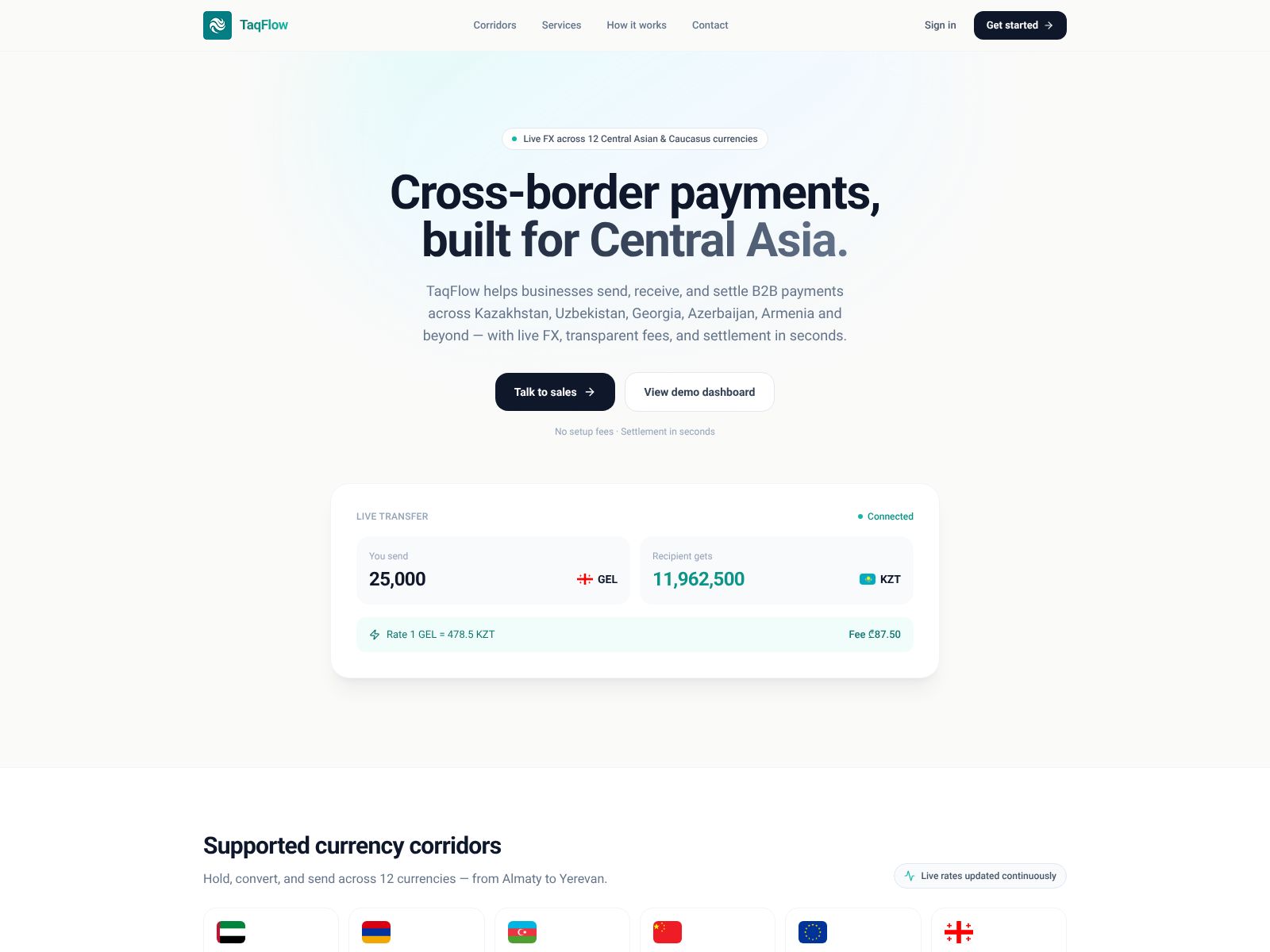
TaqFlow Review & Overview
If you move money across borders, you already know the pain: slow wires, opaque fees, and constant uncertainty about when your funds will land. TaqFlow steps into that gap with a mission that’s both simple and ambitious—make cross-border business payments fast, secure, and predictable, with a special focus on unlocking the economic potential of Central Asia. Built by a global team of digital nomads and fintech builders, TaqFlow blends blockchain technology with a dedicated, ultra-low-latency network to clear and settle value quickly while stripping out many of the bottlenecks you see on legacy rails.
In this review, I’ll walk you through what TaqFlow does, its standout features, who it’s best for, what to consider before adopting it, and how it compares to top alternatives. My goal is to give you a clear, no-jargon view so you can decide if TaqFlow belongs in your payment stack.
What does TaqFlow do?
TaqFlow is a cross-border payment platform that lets your business move money across countries—especially to and from Central Asia—with speed and automation. It uses blockchain technology behind the scenes and runs on a dedicated low-latency network so you can send and settle funds faster and more reliably than with traditional bank wires.
TaqFlow Features
TaqFlow’s approach blends modern infrastructure with practical business tools. Here are the core areas that matter most to teams like yours.
1) Built for cross-border B2B payments
- Focus on real business needs: vendor payouts, supplier settlements, marketplace disbursements, payroll for distributed teams, and treasury movements.
- Regional strength: designed to serve Central Asia’s growing trade corridors, bridging local realities with global capital flows.
- End-to-end flow: send, track, and settle transactions with less friction than traditional rails that depend on multiple correspondent banks.
2) Ultra-low-latency network
- Speed by design: a dedicated network minimizes hand-offs and queueing, so transactions can move faster than typical international wires.
- Predictability: lower latency improves time-to-finality, giving you clearer expectations on when funds will arrive.
- Better user experience: your finance team spends less time chasing “where is the wire?” tickets and more time on higher-value work.
3) Blockchain-powered settlement
- Modern rails: blockchain technology helps accelerate settlement and improve transparency into the movement of value.
- Security baked in: cryptographic verification adds an extra layer of integrity compared to purely message-based banking transfers.
- Automation-friendly: programmatic rails enable smarter workflows—like conditional releases, scheduled payouts, and structured approval chains.
4) Automation and APIs
- Developer-first: APIs and webhooks (where available) let you wire TaqFlow into your ERP, marketplace, or back-office tools.
- Bulk operations: streamline mass payouts and repetitive treasury movements without manual file uploads or hand-entered instructions.
- Workflow rules: set approvals, thresholds, and alerts so payments obey your internal controls automatically.
5) Treasury and multi-currency support
- Operate globally: manage funds across multiple currencies as your business sells, buys, or hires in different markets.
- Reduce friction: centralize your balances and transfers to reduce the chaos of juggling many bank portals.
- Improve cash visibility: keep a clearer picture of your inflows and outflows by corridor and currency.
6) Cost-efficient rails
- Lower total cost: by avoiding layers of correspondent banks and “mystery” lifts, TaqFlow aims to reduce your all-in cost per transfer.
- Transparent economics: better predictability for your finance team and clearer landed costs for vendors.
- Scale benefits: as your volume grows, automated rails and lower latency can translate into meaningful savings and fewer operational headaches.
7) Compliance-minded design
- KYB/KYC workflows: streamline onboarding for your business and counterparties with identity and documentation flows built for cross-border trade.
- Risk controls: set roles, permissions, and spending limits so you meet policy requirements without slowing the team to a crawl.
- Auditability: produce logs, records, and payment proofs to satisfy internal reviews and external audits.
8) Security and controls
- Defense in depth: combine blockchain settlement with enterprise security practices to protect funds and data.
- Segregation of duties: separate initiators, approvers, and reviewers to reduce the risk of internal fraud.
- Real-time alerts: catch anomalies quickly with notifications on unusual activity, amount spikes, or disallowed counterparties.
9) Reconciliation and reporting
- Transaction clarity: track status across initiation, transmission, and settlement so you always know what’s next.
- Books-ready exports: pull reports your accounting team can feed into the general ledger faster.
- Vendor confidence: provide counterparty confirmations so suppliers know when to ship or release goods.
10) Purpose-built for Central Asia
- Regional insight: tailored for the realities of Central Asian corridors, helping you navigate practical constraints and time zones.
- Trade heritage meets tech: connects long-standing regional commerce patterns with modern, programmable rails.
- Gateway to growth: access under-served routes where legacy banking overhead has held businesses back.
11) Developer experience
- Straightforward integration: connect your order management, ERP, or payout engine to automate the last mile of cross-border flows.
- Webhooks and events: trigger downstream actions the moment settlements clear or approvals complete.
- Sandbox and testing: validate flows before you go live, so launch is smooth and low-risk for your team.
12) Support and service
- Global team: built by operators who know the day-to-day realities of moving money across borders.
- Responsive help: access onboarding guidance and operational support so you can scale with confidence.
- Partner mindset: expect collaborative problem-solving for complex payout or treasury scenarios.
Who is TaqFlow best for?
- Exporters and importers operating in or with Central Asia who need faster settlement to release goods and reduce working capital pressure.
- Marketplaces and platforms that pay many sellers or service providers across borders and want automated, bulk payouts.
- Finance teams seeking lower fees and better reliability than traditional cross-border wires, with strong controls and audits.
- Companies paying distributed teams or contractors and needing predictability on payment timing and costs.
- Treasury teams that want programmable, API-driven movements with clear reconciliation.
What to consider before adopting TaqFlow
- Corridor coverage: confirm the countries, currencies, and corridors you need are supported today, especially if you operate beyond Central Asia.
- Integration scope: plan the API work (ERP, billing, payouts) so you fully benefit from automation rather than running TaqFlow purely as a standalone tool.
- Change management: align roles, approvals, and finance policies so your team uses the platform consistently and safely from day one.
- Compliance fit: verify that KYB/KYC and other policy requirements match your internal and external obligations.
- Cost model: request pricing aligned with your volume profile and expected growth to understand your per-transaction economics.
TaqFlow Pricing
TaqFlow’s pricing is typically tailored to your use case, corridors, and volume. Expect a structure that reflects:
- Per-transaction fees that undercut or replace traditional wire and correspondent bank charges.
- FX-related costs where currency conversion applies.
- Potential discounts as your monthly volume scales.
Because pricing can vary by region and corridor, the most accurate way to estimate your costs is to share recent payment statements and routes during a sales conversation. That lets you compare your current all-in cost (including hidden lifts and delays) to TaqFlow’s model side by side.
Pros and Cons
Pros
- Faster settlement and better predictability than legacy cross-border wires.
- Cost-efficient rails that reduce hidden correspondent fees.
- Automation and APIs that cut manual work and errors.
- Designed for Central Asian corridors where legacy options can be slow and expensive.
- Compliance-minded workflows, approvals, and auditability for finance and operations teams.
Cons
- Coverage varies by corridor; confirm your exact routes and currencies.
- Implementation effort if you want deep integrations with ERP, payouts, or custom workflows.
- Change management required to shift processes away from traditional bank wires.
How TaqFlow fits into your stack
- ERP and accounting: connect payouts and settlements so records sync cleanly into your GL and vendor subledgers.
- Marketplaces: trigger disbursements upon order completion or milestone approval, with webhooks to update seller dashboards.
- Finance operations: use approval chains and limits to enforce policy with less manual oversight.
- Treasury: schedule liquidity movements by corridor and currency to optimize working capital.
TaqFlow Top Competitors
While TaqFlow is purpose-built for Central Asia and fast settlement, you may compare it with other global payment and payout platforms. Here are notable alternatives to consider:
-
Wise Business (formerly TransferWise)
Known for transparent pricing and good mid-market FX. Strong for SMBs and contractor payouts across many countries. Speed can vary by corridor; not optimized for complex B2B trade flows or specialized Central Asian routes.
-
Airwallex
A global money movement platform with multi-currency accounts, cards, and APIs. Good developer tooling and broad corridor coverage. Focus is wide rather than specifically on Central Asia’s unique routes.
-
Payoneer
Popular for marketplace payouts and freelancer payments, with a large network of receiving accounts. Strong for digital economy payouts; may not always match the latency or automation depth of a dedicated, blockchain-enabled rail.
-
Nium
Enterprise-grade global payments infrastructure with APIs for payouts and card issuing. Good for embedded finance use cases; corridor specifics and fee profiles depend on your routes and volumes.
-
Rapyd
A fintech-as-a-service platform with collections, disbursements, and wallets. Wide global coverage and integrations with local methods. Suited for companies seeking a broad toolkit; performance depends on corridor design.
-
Thunes
Cross-border payments network focused on emerging markets. Good payout reach, particularly for wallets and alternative methods. Corridor speed and costs vary; compare for your specific routes in and out of Central Asia.
-
TerraPay
Global real-time payments company connecting banks, wallets, and money transfer operators. Strong in remittances and consumer-to-consumer flows; B2B trade needs may require custom workflows.
-
Circle (USDC for cross-border settlement)
If you’re crypto-savvy, using stablecoins like USDC can accelerate settlement. You’ll still need business tooling for compliance, onboarding, workflows, and reconciliation—areas where a platform like TaqFlow adds value.
-
SWIFT gpi (via your banks)
Enhanced tracking and speed over legacy wires, available through many banks. Familiar to finance teams, but correspondent fees and latency can still be an issue, especially on less-traveled corridors.
-
dLocal
Focused on emerging markets with an emphasis on collecting and paying in local methods. Strong local reach; may be more aligned to platform collections than trade settlement in Central Asian corridors.
When comparing, keep two lenses in mind:
- Corridor performance: Can the provider deliver speed, predictability, and cost control on your exact routes?
- Operational fit: Will their APIs, controls, and reporting integrate cleanly with your stack and policies?
How TaqFlow stands out
- Regional edge: prioritizes Central Asia, where legacy options can be slow and costly.
- Dedicated low-latency network: engineered for faster, more predictable settlement.
- Blockchain foundation: improves transparency, programmability, and security of flows.
- Business-first tooling: approvals, audits, reconciliations, and developer APIs built for operations teams.
Example use cases
- Supplier settlements: You receive goods in Kazakhstan, pay a supplier from the EU, and need funds to arrive quickly to release shipments. Predictability and speed reduce demurrage and warehousing costs.
- Marketplace payouts: Your platform serves sellers in Uzbekistan and Kyrgyzstan; you automate weekly disbursements with clean reconciliations and audit trails.
- Distributed payroll and contractors: You pay cross-border teams with consistent timing and fewer unpredictable fees, improving retention and cash planning.
- Treasury optimization: You move liquidity between regions and currencies with scheduled, rules-based workflows instead of ad-hoc wire requests.
Onboarding and getting started
Here’s a simple path to test and roll out TaqFlow:
- Discovery: map your corridors, volumes, currencies, and pain points. Share historical statements to baseline costs and speed.
- Pilot: run a limited set of flows on one corridor to validate timing, costs, and reconciliation against your expectations.
- Integration: connect key systems (ERP, payouts, or treasury tools) to tap into automation and reduce manual work.
- Scale: expand to more corridors, add approval rules, automate bulk payouts, and refine alerts and reporting.
FAQ
-
Is TaqFlow only for Central Asia?
TaqFlow is purpose-built to unlock Central Asia’s potential, but it’s used for cross-border business flows more broadly. Confirm your required corridors during scoping.
-
Do I need to understand blockchain to use it?
No. The blockchain layer works behind the scenes. You interact with business tools, dashboards, and APIs designed for finance and ops users.
-
How fast are transfers?
Speed depends on corridor and currency. TaqFlow’s dedicated network and blockchain settlement are designed to improve time-to-finality compared to legacy wires. Validate performance on your routes in a pilot.
-
What about compliance?
Expect KYB/KYC and policy controls built for cross-border payments. Align these with your internal policies and any external obligations you must meet.
-
Can I integrate it with my systems?
Yes—APIs and webhooks help you embed TaqFlow into existing workflows for payouts, treasury, and reconciliation.
When TaqFlow is a strong fit
- You need faster and more predictable cross-border payments than standard wires can deliver.
- Your business depends on Central Asian routes or you want to expand there with confidence.
- Finance and ops want automation, approvals, and clean reconciliations, not just a transfer button.
- You want to reduce total landed costs and remove hidden correspondent fees.
When to explore other options
- Your corridors are fully covered by an existing provider with excellent speed and low fees, and you’re satisfied with the status quo.
- You need consumer-first solutions (e.g., remittances) rather than B2B trade and platform payouts.
- You’re not planning to integrate APIs or automate workflows and prefer to stay with manual bank wires.
How to evaluate TaqFlow vs. alternatives
Use a simple scorecard for an apples-to-apples comparison:
- Corridor coverage: Does it support every country and currency you need today and in 12–18 months?
- Speed and finality: What are typical settlement times, including worst-case scenarios?
- All-in cost: Include transaction fees, FX, and hidden lifts you see with correspondent banks.
- Operational fit: Are there APIs, webhooks, roles, approvals, and audits that match how your team works?
- Support and SLAs: Do you get the responsiveness and guarantees you need for mission-critical flows?
Bottom-line value
- Cash flow: Faster settlement means lower working capital strain and fewer stalled shipments.
- Cost: Reduced fees and better FX transparency cut your per-transaction cost over time.
- Risk: Strong approvals and auditability reduce internal and external risk exposure.
- Productivity: Automation saves headcount hours and eliminates manual reconciliation headaches.
Wrapping Up
TaqFlow brings a modern, automation-first approach to cross-border payments, combining blockchain settlement with a dedicated low-latency network. If your business depends on Central Asian corridors—or you want a faster, more predictable way to move value across borders—TaqFlow is well worth your attention. The platform’s focus on speed, security, and operational control can help your team reduce costs, improve cash flow, and spend less time chasing wires.
Before you decide, validate the corridors and currencies you need, run a pilot for timing and reconciliation, and compare all-in costs to your current setup. If those checks line up, TaqFlow can become a reliable, scalable gateway for moving capital across borders with far less friction than legacy rails.
Learn more or start a conversation at taqflow.io.