Tabib AI Review & Overview
If you run a clinic or telemedicine service, you already know the pain: long intake forms, scattered documents, late-night charting, and the constant push to see more patients without burning out your team. Tabib AI steps into that gap. It’s a clinical workflow AI platform designed to help you get through intake, document review, and note drafting faster—while keeping clinicians firmly in control of the final decisions.
In this review, you’ll get a clear, no-jargon overview of what Tabib AI does, what makes it different, who it’s for, how its features work, what to consider on pricing, and which alternatives to compare it with before you buy.
Fast facts: Founded in June 2026 and headquartered in Egypt, Tabib AI is a bootstrapped, revenue-generating B2B SaaS that serves clinics across Egypt and the MENA region and has plans for global expansion. The platform is HIPAA-aware and GDPR-aligned, with encrypted storage, audit logging, and environment separation built into its architecture.
What does Tabib AI do?
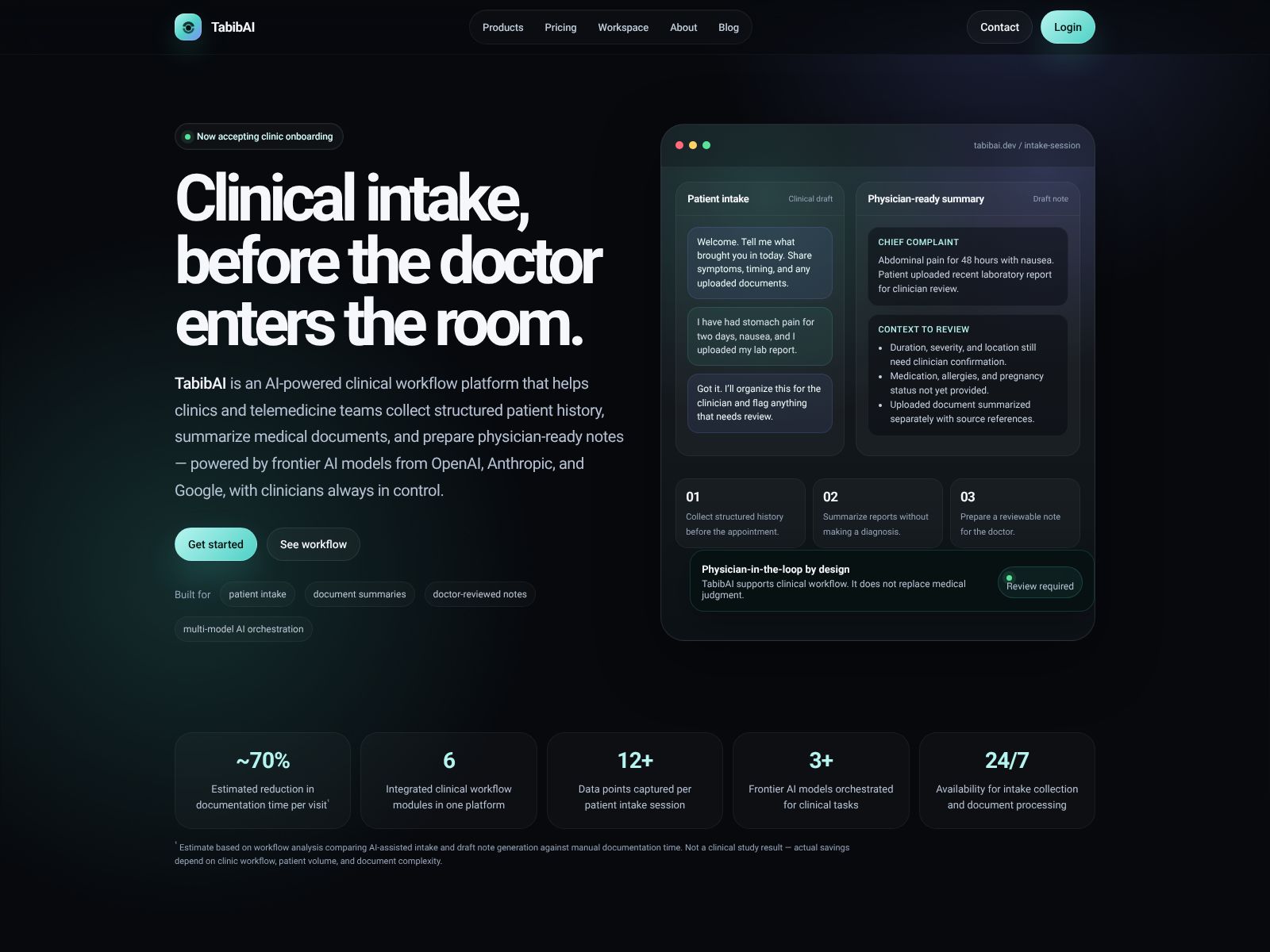
Tabib AI helps your clinic or telemedicine team speed up patient intake, review medical documents, and draft physician-ready notes. It combines leading AI models from OpenAI, Anthropic, and Google with a medical knowledge layer (ICD-10, RxNorm, SNOMED-CT) to produce structured, reviewable drafts that your clinicians can quickly edit and sign off. It does not diagnose or prescribe—every output is clearly labeled as a draft for clinician review.
Tabib AI Features
Tabib AI organizes its product into six modules. Each one targets a common clinic workflow pain point while leaving you, the clinician, in control.
1) Intake Copilot
The Intake Copilot is designed to shorten and standardize patient intake so your team collects the right information the first time. Instead of juggling paper forms or generic questionnaires, the Intake Copilot can guide a digital intake conversation, surface relevant follow-up questions, and structure responses around common medical ontologies.
- What it helps with:
- Pre-visit questionnaires, history collection, and symptom documentation
- Capturing allergies, medications, and relevant past medical history
- Structuring input against ICD-10, RxNorm, and SNOMED-CT for downstream use
- Why it matters: Better intake means fewer gaps during the visit and smoother documentation later. It also prepares your clinical team with a focused view before they enter the exam room or start a telemedicine call.
- Clinician control: Everything is saved as a draft. You approve, adjust, or discard before it becomes part of the record.
2) Document Review
Clinical teams drown in PDFs, scans, referral letters, and lab results. The Document Review module helps you make sense of incoming files rapidly. It can highlight key findings, extract structured data, and summarize long documents into a concise brief that a clinician can validate.
- What it helps with:
- Summarizing multi-page referrals or previous records
- Pulling out diagnoses, medications, allergies, labs, and imaging results
- Mapping extracted terms to ICD-10, RxNorm, and SNOMED-CT
- Why it matters: Faster triage and prep, less time hunting for details, and fewer missed items that lead to back-and-forth with patients or labs.
- Clinician control: Every summary and extraction is a starting point for your review—not a final record.
3) Doctor Notes
Doctor Notes is about drafting physician-ready notes that are easy to review and sign off. It uses your intake data, document summaries, and clinician prompts to produce a structured draft note.
- What it helps with:
- Turning unstructured inputs into a clean, organized SOAP note or your preferred format
- Pre-filling diagnoses (ICD-10 mapped), medications (RxNorm), and clinical terms (SNOMED-CT)
- Reducing after-hours charting and documentation fatigue
- Why it matters: You keep accuracy high while getting your time back. The note is built on standardized vocabularies, making it easier to use downstream.
- Clinician control: You edit, accept, or reject the draft. Tabib AI does not diagnose or prescribe, and it does not replace your clinical judgment.
4) Team Workspace
Clinical work is a team sport. Team Workspace keeps everyone aligned across front desk, nursing, physicians, and administrators without creating more inbox noise.
- What it helps with:
- Centralizing drafts, comments, and task assignments around a patient encounter
- Keeping an audit trail of who did what, when
- Maintaining shared context across in-person and telemedicine workflows
- Why it matters: Clear delegation and shared visibility mean fewer delays and more consistent care.
- Clinician control: You decide what becomes part of the official record. Drafts remain drafts until a clinician finalizes them.
5) Safety Layer
Healthcare AI must be safe by design. The Safety Layer focuses on guardrails and oversight so your team can use generative AI with confidence.
- What it focuses on:
- Keeping the AI within intended clinical support boundaries (no diagnosis or prescribing)
- Labeling outputs clearly as drafts for clinician review
- Reducing common AI failure modes like unsupported claims through checks tied to medical ontologies
- Why it matters: Trust is earned through consistency and transparency. Safety features help your team adopt AI without risking patient care standards.
6) Cloud Foundation
Under the hood, Tabib AI runs on a cloud architecture designed for healthcare-grade data protection and operational oversight.
- Security and compliance posture:
- HIPAA-aware and GDPR-aligned design considerations
- Encrypted storage for PHI and sensitive data
- Audit logging for traceability across your workspace
- Environment separation to reduce risk and contain incidents
- AI engine approach:
- Uses frontier models from OpenAI, Anthropic, and Google
- Layers in medical knowledge via ICD-10, RxNorm, and SNOMED-CT
- Routes tasks to appropriate models based on use case
Human-in-the-loop by design
Across every module, Tabib AI keeps clinicians in control. It does not diagnose, prescribe, or make final decisions. All outputs are labeled as drafts that require a clinician’s review and sign-off. This design choice respects regulatory realities and your professional judgment—and it’s a practical way to build trust with your team.
Who is Tabib AI for?
- Outpatient clinics that want to speed up intake and reduce documentation time
- Telemedicine teams that need structured, reliable notes from virtual visits
- Multi-specialty practices seeking a common workflow layer grounded in medical standards
- Clinics in the MENA region (and beyond) that prefer a platform already serving peers in similar regulatory and operational contexts
How a day with Tabib AI can look
Here’s a simple illustration of how your team might use Tabib AI across a typical patient journey:
- Before the visit: Your patient completes a short digital intake via the Intake Copilot. Symptoms, PMH, allergies, and current meds are captured in structured form. If the patient uploads referral letters or lab PDFs, the Document Review module summarizes them.
- During the visit: Your clinician sees a concise pre-visit brief. The patient’s concerns, relevant history, and key prior results are laid out in plain view. As the encounter proceeds, the clinician adds notes and clarifications.
- After the visit: Doctor Notes drafts a structured note based on intake and encounter context. Diagnoses and medications are mapped to ICD-10 and RxNorm. The clinician reviews, edits, and finalizes the note.
- Team coordination: In the Team Workspace, your nurse flags a follow-up task and your admin confirms patient outreach. Everything stays auditable.
The result is less “paperwork overhead,” fewer loose ends, and more time focused on the patient.
Benefits you can expect
- Time savings: Shorter intake, faster chart prep, and reduced after-hours documentation
- Consistency: Structured drafts mapped to medical standards to support coding and downstream systems
- Team clarity: Shared workspace, tasks, and audit trails
- Risk awareness: HIPAA-aware, GDPR-aligned design with encryption and logging
- Control: Human-in-the-loop at every step; AI assists, clinicians decide
What Tabib AI does not do
- It does not diagnose or prescribe
- It does not replace your clinical judgment
- It does not automatically finalize notes without a clinician review
Tabib AI Pricing
Tabib AI is a B2B SaaS platform. As of this review, specific pricing details are not publicly listed on the company’s site. That’s common in healthcare software, where pricing varies by size, specialty, and deployment needs. Expect pricing to depend on factors like:
- Number of clinicians and staff seats
- Volume of monthly patient encounters or documents processed
- Required security controls, data retention, and audit needs
- Support level and onboarding services
- Regional considerations and contracting requirements
If you want an exact quote, your best next step is to request a demo and pricing conversation at the official site: tabibai.dev. Bring a quick snapshot of your current volume and workflows (intake method, number of visits per week, note templates, typical document types). That will help the team tailor a plan and give you a more accurate estimate.
Tabib AI Top Competitors
When you evaluate Tabib AI, you’ll likely compare it with AI scribes, clinical documentation assistants, and workflow platforms used in ambulatory and telemedicine settings. Here are notable alternatives to consider. Each has a different strength—some focus on ambient scribing, others on intake and automation, or deeper EHR workflows.
- Ambience Healthcare
- Focus: Ambient AI scribing and clinical workflows
- Why compare: Strong note generation and physician experience
- Abridge
- Focus: Ambient clinical documentation from conversations
- Why compare: Widely adopted for generating notes from audio with clinician oversight
- Nabla Copilot
- Focus: AI assistant for clinicians, including note drafting
- Why compare: Lightweight tools that can fit into various clinical contexts
- Suki AI
- Focus: Voice-enabled clinical assistant and documentation
- Why compare: Strong speech-to-note capabilities
- DeepScribe
- Focus: Ambient AI scribing
- Why compare: Documentation from patient-clinician conversations
- Augmedix
- Focus: Medical scribing services augmented by AI
- Why compare: Hybrid human/AI documentation approach
- Notable
- Focus: AI-driven healthcare automation
- Why compare: Broader automation beyond note drafting, including intake and outreach
- Nuance Dragon Medical / DAX (Microsoft)
- Focus: Speech recognition and ambient clinical documentation
- Why compare: Longstanding footprint and integration depth in many health systems
- Tali AI
- Focus: AI dictation and clinical assistant tools
- Why compare: Practical documentation helpers for smaller practices
How Tabib AI is different: It centers on workflow modules across intake, document review, and doctor notes, and explicitly grounds outputs in ICD-10, RxNorm, and SNOMED-CT. It also emphasizes clinician control (drafts only) and a Safety Layer for guardrails. If your top pain points are scattered intake, messy document reviews, and manual note formatting, Tabib AI is tailored to that flow. If your main need is high-fidelity transcription of live conversations, an ambient scribe like Abridge, Ambience Healthcare, or Nuance DAX may be a stronger match—or complementary alongside Tabib AI.
Implementation considerations
Before you reach out for a demo, it helps to clarify a few basics so you can evaluate fit quickly:
- Workflow goals: Is your priority intake speed, document summarization, or note drafting? Rank them.
- Volume: Approximate daily/weekly patient encounters and number of documents you process.
- Roles: Who will use it—front desk, nurses, physicians, admins? Which tasks will they own?
- Templates: Which note formats do you prefer (e.g., SOAP)? Any specialty-specific sections to preserve?
- Security posture: What are your requirements for data storage, retention, and audit logs?
- Change management: Who will champion adoption? How will you measure success (e.g., minutes saved per note, time to first draft, chart closure rates)?
Starting with a small pilot often works best. Choose a motivated clinic lead, define a 4–6 week trial, and track a few simple metrics: time spent on intake, time to prepare for visits, time to finalize notes, and rework rates. Share quick wins with the team and iterate on your templates.
Data protection and compliance
Tabib AI is described as HIPAA-aware and GDPR-aligned, with encrypted storage, audit logging, and environment separation. For a healthcare buyer, that’s the right direction. As with any vendor handling sensitive data, you should still:
- Request security and privacy documentation
- Confirm data flow diagrams and encryption standards
- Ask about data retention, deletion, and access controls
- Clarify incident response processes and audit support
- Ensure business associate agreements (BAAs) and regional requirements are addressed where applicable
It’s also useful to understand how and when data is sent to underlying AI providers (OpenAI, Anthropic, Google) and what controls are in place to minimize unnecessary exposure.
Strengths and trade-offs
Every platform has a profile of strengths and limitations. Here’s a balanced snapshot to guide your evaluation.
- What you’ll likely appreciate:
- Clear focus on core clinic workflows: intake, document review, and doctor notes
- Grounding in medical ontologies (ICD-10, RxNorm, SNOMED-CT) for structured outputs
- Human-in-the-loop by default; drafts labeled for clinician review
- Security posture with encryption, audit logging, and environment separation
- Team collaboration and traceability via a shared workspace
- Bootstrapped and customer-focused, with traction in Egypt and MENA clinics
- Trade-offs to consider:
- Newer company (founded June 2026), so references and integrations may still be growing
- Pricing is not publicly listed; requires a sales conversation to estimate total cost
- If your top need is ambient scribing from live audio, you may want to pair Tabib AI with a dedicated scribe solution
Who will get the most value?
- Clinics that feel the biggest drag in intake, triage, and note finalization
- Telemedicine teams that need structured, standardized notes after virtual visits
- Practices that want clinician-first controls and transparent drafts
- Teams that appreciate a practical, modular platform rather than an all-or-nothing overhaul
Tips for a smooth rollout
- Start with 1–2 specialties and a small group of motivated clinicians
- Agree on note templates and intake prompts before day one
- Measure time saved and chart closure rates weekly
- Hold a 20-minute feedback huddle each week to tune prompts and templates
- Document “before and after” examples to train new users quickly
FAQs
Is Tabib AI a medical device or diagnostic tool? No. It does not diagnose or prescribe and is not a replacement for clinician judgment. All outputs are drafts for review.
Does Tabib AI integrate with my EHR? The company emphasizes structured outputs and clinician-ready notes. The specific integration approach can vary by clinic. In your demo, ask about exporting formats, APIs, and workflow options that fit your environment.
What models does Tabib AI use? It routes tasks to frontier models from OpenAI, Anthropic, and Google, layered with medical knowledge via ICD-10, RxNorm, and SNOMED-CT.
Where is Tabib AI available today? Tabib AI serves clinics across Egypt and the MENA region and plans to expand globally. Check with the team for your country and compliance requirements.
Bottom line on value
Tabib AI aims to solve the parts of clinical work that quietly consume your day: getting clean intake, extracting what matters from documents, and producing a clear, structured note that you can finalize quickly. If those are your bottlenecks, the platform’s focus on medical ontologies, human-in-the-loop safety, and team collaboration will likely resonate.
Wrapping Up
Tabib AI is a clinician-first workflow assistant that keeps you in charge. It helps you collect better data upfront, make sense of the paperwork deluge, and turn everything into a physician-ready note grounded in ICD-10, RxNorm, and SNOMED-CT. The platform is HIPAA-aware and GDPR-aligned, built with encryption, audit logging, and environment separation. It’s bootstrapped, live with clinics in Egypt and the MENA region, and pursuing broader growth.
If you’re evaluating AI tools for your clinic or telemedicine team, put Tabib AI on your shortlist—especially if intake quality, document review speed, and note finalization are top pain points. Because pricing isn’t publicly listed, request a demo and a tailored quote at tabibai.dev. Go in with a pilot mindset, measure your time savings, and let your clinicians decide if it meaningfully reduces their documentation burden. If it does, you’ll feel it quickly: fewer late-night notes, tighter team coordination, and more time with your patients.