
SustainaVerseNo Logo Placeholder
ClimateTech

SustainaVerse

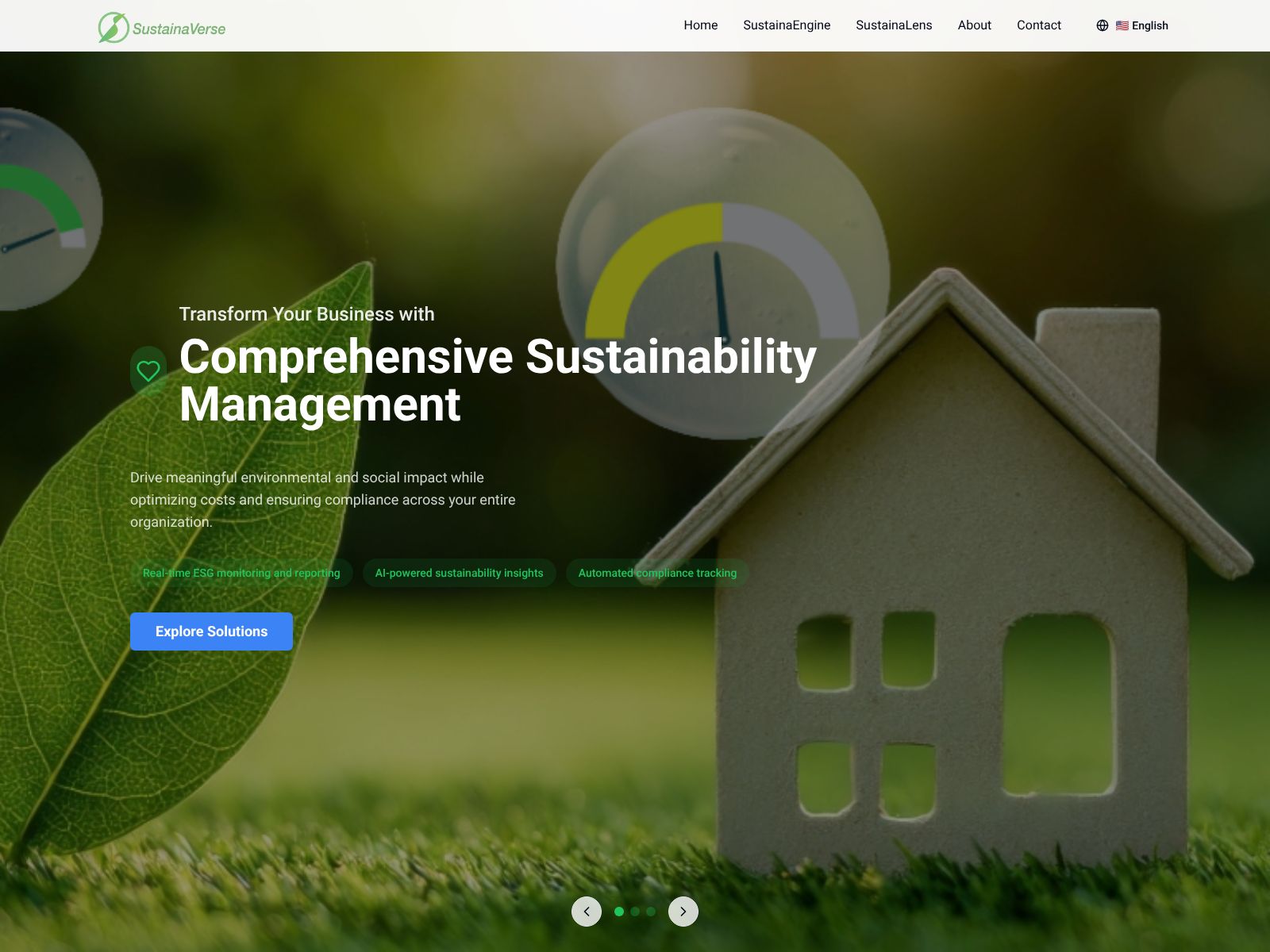
SustainaVerse, a Hitachi carve-out, provides an AI-powered ESG scoring platform that turns fragmented data into clear, ROI-linked actions. Using 200+ transparent E/S/G indicators, it scores products, services, supply chains, and investments via a B2B SaaS with SKU-level insights or the SustainaVerse API that integrates into procurement, product, and supply-chain systems. Companies use it to choose suppliers, redesign products, prioritize investments, improve transparency, meet global regulations, and build stakeholder trust. Since launching in 2025, we’ve seen thousands of app downloads, initiated PoCs with major enterprises including Hitachi, and signed an MoU with FutureSense in Korea to connect ESG scoring with food traceability. Backed by a global team in Silicon Valley, Tokyo, Seoul, and Europe, we’re scaling to link consumer choices with corporate responsibility and accelerate a sustainable future.

More About SustainaVerse

Founded:
Total Funding:
Funding Stage:
Seed
Industry:
ClimateTech
In-Depth Description:
SustainaVerse is a Hitachi carve-out building a decision-grade sustainability scoring platform for enterprises. We turn fragmented ESG data into clear, ROI-linked actions—helping teams choose suppliers, redesign products, and prioritize investments. Our scoring goes beyond carbon with 200+ transparent E/S/G indicators and can be used via B2B SaaS (SKU-level insights) or an API (“SustainaVerse API”) that integrates into existing procurement, product, and supply-chain systems. For businesses, SustainaVerse provides an enterprise SaaS platform and toolkits that score everything — products, services, supply chains, and even investments — through a unified AI-powered ESG scoring engine. These solutions integrate seamlessly into procurement, product improvement, and sustainability reporting, helping companies improve transparency, comply with global regulations, and build trust with stakeholders. Since launching in 2025, SustainaVerse has achieved thousands of app downloads and initiated proof-of-concept projects with major corporations, including Hitachi. We have also signed a strategic MoU with FutureSense in Korea to integrate ESG scoring with food traceability. Backed by a diverse global team in Silicon Valley, Tokyo, Seoul, and Europe, SustainaVerse is scaling rapidly to meet the growing demand for trustworthy ESG measurement. Our mission is to bridge individual consumer choices with corporate responsibility and accelerate the world’s transition to a truly sustainable society.
SustainaVerse

SustainaVerse Review & Overview

If you have ever felt stuck turning ESG data into real business action, you are not alone. Many teams sit on piles of sustainability information yet still struggle to decide which suppliers to keep, which products to redesign, or where to invest. SustainaVerse steps into that gap. Born as a carve-out from Hitachi, SustainaVerse offers a decision-grade sustainability scoring platform that transforms fragmented ESG data into clear, ROI-linked actions for enterprises. In this review and overview, you will learn what SustainaVerse does, how it works, where it shines, how it compares to alternatives, and how your team can evaluate if it is the right fit for your goals.

SustainaVerse can score products, services, supply chains, and even investments through a unified AI-powered engine. You can use it as a B2B SaaS platform for SKU-level insights or connect it through the SustainaVerse API into your existing procurement, product, and supply chain systems. The result is a single source of truth that goes beyond carbon to cover 200+ transparent indicators across environmental, social, and governance dimensions—so your team can act with confidence and show measurable results.

Since launching in 2025, SustainaVerse has attracted thousands of app downloads and initiated proof-of-concept programs with major corporations, including Hitachi. The company also signed a strategic MoU with FutureSense in Korea to integrate ESG scoring with food traceability—pointing to real-world, cross-industry use cases. With a global team spanning Silicon Valley, Tokyo, Seoul, and Europe, SustainaVerse is scaling to meet the demand for trustworthy ESG measurement and action. Their mission is clear: bridge individual consumer choices with corporate responsibility and speed the transition to a sustainable society.

What does SustainaVerse do?

SustainaVerse scores the sustainability of what your business buys, makes, and invests in. It turns messy ESG data into decision-grade insights and recommended actions, so your team can choose better suppliers, redesign products, and prioritize investments with a measurable return on sustainability.

Who is SustainaVerse for?

  • Procurement teams that need supplier-level and part-level scoring to guide sourcing and RFPs.
  • Product and engineering teams that need SKU-level insights to redesign materials and packaging for impact and cost.
  • Supply chain leaders who need a repeatable, transparent way to assess upstream and downstream risk.
  • Finance and investment teams looking to evaluate portfolios or capex through an ESG lens beyond carbon.
  • Sustainability and reporting teams that must align data, reduce manual work, and build stakeholder trust.

SustainaVerse Features

Unified ESG scoring engine with 200+ indicators

SustainaVerse’s core is a transparent scoring engine that covers environmental, social, and governance dimensions—not only carbon. The platform aggregates evidence from many sources and calculates scores you can trust, with clear indicator definitions and roll-up logic. That transparency matters: you can trace how a score was derived and what moved it up or down.

SKU-level product insights

If you build products, you know how hard it is to see sustainability at the SKU or part level. SustainaVerse provides SKU-level insights that help you compare materials, vendors, and design choices. This makes it easier to run trade-offs—like emissions vs. cost or recyclability vs. durability—and track the impact of redesigns over time.

Supplier scoring and sourcing support

Procurement has to make fast, high-stakes calls. SustainaVerse scores suppliers with a common yardstick across E, S, and G. You can use these scores in RFPs, supplier onboarding, and quarterly reviews. The platform also helps you prioritize engagement: who needs a corrective action plan, who is best-in-class, and where you should diversify risk.

ROI-linked recommendations

Scores alone do not change outcomes. SustainaVerse connects score improvements to practical, ROI-linked actions—like switching to a different material, consolidating shipments, or adopting a more energy-efficient process. Your team can weigh cost, availability, and lead time before deciding, so changes are realistic and defensible.

B2B SaaS and the SustainaVerse API

You can use SustainaVerse as a standalone enterprise SaaS portal or embed its scoring engine via the SustainaVerse API into your existing systems. Integrate with procurement tools, product data systems, PLM, ERP, or supply chain platforms so teams never leave their daily workflows. The API lets you trigger scoring, pull results at SKU or supplier level, and automate updates.

Data ingestion and harmonization

SustainaVerse is built for the messy reality of ESG data. It can ingest supplier questionnaires, internal operational data, and third-party datasets your team already uses. Once ingested, the platform harmonizes formats and fills gaps with clear assumptions so you can compare like-for-like across suppliers, geographies, and product lines.

Investments and portfolio view

Beyond sourcing and product, the platform can score investments and portfolios through the same engine. This helps you align capital allocation with your sustainability strategy and identify where small changes could move the needle most.

Transparency, auditability, and trust

SustainaVerse emphasizes clarity. Each indicator is defined and traceable. Evidence is attached. Assumptions are documented. This is helpful for audits, internal buy-in, and communication with customers, partners, and regulators.

Reporting and stakeholder communication

The platform can simplify reporting by giving you a consistent methodology and a single source of truth. That can help you address regulatory requirements and create materials for customers and investors. You get clearer narrative and fewer spreadsheet reconciliations.

Workflows and collaboration

Because ESG is cross-functional, SustainaVerse supports workflows across procurement, product, sustainability, and finance. Assign tasks, set goals, track milestones, and close the loop when score changes translate into real-world results.

Scenario analysis and benchmarking

You can run what-if scenarios to explore trade-offs before committing to change. Benchmark scores by category, supplier tier, or region to see what “good” looks like and set realistic targets for improvement.

Security and governance

Enterprise buyers expect robust security and role-based access. SustainaVerse is designed for controlled sharing across internal teams and with suppliers where needed, reducing risk while keeping collaboration easy.

Global footprint and partnerships

With a team across Silicon Valley, Tokyo, Seoul, and Europe, SustainaVerse understands regional needs and supply chain realities. The strategic MoU with FutureSense in Korea to connect ESG scoring and food traceability highlights its ability to partner in industry-specific contexts.

Implementation and onboarding

Adopting a sustainability scoring platform touches people, process, and data. A practical path looks like this:

  • Scope and goals: Pick two or three decisions you want to improve now—like supplier selection in a priority category or redesigning a top SKU.
  • Data mapping: Identify systems and sources for those decisions. This can include supplier documents, internal operational data, and external datasets you already license.
  • Pilot and calibration: Run a pilot aligned to your goals. Calibrate indicators to your industry context and validate results with your experts.
  • Workflow integration: Use the SaaS platform for quick wins, then connect the SustainaVerse API into procurement and product systems to scale.
  • Rollout and training: Train stakeholders, define ownership, and set review cadences so scores drive action.
  • Measure ROI: Track cost savings, risk reduction, and revenue impact from improved sustainability performance.

Because SustainaVerse has run proof-of-concept projects with large enterprises, including Hitachi, your team can expect an enterprise-grade approach to piloting, validation, and scaling.

Data sources and data quality

No platform can be better than its inputs. SustainaVerse is designed to bring together what you already have and fill gaps thoughtfully, with transparent assumptions. Typical inputs include:

  • Supplier documents and disclosures
  • Internal systems for purchasing, production, and logistics
  • External datasets your team already uses for ESG context

The advantage of a unified scoring engine is consistency. Your team can compare apples to apples across suppliers and SKUs, revisit assumptions as new data arrives, and maintain a clean audit trail. This builds trust internally and externally.

Pricing and plans

SustainaVerse does not publicly list pricing details. As an enterprise SaaS with an API, pricing typically reflects scope and usage. Expect factors like:

  • Number of users and collaborating suppliers
  • Volume of SKUs, parts, or services scored
  • API usage and integration complexity
  • Modules or feature sets you enable
  • Onboarding and professional services for data mapping and pilots

To build your business case, focus on measurable outcomes: reduced supplier risk, faster sourcing cycles, product cost savings from material changes, improved margins on sustainable lines, and time saved on reporting. When you speak with the SustainaVerse team, ask about pilot packages, proof-of-value timelines, and the ROI you can expect in the first two quarters.

Strengths and trade-offs

Every platform has strong points and practical trade-offs. Here is what to consider with SustainaVerse:

  • Strength: Goes beyond carbon with 200+ E/S/G indicators, giving a fuller picture of impact and risk.
  • Strength: SKU-level insights and supplier scoring support concrete product and sourcing decisions.
  • Strength: API integrates into systems your teams already use, reducing change management friction.
  • Strength: Transparent scoring and auditability help you build trust with stakeholders.
  • Strength: Backed by a global team and proven enterprise pilots, including a Hitachi proof-of-concept.
  • Trade-off: As a platform that spans E, S, and G, data collection across indicators may take effort, especially with new or smaller suppliers.
  • Trade-off: Change management is essential; scores drive value only if linked to sourcing and product decisions.
  • Trade-off: Like any enterprise tool, you will need clear ownership for data and workflows to keep momentum.

Common use cases

  • Supplier rationalization: Use scores to build preferred supplier lists, inform RFP criteria, and guide corrective action plans.
  • Product redesign: Identify materials or processes with outsized impact and model trade-offs before you commit to change.
  • Category strategies: Set sustainability standards by category and roll them into sourcing playbooks.
  • Portfolio investment: Evaluate projects or acquisitions through ESG scores beyond carbon to reveal hidden risk or upside.
  • Traceability and compliance collaboration: Pair ESG scoring with traceability programs (for example, through partners) to strengthen claims and reporting.
  • Customer and investor communication: Share transparent, indicator-level progress and justify decisions with evidence.

How SustainaVerse compares to top competitors

The ESG and sustainability software space is broad. Here are well-known alternatives and how they typically differ in focus. Your best choice depends on your primary use case.

EcoVadis

EcoVadis is known for supplier sustainability ratings and assessments across many industries. It offers a large network effect for procurement teams.

  • Consider if: You want supplier ratings at scale and are joining an established network.
  • SustainaVerse difference: Emphasizes SKU-level product insights, transparent 200+ indicator scoring, and API-led integration into product and supply chain systems for ROI-linked actions.

Watershed

Watershed focuses on carbon measurement and decarbonization planning, with strong enterprise adoption for climate programs.

  • Consider if: Your primary goal is deep carbon accounting and decarbonization roadmaps.
  • SustainaVerse difference: Goes beyond carbon to a wider E/S/G scope, pairing scoring with product and procurement decisions at SKU and supplier levels.

Persefoni

Persefoni is also centered on carbon accounting, emissions disclosures, and related finance-aligned reporting.

  • Consider if: You need robust carbon accounting and disclosure workflows.
  • SustainaVerse difference: Broader E/S/G indicator set and decision support embedded into sourcing and product design.

Sphera

Sphera provides EHS, risk, and sustainability solutions, including life cycle assessment tools.

  • Consider if: You want comprehensive EHS and LCA capabilities within a wider risk management suite.
  • SustainaVerse difference: Offers unified ESG scoring and SKU-level decision support, with a strong integration-first approach through the API.

SupplyShift

SupplyShift is recognized for supplier engagement and responsible sourcing data collection.

  • Consider if: You need to run supplier surveys at scale and manage responses across categories.
  • SustainaVerse difference: Central scoring engine across 200+ indicators plus product-level decision support and ROI-linked recommendations.

Sustainalytics and MSCI ESG (for investors)

These firms provide ESG ratings primarily for public companies and investors.

  • Consider if: You are focused on investment research and portfolio screening of public companies.
  • SustainaVerse difference: Built for enterprise operators as well as finance teams, with SKU and supplier-level scoring and integrations into procurement and product workflows.

How to evaluate fit for your organization

Use this quick checklist when you speak with the SustainaVerse team or plan a pilot:

  • Decisions to improve: Which decisions (sourcing, design, investments) will benefit most in the next 6–12 months?
  • Indicators that matter: Do the platform’s 200+ indicators align with your priorities and industry?
  • Data readiness: Which systems will you connect first? What supplier data do you already have?
  • Integration plan: Which workflows will use the API to bring scoring into day-to-day tools?
  • Governance: Who owns ESG data, and how will you keep it current?
  • ROI targets: What financial or risk outcomes will define success?
  • Scalability: How will you expand from a pilot to multiple categories, plants, or business units?

Tips to get early wins

  • Start with one category and a handful of high-impact SKUs. Prove value fast.
  • Pick suppliers who are engaged and data-ready to show what “good” looks like.
  • Run A/B comparisons between two design or sourcing options. Share the results broadly.
  • Tie score movements to budget and timelines so improvements are actionable.
  • Celebrate early savings or risk reductions to build momentum for rollout.

What sets SustainaVerse apart

Three qualities stand out:

  • Decision-grade depth: The platform measures what matters across E/S/G, not just carbon, and does it with transparent indicator logic.
  • Action orientation: It links scores to clear, ROI-based steps you can take in procurement and product design.
  • Integration-first approach: The SustainaVerse API lets you bring scoring to the systems your teams already use, reducing friction.

Combined with a global footprint and enterprise pilots, this focus gives you a practical path from ESG data to measurable business outcomes.

Customer momentum and ecosystem

SustainaVerse has reported thousands of app downloads and proof-of-concept engagements with major corporations, including Hitachi. The partnership with FutureSense in Korea for ESG-integrated food traceability hints at a broader ecosystem approach. For you, that means the platform is being tested in real operations, across regions and industries—useful signals as you assess maturity and support.

Roadmap questions to ask

As you evaluate, consider asking:

  • How does the scoring engine adapt to my industry’s specific materials and processes?
  • What evidence management and audit trails come standard?
  • How do you handle supplier participation and data gaps?
  • What are the most common integrations via the SustainaVerse API?
  • Which improvements do customers typically achieve in the first two quarters?
  • What services are available for onboarding, data mapping, and change management?

Getting started

Ready to explore? Here is a simple path:

  • Request a demo and discuss your top two decisions to improve.
  • Define a short pilot (8–12 weeks) with clear success metrics.
  • Map data for one category or product family and connect the initial systems.
  • Run scenarios, pick actions, and measure ROI at the end of the pilot.
  • Plan an API integration into procurement or product tools to scale.

You can learn more and reach out to the team at the SustainaVerse website: https://www.sustaina-verse.com.

SustainaVerse Top Competitors

  • EcoVadis: Supplier sustainability ratings and networked assessments.
  • Watershed: Enterprise carbon measurement and decarbonization.
  • Persefoni: Carbon accounting and climate disclosures.
  • Sphera: EHS, risk, and LCA solutions within a broader platform.
  • SupplyShift: Supplier engagement and responsible sourcing data collection.
  • Sustainalytics and MSCI ESG: ESG ratings for public companies and investors.

Each of these tools can be a good fit depending on your primary job to be done. SustainaVerse’s edge is the combination of broad E/S/G coverage, SKU-level and supplier-level decision support, and an integration-first API that brings scores into daily workflows.

Bottom line: When to choose SustainaVerse

Choose SustainaVerse if you want to turn ESG into everyday decisions with measurable ROI. If you need to:

  • Score suppliers and SKUs with transparent, 200+ indicator logic,
  • Embed sustainability into sourcing and product redesign without adding friction,
  • Unify teams around one scoring engine and one source of truth,

then SustainaVerse is worth a serious look. Its combination of depth, actionability, and integration can help you move from ESG theory to operational results.

Wrapping Up

SustainaVerse is a next-generation sustainability scoring platform built for enterprise decisions. As a Hitachi carve-out, it blends credibility with a product mindset focused on action. The platform goes beyond carbon to cover more than 200 E/S/G indicators, delivers SKU-level insights, and offers an API that integrates into procurement, product, and supply chain systems. For you, that means making sustainability part of everyday choices—who to buy from, how to redesign, and where to invest—backed by transparent scoring and a clear link to ROI.

While any ESG program requires data effort and change management, the payoffs are real: lower risk, smarter sourcing, better products, and stronger trust with customers and stakeholders. If that aligns with your goals, explore a pilot with SustainaVerse and measure the impact on one high-value decision. Start small, prove value, and scale with confidence.

To learn more, visit sustaina-verse.com and connect with the team.