Stoa (YC S26)No Logo Placeholder
Marketplace Platforms

Stoa (YC S26)

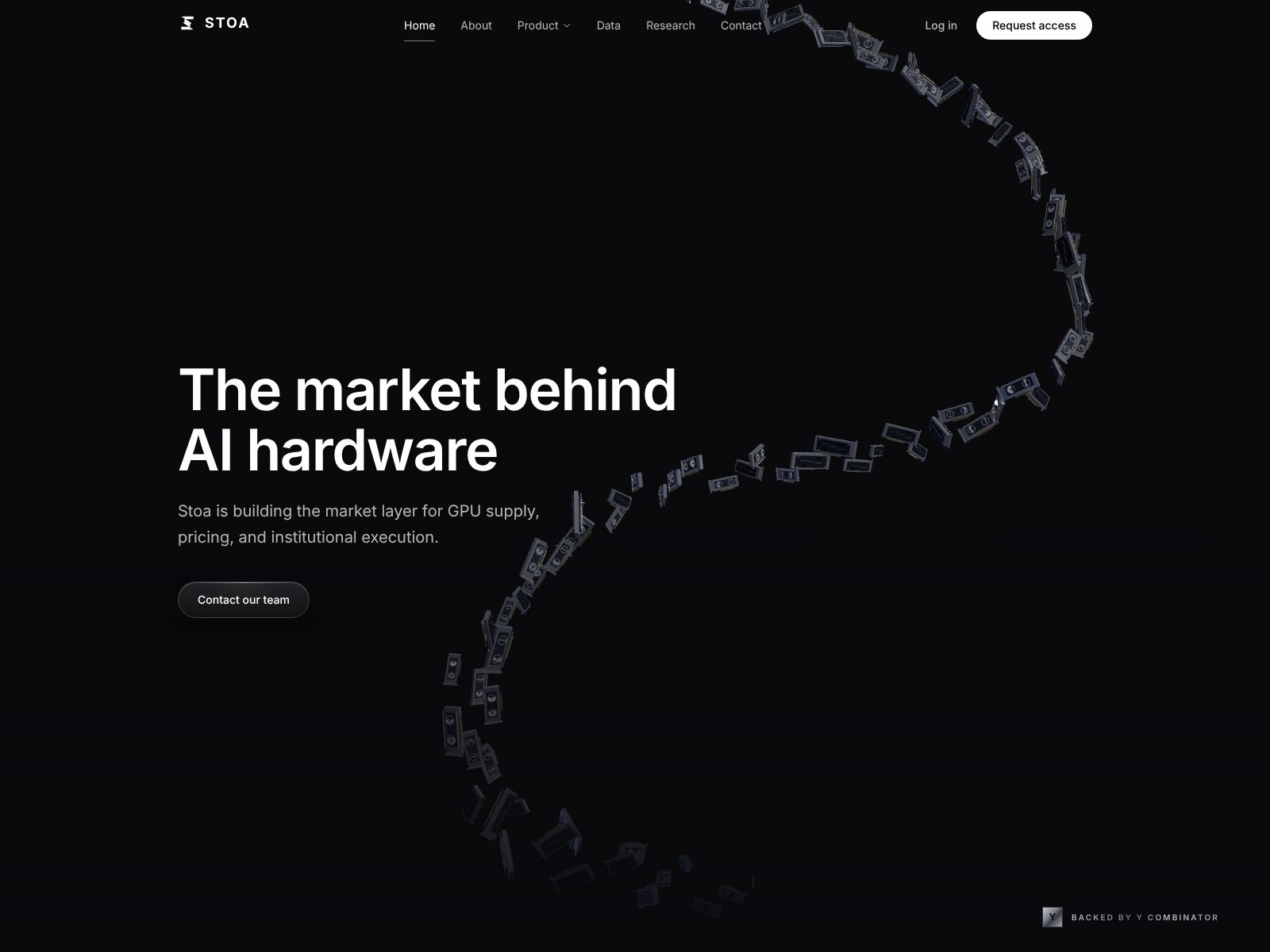
Stoa builds market infrastructure for AI hardware. Its first product, Stoa Markets, is an institutional platform that connects buyers, sellers, brokers, operators, and capital partners to source GPUs, discover prices, and transact with greater transparency—turning private hardware flow into clearer pricing, liquidity, and financial context for the AI infrastructure ecosystem.

More About Stoa (YC S26)

Founded:
Total Funding:
$500,000.00
Funding Stage:
Pre-Seed
Industry:
Marketplace Platforms
In-Depth Description:
Stoa is building market infrastructure for AI hardware, starting with Stoa Markets, a platform for institutional GPU supply, sourcing, and price discovery. The company helps buyers, sellers, brokers, operators, and capital partners transact around GPUs with better market visibility, turning private hardware flow into clearer pricing, liquidity, and financial context for the AI infrastructure ecosystem.
Stoa (YC S26)

Stoa (YC S26) Review (Features, Pricing, & Alternatives)

If you’re trying to buy, sell, or finance GPUs at institutional scale, you’ve felt the pain: fast-moving inventory, private deals, and prices that seem to change every week. Stoa (YC S26) steps into that gap with a focused goal—build market infrastructure for AI hardware so the entire ecosystem can see, price, and transact GPUs with more confidence. In this review, I’ll explain what Stoa does in plain language, walk through its likely features and workflows, talk about pricing expectations, compare top alternatives, and help you figure out whether it belongs in your stack.

Stoa is new (part of Y Combinator’s S26 batch), but the problem they’re solving is very real. The AI boom has made GPUs the most coveted asset in computing. Demand spikes, supply constraints, and long lead times have turned hardware planning into a strategic function. Private chats and spreadsheets can only take you so far. Markets need structure: clear listings, standardized terms, strong counterparty checks, and data that creates shared price understanding. That’s the infrastructure Stoa aims to provide with Stoa Markets, its platform for institutional GPU supply, sourcing, and price discovery.

What does Stoa (YC S26) do?

Stoa builds market infrastructure for AI hardware. Its first product, Stoa Markets, gives institutional buyers, sellers, brokers, operators, and capital partners a place to discover prices, source or list GPUs, and complete transactions with better visibility and standardized processes.

Why this matters now

AI hardware used to be a back-office purchase. Today it’s a core strategic asset. Training and serving modern models require consistent access to high-end GPUs, complex interconnects, and data center capacity. But the market is fragmented. Inventory moves through private channels. Prices vary by batch, geography, warranty status, and delivery window. Financing and risk management often happen in separate conversations. This fragmentation raises costs and risk for everyone involved.

Markets solve these problems by making information and process visible. When you can see credible listings, compare like-for-like SKUs, understand delivery schedules, check counterparties, and finance the transaction inside the same workflow, you reduce friction. Even if you still negotiate bilaterally, shared data creates price discovery and tighter spreads. Stoa is betting that better market rails will unlock more liquidity for AI hardware and help the ecosystem plan with fewer surprises.

Who Stoa is for

  • Institutional buyers: AI labs, enterprise ML teams, and cloud providers who need predictable access to GPUs and clear pricing.
  • Sellers and operators: Data centers, OEM-aligned operators, and fleets with surplus or scheduled decommissions who want qualified demand and cleaner settlement.
  • Brokers: Specialists who source and match inventory and need a platform that standardizes specs, terms, and fees.
  • Capital partners: Lenders, lessors, and funds who finance GPU purchases or inventory and need reliable data, provenance, and audit trails.

Stoa (YC S26) Features

Stoa describes Stoa Markets as a platform for institutional GPU supply, sourcing, and price discovery. While the company is early, the positioning points to a clear set of capabilities that matter in practice. Here’s what you should expect from a market infrastructure platform focused on GPUs, and how those features translate into value for your team.

1) Market visibility and price discovery

Opaque pricing makes planning hard. By aggregating listings and demand signals, and by standardizing how SKUs and lots are described, a platform like Stoa can help you see where the market is heading. That typically includes:

  • Normalized listings: Clear specs (GPU model, memory, interconnect, form factor, condition, warranty, batch size), delivery windows, and geographies so you can compare apples to apples.
  • Reference price ranges: Indicative prices or historical ranges that help you calibrate bids and timing. Even directional signals lower negotiation friction.
  • Liquidity snapshots: A sense of available volumes by region and time frame, so you can plan purchases or sales around the market’s depth.

Value to you: less time chasing quotes, tighter variance between budget and actual, and better internal confidence when you present a procurement plan.

2) Institutional RFQs and negotiation workflow

Enterprise transactions don’t happen on a “buy now” button alone. You request for quote (RFQ), negotiate terms, and coordinate delivery. Expect Stoa to support:

  • Private RFQs: Invite selected counterparties to bid on your needs while protecting sensitive details.
  • Structured terms: Incoterms, acceptance criteria, burn-in requirements, and standard clauses to reduce legal back-and-forth.
  • Block trades: Handle large lots with staged deliveries and milestone payments.

Value to you: faster cycle times and fewer surprises at settlement because expectations were structured from the start.

3) Counterparty verification and compliance

When GPUs are valuable and scarce, reputation risk and compliance matter. A market infrastructure platform for this category should have:

  • KYC/KYB onboarding: Verify legal entities and signatories to reduce fraud risk.
  • Sanctions and export checks: Guardrails to help you comply with relevant trade controls and shipping restrictions.
  • Audit trails: A record of negotiations, revisions, and approvals for internal compliance and future audits.

Value to you: fewer one-off vendor verifications and a cleaner paper trail for finance, security, and legal teams.

4) Logistics and settlement coordination

Hardware deals fail in the details: inspections, DOAs, shipping windows, and hand-offs between teams. Expect workflows for:

  • Inspection and acceptance: Define test criteria, burn-in durations, and RMA fallbacks up front.
  • Escrow and milestone payments: Protect buyers and sellers while keeping cash moving as commitments are met.
  • Delivery scheduling: Coordinate batches across sites and time zones, with status updates both sides can see.

Value to you: fewer last-minute scrambles and cleaner month-end reconciliation.

5) Data and analytics for planning

Beyond individual deals, Stoa’s core promise is better market context. Over time, a platform like this can surface:

  • Price curves by condition and delivery window: Compare new vs. refurbished, immediate vs. forward delivery.
  • Spread analysis: Understand the gap between ask and bid levels to decide whether to wait or transact now.
  • Regional differentials: See how availability and pricing vary across markets to optimize logistics.

Value to you: a shared source of truth for budgeting and timing decisions.

6) Financing and capital partner coordination

Many GPU deals involve lenders or lessors. Instead of separate email threads, a marketplace can streamline:

  • Introductions to capital partners: If you need financing, tap vetted lenders familiar with GPU collateral and lifecycle risk.
  • Document standardization: Align purchase agreements, security interests, and delivery proofs so financing can clear faster.
  • Inventory attestation: Provide capital partners with visibility into asset provenance and custody.

Value to you: more competitive financing and faster time to deploy.

7) API access and integrations

As you scale, manual processes break. Look for APIs and integrations that connect Stoa to your procurement, ERP, DCIM, and internal approval systems. Even basic export/import or webhook support can remove friction for busy ops teams.

8) Security and governance

Deals frequently involve NDAs, sensitive forecasts, and high-stakes deliveries. Enterprise-grade access controls, role-based permissions, and data security practices help you share the right information with the right parties—no more, no less.

How buying and selling might work on Stoa

Here’s a simple, practical picture of how you could use Stoa Markets from either side of the table:

Scenario A: You’re an institutional buyer

  • Onboard your team and set roles for procurement, legal, finance, and ops.
  • Publish a private RFQ for a specific lot (e.g., a defined GPU class with target delivery dates, region, and acceptance criteria).
  • Receive bids from verified sellers and brokers; compare normalized specs and proposed schedules.
  • Negotiate terms inside the platform (incoterms, escrow milestones, inspection windows).
  • Route the draft agreement to your approvers; lock in the trade when sign-offs are complete.
  • Coordinate delivery and inspection; trigger milestone payments from escrow as criteria are met.
  • Export the final docs and audit trail to your ERP and compliance systems.

Scenario B: You’re a seller or operator

  • Onboard your inventory with clean specs, condition, and delivery windows.
  • Respond to qualified RFQs; surface options like immediate delivery vs. staged shipments.
  • Offer inspection and burn-in terms to build buyer confidence and win the deal.
  • Use standard paperwork and escrow workflows to reduce collections risk.
  • Close the trade, coordinate shipping, and release funds as milestones clear.

In both cases, the platform’s role is to reduce misalignment and manual hand-offs—so you spend your time making the right trade, not reconciling a dozen email threads.

Pricing: how does Stoa make money?

As of this writing, Stoa has not published detailed public pricing. That’s common for early institutional marketplaces. Here’s what to expect in this category and how to think about cost:

  • Transaction fees: A take rate or structured fee per completed deal. Sometimes split between sides or tied to services like escrow or verification.
  • Membership tiers: For higher-volume users, a subscription that lowers per-transaction costs and unlocks analytics or faster support.
  • Listing and verification fees: For premium placement, expedited vetting, or advanced inspection.
  • Data services: Optional subscriptions to deeper market analytics or alerts.

How to evaluate: quantify the value you get from price discovery, faster cycle times, and risk reduction. If a platform saves you a week of delay or narrows a price spread by a few percent on a large lot, it likely pays for itself. Also ask about volume discounts, bundled services (escrow, inspections, financing introductions), and how fees are handled for block trades.

Recommendation: contact Stoa directly at stoaexchange.com for current pricing and enterprise terms.

Pros and cons

Every market platform has trade-offs. Here’s a balanced, practical take to help you decide.

Pros

  • Better visibility: Centralizes information that’s usually trapped in private chats and spreadsheets.
  • Cleaner process: Standardized RFQs, terms, and settlement reduce friction and legal back-and-forth.
  • Improved pricing confidence: Shared context helps you plan purchases and sales with fewer surprises.
  • Institutional focus: Designed for enterprise procurement, brokers, operators, and capital partners—not just one-off buyers.
  • Risk controls: KYC/KYB, compliance checks, and escrow workflows protect both sides.

Cons

  • Early-stage liquidity: New markets need time to build depth. You may still run parallel processes with direct channels at first.
  • Onboarding effort: Counterparty verification and role setup take time, though they pay off in reduced future friction.
  • Fees vs. direct sourcing: If you already have tight bilateral channels, you’ll weigh platform fees against existing relationships.
  • Geography and compliance scope: Certain regions or export controls may limit who can trade which assets, depending on your profile.

Stoa (YC S26) Top Competitors and Alternatives

Because Stoa is market infrastructure (not a cloud provider or OEM), true one-to-one competitors are limited. Still, you have several alternative paths to get access to GPUs or to sell them. Here’s how the landscape breaks down:

1) Direct OEM and authorized reseller channels

If you need new gear with full warranties and certified configurations, you can buy through OEMs and authorized partners. Think server vendors and large resellers that work directly with GPU manufacturers and their partner networks.

  • Pros: Official warranties, validated configs, professional services, predictable procurement processes.
  • Cons: Allocation constraints, longer lead times for in-demand SKUs, and limited price transparency if you’re not a top-tier account.
  • When to choose: Standardized enterprise deployments and compliance-heavy environments where vendor certification matters most.

2) Enterprise resellers and brokers

Large resellers and specialist brokers can source new or refurbished hardware and assemble deals across multiple suppliers.

  • Pros: Relationship-driven access to hard-to-find inventory, ability to move quickly, and flexible deal structures.
  • Cons: Pricing and availability often remain opaque; terms and documentation vary by counterparty.
  • When to choose: You need a trusted human network and are comfortable managing process and risk case-by-case.

3) GPU rental or cloud alternatives

If owning hardware is not required, renting compute from specialized GPU clouds can be faster than procuring equipment.

  • Pros: Immediate access, elastic capacity, and no hardware logistics. Helpful for bursts and experiments.
  • Cons: Ongoing operating cost, potential queueing or availability issues for the hottest SKUs, limited control over long-term economics compared to owning.
  • When to choose: Short-term projects, variable workloads, or when your team is capital-constrained.

4) Secondary marketplaces and IT asset disposition (ITAD)

When fleets refresh, GPUs can flow into secondary markets via refurbishers and ITAD providers.

  • Pros: Potentially lower costs and immediate availability for certain generations.
  • Cons: Mixed quality, variable warranties, and more work to validate provenance and condition.
  • When to choose: Cost-sensitive expansions, labs, or non-critical workloads where top-bin specs and long warranties are less critical.

5) What makes Stoa different

Stoa isn’t trying to replace OEM channels or GPU clouds. Instead, it targets the transaction layer between all these actors, making pricing and process clearer across private flows. If you already hop between DMs, spreadsheets, and separate escrow services to get a deal done, Stoa’s all-in-one workflow and shared data layer are the differentiators.

Evaluation checklist: is Stoa right for you?

Use this quick checklist to make a decision with your team:

  • Volume and frequency: Do you source or sell GPUs often enough that standardized RFQs and settlement would save time?
  • Need for price discovery: Would a shared view of market levels improve your budgeting and timing?
  • Counterparty diversity: Are you working with multiple sellers, brokers, or capital partners today?
  • Compliance needs: Do you need clean audit trails, KYC/KYB, and export checks to satisfy internal controls?
  • Financing complexity: Do you pair hardware purchases with external capital that benefits from standardized docs and attestations?
  • Geographic scope: Are your trades cross-border or multi-site, where logistics coordination can make or break timelines?

If you answer yes to several of these, Stoa is worth a pilot alongside your existing channels. Start with a single RFQ or a sell-side lot, learn the workflow, and expand if it saves time and tightens spreads.

Practical tips for getting value fast

  • Normalize your specs: Before you list or RFQ, write down exact requirements: model, memory, interconnect, form factor, condition, warranty, delivery windows, and inspection criteria. Clear inputs lead to better bids.
  • Be realistic on delivery: If you need staged deliveries, specify batch sizes and acceptance timing. Sellers can often meet you halfway if you’re precise.
  • Use escrow milestones: Align payments with inspection and delivery to protect both sides without stalling cash flow.
  • Loop in finance early: If you might finance the purchase, bring capital partners into the process at RFQ stage to speed underwriting.
  • Benchmark with data: Treat market ranges as context, not absolutes. Tight spreads plus a reliable counterparty usually beat chasing the theoretical lowest price.

Common questions

Do I need to be a large enterprise to use Stoa?
Stoa is built for institutional workflows—buyers, sellers, brokers, operators, and capital partners. If you transact in meaningful volumes or need enterprise-grade process and compliance, you’re in the target audience.

Which GPU generations does it support?
Stoa focuses on institutional GPU supply broadly rather than a single model. Expect coverage for current-generation accelerators and relevant prior generations, with standardized specs to compare lots clearly.

Is Stoa a cloud provider?
No. Stoa provides market infrastructure for buying, selling, and financing physical GPU inventory. If you want on-demand compute, consider GPU clouds as a complementary option.

How does Stoa handle compliance?
A platform like Stoa typically includes KYC/KYB onboarding, sanctions checks, and export control workflows. Confirm exact controls with Stoa for your jurisdiction and use case.

What about warranties and DOA?
Inspection and acceptance criteria are usually negotiated in the deal. Use the platform’s standard terms to spell out burn-in tests, DOA windows, and RMA procedures before you sign.

Where Stoa could go next

Market infrastructure improves as liquidity and data deepen. Over time, Stoa could expand into richer analytics, forward delivery scheduling, and tighter integrations with ERPs and DCIM tools. The core value—turning private hardware flows into shared pricing, liquidity, and financial context—gets stronger as more transactions run through the same rails. If you believe AI hardware will remain strategic (and volatile), structured markets are not a nice-to-have; they’re the backbone for smarter decisions.

Bottom line: who should try Stoa now?

Two groups stand to benefit immediately:

  • Buyers with urgent or ongoing needs: If your team is planning repeated purchases and wants better timing, cleaner process, and clearer pricing, Stoa can compress cycles and reduce variance.
  • Sellers and brokers with inventory to move: If you want qualified demand, standardized terms, and smoother settlement, a dedicated market workflow is often faster and safer than ad hoc channels.

If you’re happy with a single trusted channel and your deals are simple, you may not need a market platform yet. But as transaction volume and complexity rise, centralized visibility and standardized process become a real advantage.

Wrapping Up

Stoa (YC S26) is building something the AI hardware world needs: market infrastructure that makes GPU transactions clearer, faster, and safer. Its focus on institutional users—buyers, sellers, brokers, operators, and capital partners—matches how real deals get done today. By turning private flows into shared pricing and smoother workflows, Stoa can help your team plan with confidence, execute with fewer surprises, and capture opportunities that used to depend on being in the right backchannel at the right time.

The company is early, so you should expect the usual growing pains as liquidity builds. But the direction is right, the pain points are obvious, and the upside is meaningful: tighter spreads, faster cycle times, cleaner compliance, and better financing outcomes. If those results would move the needle for you, it’s worth starting a pilot and seeing how Stoa fits into your procurement or sales motion.

To learn more or request access, visit stoaexchange.com.