STATELYNo Logo Placeholder
PropTech

STATELY

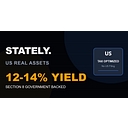
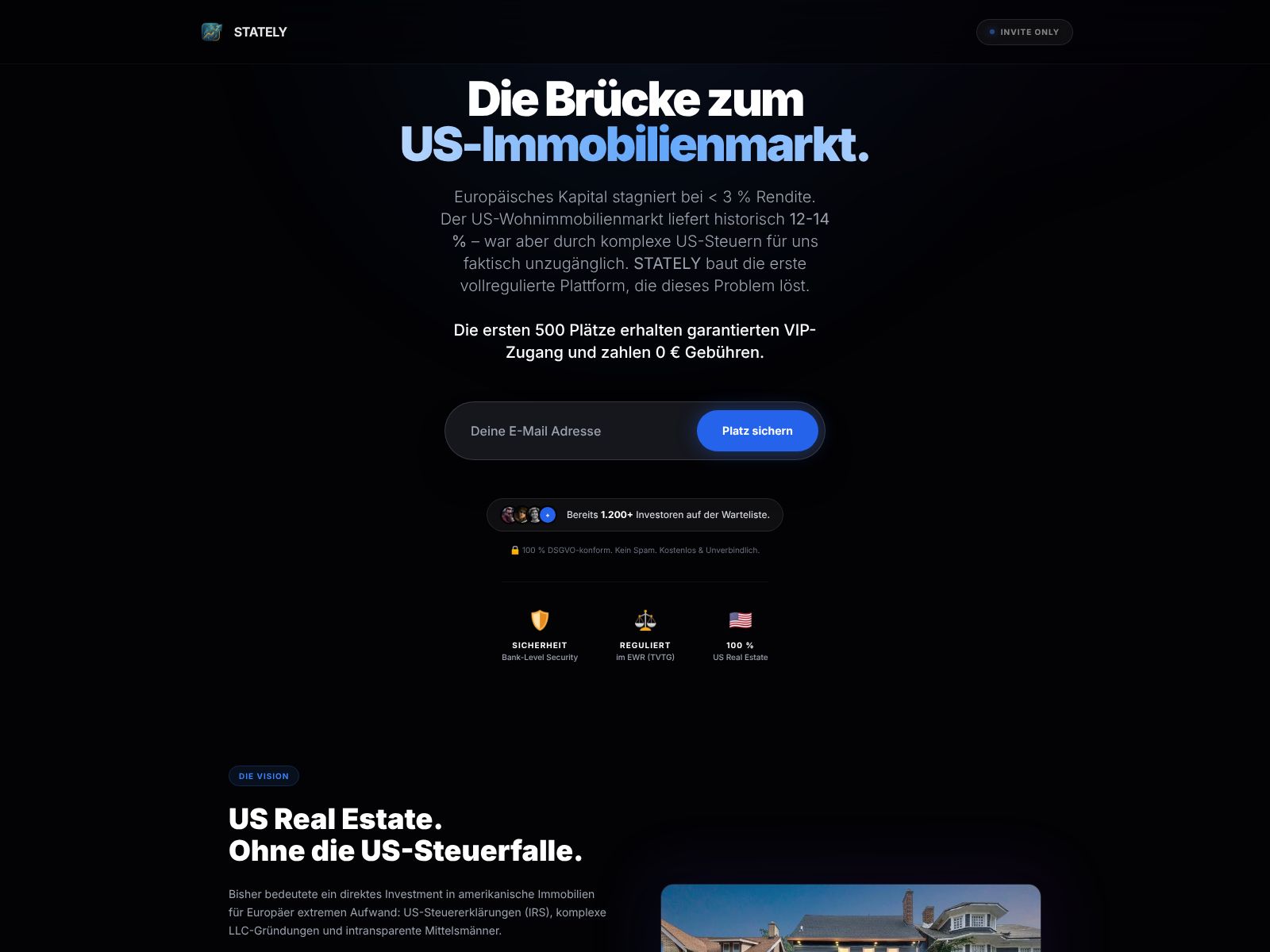
STATELY ist eine regulierte Plattform zur Tokenisierung von US‑Immobilien (Real-World Assets). Sie verbindet europäisches Kapital mit institutionellen US‑Immobilienmärkten über eine 100% asset‑light (Zero‑CapEx) Architektur. Auf Basis des liechtensteinischen TVTG und einer Delaware C‑Corp entfällt für europäische Privatanleger die US‑Steuererklärung. Die Plattform bietet Zugang zu exklusiven Off‑Market-Objekten mit historisch hohen Netto‑Renditen.

More About STATELY

Founded:
Total Funding:
$50,000.00
Funding Stage:
Pre-Seed
Industry:
PropTech
In-Depth Description:
STATELY ist eine regulierte Infrastruktur-Plattform für die Tokenisierung von US-Immobilien (Real-World Assets). Das Unternehmen verbindet europäisches Kapital mit institutionellen US-Immobilienmärkten durch eine 100% Asset-Light-Architektur (Zero-CapEx). Basierend auf dem liechtensteinischen Blockchain-Gesetz (TVTG) und einer Delaware C-Corp-Struktur eliminiert STATELY die US-Steuererklärungspflicht ("No US Tax Filing") für europäische Retail-Anleger. Die Plattform ermöglicht den Zugang zu exklusiven Off-Market-Objekten mit historisch hohen Netto-Renditen.
STATELY

STATELY Review (Features, Pricing, & Alternatives)

If you’re a European investor looking for a simple, compliant way to access U.S. real estate without the headaches of cross-border tax filings, STATELY might be exactly what you’ve been waiting for. It’s a regulated infrastructure platform purpose-built to tokenize real-world assets (RWAs)—specifically, institutional-grade U.S. real estate—and make them accessible to European retail investors through a clear legal setup. In this review and overview, you’ll learn what STATELY does in plain language, how its features work, what makes its structure unusual, how pricing typically works for platforms like this, and which alternatives you can compare it to before you decide.

Quick note: None of this is financial, legal, or tax advice. Real estate carries risk. Tokenized assets carry risk. Always do your own due diligence and speak with qualified advisors.

What does STATELY do?

STATELY lets you invest in tokenized shares of U.S. real estate through a regulated European framework. You buy digital tokens that represent your interest in professionally sourced properties, and the platform handles the heavy lifting around compliance and cross-border structure so you don’t have to file U.S. tax returns as a European retail investor.

Why STATELY exists (in one minute)

Until recently, investing directly into U.S. properties as a European retail investor was hard. You faced high minimums, complex structures, possible double taxation, and often the need to file U.S. tax forms. Tokenization reduces some friction by turning property interests into digital tokens you can buy in smaller amounts. But tokenization alone doesn’t solve the legal and tax puzzle—smart structure does. STATELY’s pitch is that it combines both: regulated tokenization plus a cross-border legal setup designed for European investors who want exposure to institutional U.S. real estate without the usual U.S. tax filing burden.

STATELY Features

1) A regulated, cross-border legal setup built for Europeans

STATELY is structured on two pillars:

  • Liechtenstein’s TVTG (the “Blockchain Act”), which provides a regulated framework for tokenized rights and assets in Europe.
  • A Delaware C‑Corp structure in the U.S. that is designed to remove the need for European retail investors to file U.S. tax returns (“No US Tax Filing”).

In plain terms: you invest through a European legal wrapper that is recognized under Liechtenstein law, and the underlying U.S. asset is held in a way that aims to shield European retail investors from needing to file directly in the U.S. You should still expect to handle taxes in your home country, but the extra administrative layer in the U.S. is what STATELY says it eliminates for you. Always confirm this with STATELY and your advisor, because tax specifics can vary by jurisdiction and personal situation.

2) 100% asset-light architecture (Zero CapEx)

STATELY describes itself as 100% asset-light. That means the company doesn’t own heavy infrastructure or large in-house property operations. Instead, it orchestrates a network of professional partners (for sourcing, property management, compliance, and custody) and focuses on the regulated tokenization, investor experience, and deal selection. For you, that typically means lower platform overhead, more flexibility in choosing partners, and a model that can scale quickly across many types of assets without being tied to one operator or property manager.

3) Access to institutional, off‑market U.S. real estate

STATELY says it sources exclusive off-market opportunities—deals you generally won’t see on public listing sites. Off-market, institutional-grade assets can be attractive because they’re often priced via relationships and track records rather than open auctions. The platform emphasizes historically strong net yields for these types of properties. Of course, “historically high” does not guarantee future performance. Real estate cycles, interest rates, tenant risk, and macroeconomics still matter.

4) Tokenization that turns property interests into investable digital units

With tokenization, your participation in a property is represented by digital tokens instead of paper shares or private placement PDFs. Benefits you might notice:

  • Lower minimums than traditional direct property deals, allowing you to start small and diversify.
  • Faster, more transparent settlement compared to offline subscription workflows.
  • On-chain records of ownership transfers and balances, making audits and reporting more straightforward.

Under the TVTG framework in Liechtenstein, tokenized rights are recognized by law, which helps bridge the gap between traditional property law and modern digital registries.

5) Compliance-first onboarding for retail investors

Cross-border real estate must meet KYC/AML requirements. STATELY’s infrastructure is built with regulated onboarding in mind, so you can expect identity verification, screening, and investor appropriateness checks. This is not just box-ticking: proper compliance is what enables platforms like STATELY to offer access to European retail investors without drifting into gray areas.

6) “No US Tax Filing” design for European retail investors

This is a standout promise. Many U.S.-based real estate platforms issue tax documents (like K‑1s or 1042‑S/1099) that can trigger filing obligations for non‑U.S. investors. STATELY’s structure is designed so that you, as a European retail investor, do not need to file in the U.S. You’ll still need to handle taxes at home, and there may be withholding considerations embedded in the structure, but the administrative hurdle of U.S. filing is what STATELY aims to remove. Confirm details with their team and your tax advisor.

7) Transparency and data rooms

Sophisticated investors want to see the underwriting. Expect standardized data rooms with property-level documents (financials, leases, appraisals, third-party due diligence). Tokenization doesn’t replace diligence—it should make it easier to access. The more transparent the deal room, the more confidently you can assess risk and projected returns.

8) Distributions and reporting

As a token holder, you typically receive your share of net income after expenses and fees. The exact distribution cadence (monthly, quarterly) and payout methods depend on the specific deal and service providers, so review each offering’s memorandum. On the reporting side, a good tokenization platform gives you dashboards with position values, distributions received, and downloadable statements you can use at tax time in your home country.

9) Liquidity and secondary options

Tokenization can allow for secondary transfers, but that doesn’t automatically mean high liquidity. Real estate is still a relatively illiquid asset class. Liquidity—if available—usually comes through regulated, compliant venues (or issuer-managed transfer processes) and may be subject to lock-ups, transfer restrictions, and whitelist controls. Go in with a “buy-and-hold for income” mindset and treat any exit liquidity as a potential bonus rather than a guarantee.

10) Security, custody, and wallets

With tokenized assets, you must think beyond property safety and include digital asset security. STATELY’s asset-light model suggests it partners for custody and wallet infrastructure. Ask about:

  • Whether you can self-custody tokens or must use a qualified custodian.
  • How private keys are managed (MPC, HSM, multisig).
  • What happens if you lose access to your wallet.
  • Business continuity and disaster recovery for both the tech and legal layers.

11) Fees and pricing

STATELY has not publicly listed a universal pricing menu at the time of writing, and fee structures can vary by deal. That said, real estate tokenization platforms commonly use some mix of:

  • Acquisition or arrangement fees paid at closing.
  • Ongoing asset management fees (a small percentage of invested capital or net asset value).
  • Property management and operating expenses passed through at the asset level.
  • Performance fees or carried interest on realized gains, when applicable.
  • Secondary transfer or withdrawal fees if you trade tokens or exit early.

Before investing, ask for a full fee schedule, examples of net yield calculations, and a sensitivity analysis that shows how fees and operating assumptions affect your net returns.

12) Who STATELY is best for

  • European retail investors who want U.S. real estate exposure without U.S. tax filing.
  • Advisors and family offices seeking smaller-ticket entries into institutional deals for client diversification.
  • Crypto‑native investors who prefer on-chain records but want asset-backed exposure and real cash flows.
  • Income-focused investors comfortable with medium- to long-term holding periods.

13) What to watch out for (realistic risks)

  • Market and rate risk: Property values and net operating income move with interest rates, rents, vacancy, and cap rates.
  • FX risk: If your base currency is EUR or CHF and distributions come from USD assets, exchange rates will impact realized returns.
  • Liquidity risk: Tokenization may enable transfers but doesn’t guarantee an active market.
  • Operator and counterparty risk: Asset-light models rely on partner quality. Review who underwrites, manages, and audits.
  • Regulatory risk: Tokenization and RWA rules evolve. A strength today (clear structure) must keep pace with tomorrow’s rules.
  • Smart contract and custody risk: Digital asset security is critical. Understand how tokens are safeguarded and recoverable.

14) How to evaluate a STATELY deal

When you look at any offering, consider a simple checklist:

  • Deal thesis: Why this asset in this market now? What’s the downside case?
  • Income drivers: What tenants, leases, and market dynamics support net distributions?
  • Stress tests: What happens to yield if vacancy rises or financing costs increase 200 bps?
  • Business plan timeline: Core, value-add, or development? What’s the path to value creation?
  • Fees: All-in annual drag and how it affects long-term IRR.
  • Exit paths: Hold-to-income, refinance, sale? Any soft assurances about secondary liquidity?
  • Legal docs: Clear rights for token holders under Liechtenstein TVTG and the U.S. corporate structure.

STATELY Top Competitors

Before you decide, compare STATELY against a few well-known alternatives. Each has a different focus, regulatory approach, and investor fit. Your choice should align with your risk tolerance, residency, and income vs. growth goals.

RealT

RealT tokenizes U.S. rental properties and distributes rental income to token holders. It’s popular among crypto‑native investors and offers frequent payouts on a property-by-property basis. RealT uses U.S. entities (often LLCs) owning the underlying assets.

How it compares:

  • Strengths: Large catalog of properties, frequent distributions, crypto-friendly experience.
  • Tradeoffs: Non‑U.S. investors may face U.S. tax forms or withholding, and tax handling can be more involved than STATELY’s “No US Tax Filing” design for European retail investors.

Lofty

Lofty offers tokenized shares of U.S. rental properties, with transparent property pages and daily rental accruals for token holders. It’s designed for quick, low-minimum investing.

How it compares:

  • Strengths: Low entry barriers, simple UX, many small rental assets to diversify.
  • Tradeoffs: Similar to RealT, non‑U.S. investors may encounter U.S. tax considerations; also, assets are typically smaller than the institutional off‑market deals STATELY aims to source.

Securitize

Securitize is a regulated tokenization and transfer agent platform that works with issuers across multiple asset classes, including real estate funds. It’s strong on compliance, cap table management, and secondary trading for certain securities.

How it compares:

  • Strengths: Deep regulatory stack, established infrastructure, access to a range of tokenized securities.
  • Tradeoffs: Often geared toward accredited or professional investors; does not specifically offer the “No US Tax Filing” feature tailored to European retail that STATELY emphasizes.

DigiShares

DigiShares provides white‑label software for real estate tokenization. Issuers use it to manage offerings, investor onboarding, and compliance. It’s more of a toolkit for sponsors than a retail investor marketplace.

How it compares:

  • Strengths: Flexible infrastructure, suitable for developers and sponsors.
  • Tradeoffs: Not a direct one-stop platform for European retail investors seeking curated U.S. properties and a specific tax outcome.

Blocksquare

Blocksquare offers tech infrastructure for real estate tokenization and liquidity solutions through its protocol. It supports marketplaces and issuers looking to tokenize property income streams.

How it compares:

  • Strengths: Robust protocol layer, marketplace enablement.
  • Tradeoffs: Like DigiShares, it’s infrastructure-first, not necessarily a curated pipeline of institutional U.S. properties with a cross‑border tax wrapper for European retail.

Arrived Homes

Arrived fractionalizes U.S. rental homes into shares (not always blockchain‑based) and handles property management and distributions. Historically, it has catered primarily to U.S. investors.

How it compares:

  • Strengths: Clean user experience, simple property selection, low minimums.
  • Tradeoffs: Generally U.S.‑centric and not tailored to removing U.S. tax filing for European retail investors.

ADDX

ADDX is a Singapore-based platform for tokenized alternative investments, including real estate funds, private equity, and credit. It lowers minimums but usually serves accredited investors in Asia and other permitted regions.

How it compares:

  • Strengths: Broad alternative lineup, regulated marketplace, institutional issuers.
  • Tradeoffs: Geographic and accreditation constraints; not specifically focused on European retail with U.S. real estate exposure and a no‑U.S.-filing structure.

Reental

Reental tokenizes real estate in Spain and other markets, making rental income accessible to global investors. It’s an example of a European real estate tokenization platform with a strong local pipeline.

How it compares:

  • Strengths: Exposure to European properties, steady rental strategies.
  • Tradeoffs: Not focused on U.S. institutional real estate nor the specific cross‑border tax advantages STATELY targets for European retail investors.

Where STATELY fits in this landscape

If you are specifically a European retail investor aiming for U.S. real estate exposure, STATELY’s value proposition is its legal and tax engineering: Liechtenstein TVTG compliance plus a Delaware C‑Corp setup intended to eliminate U.S. tax filing for you. Many alternatives either don’t focus on European retail or don’t remove U.S. filing obligations. If that single feature matters to you, STATELY is differentiated.

Pricing: what to expect and how to compare

Because pricing may vary by deal and partner, treat it as part of your underwriting. Ask for:

  • All one-time fees at acquisition and closing.
  • Ongoing asset management fees as a percent of capital or NAV.
  • Property-level operating costs and third-party management fees.
  • Any performance fee or carry tied to exits or refinances.
  • Transfer fees for secondary liquidity, if available.

Then do side-by-side math. If two platforms source similar assets with similar leverage, the lower all-in fee and better operator execution will usually win over time. Remember to convert cash flows into your base currency so FX doesn’t surprise you.

How to get started (typical flow)

While exact steps depend on deal and jurisdiction, your journey will likely look like this:

  • Create an account and complete KYC/AML checks.
  • Review available offerings and download the data room files.
  • Confirm your investment size, funding method, and custody preference.
  • Sign the subscription agreements and review the token issuance terms.
  • Receive tokens (or a custodial confirmation) and start earning distributions according to the deal terms.
  • Monitor performance through your dashboard and periodic reports.

Pros and Cons

Pros

  • Regulated European framework (Liechtenstein TVTG) combined with a U.S. structure aimed at “No US Tax Filing” for European retail investors.
  • Access to curated, off‑market, institutional U.S. real estate you typically can’t find as an individual.
  • Tokenization improves accessibility, minimums, and record-keeping.
  • Asset-light model lets STATELY focus on partnerships and investor experience.
  • Clear positioning for European investors who want U.S. exposure without U.S. administrative burden.

Cons

  • Liquidity is not guaranteed; treat these as medium‑ to long‑term holds.
  • Pricing can vary by deal; you need to analyze fees carefully.
  • FX risk can erode returns when converting USD income to EUR/CHF or others.
  • Regulatory and tax frameworks evolve, so continued compliance monitoring is essential.
  • As with any asset-light model, results depend on the quality of partners (managers, custodians, auditors).

Use cases and strategies

  • Income diversification: Add a slice of U.S. real estate cash flows to a European portfolio without opening a U.S. tax file.
  • Real asset hedge: Balance equity and bond exposure with a physical asset class that historically reacts differently to inflation and rates.
  • Gradual build: Start with smaller tickets across multiple properties, then rebalance as performance data accumulates.
  • Advisor-led allocations: Family offices and wealth managers can use tokenization to deploy across many deals at smaller sizes.

Due diligence questions to ask STATELY

  • What precise legal rights do the tokens grant under TVTG? How are those rights enforced?
  • How exactly does the Delaware C‑Corp structure remove U.S. tax filing for European retail investors? Any exceptions?
  • Who are the property managers and who underwrites each deal? Can I see third‑party reports?
  • How are tokens custodied? Can I self‑custody? What’s the recovery process?
  • What’s the full fee stack (including partner fees) and example net yield after fees?
  • What are the transfer restrictions, lockups, and any eligible secondary venues?
  • What happens if the platform changes providers or winds down? How do token holders remain protected?

Who should not use STATELY?

  • If you need daily liquidity, tokenized real estate is not a fit.
  • If you are uncomfortable with digital asset custody or wallets, consider custodial options or traditional funds.
  • If you require guaranteed yields, remember that real estate income can fluctuate and capital can be at risk.

STATELY at a glance

  • What it is: A regulated infrastructure platform for tokenizing U.S. real estate, aligned with European retail investors.
  • Regulatory basis: Liechtenstein Blockchain Act (TVTG) plus a Delaware C‑Corp structure.
  • Signature benefit: Designed to eliminate U.S. tax filing for European retail investors.
  • Deal flow: Curated, off‑market, institutional assets with a focus on historically high net yields (not guaranteed).
  • Model: 100% asset‑light with professional partners for operations, custody, and compliance.
  • Website: statelyassets.com

Wrapping Up

STATELY is built for a very specific job: connect European capital with institutional U.S. real estate in a way that keeps things regulated, simple, and tax‑efficient for retail investors. The Liechtenstein TVTG framework gives legal clarity to tokenized rights, while the Delaware C‑Corp structure is designed to remove the need for U.S. tax filings—a hurdle that often scares off would‑be cross‑border investors.

If that problem statement describes you, STATELY is worth a serious look. It won’t eliminate core real estate risks—market cycles, interest rates, operator quality, and liquidity are still critical—but it can streamline access, reduce administrative friction, and open deal flow that you’d rarely see on your own.

Before you invest, do three things:

  • Ask for the complete fee schedule and net return examples under multiple scenarios.
  • Review the legal rights embedded in the tokens and how enforcement works across jurisdictions.
  • Confirm tax handling in your home country and the practical mechanics of distributions, custody, and transfers.

With those boxes checked, you’ll have a clear, apples‑to‑apples view of how STATELY stacks up against alternatives like RealT, Lofty, Securitize‑enabled offerings, or European tokenization platforms. If the no‑U.S.-filing design and institutional, off‑market sourcing are at the top of your wish list, STATELY’s proposition is distinctly compelling.

Explore more at statelyassets.com and make sure your allocation size fits your risk tolerance and liquidity needs. Diversification, discipline, and due diligence remain your best tools—tokenized or not.