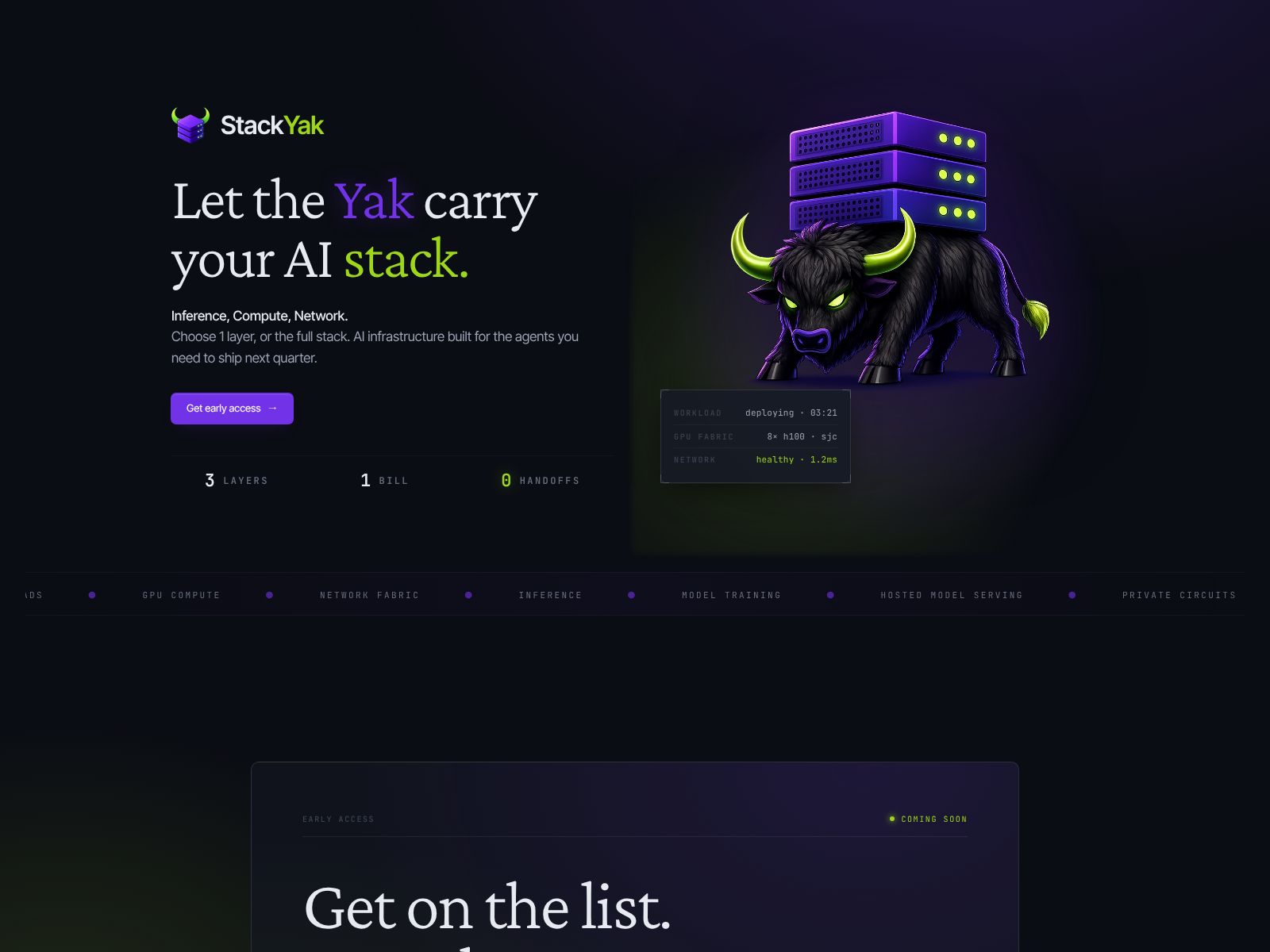
StackYak Review & Overview
If you’re trying to scale AI across your company, you’ve probably felt the pain: finding GPUs, wiring up storage, managing networks, juggling multiple clouds, and keeping everything compliant and cost-efficient. It’s hard, it’s fragmented, and it takes focus away from shipping models and applications. StackYak aims to fix that.
StackYak is a stealth technology company building next-generation AI infrastructure software. While full details are coming at launch, the company’s mission is clear: simplify how you discover, connect, and operate compute, networking, storage, and AI resources across cloud and on‑premises environments. In plain terms, StackYak wants to be the connective tissue that makes enterprise AI infrastructure feel unified, even when it isn’t.
In this review and overview, you’ll learn what StackYak is trying to do, how it could fit into your stack, the features you should expect, and which alternatives you might compare it against. Because StackYak is still in stealth, treat this as a high-level guide based on the company’s public description and common needs in enterprise AI. Specific product details may change at launch. You can follow updates on their website at stackyak.ai.
What does StackYak do?
StackYak helps your team find and connect all your compute, networking, storage, and AI resources—across clouds and data centers—and run workloads on them without the usual complexity. You get a single platform to see what you have, provision what you need, and operate it all consistently. Instead of stitching together tools and scripts for each environment, StackYak promises a simpler way to orchestrate training, fine-tuning, and inference at enterprise scale.
The end goal: reduce operational overhead, improve utilization of expensive GPUs and other accelerators, and make hybrid and multi‑cloud AI practical for real teams in real companies.
StackYak Features?
Since StackYak is in stealth, the following feature set reflects what you can reasonably expect from a platform designed to simplify AI infrastructure across cloud and on‑prem. Consider this a best‑guess preview based on the company’s mission and common enterprise requirements.
- Unified resource discovery – See your compute, networking, and storage assets in one place. That likely includes GPUs and CPUs across clouds, Kubernetes clusters on‑prem, and connections to shared storage. Instead of hunting for capacity, you’d view inventory, health, and availability in a single dashboard or API.
- Cross‑environment orchestration – Run training and inference across mixed environments (public cloud, private data centers, edge) with a consistent workflow. You’d schedule jobs to the best available resources without rewriting code or re‑provisioning every time you switch providers.
- Policy‑driven placement and scheduling – Define rules for where workloads can run (by region, GPU type, data sensitivity, cost limits). The platform would enforce these policies automatically, helping you meet regulatory, latency, and budget constraints while improving utilization.
- Networking made simpler – Expect simplified setup for secure connectivity between clouds and on‑prem resources. This might include automated peering, service discovery, and standardized network policies so your teams don’t have to reinvent networking for each project.
- Storage and data locality controls – Connect to object stores, file systems, and block storage with consistent access patterns. Keep data close to compute for performance, or move workloads to where data already lives to reduce egress costs. This is essential for large training sets and latency‑sensitive inference.
- Templates and automation – Reusable templates for common workloads (training, fine‑tuning, batch inference) with parameters for cluster size, GPU type, and software images. Pair that with automation to spin up and tear down resources on demand so you don’t pay for idle capacity.
- Security and compliance – Enterprise‑grade identity, RBAC, secrets management, and audit logging across environments. You’d expect standardized controls so teams can move faster without bypassing governance, plus isolation for projects and tenants.
- Observability and cost visibility – End‑to‑end metrics, logs, and traces for jobs and infrastructure, plus spend breakdowns by team, project, and model. This helps you tune performance, catch bottlenecks, and control GPU costs as usage grows.
- Open integrations – Flexible connectors for popular clouds (AWS, Azure, GCP), container platforms (Kubernetes), schedulers (possibly Slurm in HPC contexts), IaC tools (Terraform, Pulumi), and ML frameworks. The goal is to fit into your stack, not replace it.
- APIs and developer ergonomics – A clean API, CLI, and SDKs so platform engineering can automate and ML teams can self‑serve. That includes guardrails set by ops with the flexibility developers need to experiment and ship.
Who is StackYak for?
If your AI footprint spans more than one environment—or will soon—StackYak is for you. That includes:
- Platform engineering teams who support data science and ML groups across business units.
- IT and infrastructure teams managing hybrid or multi‑cloud environments with GPUs.
- ML engineers and researchers who need reliable access to accelerators without wrestling with infrastructure every sprint.
- FinOps and security teams who need visibility, control, and compliance without slowing everyone down.
Potential use cases
- Burst training to cloud when on‑prem GPU queues get long, then bring workloads back when capacity frees up.
- Manage an inference fleet across regions and providers with consistent deployment, scaling, and rollback.
- Keep regulated data on‑prem while using cloud GPUs for workloads that can leave the data center.
- Unify monitoring and cost tracking across providers to spot waste and improve utilization.
- Standardize job templates and environments so new teams can onboard quickly and stay compliant.
Pricing and availability
StackYak hasn’t announced pricing yet. Because it’s an enterprise platform, you can expect a model that aligns with usage and value—often a combination of platform subscription and usage‑based metrics (for example, resource hours under management, users, or tiers for features and SLAs). Many vendors in this space also offer private previews, pilots, and enterprise support packages.
If you’re evaluating solutions now, it’s reasonable to ask about:
- How pricing scales with GPU count, environments, and teams.
- Whether there’s a bring‑your‑own‑cloud model versus bundled compute.
- What’s included in base plans (RBAC, logging, API access) and what’s add‑on.
- Support levels, SLAs, and professional services for onboarding and migration.
For the latest on availability and pricing, check the official site: stackyak.ai.
StackYak Top Competitors
Because StackYak focuses on simplifying AI infrastructure across cloud and on‑prem, you’ll likely compare it to a mix of AI resource managers, hybrid cloud platforms, and cloud‑native tooling. None of these are exact substitutes, but they’re the closest categories you’ll weigh as you shape your strategy.
- Run:ai – A popular GPU orchestration and scheduling platform for Kubernetes environments. Great for improving GPU utilization, queuing, and fair‑sharing across teams. If you’re already standardized on K8s for ML, Run:ai is a strong benchmark for GPU scheduling depth.
- Platform9 / Spectro Cloud / Rafay – Managed Kubernetes platforms that simplify multi‑cluster, multi‑cloud operations. They’re strong in day‑2 ops for K8s and can support ML stacks on top. If your main complexity is K8s lifecycle across sites, these are relevant alternatives.
- VMware Tanzu / Red Hat OpenShift – Enterprise Kubernetes platforms with opinionated tooling for security, policy, and lifecycle. Broad ecosystem support. If your company standardizes on these for container workloads, you’ll likely integrate ML workloads here or compare them to a more AI‑native layer like StackYak.
- HashiCorp Terraform and Pulumi – Infrastructure‑as‑code for provisioning cloud and on‑prem resources. Great for repeatable builds, less so for dynamic AI scheduling across heterogeneous resources. Often complementary; you may use IaC beneath a higher‑level AI orchestration layer.
- NVIDIA Base Command Platform and DGX Cloud – NVIDIA’s managed offerings for GPU‑accelerated AI training. Strong vertical integration with NVIDIA hardware and software. If you want a managed NVIDIA‑centric path, you’ll compare this to a more open, multi‑vendor approach.
- CoreWeave / Lambda / Paperspace – GPU cloud providers offering high‑performance infrastructure and ML‑friendly services. These are compute destinations; you’ll compare whether StackYak can unify them alongside your on‑prem data center and hyperscalers.
- Google Anthos / Azure Arc / AWS Outposts & EKS Anywhere – Hybrid solutions from the big clouds. Great when you want a primary anchor with that vendor. If multi‑cloud neutrality and cross‑provider optimization matter, a platform like StackYak could provide a vendor‑agnostic control plane.
- HPC schedulers (Slurm, Altair PBS) – Established in scientific and engineering workloads. Excellent for batch scheduling across large clusters, though less cloud‑native. If your environment is HPC‑heavy, you’ll compare how an AI‑first orchestrator integrates or coexists with these schedulers.
StackYak vs. building it yourself
Some teams try stitching together Terraform, Kubernetes, custom operators, CI/CD, and a patchwork of scripts to manage hybrid AI. This can work, but it takes a lot of effort to keep secure, reliable, and cost‑efficient—and it puts platform engineering in a support loop that scales poorly. StackYak’s promise is to replace that glue with a unified control plane, policies, and templates that make AI infrastructure feel straightforward without losing flexibility.
What we like (based on the mission)
- Clear problem focus – Unifying AI infrastructure across environments is a real, urgent pain for enterprises.
- Vendor‑neutral stance – A neutral control plane gives you leverage and lowers lock‑in.
- Policy‑first thinking – Compliance, cost, and performance constraints should be built into the system, not bolted on later.
- Developer experience – If APIs and templates are first‑class, ML teams can move fast without creating chaos for ops.
What to watch
- Depth of integrations – Success hinges on how well it integrates with your exact clouds, clusters, networks, and storage.
- Scheduling intelligence – Policy‑aware placement is hard. The more complex your constraints, the more you’ll test the scheduler.
- Observability and cost controls – You’ll want robust, granular insights by team, model, and workload, plus automated guardrails.
- Time to value – A platform like this should deliver early wins (e.g., faster provisioning, better GPU utilization) within weeks, not quarters.
How to evaluate StackYak (or any AI infra control plane)
- Fit with your environments – Does it support your primary clouds, on‑prem stack, and networking model today?
- Security and compliance – Can you encode data residency rules, isolation needs, and audit requirements as policies?
- Developer ergonomics – Are there APIs, CLIs, and templates your ML teams will actually use without hand‑holding?
- Scalability and reliability – How does it behave under peak loads, long jobs, and regional failovers?
- Cost and utilization – Can it show measurable gains in GPU utilization and predictable spend within your first quarter?
- Integration overhead – How long to onboard your top workloads and connect to critical systems (identity, logging, storage)?
Example outcomes you should aim for
- Reduce average wait time for GPUs by pooling capacity across sites and clouds.
- Cut idle GPU time with smarter scheduling and automated tear‑downs.
- Enforce placement policies that keep regulated data where it must stay.
- Lower egress fees by moving compute to data or caching strategically.
- Shorten provisioning from days to minutes with templates and self‑service.
Frequently asked questions (based on common buyer concerns)
Is StackYak a cloud provider? No. It’s an infrastructure software platform that helps you operate resources across providers and on‑prem.
Do we need Kubernetes? Many AI stacks run on Kubernetes, and you’ll likely get strong support there. But hybrid AI also involves non‑K8s systems (HPC schedulers, VMs, bare metal). Look for flexible integrations that meet you where you are.
Will it lock us in? The aim appears to be vendor‑neutral control. Ask about data export, open APIs, and how to migrate off if needed.
Can it help with cost? Expect better visibility, policy‑based controls, and higher utilization, which typically reduce spend. Actual savings depend on your baseline and usage patterns.
How does it help ML teams directly? By making compute easier to access and standardizing environments, ML engineers can spend more time on models and less on infrastructure.
Realistic rollout plan
- Pilot scope – Choose 1–2 representative workloads: one training‑heavy, one inference‑heavy. Limit to a few environments first.
- Define success – Set clear metrics: time to provision, GPU utilization, job success rate, cost per training hour, and developer satisfaction.
- Integrate essentials – Identity (SSO/RBAC), logging/monitoring, and storage first. Avoid optional integrations in phase one.
- Codify policies – Placement, quotas, and data locality rules early, so scale doesn’t mean chaos later.
- Iterate and expand – Add more teams and environments once you see clear wins and stable operations.
Where StackYak could shine
- Enterprises with mixed estates: part cloud, part on‑prem, multiple providers.
- Organizations with scarce GPUs and competing teams that need fair access.
- Regulated industries balancing speed with strict compliance rules.
- Companies scaling from pilot projects to dozens of AI workloads and apps.
Where you may want a different approach
- If all your AI runs in a single cloud and you’re happy with native tools, a cloud‑specific solution might be simpler.
- If you have one cluster and one team, a lightweight K8s scheduler or scripts could be enough—for now.
- If your workloads are almost entirely HPC with legacy schedulers, you may prioritize deeper HPC integrations over a new control plane.
Bottom line on positioning
Think of StackYak as a neutral, policy‑aware control layer for AI infrastructure. It’s not trying to replace your clouds or data centers; it’s trying to make them work together seamlessly. If your main challenges are capacity fragmentation, complex networking and storage, and a growing queue of ML teams who need fast, compliant access to compute, StackYak’s approach should be on your shortlist.
Wrapping Up
AI is moving fast, but infrastructure complexity can slow you down. StackYak’s mission—simplifying how you discover, connect, and operate compute, network, storage, and AI resources across cloud and on‑prem—directly targets that friction. While the company is still in stealth and formal product details are coming at launch, the direction is promising for enterprises that want a vendor‑neutral, policy‑driven platform to scale AI without drowning in operational overhead.
If your teams are stitching together scripts, waiting days for GPUs, or struggling with compliance across environments, a platform like StackYak could deliver real gains in speed, utilization, and control. Keep an eye on stackyak.ai for updates, and start mapping a pilot that proves out the outcomes you care about most—faster provisioning, higher GPU utilization, and predictable, compliant operations. That’s what separates AI experimentation from sustainable AI at enterprise scale.