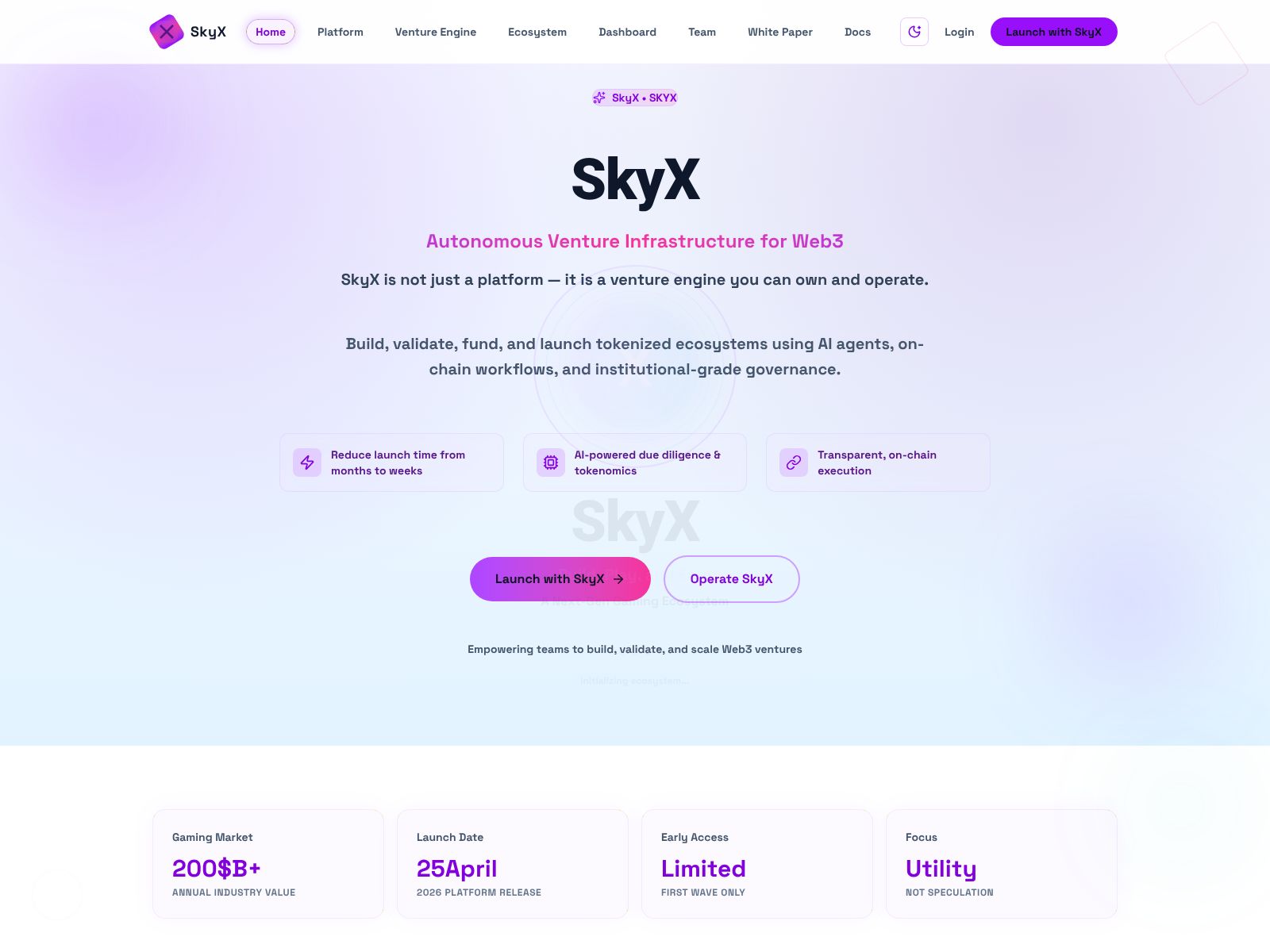
SkyX Review & Overview (Features, Pricing, & Alternatives)
If you’re building a Web3 product, you know how hard it can be to go from idea to launch to real, sustained growth. SkyX steps into that gap with an AI-powered venture platform that helps you validate, launch, and scale — all in one place. In this review, I’ll walk you through what SkyX is, how it works, the features you’ll get, how it compares to alternatives, and where it might best fit into your roadmap. By the end, you should have a clear view of whether SkyX is a good match for your team and your community.
What does SkyX do?
SkyX helps you build, launch, and grow Web3 projects using automation and community participation. You set up tasks, referrals, and incentives, and the platform coordinates user activity so your project can scale faster with less manual work.
Who is SkyX for?
- Founders and product teams who want to test and launch new ideas without building all the growth infrastructure from scratch.
- Growth and operations leads who need structured workflows, automation, and reliable reporting to manage community-driven campaigns.
- Community managers who want a clear system to engage users with quests, tasks, and referral loops.
- Ecosystem operators and partners who need scalable programs for onboarding users and expanding across chains or verticals.
- Contributors and users who want to participate in missions and earn incentives tied to real project milestones.
How SkyX works at a glance
- Define your project and goals: Outline what you’re building, who you’re targeting, and what success looks like (sign-ups, on-chain actions, beta testers, TVL, etc.).
- Set up automated workflows: Use AI-guided steps to design growth flows that connect tasks, referrals, and rewards without a pile of spreadsheets.
- Launch participation programs: Publish quests and campaigns that invite users to take specific actions and invite others.
- Validate and iterate: Use early participation data to validate interest, refine messaging, and decide what to build next.
- Scale with community: Turn validated flows into repeatable systems that your team and power users can run at larger scale.
- Reward and retain: Distribute incentives tied to meaningful activity and keep contributors engaged over time.
SkyX Features
AI-driven workflows and automation
SkyX combines AI guidance with structured automation so your team can build repeatable growth systems. Instead of manually stitching together forms, bots, and tracking sheets, you configure flows that guide users from discovery to action. The AI layer helps reduce guesswork and aligns tasks and incentives with your goals.
Gamified participation: tasks, quests, and referrals
At the heart of SkyX is a participation engine. You can design:
- Task lists and quests for on-chain or off-chain actions (join, test, stake, vote, build, share, etc.).
- Referral loops that reward users who bring in quality participants.
- Incentive paths that escalate engagement (from simple tasks to deeper contributions).
This turns your launch and growth motion into a game that users can understand and enjoy — while still focusing on real outcomes, not vanity metrics.
Project validation and structured launches
Early-stage teams can test hypotheses quickly with pre-built validation flows. You can run a structured waitlist, beta invite, allowlist, or early adopter program with clear rules and checkpoints. As you move from idea to MVP to launch, you keep the same system and simply scale it up instead of rebuilding your processes each time.
Unified growth operations
SkyX is designed to function as a single operating layer for campaigns, user onboarding, and reward tracking. Rather than juggling multiple tools, you manage your activities, measure participation, and scale programs from one place. That reduces hand-offs, makes reporting easier, and helps your team ship faster.
Incentive design and rewards engine
You can create reward structures that match the outcomes you care about. This might include points, roles, access, allowlists, or other incentives defined by your project. The key idea is that incentives are tied to meaningful activity, not just clicks, so you build a healthier and more aligned community over time.
Community-driven growth
SkyX connects your project’s growth to community contributions. Users can participate by completing tasks, referring peers, or taking on higher-impact roles. This drives network effects: as more users get involved, your growth compounds without a linear increase in manual work for your team.
Onboarding efficiency
The platform helps reduce friction in onboarding by guiding users through the right steps at the right time. With clearer flows and feedback, you can convert more curious visitors into active participants — and more active participants into long-term contributors.
Ecosystem expansion
If your goal is to grow across networks, markets, or partner communities, SkyX supports scalable programs that can be cloned, localized, and improved over time. You can align incentives across partners and roll out repeatable playbooks rather than reinventing the wheel for each campaign.
Streamlined execution
Because SkyX is built at the intersection of AI and blockchain infrastructure, it focuses on eliminating the slow, manual parts of traditional incubation and launch processes. You get automation where it matters, community energy where it’s most effective, and structure to keep efforts consistent.
Benefits: Why teams choose SkyX
- Faster time to validation and launch: You move from idea to evidence to launch with fewer tools and less coordination overhead.
- Lower operational complexity: Automation reduces repetitive work and the need to maintain many separate systems.
- Higher-quality community participation: Gamified tasks and referrals attract users who are motivated to contribute meaningfully, not just farm quick rewards.
- Repeatability and scale: Once a playbook works, you can replicate it across cohorts, markets, or partner ecosystems.
- Clearer decision-making: Structured programs surface what’s working so you can double down and cut what isn’t.
- Alignment between incentives and outcomes: Rewards are designed to reinforce the behaviors your project actually needs.
Potential limitations and considerations
- Incentive design matters: If your incentive model isn’t aligned with your goals, you may attract the wrong kind of participation. Be thoughtful and test early.
- Community fatigue risk: Overusing quests or tasks can tire users out. Balance new activities with genuine value, education, and meaningful progression.
- Compliance and regional rules: Depending on your incentives and jurisdictions, you may need legal guidance. Plan your program with compliance in mind.
- Quality control: Referrals can be powerful, but they need guardrails to avoid spam or low-quality sign-ups. Design filters and verification steps.
- Content and support requirements: Even with automation, you still need helpful content, onboarding, and timely support to keep quality high.
- Pricing fit: Make sure the cost structure (see below) matches the stage and scope of your project.
Pricing
SkyX has not publicly disclosed a detailed pricing page at the time of writing. Pricing for platforms like this often depends on factors such as:
- Stage and scale (pilot, growth, enterprise, or ecosystem-level programs)
- Features used (automation depth, advanced workflows, custom incentives)
- Support level (self-serve, managed, or co-piloted launch programs)
- Program volume (number of campaigns, active users, or integrations)
Common models in this category include tiered subscriptions, usage-based pricing, or a mix of platform fees and success-based components. Your best move is to outline your goals and expected volume, then request a quote or a demo so you can match plan options to your roadmap. If you’re comparing to alternatives, include the hidden costs you’d otherwise pay in tooling and manual operations.
SkyX Top Competitors and Alternatives
SkyX spans multiple categories: launchpads/incubation tools, community engagement platforms, and growth operations systems. Here are notable alternatives you might consider, organized by what they focus on.
Launchpads and structured fundraising/launch platforms
- CoinList: Known for token sales and distribution with a strong compliance framework and large audience reach.
- Binance Launchpad: High-visibility token launches on the Binance ecosystem with significant distribution potential.
- Polkastarter: Cross-chain launchpad for token sales and early-stage distribution with community participation.
- DAO Maker: Launch platform with focus on retail access and community involvement.
- Seedify: Growth and launch ecosystem with a strong presence in gaming and metaverse projects.
These platforms are great if your primary need is fundraising and high-profile distribution. They may not offer the same depth of ongoing automation, gamified engagement, or AI-driven workflows for broader growth operations.
Community questing and growth engagement platforms
- Galxe: Credential-based campaigns, quests, and loyalty programs centered around on-chain identity and achievements.
- Zealy (formerly Crew3): Community quests, role progression, and leaderboards for engagement and retention.
- Layer3: Quest-based experiences focused on on-chain actions and ecosystem discovery.
- QuestN: Campaign platform for tasks and quests with multi-chain reach and analytics.
These tools are strong for running campaigns and quests. SkyX overlaps here but aims to connect campaigns to a larger, automated growth system with AI-driven workflows and structured launch/validation support.
Incubators, accelerators, and venture platforms
- Outlier Ventures: Structured programs, mentorship, and network access for Web3 startups.
- Alliance DAO: Accelerator with founder community, resources, and investor access.
- Techstars (Web3 cohorts): Startup acceleration programs with mentorship and curriculum.
These programs provide guidance, network effects, and fundraising support. They are typically cohort-based and relationship-driven. SkyX complements this space with software-driven automation and community-scaled participation rather than mentorship-focused cohorts.
How SkyX differs from alternatives
- Unified growth system vs. point solutions: Many tools handle either launch, quests, or community engagement. SkyX aims to unify validation, launch, and scale within one automated system.
- AI-guided workflows: Instead of manually building every campaign from scratch, SkyX layers AI on top of your growth processes to reduce guesswork and overhead.
- Gamification with structure: SkyX ties tasks, referrals, and incentives to a coherent plan, so your campaigns build toward outcomes that matter.
- Operator-ready: Growth and ops teams can run repeatable playbooks without maintaining a patchwork of bots and spreadsheets.
- Ecosystem scaling: If you’re expanding across networks or partners, SkyX supports cloning and localizing successful programs.
Use cases and example playbooks
1) Validate a new DeFi product
You have an MVP for a DeFi protocol and need clear signal before a broader launch. In SkyX, you set up a waitlist with targeted tasks (join the community, try the testnet, provide feedback, refer peers with relevant wallets). You define incentives for quality feedback and verified activity. Within days, you can see where interest is strongest, refine messaging, and identify power users who can help seed the next phase. As you move into mainnet, you carry the same structure forward and scale participation.
2) Launch and grow a Web3 game
Your studio wants to onboard early players, encourage content creation, and test core loops. Using SkyX, you launch season-based quests with clear progression. Players complete tasks (try a build, submit clips, invite friends), earn rewards, and unlock access to private playtests. You track which quests lead to retention and which creators bring the highest-quality players. Over time, you turn the best flows into go-to-market playbooks for new releases and seasons.
3) Expand an L2 ecosystem
You operate growth for an L2 and need to onboard developers and end users across multiple partner apps. In SkyX, you clone a proven onboarding program across partners, localize the content, and use referrals to empower ambassadors. You standardize incentives so contributions are comparable across projects. Analytics help you spot which steps move the needle in each region, and you continue to refine while programs run in parallel.
How to evaluate SkyX for your team
If you’re considering SkyX, walk through this quick checklist to see if it aligns with your needs:
- Goals and metrics: Define what success looks like (early testers, on-chain actions, retention, liquidity, partnerships) and how you’ll measure it.
- Incentive design: Draft an incentive map tied to real outcomes. Avoid rewarding low-signal activity. Plan anti-spam and quality filters.
- Compliance: Confirm your program is appropriate for your jurisdictions and user base. Get legal input where needed.
- Content pipeline: Prepare educational content, FAQs, and support guides to reduce confusion and drop-off.
- Operations: Decide who owns campaign setup, monitoring, and iteration. Assign a clear point person.
- Budget and pricing fit: Estimate your program volume and desired features, then request pricing that matches your stage.
- Timeline: Outline a 4–8 week pilot with clear milestones so you can evaluate impact quickly.
Best practices for success on SkyX
- Start small, measure, and scale: Launch a focused pilot, capture signal, and only then expand to larger cohorts.
- Reward outcomes, not clicks: Align incentives with the behaviors that matter for your roadmap, product, and market.
- Design meaningful progression: Give users a sense of growth and purpose — not just a to-do list.
- Use referrals with guardrails: Encourage invites, but implement verification to keep quality high.
- Communicate clearly: Explain why each task exists, what users gain, and how their contributions help the project.
- Iterate fast: Use the data to refine steps, incentives, and messaging every cycle.
Implementation timeline (sample)
- Week 1: Define goals, success metrics, and incentive map. Prepare content and support assets.
- Week 2: Configure initial workflows and tasks in SkyX. Soft-launch with a small cohort.
- Week 3–4: Validate assumptions, adjust messaging, and tune incentives. Introduce referrals.
- Week 5–6: Scale to broader audiences and partners. Add more advanced quests tied to higher-value actions.
- Week 7–8: Consolidate learnings into a repeatable playbook. Plan the next phase (e.g., regional rollout, ecosystem expansion).
What teams like most about SkyX
- It reduces tool sprawl by combining multiple growth functions into a single system.
- It provides structure for programs that often start messy and unscalable.
- It connects community energy to real product and business milestones.
- It makes experimentation easier, so teams can discover what works faster.
What to watch out for
- Avoid over-gamification: Keep the focus on meaningful contributions and long-term engagement.
- Don’t skip onboarding education: Users need context to complete tasks correctly.
- Plan for support: Even great automation benefits from responsive human support.
- Keep transparency high: Be clear about reward criteria, timelines, and decision-making.
Who should not use SkyX?
- Teams that don’t plan to engage a community or rely on user participation.
- Projects that already have a well-oiled, custom-built growth stack and prefer full in-house ownership.
- Products that need heavy, bespoke integrations but have no bandwidth to collaborate on setup.
Who is a great fit for SkyX?
- New projects that want to validate quickly and build momentum without engineering a custom growth engine.
- Growing teams ready to scale community-driven programs in a structured way.
- Ecosystem operators coordinating multiple partners with repeatable playbooks.
Frequently asked questions
Does SkyX require a token to work?
No. While many Web3 projects use tokens for incentives, SkyX can support a variety of reward types and participation models. Choose incentives that best fit your stage and goals.
Can SkyX replace my current quest platform or CRM?
It depends. If your main need is simple quests, a quest-specific tool may suffice. If you want an end-to-end system that ties validation, launch, and scale together with automation, SkyX is designed for that broader scope. For CRM, you may still keep your customer systems and use SkyX alongside them.
How technical is the setup?
SkyX focuses on structured automation and guided workflows, so setup is designed to be approachable. Complexity depends on your goals and any integrations you need. A short pilot is a good way to test fit without heavy lift.
What results should we expect?
Results vary by project and market. Teams typically use SkyX to shorten validation cycles, improve onboarding conversion, and scale community programs with less manual effort. The biggest gains come from aligning incentives with real outcomes and iterating quickly based on data.
Final verdict: Is SkyX worth it?
If your roadmap depends on community-driven growth and you’re tired of stitching together point solutions, SkyX is worth a close look. It combines AI-driven workflows, gamified participation, and structured launch systems into one platform. That combination can help you validate faster, run cleaner launches, and scale with less operational drag.
Like any growth platform, it’s not magic. You still need clear goals, thoughtful incentives, quality content, and attentive support. But if you bring those pieces, SkyX gives you an operating system to run them at scale — and to learn what works as you grow.
Wrapping Up
SkyX positions itself as an AI-powered Web3 venture platform that helps you build, launch, and scale with structured automation and community energy. You design tasks, referrals, and incentives; SkyX turns them into workflows that users can actually follow — and that your team can measure and repeat.
If you’re weighing alternatives, consider whether you need a single campaign tool or a broader operating system. Launchpads offer reach and fundraising; quest tools offer engagement; accelerators offer mentorship and network. SkyX aims to unify the parts you’ll use every day so you can move faster and keep quality high.
Next steps: outline your goals, draft your incentive map, and plan a short pilot. Then request a demo and see how SkyX can fit your stack and your stage. For the latest details and to get started, visit the official site at skyx.finance.