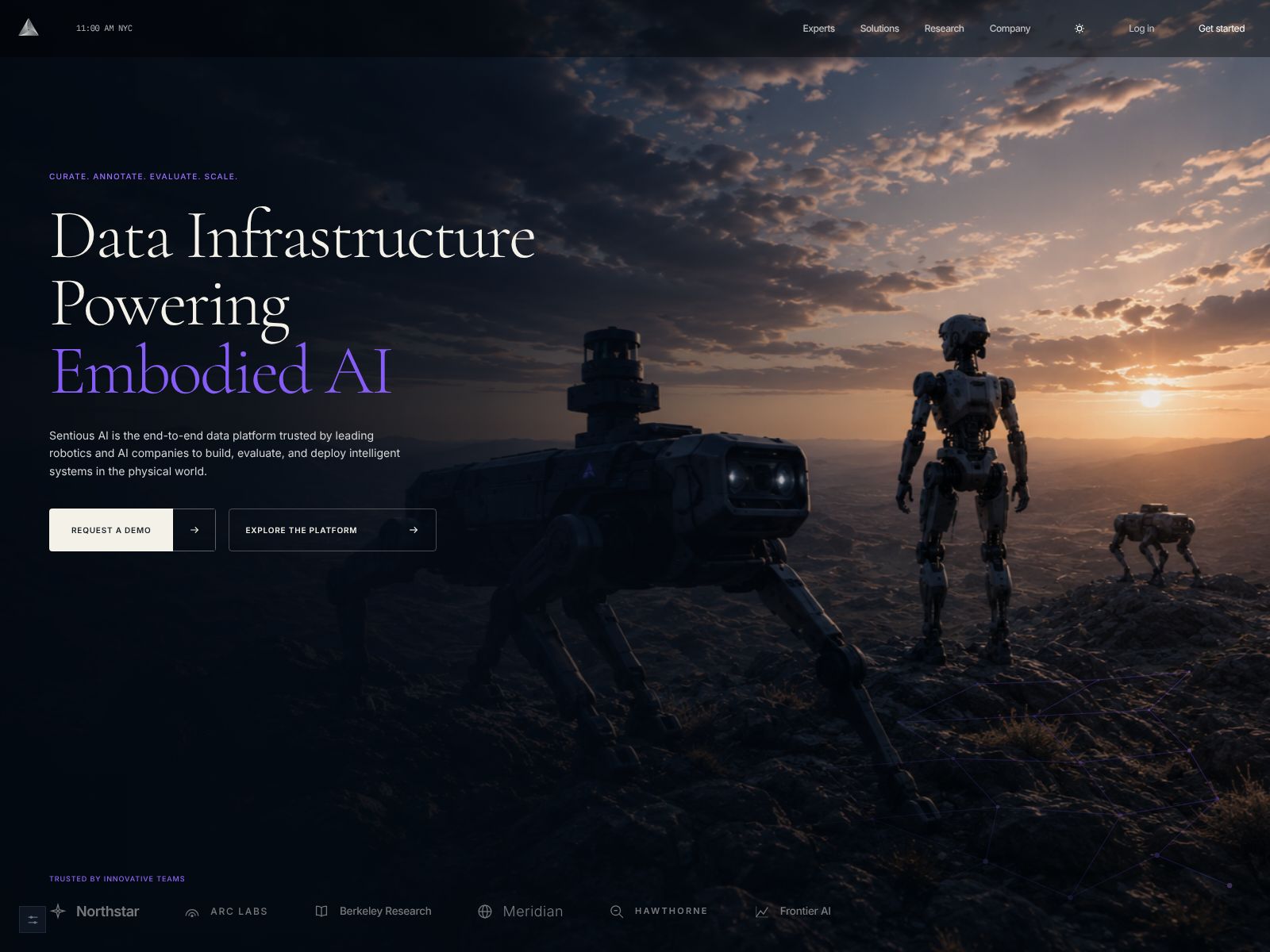
Sentious AI Review (Features, Pricing, & Alternatives)
If your robots are getting smarter but your data is getting messier, you’re not alone. Modern robotics teams collect an enormous amount of sensor data, logs, and video every day. Turning that stream into reliable, production-grade intelligence is hard. That’s where Sentious AI comes in.
In this review, I’ll walk you through what Sentious AI is, why it matters, the features to expect from a robotics data infrastructure platform, how pricing typically works in this category, and your top alternatives. My goal is to help you decide if Sentious AI is a practical fit for your team’s workflow, budget, and roadmap.
What does Sentious AI do?
Sentious AI helps robotics teams capture, organize, label, and use robot data so you can build, train, and ship better robot behaviors faster.
Who is Sentious AI for?
- Startups building their first robotics data pipeline and looking for an end-to-end foundation that doesn’t require a large infra team.
- Growing robotics companies that need consistent datasets, faster labeling cycles, and smooth handoffs from data to model to deployment.
- Enterprise robotics and autonomy programs with strict governance, compliance needs, and a mix of on-prem and cloud infrastructure.
Why does a robotics data platform matter?
Robotics data is big, messy, and multimodal. A single run might include camera frames, LiDAR point clouds, IMU/odometry, audio, logs, and operator notes. Without a solid data backbone, your team spends more time fixing data than improving robots. Common problems include:
- Scattered storage and naming chaos that makes runs hard to find or trust.
- Inconsistent labeling quality, duplicated effort, and slow review cycles.
- Fragile scripts to cobble together datasets for training or regression testing.
- Poor traceability from deployed model back to data versions and decisions.
- Struggles to reproduce results or answer “what changed?” after a field failure.
A robotics data infrastructure platform like Sentious AI aims to give you a single, reliable spine that connects data collection, curation, model development, and operations—so you can iterate faster with fewer surprises.
Sentious AI Features
Sentious AI positions itself as “Robotics Data Infrastructure.” While specific details can evolve, here are the core capabilities you can reasonably expect from a purpose-built platform in this category. Use this as a practical checklist to evaluate fit for your needs.
1) Unified data ingestion and logging
- Capture data from robots, simulators, and test rigs into one place.
- Support for common robotics formats and time-synced streams (for example, camera + LiDAR + IMU + logs).
- Edge-friendly upload with resume support for unreliable networks.
- Automatic metadata extraction (location, firmware version, run ID, operator, scenario tags, etc.).
Why it matters: If ingestion is clunky, everything downstream slows down. A good system makes it trivial for your team to get data in quickly and consistently.
2) Smart organization, search, and filtering
- Project- and robot-level organization to reflect your product lines and fleets.
- Granular tagging so you can find “nighttime, wet ground, crosswalk, pedestrian present” in seconds.
- Advanced search: filter by sensors, environments, labels, outcomes, or time windows.
- Saved queries to standardize how teams pull “golden” or “edge case” data.
Why it matters: The faster you can find the right 0.1% of data, the faster you can fix real problems.
3) Labeling, review, and QA workflows
- Annotation tools across modalities (e.g., 2D/3D bounding boxes, segmentation, keypoints, and event tagging).
- Built-in quality checks, consensus or sampling review, and inter-annotator agreement metrics.
- Labeling roles and permissions for internal teams and external vendors.
- Configurable guidelines and templates to reduce ambiguity and rework.
Why it matters: Consistent labels are the backbone of reliable models. Good QA reduces downstream bugs and costly retraining cycles.
4) Dataset versioning and governance
- Immutable dataset versions with full lineage: know exactly which files and labels were included.
- Reproducible “slices” (e.g., “rainy urban intersections v3”) for training, benchmarking, or regression tests.
- Compare datasets to quantify drift and coverage across conditions and classes.
- Audit trails and approvals for regulated environments.
Why it matters: If you can’t trace the model to its data, you can’t debug it or satisfy compliance teams.
5) Model development integration and MLOps handoff
- Export datasets to your training stack (PyTorch, TensorFlow, JAX) with well-defined schemas.
- Track experiments, metrics, and artifacts tied to dataset versions and code commits.
- Automate recurring pipelines (e.g., nightly retrains from fresh data slices).
- Connect model outputs back to real-world performance dashboards.
Why it matters: Smooth handoffs reduce bottlenecks between data, research, and deployment teams.
6) Telemetry and field feedback loops
- Monitor robot runs, flag anomalies, and pipe “interesting” events back into the data pool.
- Create feedback loops to auto-surface failure modes and rare edge cases.
- Close the loop with targeted data collection missions based on gaps in coverage.
Why it matters: A living robotics system depends on continuous learning from the field—without drowning your team in noise.
7) Simulation and synthetic data support
- Ingest and manage simulation runs alongside real-world data for apples-to-apples analysis.
- Tag sim-generated frames and scenarios clearly to avoid contamination.
- Blend simulated and real data in controlled ratios for training or stress tests.
Why it matters: Simulation helps you scale rare or risky scenarios safely. Managing it side-by-side with real data is key.
8) Integrations and deployment options
- APIs and SDKs so you can automate workflows and plug into your internal tools.
- Connectors for cloud object storage and on-prem environments.
- Single sign-on, RBAC, and enterprise security controls.
Why it matters: A platform that plays nicely with your stack will get adopted faster and cause fewer headaches for IT.
9) Security, privacy, and compliance
- Encryption in transit and at rest, plus fine-grained access controls.
- Data residency options and audit logs.
- Support for industry-standard security reviews and compliance needs.
Why it matters: Robotics data often includes sensitive environments and IP. You need to protect it from day one.
10) Support, onboarding, and success
- Hands-on onboarding to map your workflows and data types.
- Training for ops, ML, and QA teams.
- Responsive support and regular platform updates.
Why it matters: The right platform plus the right onboarding can save months of trial-and-error.
Pricing: what to expect
As of writing, Sentious AI does not publicly list detailed pricing on its homepage. That’s common in this category, because costs can vary based on data volume, number of seats, deployment choices (cloud vs. on-prem), and support tiers. Here’s how pricing typically works for robotics data infrastructure solutions:
- Core platform subscription: Usually a base fee that includes a certain number of users, projects, and features.
- Usage-based components: Storage, data transfer, and compute (for processing, previewing, or synthetic generation) often scale with your usage.
- Seats and roles: Viewer, annotator, and admin seats may be priced differently.
- Enterprise add-ons: SSO, advanced security, dedicated support, or on-prem deployments may incur extra fees.
- Professional services: Onboarding, data migration, or custom integrations can be packaged as one-time or ongoing services.
How to estimate your costs:
- Quantify your raw data rate: How many hours of runs per week? What sensors? Expected GB/TB per month?
- Define annotation scope: Which modalities, what label types, and expected throughput?
- Map your user roles: How many engineers, labelers, reviewers, operators?
- Decide on deployment: Cloud, on-prem, or hybrid. Factor in your internal infra costs if on-prem.
- Plan for growth: Add a buffer for bursts during big field tests or product launches.
Recommendation: Ask Sentious AI for a tailored quote and a proof-of-value plan that projects cost against the time saved and the quality improvements you expect across your pipeline.
Pros and cons to consider
Every platform is a set of trade-offs. Here’s a balanced view to help you decide.
Where Sentious AI is likely strong
- Purpose-built for robotics data rather than generic MLOps, which tends to reduce friction with multimodal streams.
- Emphasis on end-to-end flow from capture to training to operations, not just a single stage like labeling.
- Focus on governance and versioning that helps you move faster without losing control.
Potential limitations or watch-outs
- Platform fit: If your team only needs a lightweight vision dataset tool, a specialized point solution might be cheaper.
- Change management: Centralizing data and workflows will require some process shifts; plan onboarding time.
- Integration depth: Confirm support for your specific sensors, file formats, and internal data lakes before committing.
Sentious AI Top Competitors
If you’re evaluating Sentious AI, it helps to compare it with adjacent tools in robotics and data operations. Here are top options to consider, each with a slightly different focus.
Formant
What it is: A robotics data platform focused on fleet telemetry, remote operations, and observability. Great for monitoring, alerting, and managing robots in the field.
When to choose: You need strong fleet ops, dashboards, and teleoperation features with data flowing back to your ML loop.
Trade-off: You may still want a dedicated dataset and labeling solution for deep ML workflows.
formant.io
Foxglove
What it is: Tools for visualizing and debugging robotics data (e.g., ROS bags, point clouds, and time-synced streams).
When to choose: Your priority is interactive visualization and debugging, integrated with your pipelines.
Trade-off: You’ll pair it with a separate system for dataset management and labeling.
foxglove.dev
Viam
What it is: A general-purpose robotics software platform with cloud connectivity, device management, and data services.
When to choose: You want a broader robotics stack with data features and device orchestration.
Trade-off: For specialized dataset governance or complex labeling, you may need add-ons.
viam.com
Roboflow
What it is: Vision-focused dataset management, labeling, and model deployment for images and video.
When to choose: Your workload is primarily 2D vision and you want a polished, fast labeling and training loop.
Trade-off: Less emphasis on multimodal robotics data (e.g., LiDAR + IMU) compared to a robotics-first platform.
roboflow.com
Labelbox
What it is: Enterprise-grade data labeling and dataset management across multiple modalities.
When to choose: You need a robust labeling operation with vendor management and QA at scale.
Trade-off: Robotics-specific telemetry, ingestion, and time-sync workflows may require custom work.
labelbox.com
Scale AI (Nucleus)
What it is: Data curation, labeling, and analytics for ML datasets, with services for annotation at scale.
When to choose: You want managed labeling services and strong dataset curation tooling.
Trade-off: Robotics-focused ingestion and multimodal time alignment may require additional components.
scale.com
Edge Impulse
What it is: End-to-end ML for embedded and edge devices, including data collection and model deployment.
When to choose: Your robotics use cases run on constrained edge hardware and you need tooling optimized for it.
Trade-off: For large-scale fleet telemetry or complex 3D data, you may need a dedicated robotics data layer.
edgeimpulse.com
AWS RoboMaker and cloud primitives
What it is: Simulation and cloud building blocks (storage, compute, orchestration) you can stitch together.
When to choose: You have a platform team to assemble and maintain a custom stack with fine-grained control.
Trade-off: More engineering effort and longer time-to-value compared to a turnkey robotics data platform.
aws.amazon.com/robomaker
How to choose: a quick evaluation checklist
Use this checklist to run a fair, apples-to-apples comparison for Sentious AI and alternatives:
- Data types: Does it support all your sensors and formats (e.g., multi-camera, LiDAR, radar, audio, logs)?
- Time sync: Can it reliably align multimodal streams and keep that alignment through labeling?
- Search and curation: Can you easily find and slice the 1–5% of data that drives model improvement?
- Labeling depth: Are the annotation tools and QA workflows strong for your modalities and classes?
- Versioning and governance: Can you reproduce any dataset or model lineage under audit?
- Automation: Are there APIs/SDKs to script ingestion, slicing, labeling, and export?
- Integrations: Does it plug into your training stack, storage, and CI/CD?
- Security: Does it meet your security, privacy, and residency requirements?
- Deployment: Can you run it the way you need (cloud, on-prem, or hybrid)?
- Performance: Does the UI remain fast with TB-scale projects and many concurrent users?
- Support: Will you get responsive help, onboarding, and roadmap alignment?
- Total cost: Do you understand the base fee, usage fees, and expected growth over 12–24 months?
Implementation tips
If you decide to pilot Sentious AI or any similar platform, here’s how to maximize impact:
- Start with a clear problem: Pick a single, painful loop (e.g., finding and labeling nighttime pedestrian near-misses) and measure current cycle time.
- Define your “golden datasets”: Agree on minimum coverage for key scenarios and create named slices to standardize conversation across teams.
- Labeling guidelines: Write short, unambiguous labeling rules and set up QA upfront to avoid costly rework later.
- Automate early: Use the API/SDK to script ingestion and exports so you don’t depend on manual steps.
- Close the loop: Connect field telemetry to auto-surface edge cases back into curation, and track time-to-fix.
- Review monthly: Track metrics like time to first label, dataset assembly time, labeling QA pass rate, and model performance uplift.
Common questions
Is Sentious AI only for autonomy or self-driving?
No. Robotics data infrastructure applies to many domains: logistics robots, drones, warehouse automation, agriculture, inspection, and more.
Do I need this if I already use cloud storage and notebooks?
Maybe not—if your data volumes and team are small. But as soon as you juggle mixed sensors, multiple labelers, and reproducibility requirements, a dedicated platform saves time and reduces risk.
Can I keep my current training stack?
In most cases, yes. The idea is to centralize and clean up your data pipeline, then export clean datasets to your existing training flow.
What about on-prem requirements?
Many robotics teams need on-prem or hybrid. Confirm deployment options early to avoid surprises with IT and security.
Who should seriously consider Sentious AI?
- You have growing multimodal datasets and can’t reliably find, slice, and version them today.
- You run regular labeling cycles and want to boost throughput and consistency.
- You need clear lineage from model to data for audits, debugging, or safety cases.
- Your fleet is generating valuable edge cases you’re not capturing effectively.
Where a simpler tool might be enough
- You only need basic image annotation for a small model and don’t expect to scale soon.
- Your data is single-modality and neatly managed, and you already have robust MLOps.
- Budget is tight and the team can tolerate manual processes while the product matures.
How Sentious AI differentiates
Based on its focus on “Robotics Data Infrastructure,” Sentious AI’s likely strengths are:
- Multimodal-first design, acknowledging robotics complexity from day one.
- End-to-end visibility so you can make data, labeling, and model decisions in one place.
- Governance and reproducibility features that help you move fast without losing control.
If those are your top pain points, it’s worth putting Sentious AI on your shortlist.
Getting started
- Map one end-to-end workflow you want to improve (e.g., from field failure to retrained model).
- Request a demo and share your specific data types, volumes, and success metrics.
- Run a 2–4 week pilot with real runs, labels, and a small team across roles.
- Compare before/after metrics: time-to-slice, labeling QA pass rate, retrain cycle time, and model lift.
- Plan rollout, including integrations, change management, and training.
Reach out at sentious.ai to explore current capabilities and deployment options.
Wrapping Up
Robotics success is just as much a data problem as it is a control or perception problem. If your team spends more time wrangling data than building great behavior, a dedicated platform can make a dramatic difference.
Sentious AI focuses on the backbone every robotics team needs: capture, organize, label, and ship with confidence. It’s designed to handle multimodal complexity, improve labeling quality, and keep your datasets reproducible as you scale. Pricing is usually tailored, so you’ll want a quote based on your volumes and deployment.
Before you decide, compare it against tools like Formant, Foxglove, Viam, Roboflow, Labelbox, and Scale AI, and be honest about your must-haves. Use the evaluation checklist above to drive a focused pilot. If Sentious AI aligns with your data types, governance needs, and growth plans, it can become the central nervous system of your robotics data pipeline—freeing your team to ship better robots, faster.