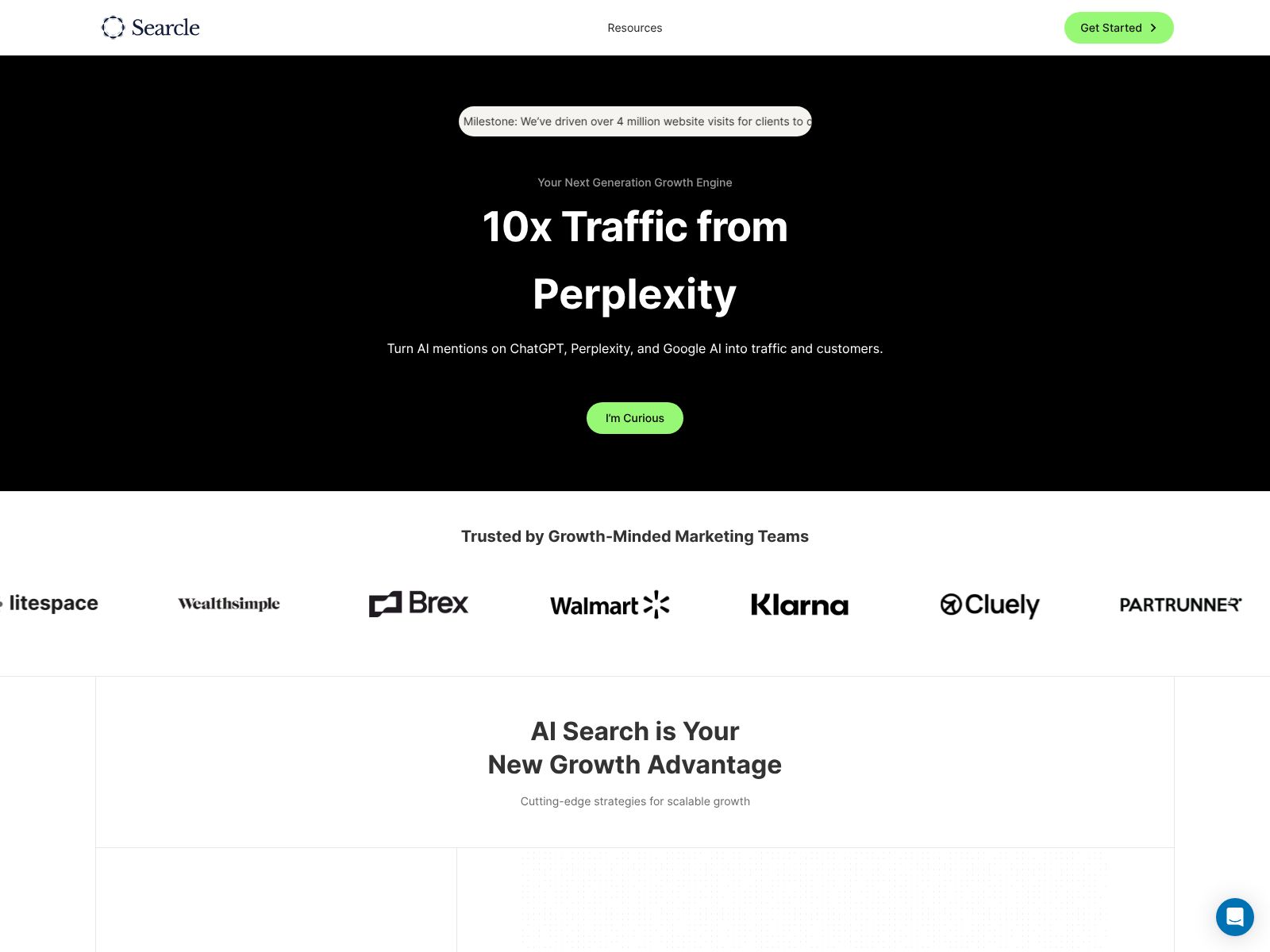
Searcle AI Review & Overview (Features, Pricing, & Alternatives)
If you’ve felt the ground shifting under your marketing strategy lately, you’re not alone. Search is no longer just a list of links. People now discover information through AI answers, chat-style interfaces, and aggregated summaries across the web. That’s changing what wins attention, how content is structured, and how teams measure impact. Searcle AI steps into this moment with a clear promise: build AI-native marketing infrastructure so your company can adapt, stay discoverable, and keep growing in a world where machines increasingly decide what humans see first.
In this review and overview, we’ll break down what Searcle AI does in plain English, what features you can expect from a platform in this category, who it’s best for, what to consider about pricing, how it compares to leading alternatives, and how to decide if it’s the right fit for your team. If you want to learn more straight from the source, visit the company at searcle.ai.
What does Searcle AI do?
Searcle AI builds AI-native marketing infrastructure that helps companies adapt to changes in how information is discovered online. In practical terms, that means helping you plan, create, structure, optimize, and measure content so it shows up in AI-driven experiences (like answer engines and generative search), not just traditional search results.
Why this shift in discovery matters
For years, marketing teams centered content around ranking on standard search results. Today, discovery happens in more places and more formats. People ask conversational questions. They get instant answers in search results. They use AI tools and assistants to compare options, summarize sites, and extract insights quickly. Less traffic clicks through, and the content that wins tends to be structured, trustworthy, and easy for machines to digest.
That change affects every layer of your marketing operation:
- Strategy: Topic selection now hinges on how AI systems interpret entities, relationships, and user intent — not just keywords.
- Content: Winning content speaks clearly to users and to machines. It’s organized, consistent, and backed by trustworthy signals.
- Optimization: Structured data, schema, and canonical relationships matter more. So does aligning content with “answerable” formats.
- Measurement: Traditional rankings and traffic are only part of the picture. You also need to see how often you’re referenced, summarized, or cited across AI experiences.
Searcle AI focuses on this new reality. Rather than bolt AI features onto old workflows, it positions itself as infrastructure built for how discovery works now — and where it’s going next.
Searcle AI features
Because Searcle AI describes itself as “AI-native marketing infrastructure,” think beyond a single tool. Expect a connected set of capabilities that help you operate across research, content, optimization, and analytics. Exact features and names change over time, so use this as a lens for evaluating the platform and confirm specifics with the Searcle AI team.
Strategy and research for AI-era discovery
Traditional keyword lists alone won’t carry you in AI-driven results. You need a richer model of your topics, entities (people, products, brands, concepts), and the relationships between them. Platforms in this space typically help you:
- Map the topics and entities that matter in your category, including gaps in your current coverage.
- Prioritize opportunities based on audience intent, business value, and likelihood of surfacing in AI answers.
- Discover questions, comparisons, and “jobs-to-be-done” that AI and users care about most.
- Standardize definitions, glossaries, and canonical sources your team can reuse across channels.
Why it matters: The more clearly your content reflects real-world entities and relationships, the easier it is for AI systems to understand and cite your work.
Content operations and creation
Winning in the new discovery landscape is about consistent, high-quality execution at scale. Expect Searcle AI to emphasize:
- Content briefs and templates aligned to user questions and machine-readable structure.
- Workflows for subject matter review, fact-checking, and brand voice consistency.
- Support for multi-format assets (articles, guides, product docs, how-tos) tailored for both humans and machines.
- Guidance to include sources, evidence, and clear attributions that strengthen trust signals.
Many teams also look for AI-assisted drafting, style suggestions, and batch updates to keep large content libraries fresh and aligned to current guidelines. If your org has strict compliance or regulatory requirements, examine how the platform handles approvals and audit trails.
Optimization for AI answers and generative search
AI systems tend to surface content that’s structured, unambiguous, and easy to quote. Platforms like Searcle AI often support:
- Structured data and schema guidance to help machines understand your content.
- Answer-friendly formatting (definitions, steps, pros/cons, comparisons) that aligns with how questions get resolved.
- Canonical entity pages and internal linking models that reinforce expertise and topical depth.
- Recommendations to reduce duplication, close content gaps, and consolidate overlapping pages.
The goal is not to “game” AI but to make your expertise legible to it. You still need substance and originality; structure simply helps that substance get recognized.
Measurement and analytics for AI-era visibility
One of the hardest problems today is measurement. Even when AI systems paraphrase your content or cite your brand, you may not see a click or a conventional impression. A platform built for this shift tends to offer:
- Visibility tracking across different discovery surfaces, not just classic search rankings.
- Signals that indicate when your content is likely powering an answer or being referenced.
- Attribution models that blend traffic, engagement, and assisted influence on downstream conversion.
- Testing and experimentation tools so you can learn what structural changes move the needle.
Expect dashboards that focus less on vanity metrics and more on outcome-linked indicators: qualified sessions, conversion contribution, and the presence of your brand in AI-driven results.
Integrations, data, and interoperability
Marketing infrastructure doesn’t live in a vacuum. To get full value, you’ll want clean data in and actionable data out. Platforms like Searcle AI typically support:
- Connections to analytics suites, content management systems, and data warehouses.
- Import/export of taxonomies, glossaries, and content catalogs.
- APIs or connectors that let you automate workflows and sync insights with your stack.
- Permissions and roles aligned with how larger teams work across regions and business units.
Ask about your exact tools (CMS, DAM, analytics, BI, collaboration) and what’s native versus custom—this can influence implementation timelines and cost.
Governance, trust, and security
As AI touches more of your content pipeline, governance is non-negotiable. Enterprise teams will care about:
- Source-of-truth controls and version history for definitions, claims, and copy.
- Brand voice systems and guardrails that keep outputs on-message.
- User management, SSO, audit logs, and role-based access.
- Data handling policies, privacy posture, and compliance with relevant frameworks.
If you operate in regulated industries, add regulatory review flows and content provenance to your checklist.
Who Searcle AI is best for
Searcle AI is aimed at teams that need to operationalize AI-era discovery at scale. If you recognize yourself in one of these, it’s worth a closer look:
- In-house SEO and content leaders facing declining click-throughs from traditional search and looking to future-proof strategy.
- Growth and product marketing teams who need consistent, high-quality content mapped to customer questions across the journey.
- Enterprises with large content libraries and complex governance who need standardization and reliable workflows.
- Brands competing in fast-moving categories where “being the best answer” is a strategic edge.
Smaller teams can benefit too, especially if you handle high-stakes topics (finance, health, legal, B2B software) where trust and structure matter. The main question is whether you’ll use the breadth of capabilities an infrastructure platform provides, versus a lighter-weight tool for a single job.
Getting started and implementation
Implementation for platforms like Searcle AI can vary, but the path often looks like this:
- Discovery and mapping: Align on goals, audiences, and the topics and entities that define your category.
- Data connections: Hook up analytics, content systems, and any relevant data sources.
- Content audit and modeling: Inventory your existing content, tag it, and build or refine your taxonomy and glossary.
- Pilot projects: Run focused initiatives (e.g., a key product area) to test workflows and measure early gains.
- Scale-up: Roll out standardized briefs, templates, and optimization practices across teams and regions.
- Ongoing measurement: Monitor visibility across AI-driven surfaces, iterate, and expand what works.
The biggest success factor is change management: getting content, SEO, product, and brand teams rowing in the same direction. If you can pair Searcle AI with internal champions, clear governance, and a bias for experimentation, you’ll move faster and learn more.
Searcle AI pricing
As of this writing, Searcle AI doesn’t publish detailed pricing on its website. That’s common for enterprise platforms where scope and integrations drive cost. Expect pricing to reflect:
- Number of users and teams.
- Volume of content or domains managed.
- Data integrations, API usage, and customization.
- Implementation and onboarding support.
Your best next step is to request a demo and a tailored quote directly from Searcle AI at searcle.ai. If you’re comparing vendors, ask each to price the same pilot scope so you can make an apples-to-apples decision.
Pros and cons to consider
Every platform choice involves trade-offs. Here’s a balanced view to help you think it through:
- Pros
- AI-native approach focused on how discovery works now, not a bolt-on to older SEO tools.
- Emphasis on structure, entities, and measurement that aligns with AI answers and summaries.
- End-to-end thinking across research, content ops, optimization, and analytics.
- Potential to unify teams around shared definitions, templates, and visibility metrics.
- Cons
- Broader infrastructure can be more to implement than a point solution.
- Requires change management and cross-team buy-in to realize full value.
- Enterprise pricing may be higher than single-purpose tools.
- Measurement in AI surfaces is still evolving across the industry; expect ongoing iteration.
Searcle AI top competitors and alternatives
No two platforms are identical, but you’ll likely compare Searcle AI with a mix of AI content platforms, SEO suites, and enterprise discovery tools. Here are notable alternatives to consider, along with where they tend to shine. Always verify current capabilities and pricing.
- BrightEdge
- Enterprise SEO platform with strong data, automation, and AI-assisted features. Good for large organizations that need mature SEO workflows, dashboards, and governance.
- Conductor
- Enterprise SEO and content platform focused on collaboration and insights. Strong for teams that want integrated research, content guidance, and reporting.
- Botify
- Technical SEO and crawling platform known for site analysis at scale. Ideal if your primary need is deep crawling, indexing diagnostics, and performance optimization.
- Lumar (formerly Deepcrawl)
- Website intelligence and technical SEO platform. Strong for continuous monitoring, governance, and site health across large sites.
- Semrush
- Broad marketing suite with SEO, content, and competitive research. Good for teams that want a versatile toolset and public pricing tiers.
- Ahrefs
- Backlink, keyword, and competitive analysis powerhouse. Useful for research and monitoring, often paired with other content ops tools.
- MarketMuse
- AI-assisted content planning and optimization. Helpful for topic modeling, content briefs, and identifying gaps in your topical coverage.
- Clearscope
- Content optimization tool focused on readability and relevance. Well-liked by writers and editors for improving on-page quality.
- Surfer
- Content optimization and SERP analysis. Popular with teams that want prescriptive on-page guidance and templates.
- Writer
- Enterprise AI writing platform with brand voice, governance, and workflow controls. Useful if you need strong compliance and style systems.
- Jasper
- AI content platform geared toward marketing outputs. Good for teams focused on scaling campaigns and creative with templates and collaboration.
- Yext
- Search and answers technology for on-site experiences and structured content. Helpful if you want to power your own answer engine and improve site search.
- Coveo
- AI-powered search and recommendations, especially for enterprise and eCommerce. Strong for on-site discovery and knowledge management.
How Searcle AI differs: Its core emphasis is on “AI-native marketing infrastructure” designed to align your entire content and measurement engine with AI-driven discovery. Some competitors specialize more in technical SEO, others in writing assistance, and others in on-site search. Your best choice depends on where your current gaps are: strategy modeling, content ops, technical structure, or measurement.
How to evaluate Searcle AI for your team
Use these questions to guide a live demo and trial:
- Strategy fit: Can the platform model our key entities, topics, and definitions? How do we maintain them over time?
- Workflow fit: Do the briefs, templates, and approvals match how we actually work across teams and regions?
- Optimization impact: How does it help us structure content for AI answers without sacrificing voice and depth?
- Measurement: What signals indicate visibility in AI-driven results? How do we connect those signals to business outcomes?
- Integrations: What’s native versus custom for our CMS, analytics, and data warehouse?
- Scale and governance: How are roles, permissions, and audits handled? Does it support our compliance needs?
- Time to value: What does a 90-day pilot look like, and what success metrics should we expect?
- Total cost: Beyond licenses, what will we invest in implementation, training, and ongoing operations?
Who should own it internally?
Successful programs usually have a cross-functional owner. A typical setup looks like this:
- Primary: SEO or Content Ops lead who drives strategy and usage.
- Partners: Product marketing, brand, and web teams who execute and maintain standards.
- Support: Analytics/BI for measurement, and IT/data teams for integrations and security.
Assign clear responsibilities for taxonomy updates, content governance, and experimentation so momentum doesn’t stall after launch.
Tips to get quick wins
- Start with high-value “answer pages” that define your category’s core entities and questions.
- Refactor a handful of evergreen pages into clean, answer-friendly structures with trustworthy citations.
- Consolidate thin or duplicative content to strengthen topical depth.
- Pilot measurement: pick a few topics, instrument visibility signals, and align to one or two downstream KPIs.
- Document a shared glossary and style rules so future content keeps compounding your gains.
Frequently asked questions
- Is Searcle AI a writing tool or an SEO platform?
- It positions itself as broader marketing infrastructure built for AI-era discovery. That typically spans strategy, content operations, optimization, and measurement.
- Do we need technical resources to implement it?
- You’ll likely want help for integrations and data governance. A pilot can often start with lighter connections and deepen over time.
- How do we measure success when AI reduces clicks?
- Look at assisted impact and visibility signals beyond classic rankings — brand presence in answers, qualified sessions, and downstream conversion contribution.
- What about compliance and brand risk?
- Ask about review workflows, audit logs, and guardrails for any AI-assisted steps. Enterprise governance is essential.
Wrapping up
The way people find information has changed, and it will keep changing. Your marketing engine has to adapt — not by chasing quick hacks, but by making your expertise legible to both humans and machines. Searcle AI focuses on exactly that: AI-native marketing infrastructure that helps you plan, create, structure, and measure content for a world of answers, summaries, and conversations.
If you need deeper strategy modeling, stronger content operations, and clearer visibility into AI-driven discovery, Searcle AI is worth a serious look. The key is to run a focused pilot, align on measurable outcomes, and bring your cross-functional team along for the ride. To learn more or request a demo, visit searcle.ai.
Bottom line: the brands that structure their knowledge, invest in trustworthy content, and measure what matters will win — no matter how the discovery landscape evolves.