Royal Laundry Review (Features, Pricing, & Alternatives)
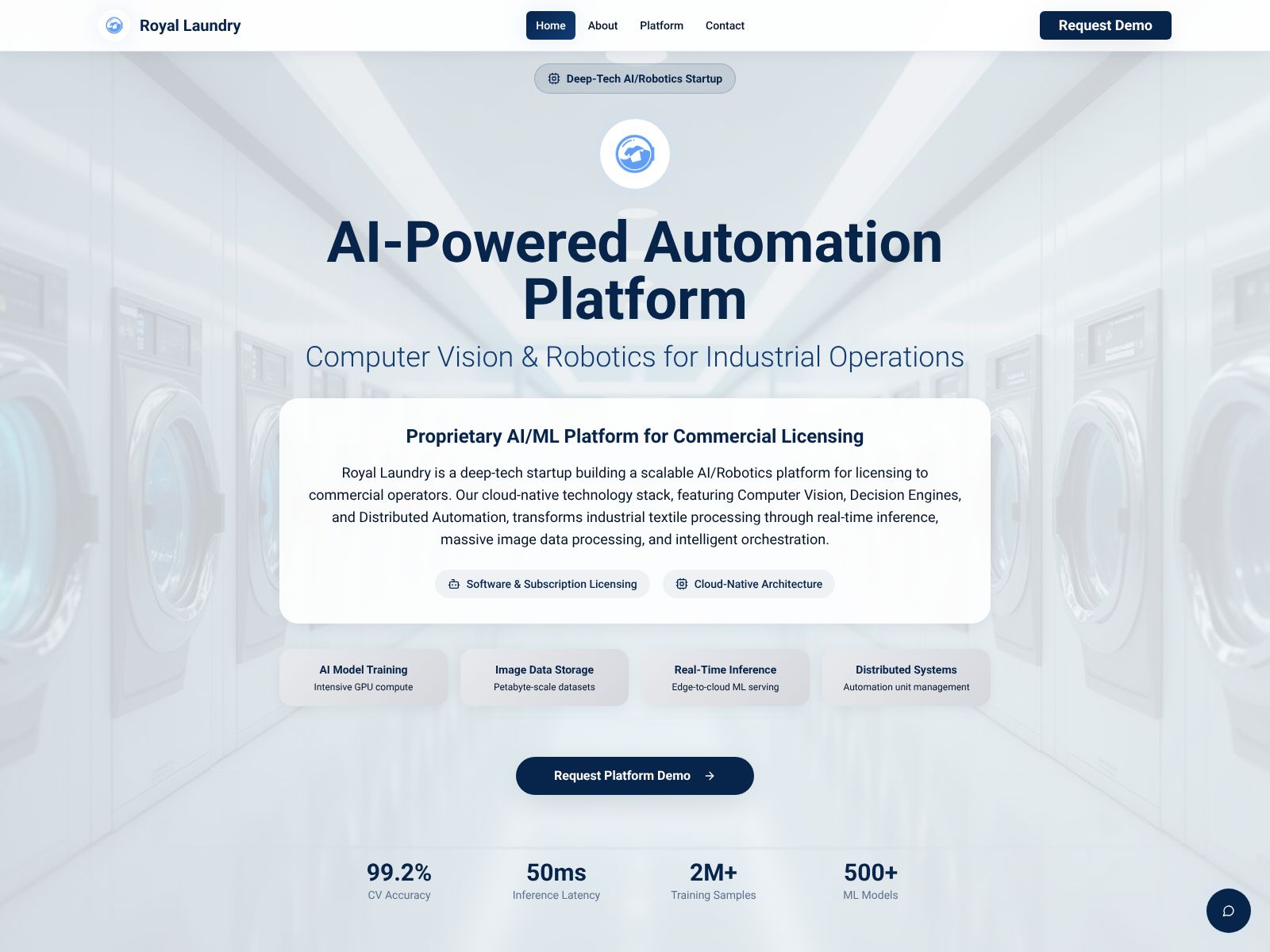
If you run an industrial or commercial laundry, you’re probably asking the same questions everyone else is asking right now: How do we handle rising volumes, tighter SLAs, and labor shortages while still improving quality and traceability? Royal Laundry is a deep‑tech startup working on exactly that problem. It offers a cloud‑native AI and robotics platform that commercial operators can license to automate key textile processing tasks and orchestrate their plant in real time. In this review, I’ll walk you through what Royal Laundry does in simple terms, what features stand out, how pricing typically works in this space, and which alternatives you should also consider.
By the end, you’ll have a practical sense of whether Royal Laundry’s approach fits your operation—and what questions to ask next if you want to evaluate it for your plant.
What does Royal Laundry do?
Royal Laundry builds software and AI/robotics tools that help commercial laundries automatically identify, sort, and route textiles through the plant. Think of it as a smart control layer that “sees” items, decides what to do next, and coordinates machines and robots so work keeps moving smoothly.
Royal Laundry Features
Royal Laundry’s platform centers on three core ideas: see what’s happening, decide the best next step, and coordinate the equipment and people needed to do it. Here’s how that translates into practical features you can use.
1) Computer vision that recognizes textiles and conditions
In a busy laundry, everything starts with accurate identification. Royal Laundry uses computer vision—cameras plus AI models—to detect items, read visual cues, and understand the state of what’s coming through. In practice, this can help you:
- Identify items by type and category to route them correctly (for example, towels vs. linens).
- Spot visual conditions early (soil level cues, potential damage, or anomalies) for exception handling.
- Reduce manual checking and improve first‑pass accuracy at sorting stations.
The advantage of AI‑driven vision is consistency at scale. As volumes swing and product mixes change, the system can keep pace and maintain the same recognition rules 24/7.
2) Decision engine that chooses “what’s next” in real time
Once an item is recognized, it needs to be routed, batched, or prioritized. Royal Laundry’s decision engine uses rules and models to:
- Assign items to the right conveyor, cart, or batch automatically.
- Balance loads to minimize bottlenecks at chokepoints like washers, dryers, ironers, or folders.
- Adjust priorities based on SLAs, promised delivery times, or operator preferences.
- Trigger exceptions when something needs human attention.
Instead of relying only on tribal knowledge at a workstation, the system makes fast, consistent decisions and can adapt as plant conditions change.
3) Distributed automation to orchestrate work across the plant
Industrial laundries are complex. Royal Laundry’s distributed automation model coordinates multiple stations at once so the system can respond to what’s happening anywhere on the floor. This orchestration layer can help you:
- Reduce idle time and “traffic jams” between upstream and downstream equipment.
- Keep WIP flowing by dynamically reallocating items across paths.
- Sync material handling (robots, conveyors, shuttles) with finishing equipment schedules.
The goal is to move beyond isolated automation into a connected operation where intelligence is shared and constantly updated.
4) Cloud‑native control with real‑time visibility
Royal Laundry is built cloud‑native, which means it’s designed to process huge amounts of image and event data while providing live dashboards, alerts, and performance metrics. For your team, that typically means:
- Web‑based monitoring from any authorized device.
- Live KPIs such as throughput, queue lengths, and station utilization.
- Analytics and historical reporting to find patterns and bottlenecks.
- Remote updates and continuous improvement without heavy on‑prem maintenance.
Cloud also makes multi‑site management simpler—you can compare sites, roll out standardized playbooks, and share best practices.
5) Massive image data processing for continuous learning
Computer vision gets better as it sees more examples. Royal Laundry emphasizes massive image data processing so the system can learn, adapt, and generalize to new textiles, changing lighting conditions, or camera angles. For you, this can translate into:
- More robust recognition across product lines and customer mixes.
- Less downtime re‑tuning systems when something changes.
- A path to continuous accuracy improvement without starting from scratch.
6) Intelligent exception handling
Automation is only as good as how it handles exceptions. Royal Laundry’s decision and orchestration layers can flag, quarantine, or fast‑track items that don’t fit the standard flow. Examples include:
- Items that appear damaged or contaminated.
- Mixed loads that need re‑sorting.
- High‑priority orders that need to jump the queue.
By making exceptions visible and actionable, you avoid surprises late in the process.
7) Open integrations and APIs
No plant starts from zero. You likely have washers, dryers, ironers, folders, conveyors, sorters, RFID solutions, and a business system (or three). Royal Laundry’s platform is built to integrate with existing equipment and software via APIs and connectors. That can include:
- Material handling and robotics providers.
- Plant control systems and PLCs.
- Laundry management or ERP software.
- RFID and barcode systems used for item tracking.
The practical benefit is leveraging what you already have while layering in new intelligence where it matters most.
8) Operator‑friendly interfaces
Even the smartest system fails if it’s hard to use. Royal Laundry focuses on clear interfaces so your team can see what’s happening, understand why the system made a decision, and intervene when needed. Expect straightforward dashboards, alerts, and workflows oriented around real jobs to be done.
9) Safety, quality, and auditability
Commercial laundries serve hospitals, hospitality brands, and manufacturers with strict standards. A platform that logs decisions, captures images, and maintains traceability makes it easier to:
- Prove quality processes to customers and auditors.
- Investigate issues quickly using time‑stamped data.
- Standardize SOPs across shifts and sites.
10) Scalability across lines and sites
Royal Laundry’s architecture is designed to scale—across additional cameras, stations, equipment types, and facilities. That matters if your throughput grows or if you want consistent tech across multiple plants. Start small, expand where ROI is strongest, and keep a single control framework.
11) Implementation approach and change management
Modernizing a laundry is a team sport. While every project is different, successful rollouts typically include:
- Process mapping to identify the best starting stations.
- Data collection to train and tune vision models for your textiles and lighting.
- Phased go‑lives that reduce risk and let you prove ROI early.
- Operator training and clear escalation paths for exceptions.
The right partner will meet you where you are—layering automation onto your current footprint rather than forcing a rip‑and‑replace.
How pricing usually works for platforms like Royal Laundry
Royal Laundry licenses its platform to commercial operators. While specific pricing isn’t published here, buyers in this category typically see a mix of:
- Software licensing or subscription fees (per site, per line, or per volume tier).
- Hardware costs (cameras, sensors, compute, and optional robotics) if supplied with the project.
- Integration and professional services (setup, model training, and commissioning).
- Support and ongoing improvements (SLA‑backed support, monitoring, and updates).
Total cost of ownership usually depends on line count, item complexity, integration depth, and the degree of robotics involved. If you’re budgeting, ask for a phased plan: start with the highest‑ROI station, then expand as savings and throughput gains fund the next phase. For the latest details, you can contact the company directly at royallaundry.co.
Who Royal Laundry is best for
While any high‑volume plant can benefit from better vision, routing, and orchestration, Royal Laundry is most compelling if you:
- Run complex product mixes and need consistent sorting and routing.
- Face labor gaps and want to move skilled people to higher‑value tasks.
- Must meet strict SLAs, customer branding standards, or regulatory requirements.
- Operate multiple sites and want standardized control and reporting.
- Are planning equipment upgrades and want a smarter control layer on top.
What outcomes you can target
Every plant is different, but when operators adopt AI‑assisted vision and automation, they typically aim for:
- Higher throughput and more predictable flow across shifts.
- Fewer sorting mistakes and rework.
- Faster exception handling and fewer surprises late in the process.
- Better traceability and audit readiness for demanding customers.
- More flexible staffing and training because systems guide decisions.
As with any automation project, it’s best to set baselines, track improvements line by line, and reinvest gains to expand the rollout.
Royal Laundry Top Competitors
When you evaluate Royal Laundry, you’ll want to compare it against both established industrial automation providers and newer AI‑first platforms. Here are credible alternatives to include in your RFP and how they differ at a high level.
1) JENSEN‑GROUP (including Inwatec)
Category: Industrial laundry equipment and automation
- Why consider them: JENSEN is a major global OEM for industrial laundry equipment and integrated automation. With Inwatec in its portfolio, the group offers robotic sorting, scanning, and material handling solutions tightly coupled with JENSEN finishing lines.
- When they fit: If you’re pursuing a comprehensive line upgrade with matched equipment, or you want end‑to‑end automation from a single vendor.
- Trade‑offs: OEM‑centric solutions may be less flexible if you want a software‑first orchestration layer across a mixed fleet of equipment.
2) Kannegiesser ETECH
Category: Industrial laundry equipment, sortation, and controls
- Why consider them: Known for large‑scale sorting, conveyors, and integrated controls. Strong for plants that want synchronized material handling with established finishing equipment.
- When they fit: Greenfield builds or major retrofits where you standardize on a Kannegiesser ecosystem.
- Trade‑offs: As with any OEM suite, cross‑vendor orchestration can be more complex unless you anchor on their stack.
3) Girbau Industrial
Category: Equipment provider with automation options
- Why consider them: A respected OEM with a wide range of industrial laundry equipment and integration capabilities.
- When they fit: If your focus is upgrading key machines with vendor‑supported automation around them.
- Trade‑offs: You may need additional software layers for AI‑driven vision and cross‑vendor orchestration.
4) Softrol Systems
Category: Plant automation, sortation, and software
- Why consider them: Offers production tracking, sortation, and rail systems with software that ties operations together.
- When they fit: If you want proven controls and tracking across conveyors and rail systems.
- Trade‑offs: Compare the depth of AI‑based vision and decisioning to ensure it matches your needs.
5) ABS Laundry Business Solutions
Category: Laundry management software and ERP
- Why consider them: Provides business systems—order management, billing, route accounting, and operational planning—that many plants rely on.
- When they fit: If your priority is enterprise‑level software for planning and administration, with operational data integration.
- Trade‑offs: You may still want an AI/vision‑driven layer for real‑time item recognition and orchestration on the floor.
6) Datamars Textile ID (RFID)
Category: RFID tracking and identification
- Why consider them: A leader in RFID tagging and reading systems for item‑level or batch‑level tracking across the laundry lifecycle.
- When they fit: If you already tag items or want precise tracking throughout wash cycles and customer deliveries.
- Trade‑offs: RFID and computer vision are complementary—RFID helps with identity and traceability, while vision adds condition and context awareness for routing and quality.
7) System integrators and robotics partners
Category: Custom automation builds
- Why consider them: If you prefer a bespoke solution with PLCs, robots, and conveyors tailored to your plant, an experienced integrator can stitch it together.
- When they fit: Highly specialized flows or brownfield sites where off‑the‑shelf packages don’t align well.
- Trade‑offs: Custom work can be powerful but may be harder to scale and maintain across sites without a standardized software platform.
How to choose among them
Here’s a simple way to compare Royal Laundry with the alternatives above:
- If you’re planning a major equipment refresh and want a single OEM ecosystem, shortlist JENSEN‑GROUP and Kannegiesser alongside Royal Laundry to see whether a software‑first orchestration layer or OEM‑first stack better matches your roadmap.
- If your priority is enterprise business software, include ABS and evaluate how their systems integrate with real‑time floor intelligence like Royal Laundry’s.
- If item‑level tracking is central to your operation, include Datamars and explore how RFID and vision can complement each other for identity plus condition.
- If you need a tailored build, speak with integrators—but weigh the long‑term cost of custom code versus a licensable platform that keeps improving.
Questions to ask during evaluation
Whether you’re considering Royal Laundry or another provider, use these questions to anchor your RFP and demos:
- Vision accuracy: What are typical recognition rates on my item mix and lighting? How is accuracy measured and improved?
- Throughput impact: What real‑world throughput gains should I expect on sorting or finishing lines similar to mine?
- Exception handling: How are damaged or unusual items flagged and resolved? What’s the operator’s workflow?
- Integration: Which equipment and systems do you already integrate with? What is the timeline and cost for new connectors?
- Scalability: How does the platform expand from one station to multiple lines or sites? What licensing model supports growth?
- Data ownership: Who owns images and operational data? How is data secured and governed?
- Support: What SLAs are available? How are updates, monitoring, and retraining handled?
- ROI: Can we do a phased deployment with clear KPIs to validate savings and capacity gains?
Implementation roadmap example
If you’re looking for a low‑risk way to get started, here’s a common approach that operators use when adopting platforms like Royal Laundry’s:
- Pilot on one high‑impact station. Choose a sorting point or bottleneck where improved recognition and routing will show clear gains.
- Measure and tune. Benchmark before/after metrics like throughput, misroutes, and rework. Tune models for your textiles.
- Extend to adjacent stations. Add downstream orchestration so you capture flow benefits, not just local improvements.
- Integrate with business systems. Connect to your ERP or laundry management software for end‑to‑end visibility.
- Standardize and scale. Package SOPs, dashboards, and training so you can roll out across shifts and sites.
This stepwise path helps you capture early ROI, build buy‑in with your team, and avoid big‑bang risk.
Pros and considerations
Here’s a balanced view to help your team decide if Royal Laundry’s approach is right for you:
- Strengths
- AI‑driven vision and decisioning that adapts to real‑world variability.
- Cloud‑native architecture for continuous updates and multi‑site visibility.
- Orchestration focus that coordinates multiple stations, not just point solutions.
- Licensing model that can fit phased rollouts.
- Considerations
- As with any AI system, quality improves with data—plan time for model tuning.
- Integrations vary by plant—budget for connectors and testing.
- Change management matters—operators need clear workflows and training.
What makes Royal Laundry different
Many automation tools focus on a single station or a narrow task. Royal Laundry is built as a platform: see, decide, and orchestrate across the whole plant. That broader scope is useful when you want to improve flow, not just fix a local pain point. The combination of computer vision, real‑time decisioning, and distributed automation—delivered as a cloud‑native, licensable product—sets it apart from both pure OEM stacks and bespoke one‑off automation projects.
How to build a business case
When you present this to stakeholders, keep the math simple and tied to your plan floor:
- Baseline key metrics: misroutes, rework, pieces per hour per station, average queue times, and SLA hits/misses.
- Assign dollar values: labor hours saved, rewash/rework costs avoided, overtime reduction, and SLA penalties avoided.
- Model a phased rollout: station A, then station B, then site standardization, each with expected gains and cost.
- Include risk controls: pilot gates, accuracy thresholds, and rollback plans to build confidence.
The strongest cases show fast payback at the pilot station and compounding gains as orchestration extends downstream.
How to engage with Royal Laundry
If the approach fits your needs, the next steps are straightforward:
- Share your item mix, volumes, layout, and SLA requirements.
- Request a demo focused on your use cases and exception types.
- Define a pilot scope, success criteria, and a 60–90 day timeline.
- Agree on integration points and data handoffs with your existing systems.
You can learn more and get in touch at royallaundry.co.
Wrapping Up
Royal Laundry is building a modern AI and robotics platform for commercial laundries that want to automate recognition, make smarter decisions in real time, and coordinate plant activity across stations. The promise is a smarter flow: fewer misroutes, quicker exception handling, and better throughput without sacrificing quality or traceability.
It’s not the only path forward—you should look closely at established OEM solutions, business software providers, RFID tracking, and custom integrators, then decide what mix best fits your plant. But if you want a software‑first layer that can sit across mixed equipment, learn from massive image data, and keep improving as your operation scales, Royal Laundry is worth a serious look.
Start with a targeted pilot. Prove the ROI at one station. Expand where the gains are greatest. And keep your options open with a platform designed to evolve with your business. To explore whether it’s the right fit for your team, visit royallaundry.co and ask for a demo tailored to your floor.