




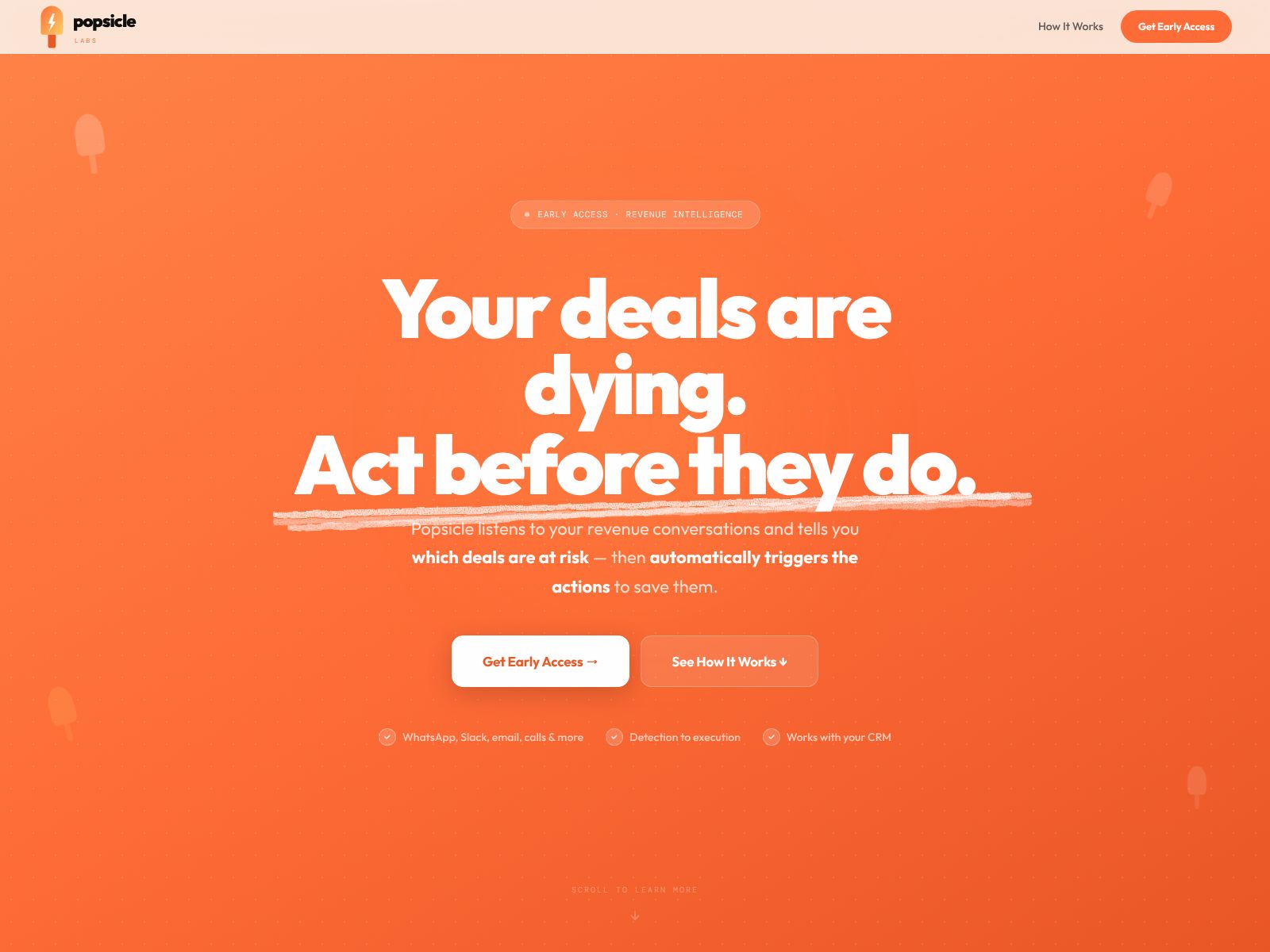
If you lead a B2B revenue organization, you already know the hardest part of running a dependable forecast isn’t the math—it’s the reality check. What’s really happening in your pipeline this morning? Which deals are quietly slipping? Where are reps stuck, and which conversations are gaining momentum? Popsicle Labs set out to solve that gap with a focused product called Popsicle: an AI-powered signal layer that sits between your conversation platforms and your CRM, then turns all that activity into timely, actionable signals for CROs, VP Sales, and RevOps leaders. Founded in Jakarta, Indonesia and built for a global market by operators with 15+ years of B2B technology experience across Southeast Asia, Popsicle is designed to help teams detect what’s happening and act before it’s too late.
In this review and overview, we’ll cover what Popsicle Labs does, the features that matter, how it compares to alternatives, and what to consider if you’re evaluating a signal-first approach to revenue visibility. Whether you run a multi-region sales organization or an emerging GTM team that needs to tighten process and predictability fast, the core promise is simple: fewer surprises, faster reactions, and a cleaner picture of your pipeline’s true health.
Popsicle Labs provides an AI-powered signal layer for B2B revenue teams. It connects to your conversation platforms and CRM, detects what’s really happening in your deals and team activity in real time, and alerts you so you can take action immediately.
Popsicle is built around the concept of a “business signal infrastructure” for go-to-market teams. Instead of adding another place for your team to work, it sits between systems you already use and turns raw interactions into real-time, high-signal insights. Here are the capabilities you should expect and evaluate.
Popsicle’s core is an intelligence layer that ingests data from conversation platforms (for example, meeting or call tools) and your CRM. By living between the two, it can correlate what was said and done with what’s recorded in the deal, then flag gaps or changes that matter. The goal isn’t to replicate your CRM’s record of truth—it's to improve the quality and timeliness of the reality feeding it.
Deals don’t fall apart overnight; they decay through missed follow-ups, slipping close dates, single-threading, and stalled next steps. Popsicle’s emphasis on real-time signals means it can catch those warning signs as they appear and push them to the right person. Conversely, it can elevate positive momentum signals—like multi-threading progress or executive engagement—so leaders can double down where it counts.
Activity data is most useful when it’s contextual. Rather than counting dials for their own sake, Popsicle aggregates activity around accounts and opportunities to show whether sales motions match your playbook. It can surface adherence issues (for example, missing next steps after key calls) and help managers coach on quality, not just quantity.
Signals are only valuable if someone acts on them. Popsicle emphasizes fast delivery—think nudges to Slack or email, task creation in your CRM, or digest summaries to keep leaders focused. Done right, your team sees the signal in context and knows the next best action to take, without hopping across tools to piece a story together.
Every revenue engine has its own hygiene rules, stage definitions, and handoff criteria. Popsicle’s value grows when RevOps can tune signals to your process: which fields must be updated, what “good” looks like by stage, what time-to-next-step is acceptable, and which negative patterns require escalation. This reduces noise and helps your team see only what matters.
AI is most helpful when it’s applied to specific, high-friction problems. In Popsicle’s case, that means using AI to transform unstructured conversations and scattered activity into discrete, interpretable signals—like “no follow-up scheduled after discovery,” “budget authority not identified,” or “close date moved without new stakeholder contact.” The outcome isn’t a wall of transcripts; it’s a list of actions you can take.
Everyone promises a cleaner forecast. Popsicle supports this by tightening the loop between what is said in meetings and what appears in your CRM. By exposing slippage and misalignment early (for example, stage doesn’t reflect meeting outcomes), it helps leaders pressure-test forecasts based on ground truth, not wishful thinking.
Leaders need signal density, not data density. Popsicle’s dashboards can roll up deal risk, momentum, and process adherence by segment, team, or rep so you can see how health is trending. Digest reports (daily or weekly) help you triage: which deals require intervention, where coaching is needed, and which motions deserve more investment.
Because Popsicle was founded with a global audience in mind, it’s designed for geographically distributed teams. That typically shows up in flexible time zones, cross-region rollups, and configuration that lets you tailor rules by market segment or region. If your sales org spans multiple countries, that kind of flexibility reduces false positives and keeps accountability clear.
Signal platforms touch sensitive revenue data. Expect fine-grained permissions for leaders, managers, and reps; clear audit trails for changes; and admin controls to determine which signals appear where. If you operate in regulated industries or across borders, confirm data handling, privacy practices, and any regional storage options during evaluation.
Popsicle’s value depends on clean connections to your CRM and the conversation platforms you rely on. While exact connectors vary by stack, the guiding principle is straightforward: reduce time to value by plugging into what you already use, rather than asking your team to switch tools or duplicate data entry.
New systems often fail because they ask reps and managers to change where they work. Popsicle approaches this by surfacing signals into your existing channels and creating tasks inside your CRM. The benefit is a shorter ramp, less change fatigue, and a faster path to measurable improvements in hygiene and forecast confidence.
Most revenue leaders don’t suffer from a lack of data—they suffer from a lack of timely, trusted signals. CRMs capture records after the fact. Conversation tools capture what happened in the room. But only a small percentage of teams can connect those dots in time to change an outcome. Popsicle focuses on this gap. It doesn’t try to be your engagement platform or your CRM; it’s the connective tissue that translates activity into action. For you and your team, that means fewer pipeline surprises, more consistent execution against your playbook, and a steadier forecast.
Because Popsicle sits between your conversation tools and CRM, your path to value depends on a clean integration footprint and clear signal definitions. A pragmatic rollout usually looks like this:
The biggest risk in any signal platform is noise. Keep early signal rules tight and expand only when adoption is strong and false positives are low. Make sure managers champion the change by tying signals to coaching and pipeline health outcomes—not just compliance.
Popsicle Labs does not publicly list pricing details at the time of writing. Expect pricing to reflect typical B2B revenue intelligence models, often based on the number of users, data sources, and feature tiers. If you’re evaluating Popsicle, the best next step is to request a demo and a tailored quote based on your team size, CRM, conversation platforms, and any specific security or data governance requirements you have.
The “signal layer” category overlaps with revenue intelligence, sales analytics, and forecasting platforms. If you’re comparing options, these are the most common alternatives leaders consider. Each approaches the problem from a slightly different angle—conversation intelligence, forecast accuracy, or rep productivity—so your choice depends on what you need most.
How Popsicle differs: Popsicle positions itself specifically as a business signal infrastructure built to translate cross-system activity into timely, actionable alerts. If you already have a conversation intelligence tool but still struggle with pipeline surprises or process adherence, a neutral signal layer like Popsicle can complement your stack rather than replace cornerstone systems.
Here’s a balanced view to guide your evaluation.
To make a strong business case, define success metrics before rollout and track them consistently. Common KPIs include:
Run a 60–90 day pilot with a clear baseline, instrumented signals, and manager involvement. If the platform does its job, you’ll see earlier interventions, steadier commits, and fewer Friday surprises.
If you think in layers, Popsicle sits between systems of record and systems of engagement:
This design is attractive for teams that don’t want to rip and replace their current stack. Instead, you can raise execution quality and visibility by improving the connective tissue. That’s often the fastest path to better outcomes with minimal disruption.
Popsicle Labs was founded in Jakarta, Indonesia by operators with deep experience building and running B2B technology across Southeast Asia. That matters for two reasons. First, it brings a global perspective to how revenue teams actually operate—across time zones, languages, and markets with different sales motions. Second, it tends to produce pragmatic product choices focused on time-to-value, integration fit, and flexibility rather than monolithic “platform for everything” approaches. If you’re scaling beyond a single region, these trade-offs show up as practical advantages in day-to-day use.
The best revenue teams build an unfair advantage from better feedback loops. Popsicle Labs focuses squarely on those loops: detecting reality as it happens, aligning it to your process, and turning it into action—without asking your team to change where they work. If your current stack leaves you guessing until the end of the week (or the end of the quarter), a signal-first approach can close that gap and turn more “we should have known” moments into “we caught it and fixed it” outcomes.
Popsicle Labs offers a focused solution to a widespread problem in B2B sales: the gap between what’s happening in conversations and what shows up in your CRM and forecast. By providing an AI-powered signal layer that detects meaningful changes in pipeline and team activity in real time, Popsicle helps CROs, VP Sales, and RevOps leaders act fast, coach better, and forecast with more confidence. It’s especially compelling for distributed, global teams that want tighter execution without adding heavy process overhead.
As you evaluate your options, compare Popsicle to established revenue intelligence and forecasting platforms not just on features, but on signal quality, actionability, and time-to-value. Start with a small, high-impact signal set, measure outcomes over 60–90 days, and let managers lead the adoption. If you get the signals right, the downstream benefits—cleaner pipeline, steadier forecasts, and more wins—tend to follow.
To learn more or see if it fits your stack, request a demo from Popsicle Labs and explore how their approach can bring sharper visibility and faster reactions to your revenue engine.
