




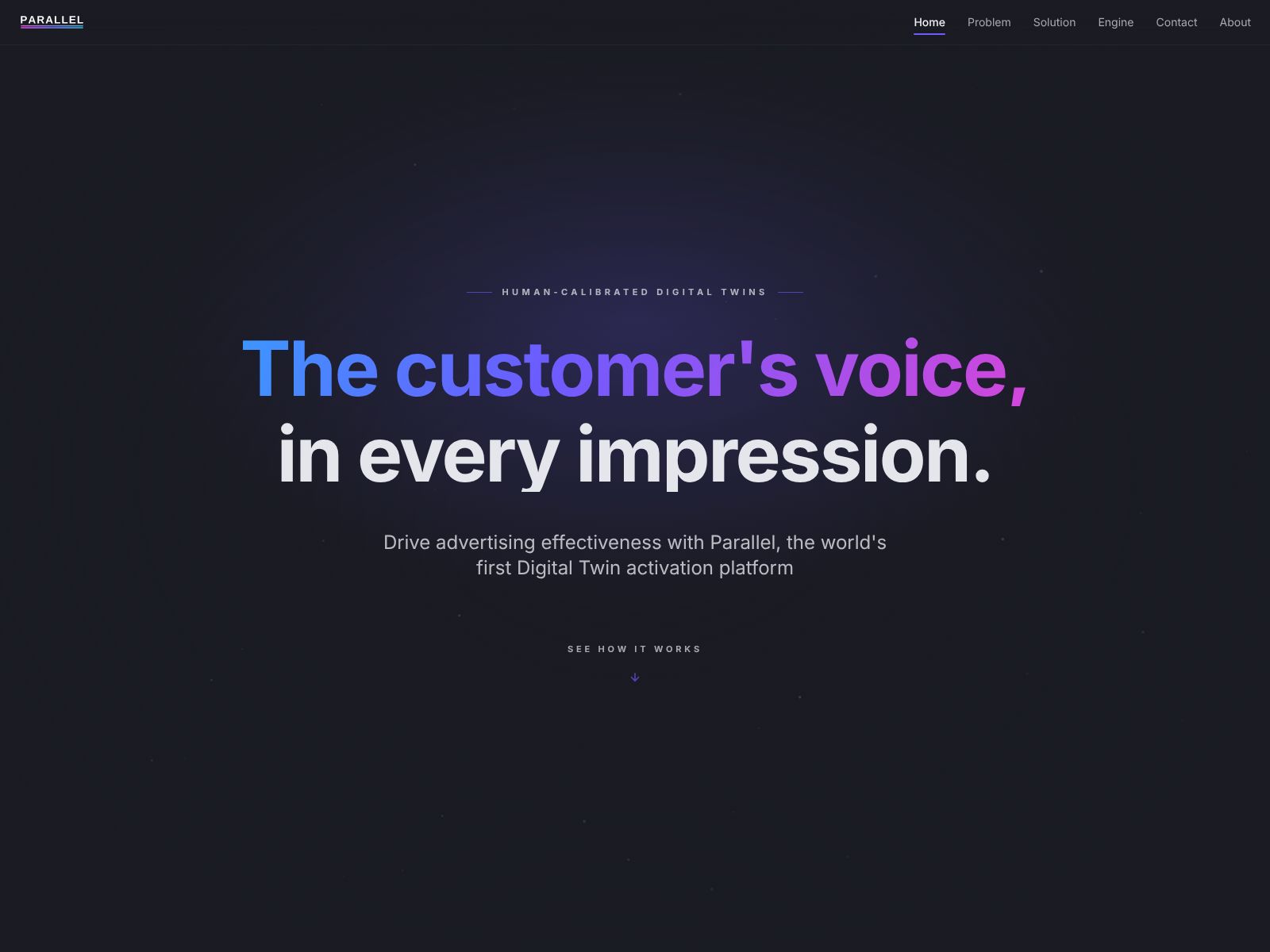
If you’ve ever poured time and money into a campaign that “should” have landed but didn’t, you’re not alone. Creative that tests well in isolation can still miss the mark when it meets a real person, in a real moment, inside real content. Parallel aims to close that gap. It positions itself as the world’s first digital-twin activation platform, using human-calibrated digital twins to predict how customers will respond to your creative in the exact content and context where it runs. In this review and overview, I’ll walk you through what Parallel does in simple terms, who it’s for, the core features, how it might fit into your stack, how to think about pricing, the top alternatives to consider, and a few practical tips to help you evaluate it with confidence.
Parallel is a young company—founded in 2026—with teams in Sydney and London and a footprint across Australia and the UK. That freshness is part of its promise: a new approach designed for the reality of today’s fragmented media and fast-moving creative cycles. If you’re a brand or agency trying to make every impression count, Parallel’s idea is straightforward: model your customer, score your creative against the content it will sit within, and activate the impressions that are most likely to land. In short, better fit, less waste.
Parallel predicts how your customers will respond to your ads in the places you plan to run them, then helps you activate the impressions most likely to work. It uses digital twins—data-driven profiles that mirror real customer behavior and preferences—and calibrates them with human input. You get a score that tells you how suitable a creative is for a given audience in a given context, and tools to act on that score in your campaigns.
Parallel talks about closing the gap of “Customer Suitability.” You can think of this as the fit between your message, your viewer, and the moment. Plenty of tools help you find people who look like your buyers. Plenty of tools help you place ads in brand-safe environments. What’s often missing is the connective tissue: knowing whether your specific creative will resonate with that person inside that exact piece of content right now—and then activating only those impressions that meet that bar.
When suitability is high, people feel like the ad belongs. When it’s low, they skip, scroll, or forget. Customer Suitability is about measuring that fit ahead of time, not guessing, and then using that knowledge to guide where, when, and how your ads appear.
Here’s the simple flow:
Parallel calls its models “human-calibrated,” which means it blends machine predictions with real human signals and research. The important part for you: the outputs aim to be grounded in how people actually feel and behave, not just in abstract data patterns.
Below are the types of capabilities you can expect from Parallel’s digital-twin activation approach. Because this is a new category, I’ll describe each feature in plain language and focus on how you might use it day to day.
Parallel uses digital twins—data-backed stand-ins for real customers—to predict responses to your ads. The “human-calibrated” piece suggests the twins are tuned with research, testing, or labeled signals from people. In practice, this means the model aims to reflect actual human reactions, not just clicks or proxies. For you, the value is simple: you get a more realistic read on how people will respond before you spend media dollars.
Parallel’s core output is a score that predicts how suitable a creative is for a given audience in a given context. Imagine a single number that answers: “Is this ad likely to land here, with this viewer?” You can use that score to compare versions of a spot, pick thumbnails or headlines, select placements, and decide where to put budget. Over time, these scores can help your team develop patterns for what resonates and what doesn’t, shortening iteration cycles.
Most pre-testing treats the ad in isolation. Parallel emphasizes the content environment itself: the video someone is watching, the article they’re reading, or the theme of the page. Context matters because tone, pace, and topic can shape how your ad feels in the moment. Parallel’s scoring is designed to account for that context so your media and creative decisions are informed by fit, not only by broad targeting rules.
Scoring only helps if you can act on it. Parallel’s activation concept is about pushing those suitability signals into your planning and buying flows. In clear terms: give more budget to placements that test well, throttle down the ones that don’t, and continuously learn. Depending on your setup, that could mean building inclusion lists, prioritizing certain content categories, or using the scores to drive optimization rules. The end goal is straightforward—more high-fit impressions, fewer low-fit impressions.
Before you launch, you can run “what if” checks. Which cutdowns perform best in comedy content versus serious news? Does a certain opening shot help when the viewer is already watching sports highlights? A testing sandbox lets your team answer these questions quickly, pick winners, and head to market with more confidence.
Scores are useful, but explanations make them actionable. Expect breakdowns like: which elements of the creative are helping or hurting suitability, which contexts lift or suppress response, and what patterns show up across campaigns. These insights help creative teams iterate smarter and give media teams a clear rationale for placements and pacing.
Customer Suitability becomes a shared language. Creative, media, and analytics can align on one metric that translates into real actions. Creative teams get faster feedback; media teams gain a new lever beyond bid and audience; analytics teams get structured inputs for ongoing measurement. That alignment is often the hardest part in modern marketing. A single suitability score—used by everyone—can move you from debates to decisions.
Any system working with customer-like data and content signals needs strong privacy guardrails. While specifics vary by client, expect Parallel to support privacy-first workflows and controls over what data is used and how. If you operate in regulated markets or handle sensitive segments, you’ll want to discuss data handling, retention, and governance in detail during evaluation.
To realize value, suitability signals have to flow into your planning and buying stack. Integration options typically include ways to export scores, share lists, and connect with your existing tools. If you use external partners for buying or you’re running across multiple channels, map out where these signals will live and how they’ll trigger decisions. Keep it simple: start with one or two channels, prove the lift, then expand.
Because this is a newer category, onboarding matters. Expect a guided calibration phase to make the digital twins relevant to your brand and category, plus training sessions for creative and media teams. A good onboarding leaves you with clear playbooks: how to score, how to interpret outputs, how to push changes into live campaigns, and what to measure along the way.
Parallel is built for brands and agencies that want to connect creative and media decisions more tightly. If any of these sound familiar, Parallel could be a fit:
One of the best parts of Parallel’s approach is that you don’t need to overhaul your data stack to start. At a minimum, you’ll need:
From there, you can run initial scoring, compare versions, and plan activation rules. As you scale, you might add:
Start small: pick one campaign or channel, measure the impact on attention or engagement, then expand. This lets your teams build confidence and muscle memory without overwhelming your process.
Parallel does not publicly list pricing details at the time of writing. Because it’s an emerging, enterprise-oriented platform, you should expect pricing to vary based on factors like the number of brands or markets you run, the volume of assets you score, channels you activate, integrations you need, and the level of service for onboarding and calibration.
Practical tips for pricing conversations:
If you’re comparing vendors, use a consistent checklist. Align on your must-haves (channels, timelines, target markets) and your nice-to-haves (advanced explainability, custom models) so you can compare like for like.
Because Parallel defines a new lane—digital-twin activation—there’s no one-to-one clone. That said, you’ll likely compare it to three nearby categories: creative intelligence and testing platforms, attention and contextual solutions, and broader optimization or measurement tools. Here are notable alternatives and how they differ in approach.
How to evaluate across these options:
To help you picture Parallel in action, here are a few simple workflows:
Parallel was founded in 2026 and operates across Australia and the UK, with offices in Sydney and London. If your teams or markets are in those regions, you may benefit from closer time zone alignment and local support. As the category grows, keep an eye on geographic expansion and partner ecosystems.
Rolling out a new signal like Customer Suitability works best when it’s simple and shared. Here’s a lightweight plan:
Because every brand and market is different, avoid one-size-fits-all benchmarks. Instead, focus on directional improvements you can attribute to suitability-led decisions. Examples include:
Without a suitability layer, you rely on separate tools—creative pre-tests, brand safety checks, audience lists, and post-campaign measurement—to piece together a plan. That can work, but it’s slow and often reactive. Parallel proposes a single predictive signal, grounded in human-calibrated twins and content context, that feeds both planning and activation. If your team wants fewer handoffs and more action, that’s the core advantage to test.
Parallel’s promise is appealingly direct: understand whether your creative will land with your audience in the exact content where it will appear, then activate more of the impressions that do. By centering on Customer Suitability and blending human-calibrated digital twins with context-aware scoring, Parallel gives creative and media teams a shared, actionable signal. That’s a big deal if you’re tired of guessing before launch and explaining after the fact.
No single tool is a silver bullet. You’ll still need great ideas, smart media plans, and disciplined measurement. But if your biggest pain is that campaigns don’t resonate where they run, Parallel is worth a serious look. Start with a focused pilot, align your teams on how you’ll use the scores, and measure what matters. Done well, you’ll spend less time debating and more time delivering work that feels right to the people you care about most—your customers.
If you want to learn more or see a demo, visit Parallel at helloparallel.com. And if you’re evaluating alternatives, use this lens: will the platform help you predict resonance in context, before you spend, and then act on it in your live campaigns? If the answer is yes, you’re on the right track.
