Owl Hoot Tech Review & Overview (Features, Pricing, & Alternatives)
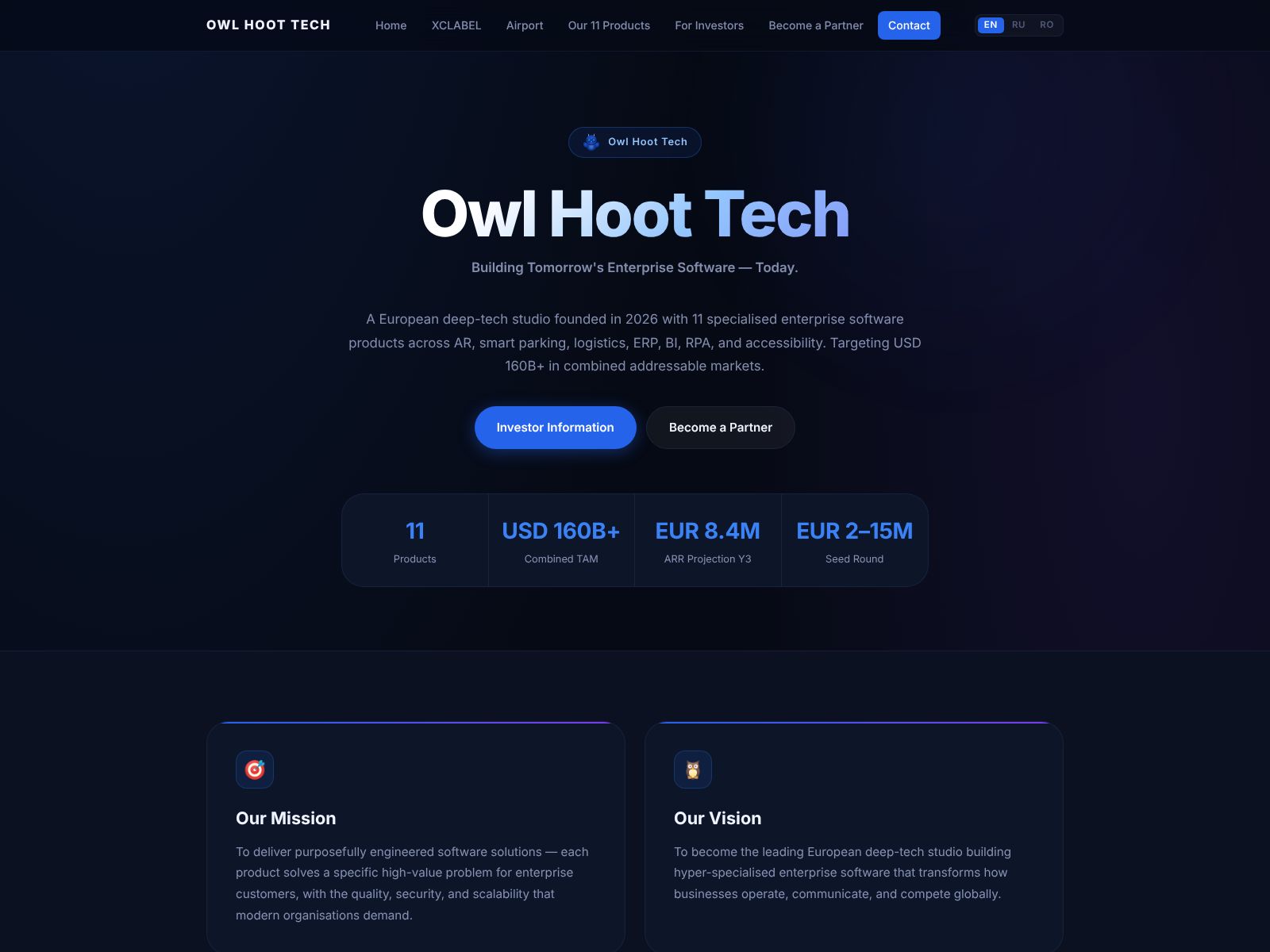
If your team needs modern enterprise software that actually works well together, Owl Hoot Tech is a name worth putting on your shortlist. It’s a European deep-tech studio founded in 2026, and it already claims a portfolio of 11 specialized enterprise products spanning augmented reality (AR), smart parking, logistics, ERP, BI, robotic process automation (RPA), and accessibility. That’s a wide footprint aimed at a combined addressable market north of USD 160B, and it suggests one big idea: you can solve multiple operational challenges from a single ecosystem, rather than stitching together a dozen different vendors.
In this review and overview, I’ll walk you through what Owl Hoot Tech does in plain language, what to expect from its features, how you might think about pricing, which competitors you should compare it to, and how to decide if it’s right for your organization. My goal is to make this simple to read, practical to apply, and directly useful as you and your team evaluate options for the next phase of your digital operations.
Want to go straight to the source? You can learn more at the company’s page: https://www.xclabel.com/owlhoot.html.
What does Owl Hoot Tech do?
Owl Hoot Tech builds and ships enterprise software. Its portfolio includes 11 products across AR, smart parking, logistics, ERP, BI, RPA, and accessibility. In short, it helps you see your operations clearly, automate routine work, and connect your teams and data so you can move faster and make better decisions.
Owl Hoot Tech Features?
Because Owl Hoot Tech covers several product areas, your exact feature set will depend on which products you pick. That said, here’s how to think about the common themes and what you can reasonably expect across its portfolio.
1) A portfolio designed to cover critical enterprise workflows
- AR: Tools that bring digital instructions, 3D content, and contextual guidance to frontline workers and field teams.
- Smart parking: Software that helps operators and cities manage parking assets, occupancy, and potentially payments and enforcement data.
- Logistics: Capabilities for planning, tracking, and coordinating the movement of goods across your network.
- ERP: The finance, inventory, procurement, and order management backbone that unifies operations.
- BI: Dashboards and analytics that make your KPIs easier to see and act on.
- RPA: Automation that handles repetitive clicks and tasks so your team focuses on higher-value work.
- Accessibility: Tools that help you build and run more inclusive digital experiences for all users.
Why this matters: if you’re tired of juggling 7–10 different vendors that don’t integrate well, a studio approach can simplify your stack and reduce friction between teams and data.
2) Interoperability and integrations
- APIs and connectors: Expect programmatic access to data and common integration points with identity providers, data warehouses, and line-of-business systems.
- Shared data models: A consistent way to represent entities (assets, orders, tickets, users) so products can hand off work smoothly.
- Workflow handoffs: RPA steps can trigger ERP updates; logistics status can drive BI alerts; AR instructions can reflect live inventory levels.
What to look for in a demo: ask to see a real end-to-end scenario that crosses product lines, such as a maintenance task created in ERP, executed in AR, logged back automatically, and visualized in BI.
3) Enterprise security, governance, and scale
- Identity and access: Single sign-on (SSO), role-based access control (RBAC), and audit trails are table stakes for enterprise buyers.
- Data protection: Encryption at rest and in transit, key management, and strict data residency options for European and global compliance needs.
- Operational maturity: Versioning, change management tools, and environments (dev/test/prod) to reduce risk as teams roll out changes.
Tip: Ask for documentation on certifications and controls relevant to your sector. If you operate in regulated industries, request mapping to your compliance frameworks and vendor risk requirements.
4) Deployment flexibility and performance
- Cloud-first, with options: Many enterprises want SaaS for speed and on-prem or private cloud for control. Clarify what’s available per product.
- Edge and offline: AR and logistics tools often need resilience when connectivity drops. Ask about offline modes and edge sync behavior.
- Global performance: If you have distributed teams, ensure data centers and CDNs match your footprint for low-latency access.
5) Practical analytics and decision support (BI)
- Dashboards with context: Seeing KPIs is good; knowing which lever to pull is better. Look for guided insights like anomaly highlights and trend explanations.
- Self-service with guardrails: Empower analysts while keeping centralized governance and reusable metrics definitions.
- Operational analytics: Tie insights to actions—e.g., a logistics dashboard that can trigger a task or an RPA flow directly.
6) AR that fits the real world of work
- Device coverage: Practical AR supports a range of devices (smartphones, tablets, headsets) and camera capabilities.
- Content lifecycle: Easy authoring, versioning, and distribution of AR instructions with feedback loops from field teams.
- Context awareness: Pull live data from ERP or sensors to make instructions smarter and reduce errors.
How to evaluate: pick a common SOP or training use case and have the vendor show how it moves from authoring to frontline execution to data capture.
7) Smarter parking operations
- Occupancy and asset visibility: A live picture of spaces, hardware status, and utilization trends.
- Policy and pricing: Tools that help you adapt to demand patterns and manage exceptions.
- Ecosystem links: From sensors and gates to payment providers and enforcement systems, interoperability is crucial.
If you manage a campus, municipal program, or private facility, ask for examples that match your footprint and peak-load patterns.
8) Logistics that closes the loop
- Planning to execution: Route planning, order orchestration, and event tracking in one flow.
- Exceptions first: Surface delays, damage risk, or SLA breaches early with clear playbooks.
- Control tower view: A unified screen to coordinate carriers, warehouses, and customers.
Pro tip: Bring a week of anonymized shipment or order data to a vendor session and see what the system flags—and how it recommends action.
9) ERP designed for connected operations
- Core modules: Finance, procurement, inventory, orders—choose what you need and grow over time.
- Process fit: Flexible workflows and extensions so your unique processes don’t become hard-coded headaches.
- Data hygiene: Tools for master data management and reconciliations to keep books and operations aligned.
10) RPA that actually sticks
- Low-code automation: Make it easy for business users to automate stable processes while IT governs standards.
- Resilience: Error handling, retries, and monitoring to prevent “silent failures.”
- Human-in-the-loop: Approvals and exception handling that invite operators back into the process where judgment is needed.
11) Accessibility as a first-class concern
- Standards support: Tools and guidance aligned to widely used accessibility standards and testing practices.
- Developer and QA enablement: Help your teams bake accessibility into the lifecycle rather than bolt it on.
- User impact: Improve reach, reduce legal risk, and deliver better experiences to every customer and employee.
12) Services, support, and change management
- Implementation partners: Ask about delivery capacity, certified partners, and typical timelines per product.
- Training: Role-based learning for admins, builders, and end users—plus docs and examples.
- Customer success: Health checks, roadmap reviews, and named contacts to keep momentum after go-live.
13) What “good” looks like when everything clicks
- Fewer handoffs and integrations to maintain because products speak the same language.
- Clear dashboards that don’t just inform, but trigger the right workflows or automations.
- Frontline tools (like AR) that reduce errors and training times while capturing useful data.
- Executives who can tie spend to outcomes because the stack measures both process and results.
Pricing
Owl Hoot Tech’s pricing will depend on which products you adopt, how many users or assets you manage, the environments you need, and your support level. Studios that serve the enterprise market often use a mix of license subscriptions, usage-based components, and implementation fees. While you’ll want to confirm details directly, here’s a practical way to approach the conversation so you can forecast total cost of ownership (TCO) and avoid surprises.
- Licensing model: Clarify per-user, per-asset, or per-environment costs for each product you plan to use. Confirm minimums and volume tiers.
- Usage and limits: For data, API calls, or automation minutes, ask how overages are billed and how limits scale.
- Implementation and services: Get a statement of work that includes timelines, deliverables, and assumptions—especially for integrations and migrations.
- Support tiers: Understand SLAs, response times, and escalation paths. Ask about named support and customer success.
- Security and compliance: If you require specific controls or hosting models, capture any associated premiums in your estimate.
- Discount levers: Multi-year commitments, portfolio bundles, or phased rollouts can improve terms—ask for scenarios.
- Proof of value: Consider a paid pilot tied to clear success criteria, with pricing that rolls into production if you move forward.
Bottom line: plan for software subscriptions, services to stand things up, and some ongoing change management. If your team replaces multiple point solutions, the consolidation benefits can help offset new spend.
Owl Hoot Tech Top Competitors
Because Owl Hoot Tech spans many categories, your “top competitors” list depends on which problem you’re solving first. Use the category lists below to build a smart comparison set. It’s normal if you evaluate Owl Hoot Tech against different companies in different workstreams.
Alternatives in AR (Augmented Reality for the enterprise)
- PTC Vuforia: A mature industrial AR suite with strong authoring and device support for guided work and inspections.
- TeamViewer Frontline: AR for logistics and manufacturing, plus remote support capabilities.
- Microsoft Dynamics 365 Guides and Remote Assist: AR-guided workflows integrated with the broader Microsoft stack.
- Unity’s industrial offerings: Useful where 3D visualization and interactive training are central.
Alternatives in Smart Parking
- T2 Systems: Parking management software for universities, municipalities, and private operators.
- ParkHub: Event and venue-focused solutions with hardware and analytics components.
- SKIDATA: Access control and parking solutions used in large facilities worldwide.
- Passport: Mobility management software used by cities (parking, permits, enforcement workflows).
- AppyWay: Curbside management and parking data platform, especially for open data and city use cases.
Alternatives in Logistics and Supply Chain
- Manhattan Associates: Warehouse and transportation management for complex networks.
- Blue Yonder: Planning and execution tools with AI-driven optimization.
- Oracle Transportation Management (OTM): Transportation planning, execution, and freight payment.
- project44 and FourKites: Shipment visibility platforms that integrate across carriers and regions.
Alternatives in ERP
- SAP S/4HANA: Comprehensive enterprise suite for large, complex organizations.
- Oracle NetSuite: Cloud ERP popular with midsize companies and fast-growing businesses.
- Microsoft Dynamics 365: Modular apps for finance, supply chain, and CRM with strong Microsoft integration.
- Odoo: Open-source ERP with modular breadth for SMBs and beyond.
Alternatives in BI and Analytics
- Tableau: Visual analytics and dashboards with a strong community.
- Microsoft Power BI: Deep Microsoft ecosystem integration and favorable pricing for many organizations.
- Qlik Sense: Associative engine for flexible exploration and governed self-service.
- Looker: Data modeling and governed metrics layer (often deployed on Google Cloud).
Alternatives in RPA
- UiPath: Broad automation platform with strong activity libraries and governance.
- Automation Anywhere: Cloud-native approach with enterprise controls.
- SS&C Blue Prism: Enterprise-focused RPA with robust oversight features.
Alternatives in Accessibility
- Deque axe DevTools: Developer-first accessibility testing and guidance.
- Level Access: Platform and services for accessibility compliance and program management.
- Fable: Research and testing with assistive technology users.
- UserWay: Accessibility tools and services aimed at rapid improvements.
How to choose wisely
- Start with the job to be done: Are you fixing frontline guidance, reducing parking friction, tightening supply chain execution, or unifying finance and ops?
- Map required integrations: List the systems you must connect to and rank them as “must-have” vs. “nice-to-have.”
- Define success metrics: For example, error-rate reduction in assembly, stall turnover in parking, on-time delivery improvement, or days sales outstanding (DSO) in finance.
- Pilot with production data: A short, realistic pilot can reveal more than months of slideware.
- Evaluate vendor fit: Consider services, responsiveness, roadmap clarity, and cultural alignment with how your teams work.
Wrapping Up
Owl Hoot Tech positions itself as a modern, European deep-tech studio with a wide product footprint—11 enterprise offerings across AR, smart parking, logistics, ERP, BI, RPA, and accessibility—targeting a large combined market. For you, the value proposition is straightforward: consolidate tools, streamline workflows, and connect data so that your teams can work faster and make better decisions with less friction.
Here’s when Owl Hoot Tech makes the most sense:
- You want fewer vendors and a more integrated stack covering operations, insights, and automation.
- You have cross-functional workflows that span field, warehouse or yard, finance, and executive analytics.
- You need enterprise-grade governance with strong security and deployment flexibility.
- You plan to grow into new capabilities over time and want a portfolio you can expand into without another full procurement cycle.
And here’s when you might look elsewhere:
- You need an ultra-specialized point solution that does one thing in extreme depth and you don’t mind integrating it yourself.
- Your requirements are simple and cost sensitivity is high; a lightweight single-tool alternative might suffice.
- You already standardized on a large platform (e.g., a specific ERP or analytics stack) and prefer to extend what you have rather than add to your vendor mix.
If you decide to evaluate Owl Hoot Tech, take a scenario-led approach. Bring a real use case—like a field maintenance SOP, a parking occupancy challenge, a recurring logistics bottleneck, or a finance-to-ops reconciliation problem—and ask the team to show how their products solve it end to end. Confirm integrations, deployment options, and how success will be measured. Then pressure-test pricing across 1-year and 3-year horizons, including services, to understand total cost of ownership.
Above all, choose the vendor that helps your people get real work done with less effort and fewer errors. If Owl Hoot Tech can show you a clear path from demo to daily impact, it’s well worth consideration. To learn more or request a conversation, visit https://www.xclabel.com/owlhoot.html.