



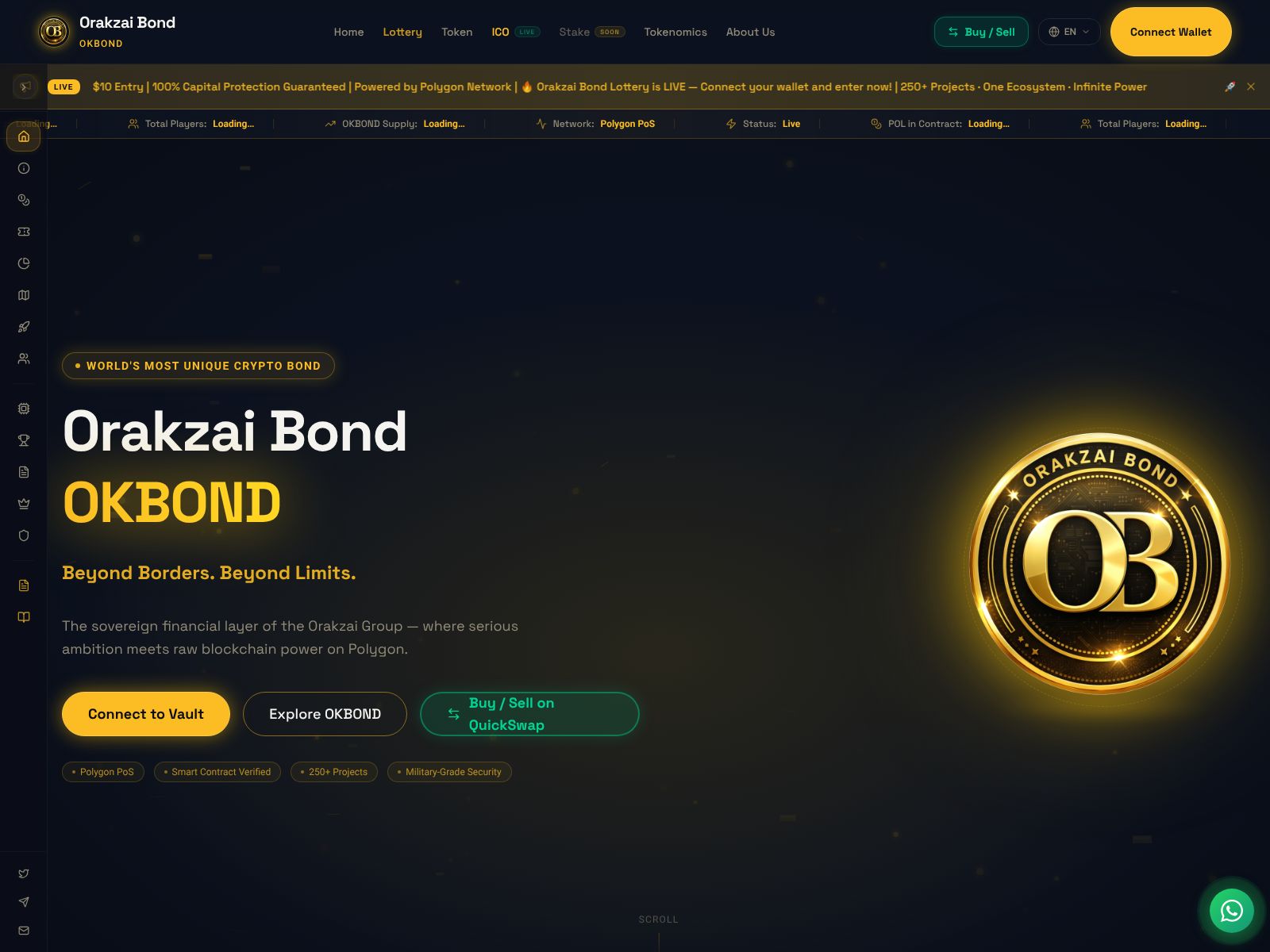
If you have been watching decentralized finance evolve and you’re looking for a more structured way to participate than simple yield farming, Orakzai Bond might be on your radar. Built on Polygon and designed around cycles, lock-ups, and smart-contract automation, Orakzai Bond (OKBOND) positions itself as a transparent, low-barrier entry to blockchain-based asset participation. In this review, I’ll walk you through what it does in plain English, the standout features, who it’s best for, how to think about costs, and which alternatives are worth comparing before you dive in.
Before we start, a quick reminder: This article is for educational purposes only and not financial advice. DeFi carries risk, and you should always do your own research. If you choose to explore Orakzai Bond, begin small, verify contract details, and make sure it fits your risk tolerance.
Orakzai Bond is a decentralized financial instrument on the Polygon blockchain that lets you stake and participate in time-bound pools managed by smart contracts. You lock funds for a set period, participate in a cycle, and receive rewards according to a transparent, rules-based system.
Orakzai Bond’s core idea is simple: structure and transparency. Instead of endless, open-ended staking, OKBOND uses cycles and smart contracts to guide participation. Here’s a straightforward way to think about the user journey.
That’s it at a high level. The emphasis is on predictability: clear windows to join, a defined lock-up, contractual reward rules, and no opaque “hand-of-God” adjustments. The fixed supply (10 million OKBOND) adds a scarcity dimension to the token itself, while Polygon’s efficient network helps keep transaction costs low enough for frequent participation.
Let’s break down the main features and why they matter to you.
Instead of letting you come and go at any moment, OKBOND uses cycles that open and close. This gives a rhythm to participation—like subscription periods in traditional finance. Benefits include:
Participation logic, timing, and reward distribution are enforced by code. You aren’t relying on a centralized operator to “do the right thing.” Instead:
This increases verifiability. If you prefer systems you can audit with a block explorer and not just a PDF brochure, this is attractive.
When you join a cycle, your stake is locked for 60 days. While lock-ups reduce flexibility, they bring benefits:
Make sure the 60-day window aligns with your liquidity needs. If you think you’ll need the funds sooner, consider waiting for a better time to join.
OKBOND uses a transparent, tiered reward approach engineered to encourage network participation and growth. The key value here is clarity. Participants can see how tiers are defined and how returns are distributed across those tiers. While the exact parameters depend on the current cycle’s rules, the intention is to make payouts predictable and not subject to ad-hoc changes.
The system’s design emphasizes retaining participant capital within the contract-governed mechanics. While this does not eliminate market or smart-contract risk, it signals that OKBOND is structured around protecting principal through its rules, rather than encouraging unchecked leverage or short-term speculation. Always examine the current cycle’s documentation to understand how retention is implemented in practice.
Scarcity is a core property of token-based systems. With a fixed supply of 10,000,000 OKBOND, there is no ongoing inflation built into the supply schedule. For you, that means any demand growth interacts with a capped supply, which may influence long-term dynamics differently than inflationary tokens. It does not, however, guarantee price performance. Token value is still driven by adoption, utility, and market conditions.
Polygon is fast and low cost, which is helpful for a cycle-driven protocol where you might join, claim, and roll over more than once. Benefits include:
OKBOND is a subsidiary project of the Orakzai Group. The positioning is to combine corporate infrastructure and operational discipline with DeFi mechanisms. While DeFi purists may prefer purely community-led models, many users appreciate corporate accountability, documented processes, and a clear support path. As always, weigh your preference for decentralization against your desire for organizational structure.
OKBOND appeals to people who want a balance between DeFi’s openness and TradFi’s structure. You might be a good fit if you:
If you need complete liquidity at all times, or you prefer highly composable DeFi strategies across many protocols simultaneously, a 60-day lock may feel restrictive. In that case, consider liquid staking or lending protocols instead.
There isn’t a traditional “pricing” plan like a SaaS tool. Participation costs and economics typically include:
Because Orakzai Bond is a token-based, on-chain system, your “costs” are less about subscriptions and more about network fees and opportunity cost (capital is locked for 60 days). Always check the live documentation for any fee updates before participating.
Security in DeFi is a shared responsibility between protocol teams and participants. OKBOND leans on on-chain transparency and smart contracts, but you should still take steps to protect yourself:
Transparency is a strong point here. Because rewards and timings live on-chain, you can cross-check distributions and cycle states yourself. If you’re new to this process, consider using a blockchain explorer regularly until the workflow feels routine.
If you want to try Orakzai Bond, here’s a simple, practical checklist:
DeFi is broad, and your choice depends on your priorities: flexibility versus structure, lock-up versus liquidity, and simplicity versus composability. Here are some categories and notable alternatives to consider on Polygon and beyond.
If you want staking exposure with the ability to stay liquid, liquid staking protocols might be a better fit than a 60-day lock. Two well-known options include:
Trade-off: Liquid staking offers flexibility, but rewards and risks differ from cycle-based, tiered reward systems like OKBOND. It’s also a different exposure (native MATIC staking vs. OKBOND’s token mechanics).
Prefer on-demand liquidity and collateralized strategies? Consider:
Trade-off: Yields may be lower than targeted incentive programs, but you get high flexibility and battle-tested infrastructure.
Want auto-compounded yields on Polygon without manually managing farms?
Trade-off: Aggregators offer convenience and diversification, but underlying risk depends on the protocols and tokens used by each vault.
If you’re interested in bond-like mechanisms and game-theory-driven incentives:
Trade-off: These systems can be complex and highly reflexive. Read tokenomics carefully and consider long-term sustainability before participating.
Want packaged strategies and defined exposures?
Trade-off: Structured products can be powerful but require careful understanding of mechanisms, counterparties, and market conditions.
OKBOND sits between flexible DeFi and strict TradFi. Here’s a quick framing to help you decide if it aligns with your goals:
Ultimately, the right choice depends on whether you value a defined participation rhythm and transparent tiers over complete liquidity and modular strategy building.
Before you commit capital, take a few practical steps:
Is Orakzai Bond decentralized?
It is built on Polygon with smart contracts governing participation and distribution. You can verify activity on-chain. That said, always review how upgrades, parameters, and administration are handled in practice.
Are rewards guaranteed?
No. Rewards in DeFi depend on protocol rules and market conditions. OKBOND’s transparency helps you understand how distributions work, but outcomes still vary.
Can I exit before 60 days?
The security lock-up is a core feature. Assume you cannot withdraw early. If liquidity is your top priority, consider alternatives like liquid staking or lending.
What are the main risks?
Smart-contract vulnerabilities, market volatility, misinterpreting cycle rules, and liquidity constraints during the lock period. Reduce risk by verifying contracts, starting small, and avoiding over-concentration.
How do I track my participation?
Use your wallet’s activity feed, PolygonScan for on-chain verification, and any dashboard tools the team provides. Mark your calendar for cycle end dates to plan ahead.
As with most DeFi projects, the more openly available data, the better. Things that help users make decisions include:
The good news is that OKBOND’s architecture lends itself to verifiability. The more the team surfaces this data in user-friendly ways, the easier it is for new participants to onboard confidently.
Orakzai Bond offers a disciplined, transparent approach to DeFi participation. If you appreciate clear rules, defined lock-ups, and on-chain verifiability—and you’re comfortable with the 60-day commitment—OKBOND could be a meaningful addition to your toolkit. The fixed 10 million token supply adds a scarcity angle, while the Polygon base keeps interactions affordable and fast.
Your decision, as always, should come down to fit. Do you want structure over fluidity? Are you okay with a 60-day lock? Do the tiered rewards align with your expectations? If the answers are yes, Orakzai Bond is worth a closer look. Start small, verify everything on-chain, and build confidence as you learn the rhythm of the cycles.
To explore further, visit orakzaibond.com, review the latest cycle documentation, and compare your options. By approaching participation with clarity and care, you put yourself in the best position to benefit from what structured DeFi can offer—without sacrificing your peace of mind.
