Nirmaan Review (Features, Pricing, & Alternatives)
If you’re exploring a new market, searching for reliable suppliers, or turning a business idea into a plan you can execute, you’ve probably felt the pain of scattered information. You look up demand signals in one place, supplier options in another, and then switch tools to manage your plan and track progress. Nirmaan aims to bring those steps together in one platform.
In this review, I’ll walk you through what Nirmaan is, how it works, the key features you’ll get, and where it fits among alternatives. By the end, you should know whether Nirmaan can help your team research faster, source smarter, and make more confident go-to-market decisions.
What does Nirmaan do?
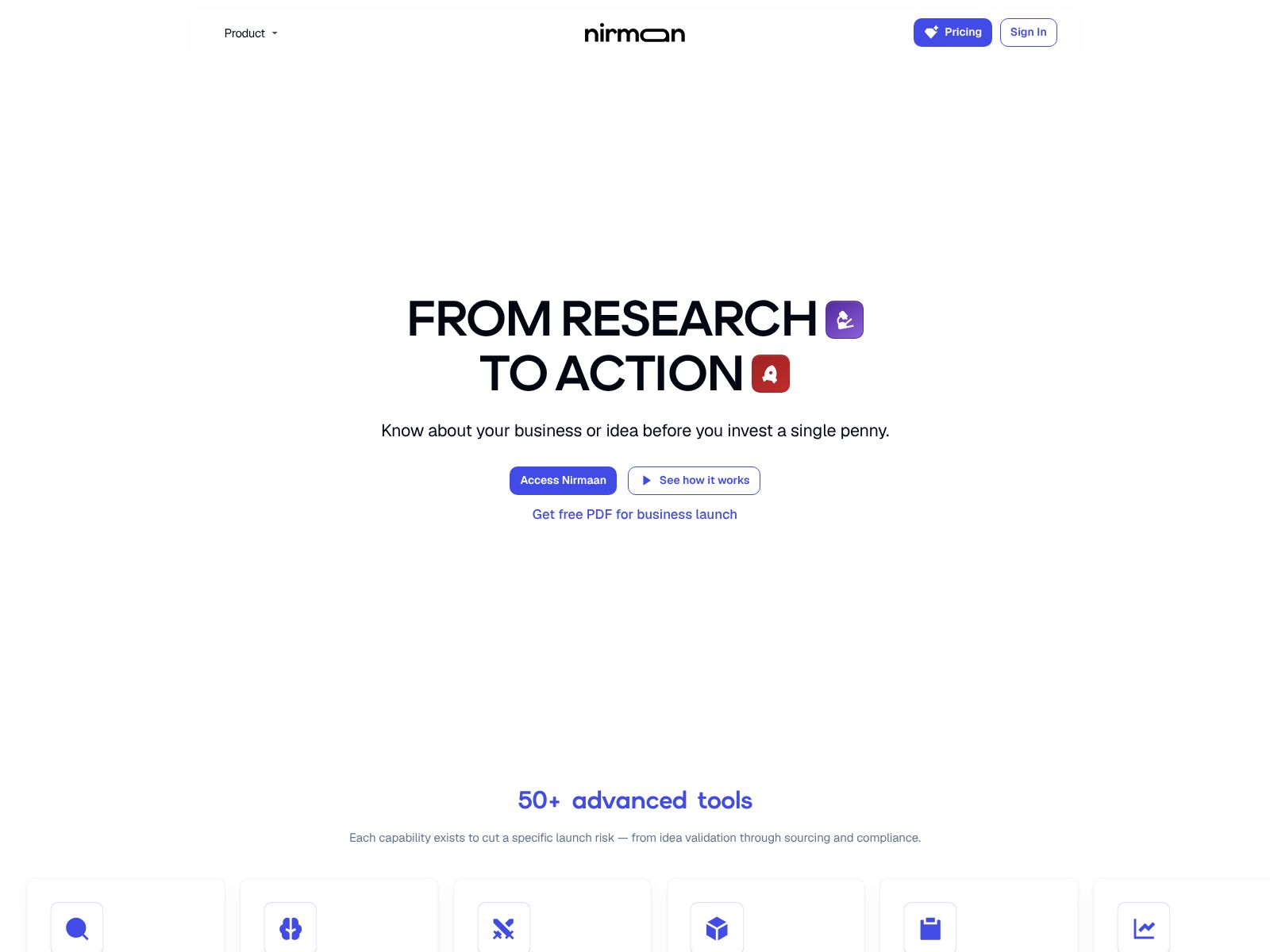
Nirmaan is a business intelligence platform that helps you research markets, find suppliers, evaluate business opportunities, and plan your execution. It combines market data, sourcing information, opportunity listings, and planning tools in one workspace so you can move from idea to action without juggling multiple tools.
In short: Nirmaan helps you discover what to build, where to launch, who to partner with, and how to execute—using one connected system.
Nirmaan Features?
Nirmaan brings several capabilities under one roof. Here’s what stands out and how you might use it.
1) Market intelligence and local data
At the core of Nirmaan is a market research layer designed to answer fundamental questions: What’s the demand in a market? How are prices trending? What risks should you anticipate? The platform supplies:
- Local market data to understand regional dynamics and spot where demand is strongest.
- Pricing information to benchmark your pricing strategy or assess supplier quotes.
- Demand signals to identify rising categories and time your market entry.
- Risk-related information so you can evaluate potential regulatory, supply chain, or market risks.
Practical ways you might use this:
- Market validation: Check if there’s enough demand before committing resources.
- Price benchmarking: Compare price ranges across regions to refine your pricing or negotiate with suppliers.
- Opportunity timing: Monitor demand signals to enter a market when momentum is building, not fading.
- Risk scanning: Flag potential roadblocks early and build mitigation into your plan.
2) Sourcing and supplier networks
Nirmaan provides access to supplier networks and sourcing information for both products and services. This is useful whether you’re building a new line, switching vendors, or expanding into a new geography. Key benefits include:
- Supplier discovery: Find potential partners faster and shortlist options for RFPs or pilots.
- Qualification: Use available information to assess fit before you commit time to outreach.
- Procurement readiness: Build a pipeline of suppliers with context on capabilities and markets served.
When your research layer and supplier discovery live in the same place, you can quickly cross-check: Is there real demand for what a supplier offers? Are regional prices aligned with your margins? That connection shortens the loop between research and action.
3) Business opportunity listings with economics
One of Nirmaan’s unique angles is its business opportunity listings. These go beyond vague “ideas” and include practical economics such as:
- Setup costs to get started
- Profit estimates based on typical conditions
- Payback period ranges so you can estimate breakeven
This can save you weeks of back-of-the-envelope modeling. If you’re scanning for your next venture or new revenue lines, these listings help you quickly rule ideas in or out, then dive deeper on the promising ones with the platform’s market data and sourcing tools.
4) Business planning tools, checklists, and milestone tracking
Nirmaan includes planning tools that move you from research to execution. You can use built-in checklists, follow guides, and track milestones to keep your project on time. This is helpful for:
- New venture launches: Work through the essentials in the right order.
- Market entries: Turn your market research into a clear go-to-market plan.
- Sourcing projects: Track vendor evaluations, samples, negotiations, and onboarding.
If you’ve ever juggled a dozen spreadsheets and to-do lists, having a structured plan with milestone tracking built into the same system where your research lives can be a relief. You reduce context switching and make it easier for your team to collaborate around a shared source of truth.
5) Workspace to keep research, sourcing, and plans organized
Beyond data and tools, Nirmaan provides a workspace where your research, supplier shortlists, opportunity assessments, and project plans can live together. The benefit is simple: everything related to a project stays connected.
- Organize: Keep data, notes, and plans in one place.
- Traceability: See how your final plan connects back to your research and assumptions.
- Handoff: Make it easier to bring new teammates into a project without long ramp-up time.
This is especially useful for cross-functional teams—strategy, product, operations, and procurement—who need to stay aligned as a project evolves from idea to execution.
6) B2B matching to connect with partners and suppliers
Nirmaan includes B2B matching tools that help you connect with potential partners and suppliers. Rather than cold-searching on the open web, you can use the platform’s context to narrow the field and focus on higher-probability matches. Over time, this can improve your hit rate and speed up discovery-to-deal cycles.
7) Risk-related insights baked into your decision flow
Risk is easy to underestimate when you’re excited about a new market or product. Nirmaan’s inclusion of risk-related information encourages a more balanced view. You can factor in potential headwinds early and design contingency plans—before you’ve committed time and capital.
8) Pricing: what to expect
Nirmaan’s site is the best place to check current pricing and plan details. Based on how platforms like this usually package value, you can expect pricing to reflect factors such as:
- Access to data scope (markets, categories, or regions)
- Feature depth (research, sourcing, opportunity listings, planning tools)
- Number of users or seats for your team
- Optional add-ons or higher usage limits for growing teams
If you’re evaluating Nirmaan for a team, it’s smart to map your must-have use cases first (for example: market validation + supplier discovery + basic planning) and then confirm that the plan you pick covers those needs without overbuying extras you won’t use right away.
9) Typical workflows Nirmaan can streamline
To see how the pieces fit together, here are a few common workflows you can run end to end inside Nirmaan:
- Validate a business idea
- Scan opportunity listings with setup costs, profit estimates, and payback periods.
- Cross-check with demand signals and local pricing data to sanity-check margins.
- Assess risk information to understand what could go wrong and how to mitigate it.
- Use planning checklists to outline your launch and set milestones.
- Source and qualify suppliers
- Discover suppliers through the platform’s networks and sourcing data.
- Compare options using available market context and pricing benchmarks.
- Shortlist and hand off to procurement with a structured plan for samples and evaluations.
- Enter a new market
- Use local market data to choose the best regions or segments to target first.
- Benchmark pricing and tailor your offering to local conditions.
- Identify partners or distributors via B2B matching tools.
- Track your go-to-market plan with milestones and checklists.
- Build and maintain a business plan
- Collect research, pricing, and risk insights as inputs to your plan.
- Document assumptions and connect them to your milestones.
- Update your plan as market data changes, keeping a single source of truth.
10) Who is Nirmaan best for?
You’ll get the most out of Nirmaan if your work spans research, sourcing, and planning. Teams who benefit include:
- Entrepreneurs and small business owners validating ideas and launching quickly.
- Strategy and new market teams that need demand, pricing, and risk insights to make go/no-go calls.
- Procurement and operations teams sourcing products or services with an eye on margins.
- Product and category teams scanning for expansion opportunities backed by data.
- Advisors and consultants who package research and plans for clients.
If your team currently cobbles together public data, vendor directories, spreadsheets, and task tools, Nirmaan can reduce friction by centralizing those steps.
11) Strengths and trade-offs
No platform does everything. Here’s a balanced view based on Nirmaan’s focus areas.
- Where Nirmaan is strong
- End-to-end flow: research, sourcing, opportunity evaluation, and planning in one place.
- Economics in context: opportunity listings with setup costs, profit estimates, and payback ranges.
- Local market data: pricing and demand signals that help you move beyond generic reports.
- Execution focus: checklists and milestone tracking to turn insights into outcomes.
- B2B matching: purpose-built tools to find partners and suppliers faster.
- Potential trade-offs to consider
- Depth vs. specialization: pure-play analyst platforms or procurement suites may go deeper in specific niches.
- Coverage variability: data depth can differ by region or industry; confirm coverage for your target area.
- Learning curve: centralizing multiple workflows can take a bit of onboarding for teams new to the platform.
- Pricing fit: ensure the plan you choose aligns with your core use cases to avoid paying for unused scope.
Nirmaan Top Competitors
Nirmaan spans multiple categories—market intelligence, supplier discovery, opportunity scouting, and planning—so alternatives come from several directions. Here are notable competitors and how they compare conceptually.
Market intelligence and research platforms
- Statista
- Best for: Quick access to charts and statistics across industries and regions.
- Why pick it: Broad, easy-to-consume data for presentations and top-level analysis.
- Trade-off: Not an execution platform; limited sourcing and planning features.
- CB Insights
- Best for: Technology trends, startup landscapes, and competitive intelligence.
- Why pick it: Deep company-level insights in tech-driven markets.
- Trade-off: Higher price point; not built for sourcing or project planning.
- PitchBook
- Best for: Private company, investor, and deal-flow data.
- Why pick it: Investment-grade market and company tracking.
- Trade-off: Financial focus; not a sourcing or planning workspace.
- Euromonitor (Passport)
- Best for: Consumer markets, category trends, and geographic analysis.
- Why pick it: Analyst-grade industry reports with global scope.
- Trade-off: Report-driven; separate tools needed for supplier discovery and planning.
- AlphaSense
- Best for: Aggregated research, earnings calls, and expert insights.
- Why pick it: Great for financial and competitive research workflows.
- Trade-off: Not oriented toward supplier matching or operational planning.
Supplier discovery and sourcing databases
- Thomasnet
- Best for: North American industrial suppliers and manufacturers.
- Why pick it: Mature directory and categories for parts and components.
- Trade-off: Focused on supplier listings; limited market intelligence and planning tools.
- Global Sources
- Best for: International supplier discovery and trade show connections.
- Why pick it: Wide supplier options across product categories.
- Trade-off: Sourcing-centric with less emphasis on market research and planning.
- Alibaba.com
- Best for: Finding and transacting with global suppliers at scale.
- Why pick it: Marketplace dynamics for price discovery and MOQs.
- Trade-off: Marketplace focus; you’ll need separate tools for demand, pricing research, and planning.
- Kompass
- Best for: B2B company listings across many countries and sectors.
- Why pick it: Broad coverage for basic discovery.
- Trade-off: Database-first approach; limited end-to-end project support.
- Panjiva
- Best for: Trade data and import/export insights useful for supplier vetting.
- Why pick it: Visibility into shipment activity and trade relationships.
- Trade-off: Data-focused; does not include planning checklists or opportunity economics.
- ImportYeti
- Best for: Shipment history lookups to infer supplier relationships.
- Why pick it: Handy for competitive sourcing intelligence.
- Trade-off: Narrow scope; you’ll still need market data and planning tools elsewhere.
Business planning software
- LivePlan
- Best for: Structured business plans with financial forecasts.
- Why pick it: Guided planning for startups and SMBs.
- Trade-off: Strong on planning, weaker on market intelligence and sourcing.
- Bizplan
- Best for: Entrepreneurs building investor-ready plans.
- Why pick it: Templates and guidance to package your plan.
- Trade-off: Requires separate tools for supplier discovery and demand/pricing signals.
Supplier and risk intelligence platforms
- Craft.co
- Best for: Supplier intelligence, monitoring, and risk tracking.
- Why pick it: Good for vendor vetting and ongoing visibility.
- Trade-off: Not focused on opportunity economics or business planning workflows.
- Prewave / Similar risk tools
- Best for: Supply chain risk monitoring across tiers.
- Why pick it: Alerts on disruptions and ESG issues.
- Trade-off: Risk specialists; you’ll need separate research and planning tools.
How Nirmaan compares conceptually
Most alternatives specialize: they either give you market research, or supplier discovery, or planning. Nirmaan’s edge is that it blends these into one workflow. If you primarily need deep analyst reports or a heavyweight procurement suite, a specialist might be better. But if you want a single place to:
- Validate demand and pricing
- Discover and evaluate suppliers
- Estimate unit economics and payback
- Plan execution and track milestones
…then Nirmaan’s end-to-end approach can reduce the overhead of stitching tools together.
Choosing between Nirmaan and alternatives
- Pick Nirmaan if:
- You want a connected flow from research to sourcing to planning.
- Opportunity listings with setup costs, profit estimates, and payback periods will save you time.
- Your team needs a shared workspace to keep research, vendor options, and plans in sync.
- Pick a specialist if:
- You require deep analyst coverage for a narrow industry (for example, long-form, sector-specific reports).
- You need enterprise procurement features beyond discovery (for example, contract lifecycle management within the same tool).
- Your existing stack already covers research or planning, and you only need a supplier directory or trade data feed.
Wrapping Up
Nirmaan brings together four pillars that growing businesses often keep separate: market intelligence, supplier discovery, opportunity economics, and planning. By combining local market data, pricing information, demand signals, and risk insights with sourcing tools and B2B matching, the platform helps you move from “Is this a good idea?” to “Here’s the plan and the partners to execute it.”
The standout features are the practical opportunity listings—including setup costs, profit estimates, and payback periods—and the built-in planning tools with checklists and milestone tracking. These make it easier to go beyond research and into action, all while keeping your assumptions and data in one organized workspace.
Before you choose, line up your essentials. If your day-to-day involves validating markets, finding suppliers, and turning research into a living plan, Nirmaan can save you meaningful time and help your team work from the same source of truth. If you only need a pure market research database, a supplier directory, or a standalone planning tool, a specialist may be enough.
For the latest details on features and pricing, and to see if Nirmaan’s data covers your target markets and categories, visit the official site: https://nirmaan.live. If you can, start with a small pilot project—validate an opportunity, shortlist suppliers, and set a few milestones. You’ll quickly see whether the all-in-one workflow fits the way your team operates.
Bottom line: Nirmaan is a strong pick if you want to centralize market research, sourcing, and planning into one platform, reduce decision cycles, and launch with more confidence.