
MolarityNo Logo Placeholder
HealthTech

Molarity

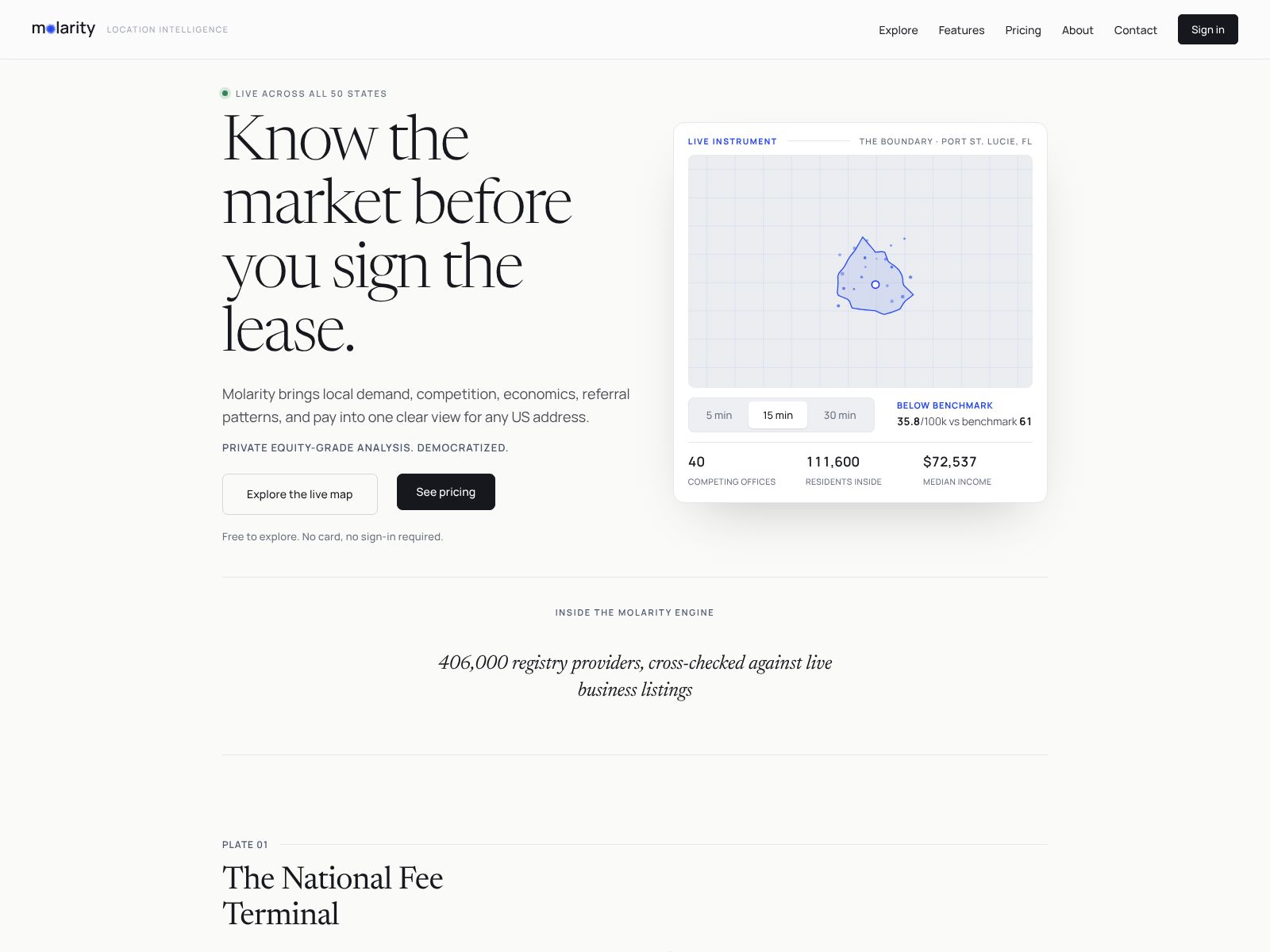
Molarity is a location intelligence platform that helps healthcare practitioners, practice owners, and private equity firms choose new sites with confidence. For any U.S. address, it analyzes local demand, competition, referral patterns, economics, and reimbursement. It cross-references 406,000 registry providers with live business listings across all 3,144 counties, weights demand across 85,000 census tracts, and maps drive-time market boundaries. Its Fee Terminal shows real Medicaid floors from all 51 state fee schedules plus modeled private-pay bands, delivering private-equity-grade market analysis for buyers and lenders at any scale. Molarity is live in all 50 states with a free exploration tier and premium Deep Reports.

More About Molarity

Founded:
Total Funding:
Funding Stage:
Pre-Seed
Industry:
HealthTech
In-Depth Description:
Molarity is a location intelligence platform for healthcare practice site selection. Practitioners, practice owners, and private equity firms use Molarity to understand a market before committing to a lease: local demand, competition, referral patterns, economics, and reimbursement for any address in the United States. The platform cross-references 406,000 registry providers against live business listings across all 3,144 US counties, weights demand across 85,000 census tracts, and maps drive-time market boundaries for any location. Its Fee Terminal surfaces real Medicaid floors from all 51 state fee schedules alongside modeled private-pay bands, giving buyers and lenders private-equity-grade market analysis at any scale. Molarity is live across all 50 states with a free exploration tier and premium Deep Reports.
Molarity

Molarity Review (Features, Pricing, & Alternatives)

Choosing a new practice location is one of the highest-stakes decisions you can make. Get it right and your team enjoys steady demand, healthy reimbursements, and long-term growth. Get it wrong and you’re tied to the wrong side of town, fighting for referrals and squeezing margins. In this review, I’ll walk you through Molarity, a location intelligence platform built specifically for healthcare practice site selection. You’ll learn what it does in plain English, the features that matter, where the data comes from, how teams use it, what it costs at a high level, and how it compares to other market analysis tools. By the end, you’ll know whether Molarity belongs in your site selection stack.

What does Molarity do?

Molarity helps you pick the right place to open or buy a healthcare practice. It shows you local demand, competition, referral patterns, economics, and reimbursement for any address in the United States—so you can commit to a lease or a deal with confidence.

Molarity Features?

Molarity is purpose-built for healthcare expansion, de novo site selection, and acquisition due diligence. Here are the features and workflows that stand out when you start using the platform.

1) Market clarity for any address in the U.S.

  • Nationwide coverage: Molarity is live across all 50 states and every one of the 3,144 U.S. counties. If you can type an address, you can analyze the market around it.
  • Quick, visual answers: See at a glance how many potential patients live nearby, who already serves them, where your likely referral sources sit, and how far patients will realistically travel to you.
  • Local-first: Instead of vague regional stats, you get street-level insight built on census tracts and drive-time trade areas—so your analysis reflects how people actually move through a market.

2) Demand modeling across 85,000 census tracts

  • Census tract weighting: Molarity weights demand across roughly 85,000 census tracts, a granular approach that outperforms ZIP-level summaries. This matters when a single ZIP includes both a dense residential pocket and a sparse industrial zone.
  • Right-size your catchment: Evaluate demand within 5-, 10-, 15-, or 20-minute drive times (or custom trade areas) and watch how your total addressable patients change by specialty and visit type.
  • Specialty-sensitive inputs: Dental, dermatology, ortho, GI, urgent care, behavioral health, pediatrics—each specialty draws different travel tolerance and encounter patterns. Molarity bakes those differences into demand estimates.

3) Competition and provider mapping you can trust

  • Cross-referenced provider universe: The platform cross-references 406,000 registry providers against live business listings. That means it’s not just scraping a directory; it’s triangulating real, practicing locations.
  • Active vs. dormant: By blending registry and live listings, Molarity reduces false positives like retired physicians still sitting on an old roster or shell offices with no patient activity.
  • Competitive intensity: See who you’re up against in your exact drive-time market boundary, segmented by specialty, subspecialty, or service line.

4) Drive-time market boundaries that mirror real life

  • Isodistances you can defend: Molarity’s drive-time polygons help you draw realistic trade areas that reflect road networks, not circles on a map. That’s especially useful in congested metros, mountain towns, or bridge-dependent suburbs.
  • Compare multiple candidate sites: Drop pins on two or three addresses and instantly see overlapping catchments, competitive pressure changes, and incremental demand you’d gain by picking one over another.
  • Support for de novo and relocation: Whether you’re opening new or moving a few miles for a better lease, drive-time analysis clarifies the risk of losing established patients versus the upside of accessing new ones.

5) Referral patterns—know who feeds your funnel

  • Map likely referral sources: Understand where the primary care, pediatric, OB/GYN, ED, or urgent care feeders are relative to your potential site—and how your location choice changes the ease of sending patients your way.
  • Identify gaps: Spot neighborhoods with outflow—areas where patients must travel farther than average for your services. These pockets are often your best entry points or targets for provider outreach.
  • Outreach planning: Build a short list of high-potential referrers closest to your preferred site for post-launch relationship development.

6) Reimbursement intelligence via the Fee Terminal

  • Medicaid floors, clearly presented: Molarity’s Fee Terminal surfaces real Medicaid floors from all 51 state fee schedules (including D.C.) so you can price out your worst-case reimbursements, service by service.
  • Modeled private-pay bands: Alongside Medicaid floors, you’ll see modeled private-pay ranges to help you bracket expected commercial rates at a market level. Use this to sanity-check your pro forma and lender assumptions.
  • Payer mix scenarios: Combine reimbursement data with local demographics to stress test different payer mix assumptions. This is particularly powerful in markets with fast-changing coverage patterns.

7) Economics and site viability inputs

  • Income and insurance coverage: Layer in household income, insurance coverage, and age distribution to understand which patients are near your address and what coverage they likely bring with them.
  • Visit propensity and out-of-pocket sensitivity: For elective or cash-pay heavy services, model how affordability and drive-time friction could alter demand capture.
  • Under-served vs. saturated: Quantify unmet need by comparing weighted demand to active supply, not just at the county level but within the precise area patients would drive to visit you.

8) Deep Reports for lenders, boards, and diligence

  • Private-equity-grade output: When you need a formal deliverable, Molarity’s Deep Reports turn your analysis into a comprehensive market read—complete with methodology, visuals, and assumptions you can stand behind.
  • Scalable across roll-ups: Buyers and lenders can generate standardized reports across dozens of markets quickly, aligning underwriting and investment committee discussions.
  • Defensible methodology: Because the platform anchors on registry providers, live listings, census tract weights, and state fee schedules, your diligence doesn’t rely on guesswork or anecdote.

9) Nationwide scope with a free starting point

  • Free exploration tier: You can explore the platform at no cost to get a sense of coverage and basic insights before you commit. It’s an easy way to sanity-check a few candidate locations or markets.
  • Premium access: Upgrade for full analytics, the Fee Terminal, and Deep Reports. Molarity positions this for practice owners, multi-site groups, private equity, and lenders who need repeatable, defensible analyses.

10) Practical workflows for real teams

  • De novo site selection: Compare two corners across town, weigh differences in drive-time demand, identify referrer density, and check whether reimbursements will support your rent and staffing plan.
  • Relocation scenarios: Test if moving three miles closer to a highway exit adds enough incremental demand to offset disruption and lease-up costs.
  • Acquisition diligence: For a practice you’re buying, test whether the site is underperforming its addressable market (good upside) or already topped out (limited growth).
  • Service-line expansion: Add a new modality—say pedo or endo for dental, or outpatient PT next to ortho—and quantify expected demand capture and cannibalization risks at the same address.

What the data actually means for you

Numbers don’t make decisions—people do. Molarity’s advantage is that it gives you the small set of facts most likely to change your mind: how many potential patients live in your real-world catchment; how many competitors already serve them; where the referrers actually are; and what your reimbursement floor looks like if the economy tightens. Those are the inputs lenders want to see, partners want to debate, and your team needs to move forward with confidence.

Who benefits most from Molarity

  • Practice owners and operators planning 1–10 new clinics over 12–24 months.
  • MSOs and PE-backed platforms planning regional or national roll-ups.
  • Lenders underwriting healthcare real estate or buyouts.
  • Developers and RE brokers supporting health services tenants.

What about pricing?

Molarity offers a free exploration tier to let you try the core experience. For full capabilities—like comprehensive provider/demand modeling, the Fee Terminal, and Deep Reports—you’ll move into paid access. Pricing varies by depth of reporting and scale (number of markets, sites, or reports). If you’re evaluating platform-wide use or portfolio diligence, it’s best to contact the team at molarity.ai for current plans.

Molarity Top Competitors

If you’re surveying the landscape, here are the most common alternatives teams consider, plus how they compare to Molarity for healthcare site selection.

1) Trilliant Health

What it is: A healthcare analytics company focused on consumer demand forecasting, provider supply, and market dynamics. Trilliant offers robust claims-driven insights and national market views.

Where it fits: Health systems, payers, and large platforms that need macro-level strategy, competitive dynamics, and growth forecasting.

How it compares: Trilliant shines for broad strategy and payer mix insights at scale. If your primary need is site-by-site address analysis, drive-time trade areas, and reimbursement floors for a specific specialty, Molarity takes a more location-centric approach out of the box.

2) Definitive Healthcare

What it is: A comprehensive database of providers, facilities, affiliations, referral patterns, and claims-based insights used widely for sales targeting and market research.

Where it fits: Teams that want rich profiles on organizations and physicians, plus robust affiliation networks and claims-derived activity.

How it compares: Definitive is a broad intelligence platform, not a dedicated site selection tool. Molarity is more purpose-built for picking an address and sizing the de novo or acquisition opportunity with drive-time, demand, and reimbursement modeling.

3) Stratasan

What it is: A healthcare market intelligence and strategic planning platform used by hospitals and providers for growth planning and service line strategy.

Where it fits: Health systems and strategy teams crafting multi-year plans and analyzing community need, patient origins, and competitive positioning.

How it compares: Stratasan is strong for system-level strategy and community health analytics. Molarity is specialized for stand-alone practice site selection, private equity diligence, and lender-ready market reports built around an exact address.

4) Clarify Health

What it is: A health analytics company offering claims-based performance, market, and patient flow analytics to understand demand, leakage, and network performance.

Where it fits: Organizations optimizing network design, performance, and population health economics.

How it compares: Clarify is powerful for network and performance analytics. If your primary job is choosing one location over another and pressure-testing reimbursements by address, Molarity’s workflow is more narrowly tuned for that decision.

5) Esri ArcGIS (with healthcare data)

What it is: The industry-standard GIS platform. With the right datasets, analysts can build sophisticated maps and models for nearly any use case, including healthcare site selection.

Where it fits: Teams with GIS talent who want full control over layers, custom models, and geoprocessing.

How it compares: ArcGIS is incredibly flexible but requires specialized skills and time. Molarity packages provider cross-references, census tract weighting, drive-time catchments, and reimbursement cues so operators can answer site questions fast without building bespoke GIS pipelines.

6) CARTO (with healthcare layers)

What it is: A modern geospatial platform for building location apps and analyses in the cloud. Great for teams wanting modular, data-science-ready GIS workflows.

Where it fits: Data teams who prefer to assemble their own stack and integrate multiple third-party healthcare datasets.

How it compares: CARTO is a toolkit; Molarity is a finished application targeted at healthcare site selection, with specific healthcare demand/supply logic and the Fee Terminal baked in.

7) Buxton (multi-industry site selection)

What it is: A long-standing site selection and customer analytics company serving retail, restaurants, and some healthcare segments.

Where it fits: Organizations comfortable with a cross-industry approach and consulting-heavy engagements.

How it compares: For healthcare-specific dynamics—referrals, reimbursements, Medicaid floors, modeled private-pay ranges—Molarity offers more targeted healthcare detail and workflows aligned to practices and lenders.

8) Placer.ai

What it is: A foot traffic analytics platform that measures visits to locations using mobile device data. Great for retail co-tenancy analysis and understanding site activity patterns.

Where it fits: Real estate teams wanting to validate centers with strong traffic or understand daypart patterns.

How it compares: Placer.ai can complement healthcare site selection, especially for urgent care and retail-adjacent services. But it doesn’t address provider supply, specialty demand modeling, or reimbursement. Molarity fills those healthcare-specific gaps.

Which should you choose?

If your mission is to decide whether to sign a lease at 123 Main Street, persuade your lender, or greenlight a roll-up market-by-market, you’ll likely get to an answer fastest with a healthcare-first, address-based tool like Molarity. If you’re building a custom analytics environment or doing system-level strategy, a broader analytics platform (or a GIS toolkit) might be a better fit—especially if you have in-house analysts. Many teams pair a generalist tool with Molarity to speed up the last-mile, site-specific decision.

Wrapping Up

The questions that matter most before you commit to a site are simple but unforgiving:

  • Are there enough potential patients within a realistic drive time?
  • How many competitors already serve them, and where are they?
  • Who will refer to you, and how easy is that referral pathway?
  • What reimbursements should you actually plan for in this state and market?
  • Does the address still pencil out when you stress test payer mix and rent?

Molarity is built to answer those specific questions for any U.S. address. By cross-referencing 406,000 registry providers with live business listings, weighting demand across 85,000 census tracts, and mapping realistic drive-time trade areas, the platform turns a fuzzy “good part of town” hunch into a defendable site selection decision. Its Fee Terminal then grounds your pro forma with real Medicaid floors from all 51 state fee schedules and modeled private-pay bands—so you’re not surprised later.

For solo owners and small groups, the free exploration tier offers an easy on-ramp to test a few markets. For multi-site platforms, private equity buyers, and lenders, premium Deep Reports package everything into private-equity-grade diligence you can take to an investment committee or credit team.

No platform can replace local knowledge, a drive-by, or broker intel. But a defensible, data-driven market read keeps you from learning the hard way after the ink is dry. If you’re opening, relocating, or buying a practice this year, it’s worth spinning up a few addresses in Molarity and seeing what the data says before you fall in love with a building.

Want to test it yourself? Explore Molarity at molarity.ai and start pressure-testing your next site with the same kind of analysis buyers and lenders expect.