
Masuda GroupNo Logo Placeholder
Data & Analytics

Masuda Group

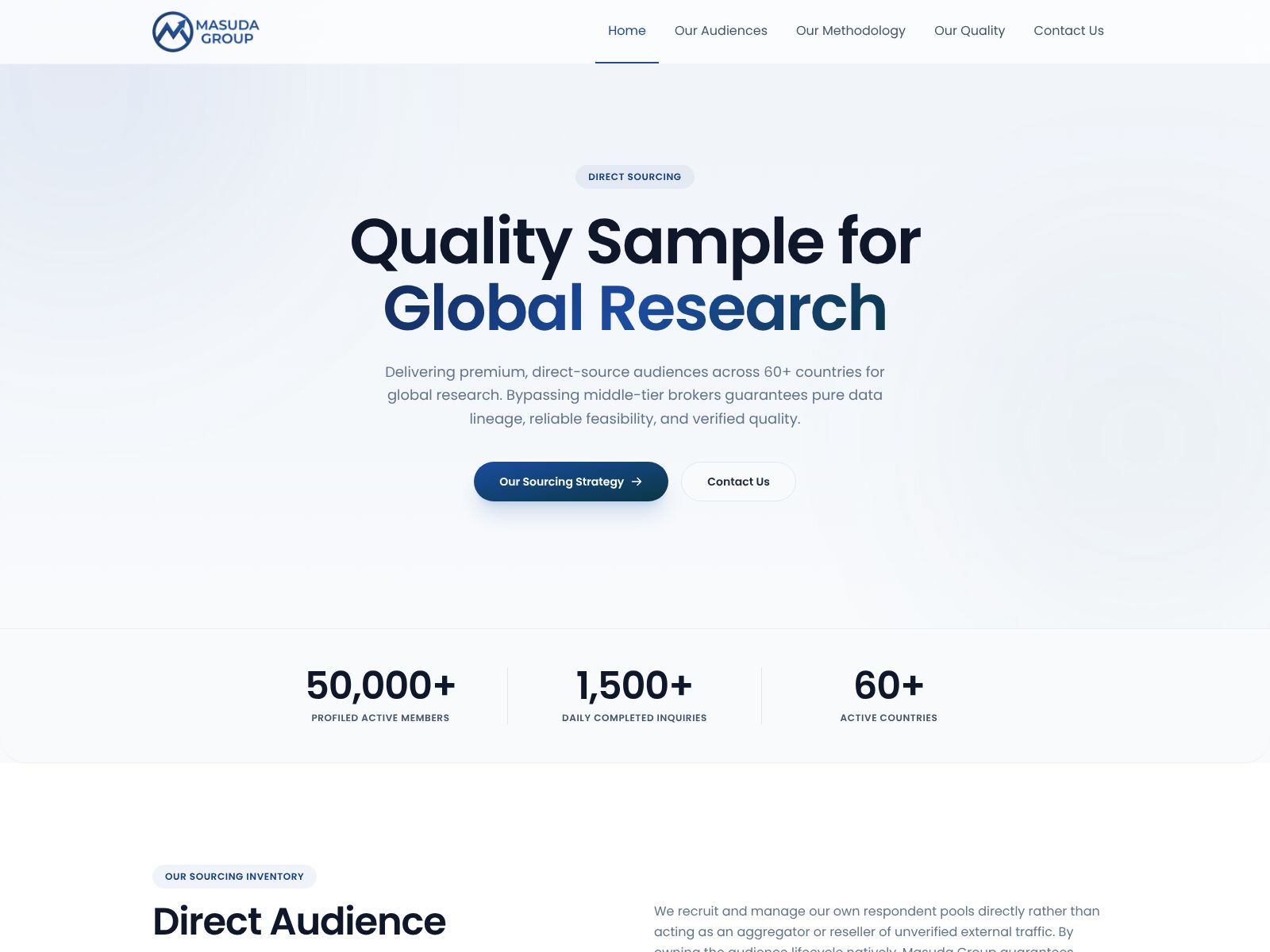
Masuda Group LLC delivers direct, first-party research audiences for enterprise market studies. We recruit, verify, and manage our own survey participants—no brokers or resellers—ensuring consistent sample quality, transparent data provenance, and full compliance. Our network spans 60+ countries across North America, Europe, Asia-Pacific, Latin America, and the Middle East & Africa, operating under GDPR, CCPA, and ESOMAR standards.

More About Masuda Group

Founded:
Total Funding:
$10,000.00
Funding Stage:
Pre-Seed
Industry:
Data & Analytics
In-Depth Description:
Masuda Group LLC is a direct-source audience supplier providing first-party respondent ecosystems for global enterprise market research networks. We recruit, verify, and manage our own respondent pools directly, with no brokers and no third-party resellers. This gives enterprise research buyers consistent sample quality, pure data provenance, and full compliance alignment on every project. Our network spans 60+ countries and 6 continents, covering North America, Europe, Asia Pacific, Latin America, and the Middle East and Africa. Our operations are aligned with GDPR, CCPA, and ESOMAR standards.
Masuda Group

Masuda Group Review & Overview (Features, Pricing, & Alternatives)

If you buy research sample for large studies, you already know the pain of juggling multiple brokers, worrying about data quality, and explaining provenance to your stakeholders. Masuda Group steps into that reality with a promise that speaks directly to enterprise needs: first-party audiences, sourced and managed directly, with global reach and tight compliance. In this review, I’ll walk you through what Masuda Group does, how it’s different, where it fits, what to expect on pricing, and which alternatives to compare it against. By the end, you’ll have a clear sense of whether it belongs on your shortlist for upcoming programs.

What does Masuda Group do?

Masuda Group is a direct-source audience supplier. They recruit, verify, and manage their own respondent pools across 60+ countries, without brokers or third-party resellers. That means you get first-party sample, clear data provenance, and compliance with standards like GDPR, CCPA, and ESOMAR for your market research projects.

Masuda Group Features

Masuda Group’s appeal comes down to three pillars: ownership of audiences, rigorous verification, and enterprise-grade governance. Here’s a closer look at the most relevant features and what they mean for your team.

1) First-party respondent ecosystems

Instead of stitching together respondents from marketplaces or reseller networks, Masuda Group builds and manages its own respondent pools. In plain terms, you’re getting people Masuda Group recruited and maintains directly, not a blend from unknown sources. For you, this reduces guesswork, makes sample behavior more predictable across waves, and makes post-field questions about recruitment methods easier to answer for internal review boards or clients.

2) No brokers or third-party resellers

When brokers and resellers layer into a study, control and transparency tend to erode. Masuda Group removes that layer by keeping sourcing and management in-house. This typically leads to fewer surprises mid-field, easier troubleshooting, and less risk of uneven quality between batches.

3) In-house recruitment, verification, and ongoing management

Masuda Group handles the full respondent lifecycle—from recruitment to ongoing verification and management—under one roof. While every supplier describes “quality checks,” what matters is the combination of ownership and process. Because Masuda Group owns the relationship with respondents, it can enforce consistent standards, spot anomalies faster, and align incentives toward long-term data quality instead of one-off throughput.

4) Pure data provenance and traceability

For enterprise buyers, provenance is more than a buzzword. It’s the backbone of auditability and the reason your compliance team will sign off—or not. Masuda Group’s first-party model means each response has a clean line back to an owned ecosystem. That clarity helps you defend sampling choices, explain recruitment channels, and document compliance actions without guesswork.

5) Compliance alignment (GDPR, CCPA, ESOMAR)

Regulatory and industry frameworks shape how you can collect, process, store, and use data. Masuda Group states that its operations align with GDPR, CCPA, and ESOMAR standards. In practice, this means consent handling, data minimization, rights requests, and data processing transparency are built into how projects run. For global enterprise teams, this alignment reduces friction with legal and privacy stakeholders and lowers the risk of compliance gaps.

6) Global reach across 60+ countries and 6 continents

Masuda Group’s network spans North America, Europe, Asia Pacific, Latin America, and the Middle East and Africa. If you run trackers across multiple regions or need comparable execution in new markets, this coverage lets you centralize vendor management while still fielding locally. It also simplifies cross-border coordination and speeds up feasibility checks when timelines are tight.

7) Consistent sample quality for enterprise studies

Blended sources can introduce variability that shows up as noise in your data. By standardizing sourcing and governance across its own ecosystems, Masuda Group aims for more consistent signal. For your team, this can mean cleaner baselines across waves, fewer re-contacts to replace bad completes, and less time scrubbing unexpected patterns during QA.

8) Alignment with enterprise research networks

Masuda Group is built for enterprise research networks—large buyer organizations, global agencies, and teams that operate at scale. The service model prioritizes coordination, documentation, and repeatability across markets and programs. If you handle multi-country trackers or centralized procurement for insights, this orientation will likely match how your workflows already run.

9) Flexible execution across study types

Because Masuda Group controls its respondent ecosystems directly, it can align recruitment and verification protocols to a range of standard market research designs—from ad testing to concept checks to brand tracking to audience profiling. The first-party model gives a consistent starting point, even as questionnaires, quotas, or geographies shift.

10) Clearer communication and fewer handoffs

Direct ownership often means shorter lines between your project team and the people making fielding decisions day-to-day. That can reduce delays when you need to update screeners, tweak quotas, or clarify edge cases mid-field. It also makes post-mortems and learnings more valuable since the same team can roll improvements into future waves.

How it typically works (a simple view of the engagement flow)

Every supplier has its own SOPs, but if you’re picturing how a first-party sample engagement runs with Masuda Group, you can expect a flow like this:

  • Scoping and feasibility: You share your target markets, audience definitions, screening criteria, sample sizes, estimated incidence, LOI, quotas, and timeline. Masuda Group confirms feasibility and flags any risk areas.
  • Compliance and governance: Consent language, data processing needs, and cross-border considerations get aligned up front so the project is compliant from day one.
  • Recruitment and deployment: Masuda Group recruits and invites respondents from its owned ecosystems, applies verification, and monitors live fielding for quality and pace.
  • Quality checks and remediation: Fraud, duplicates, and speeders are filtered; any anomalies trigger investigation and replacement completes as needed.
  • Delivery and documentation: Completes are delivered along with the documentation your stakeholders expect around sampling and compliance. This is where provenance and alignment pay off.
  • Post-project learning: Because Masuda Group owns the ecosystem, process improvements carry forward into future waves or markets without re-training a new vendor each time.

Who Masuda Group is best for

Not every team needs a first-party supplier. But if you see your situation in the list below, Masuda Group likely fits well.

  • Enterprise research networks: You coordinate projects across many countries and vendors today and want one partner to centralize first-party sourcing.
  • Compliance-heavy environments: Your legal or privacy teams require clear provenance, consent management, and alignment with GDPR, CCPA, and ESOMAR.
  • Long-running trackers: You need stable baselines and predictable quality across waves and regions, with minimal drift from blended sources.
  • Global coverage needs: You run multi-market studies and prefer consistency in sourcing and governance across North America, Europe, APAC, LATAM, and MEA.
  • Audit-ready teams: You’re often asked to document how, where, and from whom data was collected—and you want that story to be clean and defensible.

Benefits to expect

  • Higher control and visibility: Direct sourcing and ownership reduce layers and make the supply chain transparent.
  • Consistency across programs: First-party ecosystems offer more predictable quality wave-to-wave and market-to-market.
  • Stronger compliance posture: Alignment with GDPR, CCPA, and ESOMAR streamlines approvals and reduces risk.
  • Faster problem-solving: Fewer handoffs mean quicker changes to quotas or criteria during field.
  • Better provenance for stakeholders: Easier to explain and defend sampling methods and quality controls.

Tradeoffs to consider

  • Custom scoping vs. shelf pricing: Enterprise-first, first-party models usually price by project variables—this gives control but can take more time than clicking a marketplace order.
  • Niche or ultra-rare targets: Any supplier may need longer lead times for highly niche audiences; discuss feasibility early.
  • Process alignment: If your internal workflows are very marketplace-driven, you may need to adapt to a more managed, documentation-rich process.

Pricing: what to expect and how to plan

Masuda Group does not publish pricing publicly. Like most enterprise audience suppliers, costs are usually based on a mix of factors specific to each study. While the exact model comes from a custom quote, you can plan around these common drivers:

  • Audience incidence: Lower incidence audiences typically cost more per complete because they require more screening.
  • Length of interview (LOI): Longer surveys increase incentives and dropout management, affecting cost.
  • Sample size and quotas: Larger N and complex quota grids often increase cost and field time.
  • Geography: Country and region affect recruitment costs, reach, and regulatory constraints.
  • Timeline: Rush timelines may carry premiums to prioritize recruitment and monitoring.
  • Targeting depth: The more granular your screening criteria, the more effort required to source and verify.
  • Compliance and data needs: Extra consent flows, special data handling, or documentation can add scope.

To make budgeting smoother, approach pricing with a clear brief. Share your incidence assumptions, LOI, quota plan, and must-have vs. nice-to-have criteria. Build in time for feasibility feedback so you can adjust early and avoid downstream changes that add cost.

Quality and governance: why first-party matters

If you’ve ever replaced a surprising percentage of completes after QA, you know the hidden costs of uneven supply chains. First-party ecosystems aim to reduce those costs by controlling who gets invited, how they’re verified, and how incentives are managed. When the same organization recruits, verifies, and manages respondents across markets, you tend to see steadier data patterns, fewer outliers, and less churn from re-contacts. On top of that, clean provenance simplifies everything from IRB questions to client procurement audits.

Operational considerations for your team

  • Documentation: Expect stronger documentation around sampling, consent, and governance—which helps with stakeholder approvals.
  • Repeatability: If you intend to run multiple waves, align early on sampling definitions and verification criteria so they lock in across the program.
  • Localization: For multi-market studies, confirm localization expectations early (languages, cultural screening nuances, region-specific exclusions) to keep field speed on track.
  • Data handoff: Align on formats, redaction rules, and respondent-level metadata you need for analytics and compliance.

Masuda Group Top Competitors

You have many choices for sample supply. Here are reputable alternatives to compare with Masuda Group. Some focus on first-party communities, others on programmatic marketplaces, and some offer end-to-end insight platforms. Your best fit will depend on how much you value direct sourcing, how global your needs are, and how tightly you need to manage compliance.

  • Dynata: A large first-party data company with global reach across consumer and business audiences. Known for scale and breadth of panels, plus managed services and integrations.
  • Cint: A programmatic sample platform that connects buyers to a wide network of supply sources, including panels and publishers. Strong for teams that prefer marketplace flexibility and automation.
  • Toluna: Combines a global insights community with research tools and services. Useful if you want both audience access and an end-to-end platform for design and reporting.
  • Prodege: Owns consumer communities and loyalty platforms that power its sample supply. A good option for consumer-focused studies and rapid turnaround.
  • Kantar Profiles: Part of Kantar’s data and insights ecosystem, offering global panels with strong research heritage and governance practices.
  • PureSpectrum: A marketplace model with quality controls and a broad supplier network. Often chosen for speed and flexibility across multiple sources.
  • Ipsos (Ipsos iSay / Ipsos panels): Ipsos maintains respondent communities as part of a full-service research offering. Consider when you want audience access wrapped in agency support.
  • SurveyMonkey Audience / Momentive: Useful for quick-turn consumer research with a self-serve interface; better for simpler studies and broad consumer targets.

When comparing these providers to Masuda Group, focus on three questions:

  • How much direct control and provenance do you need? First-party ownership (like Masuda Group) vs. marketplaces (like Cint or PureSpectrum) changes your risk and visibility profile.
  • How global and standardized must your operations be? If you run coordinated trackers across 60+ countries, confirm that any alternative can match both coverage and governance.
  • What is your internal workflow? If your team relies on fully self-serve ordering, a marketplace or platform model may fit better; if you prioritize managed, audit-ready delivery, first-party suppliers typically shine.

How to choose: a quick checklist

Use this simple framework to make an apples-to-apples comparison between Masuda Group and alternatives:

  • Audience clarity: Does the vendor document where respondents come from and how they’re verified?
  • Compliance strength: Can they articulate GDPR/CCPA/ESOMAR alignment and provide necessary documentation on request?
  • Global coverage: Can they support your planned countries now and in future waves, with localization as needed?
  • Quality KPIs: What metrics do they report (incidence accuracy, dropout, replacement rate, fraud rate)? How do they act on anomalies?
  • Operational fit: Does their process align with your procurement, data governance, and study design workflows?
  • Cost predictability: Do they scope clearly, flag risk early, and help you optimize without undermining quality?
  • Repeatability: Will quality and process be stable across programs and waves, or will it vary by region or project manager?

Practical tips for getting the most from a first-party supplier

  • Lock your definitions early: Agree on target audience, exclusions, and verification criteria up front; it saves time and rework.
  • Share past learnings: If you’ve seen bad question behavior or fraud patterns before, share examples so the team can preempt them.
  • Pilot when possible: A small pilot can validate incidence, LOI, and screening flow before scaling up.
  • Track the right signals: Ask for periodic snapshots of quality indicators during field so you can adjust quickly.
  • Document for reuse: Keep a shared checklist of what worked well and what to refine; apply it to the next market or wave.

Where Masuda Group stands out

The core differentiator is its first-party, direct-source model at global scale. If your top priorities are clean provenance, predictable quality, and strong compliance alignment, Masuda Group fits the enterprise playbook. The worldwide coverage (60+ countries, 6 continents) is particularly useful for coordinated programs where you want the same standards applied in every region. And because recruitment, verification, and management are in-house, communication lines tend to be shorter, which helps when timelines are tight and stakes are high.

Where to ask deeper questions

Any time you evaluate a supplier for enterprise programs, dig into how their approach holds up under pressure. Useful areas to probe include:

  • Verification specifics: Without needing proprietary details, understand the checks used to manage fraud, duplicates, and inattentive behavior.
  • Niche targeting: Ask how they approach ultra-low-incidence targets and what timelines or sample strategies they recommend.
  • Wave-to-wave controls: Learn how they keep baselines stable in longitudinal trackers and how they handle panel fatigue or churn.
  • Compliance workflows: Confirm how consent, data rights requests, and cross-border data handling are operationalized.
  • Documentation depth: Ensure the project-level documentation will satisfy your internal reviews and procurement audits.

What success looks like with Masuda Group

Success with a first-party supplier usually shows up in a few repeatable ways: feasibility calls that surface risks early, field that runs close to plan, quality checks that catch issues before delivery, and documentation that stands up to scrutiny. Over time, you should see steadier incidence estimates, fewer unexpected replacements, and easier approvals from legal and compliance. If you run multi-market trackers, you should also see less variance driven by source changes and more genuine signal from your markets.

How to get started

If you’re considering a pilot with Masuda Group, prepare a concise brief that includes audience definitions, geographies, LOI, sample sizes, quotas, and any compliance or documentation requirements. Ask for feasibility and an outline of verification and reporting. If the match looks good, start with a pilot or a single market before expanding to multi-market or multi-wave programs. This lets you validate fit while building internal confidence and forecasting accuracy.

Wrapping Up

Masuda Group offers a clear value proposition for enterprise research buyers: first-party, directly sourced audiences with rigorous verification, global coverage across 60+ countries, and alignment with GDPR, CCPA, and ESOMAR. If you need consistent sample quality, pure provenance, and audit-ready compliance for multi-market programs, it deserves a place on your shortlist.

Compared with marketplace-driven alternatives, Masuda Group’s first-party model trades a bit of on-demand convenience for control, predictability, and governance—tradeoffs many enterprise teams are happy to make. As you evaluate suppliers, focus on provenance, verification, compliance, and repeatability across regions and waves. If those are your priorities, Masuda Group is built for the way you work.

To explore fit for your next study or tracker, visit Masuda Group’s site and request a feasibility check with your target audience and markets. A short pilot can confirm assumptions and set you up for smoother execution at scale.