




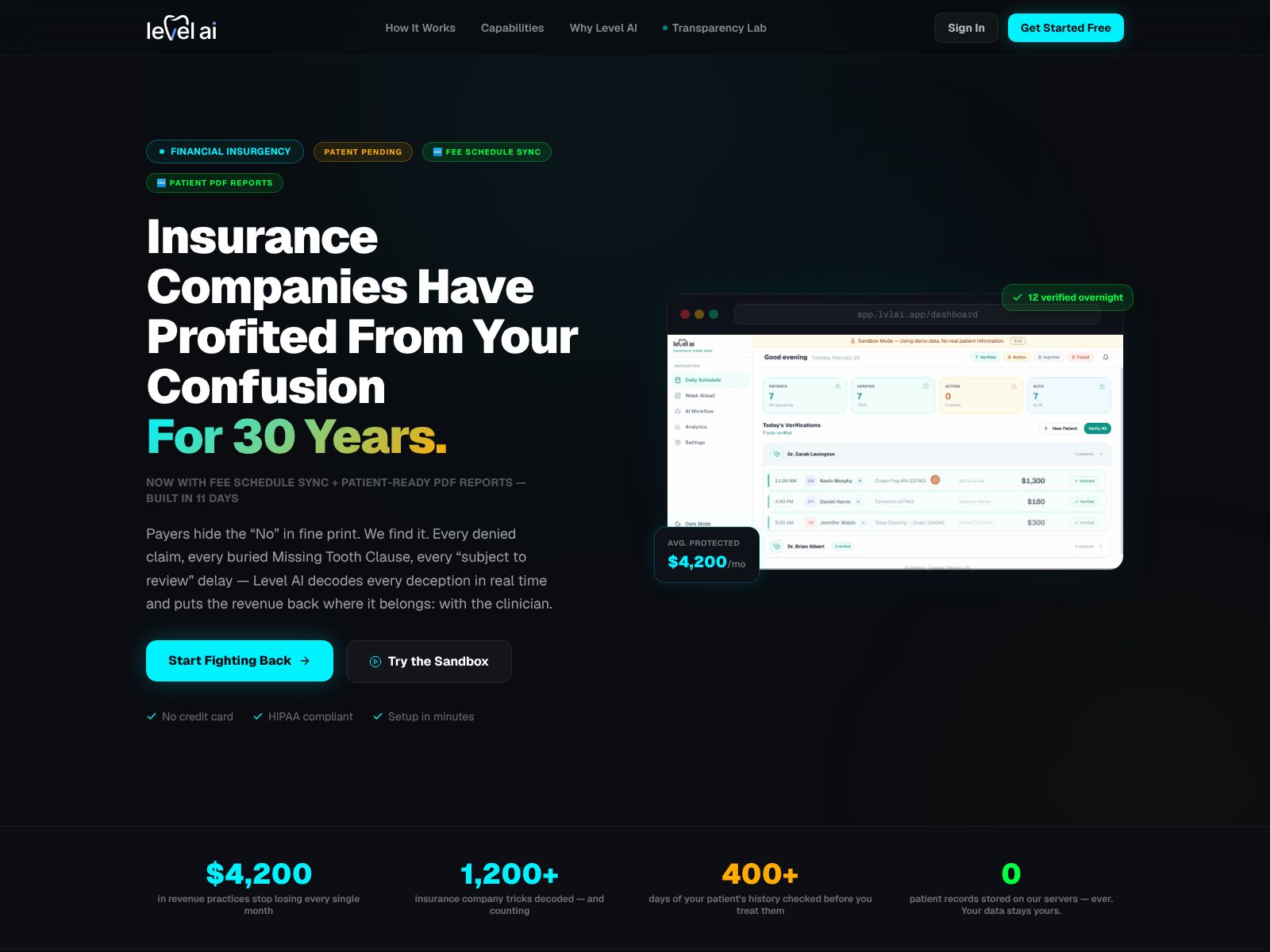
If you manage a dental practice, you know how much time and money can disappear into insurance verification, pre-authorizations, and claim denials. It slows your front office, delays collections, and frustrates patients. level ai is built to fix that. It’s an AI-powered platform designed specifically for dental revenue cycle workflows. It helps your team verify benefits, automate pre-auths, predict potential denials before you submit claims, and write everything back into your practice management system—without storing protected health information (PHI). In this review, you’ll get a clear picture of what level ai does, who it’s best for, how it works, its strengths and trade-offs, and which alternatives you might compare it against.
level ai automates core insurance tasks in your dental practice. It verifies patient eligibility, automates pre-authorizations, flags claims likely to be denied before you submit them, and sends structured results back into systems like Open Dental, Dentrix, and Eaglesoft. It also supports automated faxing and patient communication. The platform uses a stateless architecture to avoid storing PHI while supporting HIPAA compliance, helping your team work faster and reduce denials without creating more security risk.
Here’s a closer look at the core capabilities you can expect from level ai:
Stop spending hours on payer portals and phone queues. level ai verifies patient eligibility and benefits for you, returning structured data your team can actually use. Because it writes results back into your practice management system, your front desk doesn’t have to copy and paste or re-key details.
Pre-authorizations (predeterminations) are unavoidable for many procedures, but they don’t have to be tedious. level ai automates the prep and submission workflow so your team can move from case acceptance to treatment faster. By standardizing the process, it reduces back-and-forth and the risk of missing information.
Claim denials are expensive and time-consuming. level ai uses a machine learning engine to predict which claims are at risk before you submit them. If a claim is likely to be denied, your team can fix the issue—like missing attachments, coding conflicts, or benefit limitations—up front, which can improve first-pass acceptance and speed collections.
Data shouldn’t live in silos. level ai writes structured results directly into leading dental practice management systems, including Open Dental, Dentrix, and Eaglesoft. This keeps your patient records, claim notes, and verification details centralized and eliminates duplicate data entry.
Many payers and specialists still rely on fax. level ai includes automated faxing so your team can send and receive documents without jumping between systems or paper-based steps. This is especially useful for attachments, pre-auth documentation, and payer requests for additional information.
Clear communication reduces surprises for patients and for your team. level ai includes tools to reach patients with updates or requests related to insurance information, helping you finalize eligibility or collect missing details ahead of appointments.
Unlike generic RCM software, level ai is purpose-built for dental. That means it understands the quirks of dental benefits, codes, predeterminations, and typical attachment requirements—so your workflows align with real-world dental operations.
Security and compliance are front and center. level ai operates on a stateless architecture intended to avoid storing PHI while still supporting HIPAA compliance. This design reduces data exposure while still giving your team what they need to process claims efficiently.
While you don’t need to be technical to use it, it’s helpful to know how level ai fits into your day-to-day:
Because the platform is designed to avoid storing PHI and supports HIPAA compliance, you get automation without unnecessary data retention risks. The big value is speed and accuracy: fewer errors, fewer denials, and more time for your team to focus on patients.
level ai is a strong fit if you want to modernize your insurance workflows without swapping out your core practice software. It’s especially helpful for:
If your practice struggles with denials, spends too much time on phone calls, or has long delays between treatment planning and case acceptance due to insurance bottlenecks, level ai is worth a serious look.
Every practice is different, but the typical onboarding flow looks like this:
Change management is often the biggest hurdle. Pick a pilot location or a subset of providers, gather feedback, and then roll out across the practice or DSO with refined settings. Because level ai is designed to fit into your existing software, the transition can be smoother than moving to a brand-new PMS or clearinghouse.
level ai is designed with a stateless architecture intended to avoid storing protected health information while supporting HIPAA compliance. For many practices, that’s reassuring—especially if you’ve been burned by disconnected tools that scatter PHI across inboxes, faxes, and personal files. With level ai, the aim is to process data, deliver structured results back to your PMS, and minimize persistent exposure.
As always, you should confirm your own compliance requirements, business associate agreements (BAAs), and any security reviews your organization needs. But the platform’s design choices signal a strong focus on privacy and safe handling of sensitive information.
level ai uses a vertical, enterprise-grade approach rather than a consumer-style plan picker. Pricing typically depends on factors like practice size, number of locations, monthly verification and claim volume, and which modules you use (e.g., eligibility, pre-auths, automated faxing, patient communication). To get exact numbers, you’ll need to contact the company for a quote.
If you’re building a business case, focus on the ROI drivers you can measure:
Even modest improvements in these areas can outweigh the cost of a specialty platform if your practice has meaningful insurance volume.
Here’s a balanced view to help you decide:
When you compare level ai, you’ll find it sits between traditional clearinghouses and full-blown practice management systems. It’s a vertical automation layer focused on dental insurance operations. Here are top alternatives and how they differ:
What it is: A long-standing dental clearinghouse offering claims, eligibility, predeterminations, and attachments.
How it differs: DentalXChange is a clearinghouse first. It’s strong for payer connectivity, EDI, and attachments. While it offers eligibility and predeterminations, it doesn’t center on AI-driven denial prediction or stateless architecture in the way level ai does. If you mainly need robust clearinghouse connectivity and your team is comfortable with portal workflows, DentalXChange is a solid choice.
What it is: A major network for dental claims, eligibility verification, and payer connectivity.
How it differs: Similar to other clearinghouses, the emphasis is on transaction rails and payer connections rather than predictive denial analytics. If you prioritize breadth of payer connections and already use a PMS integration through Change Healthcare, it may fit your stack. If you want pre-submission denial prediction and structured write-back with AI-driven workflows, level ai is the more specialized option.
What it is: A platform known for claims, attachments, and communications for dental practices.
How it differs: Vyne Dental focuses on documentation and claims attachments along with communications. It’s valuable if your main bottleneck is gathering and routing documentation. level ai, by contrast, pushes further into automation around eligibility, pre-auths, denial prediction, and PMS write-back.
What it is: An outsourced RCM service where specialists handle your claims follow-up, posting, and appeals.
How it differs: eAssist is people-driven, not a software automation layer. If you want to offload the work to a partner, eAssist can make sense. If you prefer to keep operations in-house but supercharge them with automation and AI, level ai is the more software-centric route.
What it is: A dental RCM automation platform aimed largely at DSOs, with tools for claims management and payer intelligence.
How it differs: There’s overlap in the goal—modernize dental RCM. Zentist focuses on claim workflows and analytics at scale. level ai carves out a strong position in pre-submission denial prediction and tight PMS write-back alongside eligibility and pre-auth automation. For DSOs, both are worth evaluating side by side based on your specific bottlenecks.
What it is: Built-in or add-on services from your existing PMS for eligibility, claims, and sometimes predeterminations.
How it differs: Staying within your PMS can be simple and familiar. However, the depth of automation, AI-driven denial prediction, and cross-workflow orchestration may be more limited than a dedicated platform like level ai. If you need advanced automation without switching PMS, level ai slots in as a specialized layer.
Use your current bottlenecks to guide the decision:
Does level ai replace my clearinghouse?
Not necessarily. You can think of level ai as an automation and intelligence layer that works alongside your PMS and clearinghouse. It helps you catch problems early, standardize workflows, and reduce manual steps.
Do I need to switch from Open Dental, Dentrix, or Eaglesoft?
No. level ai integrates with those systems and writes structured data back to them, which is one of its key strengths.
Will my team still review results?
Yes. Automation speeds up the work and highlights issues, but your team can review and approve before moving forward—especially for higher-risk cases.
What about HIPAA and PHI?
level ai is built on a stateless architecture designed to avoid storing PHI while supporting HIPAA compliance. As with any vendor, confirm details during security review and ensure you have appropriate agreements in place.
How quickly can we see ROI?
It depends on your volume and baseline metrics. Practices that process many insurance cases, face frequent denials, or rely on manual pre-auths usually see impact faster—often as soon as workflows stabilize and the team trusts the system.
If insurance tasks are slowing your practice, level ai gives you a focused, dental-specific automation layer that helps you verify benefits, automate pre-authorizations, and prevent denials before they happen. It integrates with Open Dental, Dentrix, and Eaglesoft, writes structured data back to your charts, and uses a stateless architecture designed to avoid storing PHI while supporting HIPAA compliance. While you’ll want a custom quote and a short pilot to confirm fit, the value proposition is straightforward: fewer denials, faster collections, and a front office that can spend more time with patients and less time wrestling with portals and faxes.
To learn more or request a demo, visit lvlai.app.
