




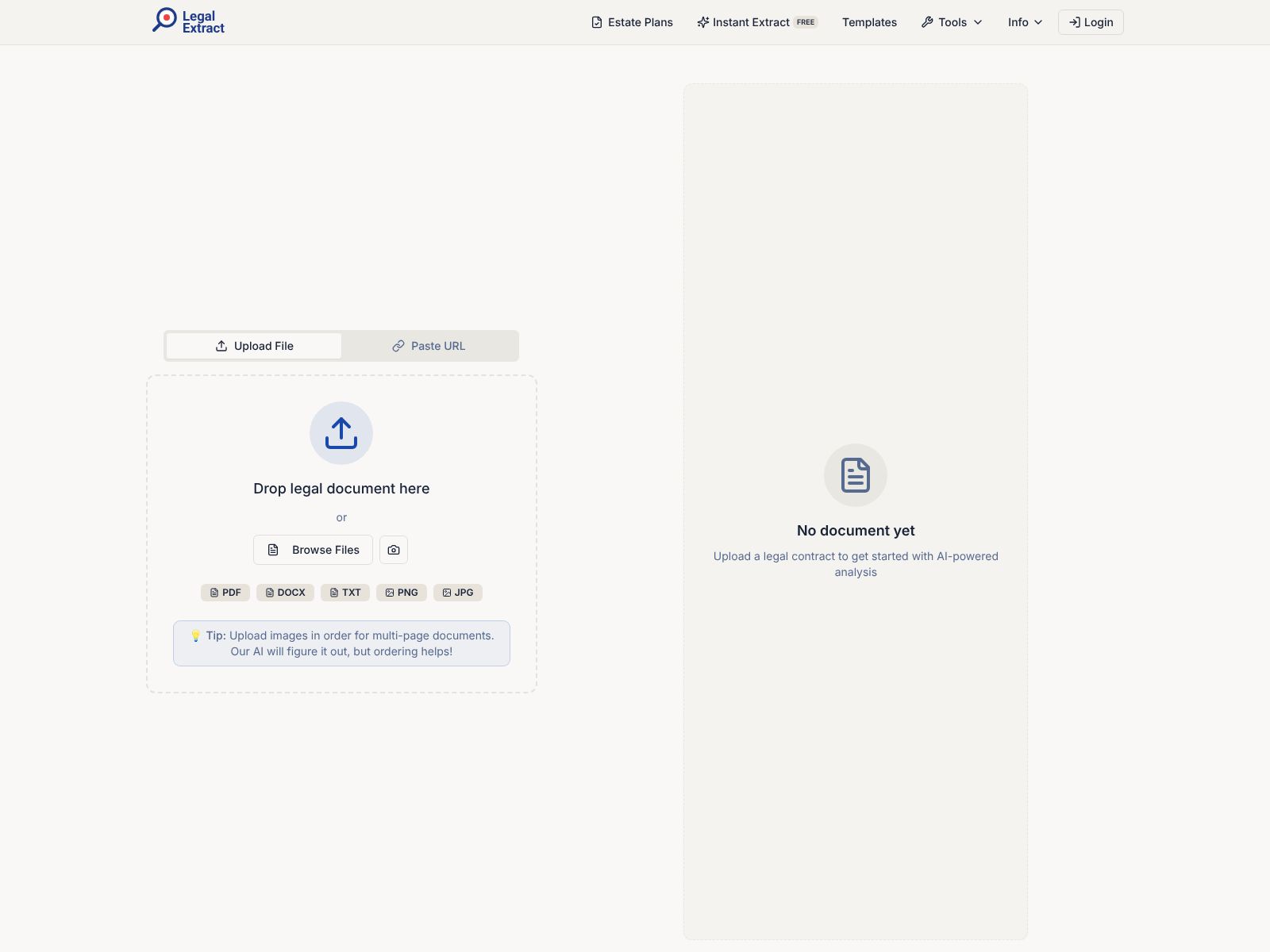
If you’ve ever felt overwhelmed by contracts, leases, or estate planning documents, you’re not alone. Legal language is dense, time-consuming, and risky to skim. Legal Extract AI aims to fix that. It’s an AI-powered contract and document intelligence platform designed to help you understand what matters fast, prepare for negotiations with confidence, and even generate legal documents with consistency and control.
In this review, I’ll walk you through what Legal Extract AI does, where it shines, what to watch for, how it compares to alternatives, and what types of teams will get the most value. My goal is to help you decide if it’s a good fit for your legal and business workflows.
Legal Extract AI analyzes contracts and legal files to pull out key terms, obligations, risks, and hidden clauses, then presents those insights in a clear, structured format. It also includes tools for deal intelligence (especially helpful in real estate), negotiation prep, and legal document creation using configurable templates and clause libraries. In short: it helps you review faster, negotiate smarter, and draft with consistency.
Upload your contracts and legal files and Legal Extract AI scans them for the details you care about. It extracts and organizes:
You get a standardized summary that makes it easy to compare documents side by side. This consistency is a big deal. When everything is normalized, you can actually audit your portfolio and make decisions, instead of hunting through PDFs one by one.
Real estate contracts have their own landmines. Deal Extract focuses on what matters most in property transactions. It surfaces:
If you’re evaluating offers, managing leases, or working through due diligence, this feature helps you prioritize and act. You can avoid surprises and enter negotiations with a clear plan.
Good negotiation starts with clarity. Legal Extract AI turns contract language into practical talking points. It helps you identify:
Negotiation Prep gives you strategic guidance you can take into a call or email right away. It’s like a smart brief based on the exact language in your document.
Beyond analysis, Legal Extract AI supports drafting and managing legal documents. You can create and maintain configurable templates and modular clause libraries, so your team uses approved language every time. This is helpful for standard agreements and for estate planning documents such as trusts, wills, and related planning instruments.
Built-in version control and change oversight keep everyone aligned. You can track edits, see what changed, and ensure final documents match your policy and risk tolerance.
One of the biggest benefits is standardization. Instead of ad-hoc notes, you get structured fields and normalized outputs across your documents. That means you can filter, compare, and roll up insights across deals or vendors. It’s what turns contract data into an operational asset.
Because key terms and clauses are captured in a structured way, you can search and filter across your repository. For example, you can quickly find every agreement with auto-renewal, every lease with a specific break clause, or every vendor contract that lacks a data security addendum. This makes portfolio risk reviews and renewal planning much easier.
Legal Extract AI is built to be used by both legal and business users. You can share summaries, notes, and negotiation points with your team, keep everyone focused on the same issues, and move deals forward without endless email threads. Exports come in handy when you need to share insights with stakeholders or advisors.
Legal work is collaborative and iterative. The platform’s version control helps you manage drafts and compare changes over time. You can standardize who can edit templates, who approves changes, and how final language is selected. That means fewer mistakes and a cleaner audit trail.
Legal documents are sensitive. While specific certifications and technical details should be confirmed directly with the vendor, teams typically look for the following in solutions like Legal Extract AI:
If you handle regulated or highly sensitive data, ask the Legal Extract AI team about their security posture, data isolation, and compliance standards before you roll it out broadly.
Pricing can vary by team size, document volume, and feature needs. At the time of writing, detailed pricing is not publicly listed. Expect modern AI legal platforms to offer one or more of the following models:
Your best move is to request a quote from the Legal Extract AI team, share your typical monthly document volume and user count, and ask for a pilot. When evaluating cost, compare it to your current review cycle times, outside counsel spend, and the risk reduction from catching issues earlier.
The legal technology market is broad. Here are notable alternatives and how they compare at a high level:
Evisort is known for contract intelligence and repository search. It excels at extracting data from large contract portfolios and making it searchable for legal and business users. Compared to Legal Extract AI, Evisort is a strong choice for enterprise-scale contract data visibility, though it may be heavier to implement. Legal Extract AI places more emphasis on deal intelligence, negotiation prep, and document assembly within a single workflow.
Kira is a long-standing tool for due diligence and contract review, especially in M&A contexts. It’s respected for clause extraction accuracy across large document sets. If your main use case is big-batch diligence, Kira is a proven option. Legal Extract AI is broader, combining analysis with negotiation guidance and document creation, and it aims to be accessible to both legal and business users.
Luminance focuses on AI-powered document review and anomaly detection. It’s popular for large reviews and compliance work. If you want pattern detection at scale, Luminance is worth a look. Legal Extract AI stands out if you want built-in negotiation prep and modular document assembly alongside analysis.
Ironclad is a contract lifecycle management (CLM) platform with AI features. It’s strong on workflow orchestration, approvals, and integration across the business. Teams seeking deep CLM may prefer Ironclad. If you prioritize fast analysis, deal-specific insights, and estate planning templates in the same system, Legal Extract AI may be more focused on your needs.
DocuSign Insight is geared toward finding and reporting on contract terms at scale. It’s well-suited for organizations that already rely on DocuSign’s ecosystem. Legal Extract AI, in contrast, folds analysis into negotiation prep and drafting workflows, giving smaller teams a nimble end-to-end toolset.
LinkSquares helps in-house legal teams manage contracts, track obligations, and report on risk. It offers analytics and repository features. If your priority is post-signature visibility and reporting, LinkSquares is strong. Legal Extract AI emphasizes pre-signature analysis and negotiation readiness, plus document generation capabilities.
Agiloft is a flexible CLM with strong customization and enterprise workflows. It’s great when you need very specific processes. Legal Extract AI is a quicker path to value if your main goal is to review, negotiate, and draft with AI assistance rather than standing up a full-blown CLM.
LawGeex focuses on automated review of standard agreements against your playbook, especially for NDAs and vendor contracts. It’s strong in structured, repetitive reviews. Legal Extract AI provides similar acceleration but extends into negotiation prep and customizable document generation, with specialized support for real estate and estate planning contexts.
ThoughtRiver offers AI pre-screening of contracts to highlight risks and deviations. It’s designed to help legal teams triage and focus. Legal Extract AI covers that ground and adds deeper deal insights and drafting tools, which may reduce the number of separate tools you need.
BlackBoiler automates markup against your playbook, which is useful for high-volume, template-driven negotiations. If line-by-line markup automation is your main target, it’s a good fit. Legal Extract AI, on the other hand, equips you with analysis and strategic talking points, then supports document generation when you need to propose clean, consistent language.
Spellbook integrates AI into your drafting environment to suggest clauses and accelerate contract writing. For lawyers who live inside Word, it’s a supportive assistant. Legal Extract AI intersects with this use case through its templates and clause libraries but also brings portfolio analysis and negotiation prep to the table.
Use a CLM like Ironclad or Agiloft if your core problem is end-to-end contract workflow, approvals, and integrations across the enterprise. Choose a portfolio-focused platform like Evisort or LinkSquares if your main pain is finding information across thousands of agreements. Consider Legal Extract AI if you want an end-to-end solution centered on understanding documents quickly, preparing for negotiations, and drafting standardized documents—especially if you work with real estate agreements or estate planning paperwork.
Pros
Cons
If you’re ready to try it, map a short pilot. Pick 20–50 documents you review often, define what fields and risks you care about, and configure a first pass of your template and clause library. Run live deals through Negotiation Prep and collect feedback from both legal and business users. Within a few weeks, you should see faster turnaround and clearer decisions.
To learn more or book a demo, visit legalextract.ai.
Legal Extract AI brings analysis, deal intelligence, negotiation prep, and document generation into one streamlined system. It helps you understand complex documents fast, prepare better asks and alternatives, and keep your language consistent across matters. If you’re managing contracts at scale, working through real estate transactions, or standardizing estate planning documents, it’s a compelling option to consider.
No AI can replace expert legal judgment, but the right platform can put you miles ahead by making legal work clearer, faster, and more consistent. If those outcomes matter to you, add Legal Extract AI to your short list and see how it fits your workflow.
