
LaunchPalNo Logo Placeholder
MarTech

LaunchPal

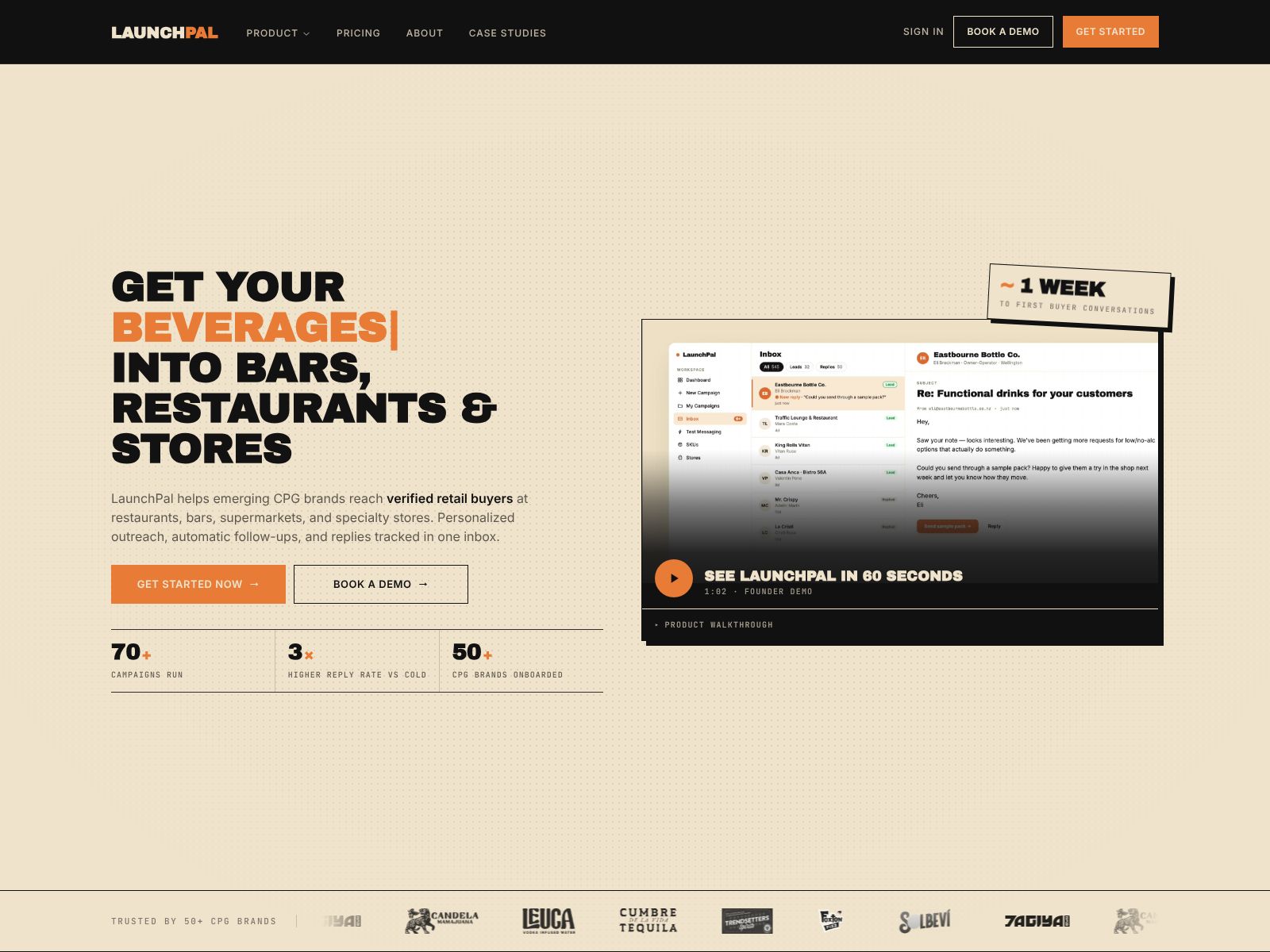
LaunchPal is an all-in-one platform that replaces manual distribution for CPG brands. Define target venues, pick territories, and launch campaigns while AI finds, verifies, and qualifies decision-makers using 39+ data points, then runs structured, personalized outreach. Track replies, conversations, and deals in a single visual dashboard.

More About LaunchPal

Founded:
Total Funding:
Funding Stage:
Pre-Seed
Industry:
MarTech
In-Depth Description:
LaunchPal replaces the manual distribution motion with one platform for Consumer Product Good brands. It helps define their target venues, select a territory, and launch a campaign. Our AI finds, verifies, and qualifies real decision-makers across 39+ data points, then runs structured personalised outreach. Brands track replies, conversations, and deals on one visual dashboard.
LaunchPal

LaunchPal Review & Overview

If you sell a consumer product, you already know the hardest part often isn’t making a great item—it’s getting on the shelf and staying there. Prospecting venues, finding the right retail buyers, crafting outreach, and tracking conversations across a growing pipeline can quickly become a manual grind. LaunchPal was built to replace that grind with a focused platform for consumer brands. In this review, I’ll walk you through what LaunchPal is, the core features, where it fits compared to alternatives, and how to think about whether it’s right for your team.

By the end, you’ll have a clear picture of how LaunchPal helps you define your target venues, pick a territory, run personalized outreach to real decision-makers, and track replies, conversations, and deals in one visual dashboard.

What does LaunchPal do?

LaunchPal helps consumer product brands find the right stores and the right people who make buying decisions, then sends them structured, personalized messages and tracks the results in one place.

Who is LaunchPal for?

LaunchPal is purpose-built for consumer brands that are growing into retail and foodservice channels—typically CPG teams who want a repeatable distribution motion without juggling multiple tools. You’ll get the most value if:

  • You’re entering new territories and want to quickly identify target venues and buyers.
  • Your team spends too much time building lists, guessing contacts, or juggling spreadsheets.
  • You need to scale outreach while keeping messages relevant and personalized.
  • You want a visual way to track replies, meetings, and deal progress.

It also fits brokers, field sales teams, and agencies who manage outreach for multiple brands and need a consistent, measurable system.

Why LaunchPal matters now

Discovery and distribution used to revolve around trade shows, in-person visits, and rolodexes. Those still matter, but they don’t scale for every brand or every territory. Buyers are busy, and they receive a stream of generic pitches every day. If you can target the right venue, reach the true decision-maker, and send a relevant message at the right moment, you win more distribution with fewer touches. LaunchPal focuses on that end-to-end motion so your team can spend less time hunting and more time closing.

LaunchPal Features

Here’s a closer look at how LaunchPal replaces manual distribution work with one connected workflow.

1) Target venues and define your territory

LaunchPal helps you choose where to focus by defining the venues that fit your product and selecting the territories you want to penetrate. Instead of chasing a broad, unfocused list, you set clear boundaries from the start—whether that’s a specific region (for example, the Mid-Atlantic), a city list, or venue types (independent grocers, specialty stores, cafes, gyms, salons, and more).

Why this matters: Territory clarity prevents spray-and-pray outreach. Your team aligns around the same market plan and concentrates effort where you can create momentum.

2) Find, verify, and qualify real decision-makers

The difference between a cold email and a conversation is usually the person you contact. LaunchPal’s AI searches across 39+ data points to find, verify, and qualify real decision-makers at target venues. That means you spend less time guessing job titles or emailing generic inboxes, and more time reaching buyers, category managers, owners, or GMs who can actually say yes.

Why this matters: Accurate contact discovery and verification reduces bounces, protects your sender reputation, and increases connection rates—especially critical if you’re ramping outreach in a new territory.

3) Structured, personalized outreach at scale

Once you’ve locked in your venues and contacts, LaunchPal runs structured outreach. The goal is to send personalized messages that reference the venue, category, region, or other known details—without making you hand-craft every note. You can standardize your approach while allowing for personalization where it counts.

Why this matters: Consistency plus relevance beats sporadic one-off emails. Structured outreach allows you to test, learn, and improve messaging across campaigns and territories.

4) Visual dashboard for replies, conversations, and deals

Instead of jumping between email, spreadsheets, and a CRM, LaunchPal centralizes the retail pipeline. You can see who replied, which conversations are active, and where deals stand—all on one visual dashboard. That makes it easier to prioritize follow-ups, coordinate handoffs inside your team, and report on progress.

Why this matters: Visibility drives better decision-making. With a clear view of outreach health and deal stages, you can reallocate effort, coach reps, and forecast with more confidence.

5) Campaigns you can learn from

Campaigns are the heartbeat of LaunchPal. Define your audience (by venue, territory, or persona), choose your message structure, and then let the platform execute while you monitor performance. Over time, you can double down on what’s working and refine the rest. This helps you build a repeatable distribution motion, not just a one-time push.

6) Data quality and verification

Bad data breaks outreach. LaunchPal’s emphasis on finding, verifying, and qualifying contacts across many data points is designed to keep your lists clean and relevant. While every database has gaps, the process of verification before outreach is key to maintaining deliverability and avoiding wasted touches.

7) Collaboration for sales and brand teams

If you work across brand, sales, and operations, you need a shared picture of distribution efforts. LaunchPal brings conversations and deal context into one place so anyone on your team can pick up a thread, add notes, or keep a buyer moving forward without losing history.

8) Practical guardrails and best practices

Outreach can go sideways if it’s not respectful, compliant, and targeted. LaunchPal’s structured approach encourages better practices: contact relevant buyers, time your follow-ups, and keep messages meaningful. You should still review local regulations and your own compliance needs, but a disciplined system helps you avoid the pitfalls of “spray email” tactics.

What LaunchPal is not

To set expectations, LaunchPal is focused on the distribution motion for consumer brands. It’s not a wholesale marketplace, e-commerce storefront, or full CRM replacement for every team. If you need marketplace order management or direct wholesale transactions, a marketplace platform might be a better fit. If you need deep customer success workflows, you’ll still want your CRM. Think of LaunchPal as the engine for retail prospecting, outreach, and deal tracking—especially useful when you’re pushing into new stores and regions.

A day in the life with LaunchPal

Here’s a simple snapshot of how your team might use LaunchPal in a typical week:

  • Monday: Choose a target territory (for example, Chicago metro). Select venue types that match your price point and category.
  • Tuesday: LaunchPal’s AI finds and verifies decision-makers in those venues across many data points. You approve or adjust targets.
  • Wednesday: Build a campaign with a message that references the venue’s category or local relevance. Schedule structured outreach.
  • Thursday: Review replies in the dashboard. Triage meetings, send follow-ups, and log any additional notes about buyer preferences.
  • Friday: Evaluate campaign performance. Double down on messages that get positive responses, tweak the rest, and queue the next wave.

This rhythm is what turns distribution into a process, not a once-a-quarter push that loses steam.

Strengths

  • Purpose-built for consumer brands: You don’t have to force-fit a generic sales tool into a retail distribution workflow.
  • End-to-end focus: From venue targeting to buyer discovery to outreach and deal tracking, the basics are all connected.
  • Verified decision-makers: Reduces the guesswork and improves the odds your message reaches someone who can act.
  • Structured personalization: Scales outreach without stripping away relevance.
  • Clear visibility: The dashboard view of replies, conversations, and deals helps teams prioritize and report.

Limitations and caveats

  • Not a wholesale marketplace: If your primary need is to receive inbound orders from retailers, consider marketplaces alongside LaunchPal.
  • Still requires good messaging: The platform gives you structure; you still need a compelling story, proof points, and offers.
  • Coverage varies by category and region: As with any data-driven platform, depth can vary. Evaluate coverage in your specific niche and territories.
  • Complementary to your CRM: If you rely heavily on a CRM for broader pipelines, plan how LaunchPal and your CRM will work together.

Use cases

  • Emerging beverage brand entering independent grocers in the Northeast: Define metro areas, target natural/specialty grocers, find category buyers, and run a sequence that references local demand and merchandising fit.
  • Beauty brand expanding into salons and spas: Identify venues that match your price point, discover owners/managers, and send concise pitches that link product benefits with service menus and retail margins.
  • Better-for-you snack brand pitching college campuses and cafes: Map campus dining and nearby cafés, find decision-makers, and run a campaign tied to seasonal traffic and student events.
  • Regional baked goods brand approaching mid-size chains: Build an outreach track for category managers with data on rotations, case sizes, and sell-through from current placements.

Pricing

LaunchPal’s website highlights capabilities rather than a detailed public pricing page. If pricing isn’t listed at the time you read this, the best next step is to request a demo and get a quote that matches your team size, territories, and campaign volume. When you evaluate cost, compare it to a stack you might piece together on your own (data provider + outreach tool + verification + a CRM setup) and the internal time spent gluing that workflow together.

Questions to ask when you scope pricing:

  • What’s included in the base plan (seats, territories, campaigns)?
  • How is contact discovery and verification metered?
  • Are there onboarding or support fees?
  • What happens if you scale to more regions or add a broker/agency partner?

How LaunchPal compares to alternatives

No single tool solves every distribution need. Here are the main categories you might compare with LaunchPal, plus how they differ.

1) Retail discovery platforms

  • RangeMe: A product discovery platform where buyers can discover brands. Great for inbound exposure and discovery, but not built for outbound, structured outreach to specific venues.
  • WeStock: Helps mobilize consumer demand to request your product at retailers. Useful for proof of demand, but different from a targeted buyer outreach workflow.

When to choose: If your strategy leans on being discovered by buyers or proving consumer pull before outreach, these can complement LaunchPal rather than replace it.

2) Wholesale marketplaces

  • Faire, Abound, Tundra, Mable: Marketplaces that connect brands with independent retailers and boutiques. They streamline ordering and payments but do not focus on targeted outreach to specific buyer roles at larger venues.
  • Pod Foods (for certain categories): A marketplace-plus-distribution approach for emerging brands in grocery, with logistics built in.

When to choose: If your goal is to accept wholesale orders from independents quickly, a marketplace can drive immediate transactions. If you’re pushing into chains, category buyers, or specific venues, LaunchPal’s targeted motion is a better fit.

3) Sales engagement and lead data tools

  • Apollo.io, ZoomInfo SalesOS, Clay, and similar: Powerful data plus sequencing tools that work across many industries. You’ll likely need to configure venue targeting, build your own buyer personas, and connect additional systems to track pipeline.
  • Lemlist, Reply.io, Mailshake: Email-first outreach tools with personalization features, better suited when you already have reliable contact data and a separate system for deal tracking.
  • Salesloft, Outreach: Enterprise sales engagement focused on tech and B2B motions, strong for SDR/AE teams but not specialized for CPG distribution flows.

When to choose: If your team is comfortable building a stack and you want complete flexibility across industries, these can work well. LaunchPal’s edge is a ready-made workflow for consumer brand distribution, including venue targeting and decision-maker discovery aligned to retail and foodservice.

4) Agencies, brokers, and field sales

Many brands hire brokers or field sales agencies. This can accelerate relationships but may limit your visibility or control over the day-to-day pipeline. Some teams combine a partner strategy with a tool like LaunchPal to keep a transparent record of who was contacted, where, and what the outcomes were.

How to evaluate LaunchPal for your brand

As you consider LaunchPal, use these criteria to make a clear decision:

  • Territory fit: Does the platform cover the regions and venue types you’re targeting in the next 6–12 months?
  • Contact quality: Ask for examples of verified decision-makers in your category and sample venues.
  • Outreach structure: Review how campaigns are built, how personalization is handled, and how opt-outs and follow-ups are managed.
  • Dashboard visibility: Ensure replies, conversations, and deal stages are easy to understand and fit your reporting cadence.
  • Workflow alignment: Map your current process to LaunchPal’s steps. Look for fewer tools, fewer exports, and less manual work.
  • Team onboarding: Confirm how quickly a new rep can get productive and what training/support is included.
  • Integration approach: If you use a CRM or BI tool, ask how data can be exported or synced to keep leadership reports current.

Tips to get the most from LaunchPal

  • Start focused: Pick one target region and venue type. Win early, learn, then expand.
  • Tighten your ICP: Clarify price point, category fit, margin expectations, and merchandising needs. Better inputs create better outreach.
  • Lead with relevance: Reference the venue’s category, region, or shopper profile in your first message. Short and specific beats long and generic.
  • Treat replies like gold: Fast follow-ups and clear next steps drive meetings. Use the dashboard to prioritize daily.
  • Iterate weekly: Review open, reply, and meeting rates. Promote high-performing templates and retire low performers.

Frequently asked questions (quick hits)

  • Does LaunchPal replace my CRM? It can replace spreadsheets and ad hoc tracking for distribution outreach, but you may still use your CRM for broader customer lifecycle management.
  • Can I use LaunchPal if I sell only online? You could, but its strengths are in retail and venue-based distribution, where finding and messaging decision-makers is critical.
  • What about compliance and best practices? You should always follow applicable regulations and your brand’s guidelines. LaunchPal’s structured outreach helps you stay targeted and relevant.

LaunchPal Top Competitors

Here’s a concise list of alternatives you’re likely to compare:

  • RangeMe (retail discovery, inbound exposure to buyers)
  • WeStock (consumer-driven retailer requests to show demand)
  • Faire, Abound, Tundra, Mable (wholesale marketplaces for independents)
  • Pod Foods (category-specific marketplace and distribution partner)
  • Apollo.io, ZoomInfo SalesOS, Clay (lead data + outreach; industry-agnostic)
  • Lemlist, Reply.io, Mailshake (email outreach tools)
  • Salesloft, Outreach (enterprise sales engagement platforms)
  • Agencies, brokers, and field sales partners (service-based alternatives)

Each of these approaches can work, but they solve different pieces of the puzzle. LaunchPal’s value is putting venue targeting, verified decision-maker discovery, structured outreach, and pipeline visibility in one platform designed specifically for consumer brands.

Who gets the most value from LaunchPal?

  • Emerging and growth-stage consumer brands that need more store doors, faster.
  • Brands expanding from local success to regional and national territories.
  • Teams without a dedicated data ops function who want verified decision-makers without manual list-building.
  • Leaders who want clearer visibility into replies, meetings, and deal progress, not just email activity.

Implementation checklist

Before you start a trial or demo, gather these details to speed up evaluation:

  • Target territories for the next 3–6 months.
  • Venue types that fit your pricing, packaging, and category.
  • Your best-performing pitch and any proof points (velocity, margins, marketing plan, demos, or shopper data).
  • Preferred buyer personas (e.g., category manager vs. owner/GM at independents).
  • Your follow-up policy and meeting booking flow.

Getting started

To see LaunchPal in action or request pricing, visit launchpal.io. In your demo, ask for a walkthrough of:

  • How they define venues and territories for brands like yours.
  • Examples of verified decision-makers in your category and region.
  • How campaigns are personalized and sequenced.
  • The visual dashboard for replies, conversations, and deals.
  • How to export data or align with your existing CRM or reporting tools.

Wrapping Up

Distribution is tough because it pulls you in a dozen directions—prospecting venues, hunting for accurate buyer contacts, writing relevant messages at scale, and tracking each conversation in a way your team can rally around. LaunchPal was built to handle that exact workflow for consumer brands. It helps you define targets, discover and verify the right decision-makers across many data points, run structured personalized outreach, and track everything on one visual dashboard.

If you’ve outgrown spreadsheets and general-purpose tools—or if you’re tired of piecing together data sources and sequences on your own—LaunchPal offers a focused, end-to-end alternative that speaks the language of CPG distribution. It won’t replace every system you use, and it’s not a marketplace, but as a distribution engine it can compress the time from “we should be in those stores” to “we have meetings on the calendar.”

For consumer brands ready to scale retail placement with more precision and less manual work, LaunchPal is well worth a look. Start with a clear territory plan, bring your best message, and use the platform’s structure to keep your team consistent week after week. Momentum in distribution is about winning the next right doors, then repeating the process. LaunchPal helps you do exactly that.