Formulate Robotics Review (Features, Pricing, & Alternatives)
If you make products in batches—chemicals, food and beverage, cosmetics, paints and coatings, nutraceuticals, specialty materials—you know the drill: recipes on paper or in spreadsheets, operators juggling setpoints and equipment, and long delays when anything changes. You want faster turns from R&D to line, tighter consistency, and fewer surprises. That’s the promise of Formulate Robotics.
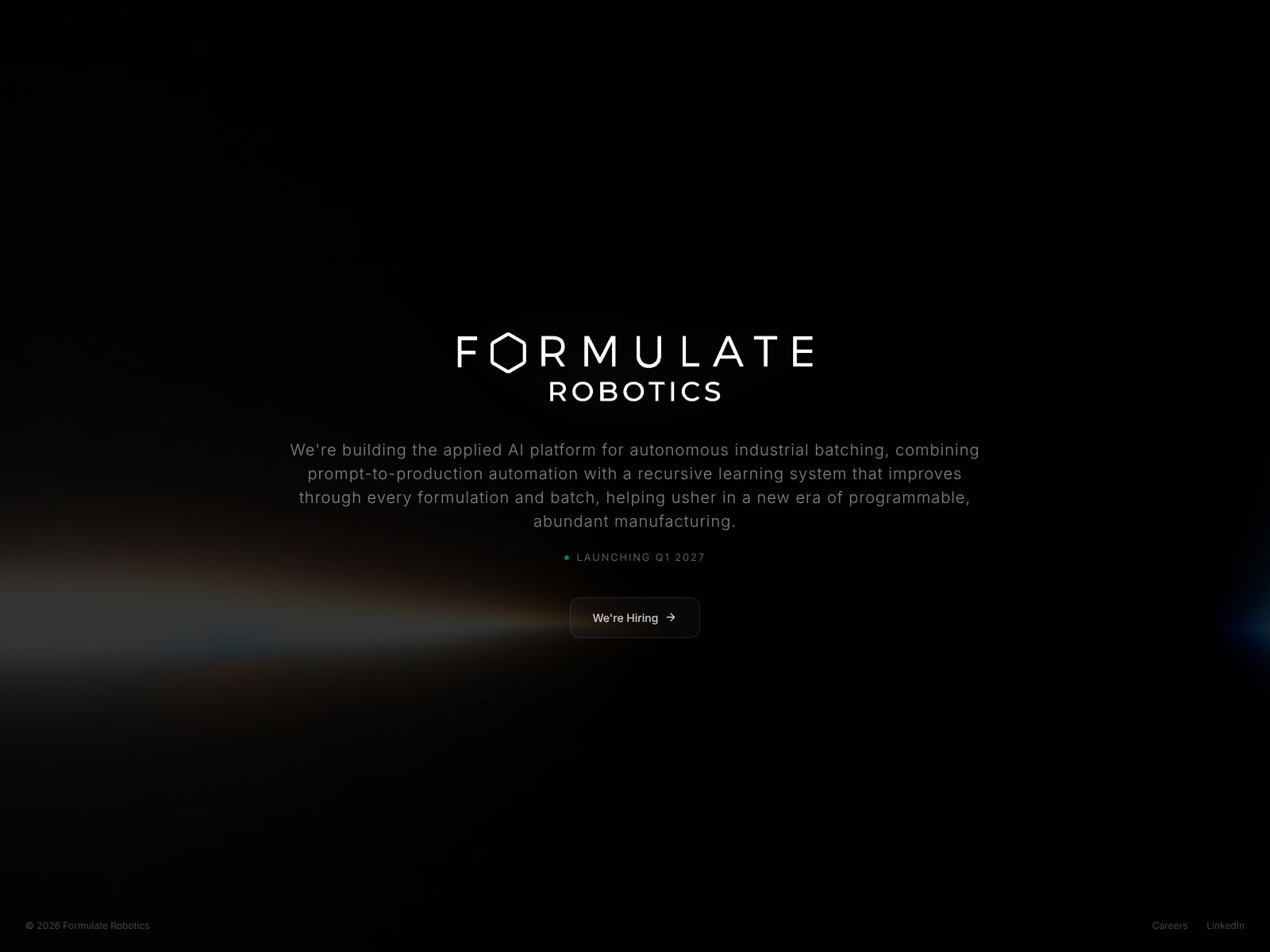
Formulate Robotics is building an applied AI platform for autonomous industrial batching. In plain terms, they aim to let you describe what you want to make and then have the system plan, run, measure, and improve the batch—learning from each run so production gets better over time. The company calls this prompt-to-production automation with a recursive learning system. The goal is to move from static recipes and manual steps to programmable, abundant manufacturing that self-improves.
In this review and overview, I’ll explain what Formulate Robotics is trying to do, what features you should expect from a platform in this category, who it’s for, what benefits it can unlock, how pricing typically works, and what alternatives you can compare it against. Because the company is evolving and details can change, consider this a practical guide to the space and verify specifics with the vendor.
What does Formulate Robotics do?
Formulate Robotics is developing an AI-driven platform that automates industrial batching end to end. You describe the batch you want, the system plans and executes it with robots and equipment, and then it learns from the results to improve the next run. It’s built to shrink the gap between a formula idea and consistent, scalable production.
Why this matters now
Batch manufacturing has always fought three headwinds: slow ramp-ups, variable quality, and labor-intensive adjustments when ingredients, equipment, or targets change. Traditional control systems are reliable, but they’re rigid. AI adds adaptability—tuning process parameters based on live data, learning from outcomes, and codifying tribal knowledge so it’s reusable. That can mean faster experiments, quicker tech transfers, and steadier output without reinventing your stack every time you change a formulation.
Who is Formulate Robotics for?
If your team runs or scales batches and wants more automation without losing agility, you’re the audience. Typical profiles include:
- R&D and process teams who need rapid iteration and clean handoffs to pilot or production.
- Manufacturing leaders seeking consistent quality and less downtime when recipes or suppliers change.
- Operations and quality teams who want traceability and closed-loop control, not just reports.
- Industrial firms ready to explore AI-driven autonomy but still need guardrails, safety, and compliance.
Key ideas behind the platform
- Prompt-to-production: Instead of hard-coding every step, you express goals and constraints (what to make, tolerances, equipment options). The system turns that into an executable plan.
- Autonomous batching: Automated execution coordinates equipment, robots, and sensors, adjusting in real time within safety limits.
- Recursive learning: Each batch feeds data back into the model. Over time, the system gets better at predicting outcomes, choosing parameters, and catching drifts.
Formulate Robotics Features?
Based on the company’s mission and what an applied AI platform for autonomous batching typically includes, here are capability themes you can expect. Treat this as a helpful lens for evaluating Formulate Robotics and confirm current availability, integrations, and scope with their team.
- Natural-language to process plan
A human-friendly way to specify a target product, batch size, constraints, and equipment. The platform interprets your intent and generates a safe, sequenced plan with steps, setpoints, and checks. This lowers the barrier for new recipes and makes iteration faster.
- Recipe and formulation management
Digitized recipes with version control, parameter ranges, and dependencies. It should handle scaling rules (lab to pilot to production), substitutions, and supplier variability, so your team can manage change without chaos.
- Autonomous execution engine
A coordinator that runs the batch across robots, dosing systems, mixers, heaters, valves, and conveyors. Expect capabilities like step orchestration, concurrency where safe, retries with human-in-the-loop escalation, and automatic logging of every action.
- Real-time sensing and closed-loop control
Continuous data capture from scales, flow meters, temperature probes, vision systems, and other sensors. The system adjusts within approved limits—e.g., time, speed, temperature, or agitation—based on live readings and learned models.
- Quality and analytics feedback
In-line or at-line quality checks inform the next step. If viscosity is high, the plan may add mixing time; if temperature lags, heating might be extended. Post-run analytics summarize what happened, highlight deviations, and recommend improvements.
- Learning layer (recursive improvement)
Every batch informs the model: what setpoints worked best, how ingredients behaved, which equipment combo was most stable. Over time, the platform proposes better defaults and narrower control bands to tighten outputs.
- Simulation and sandboxing
A safe environment to test recipes and changes virtually before you commit. You can explore “what if” scenarios and verify that the generated plan respects constraints and safety rules.
- Safety, compliance, and human oversight
Guardrails to ensure autonomy never violates safety interlocks, SOPs, or regulatory requirements. Operators can pause, approve, or override steps, with clear logs and audit trails for reviews and inspections.
- Traceability and genealogy
A full record of inputs, equipment states, setpoints, alarms, approvals, and outcomes. This helps with CAPA, root-cause analysis, and continuous improvement across sites and product families.
- Integrations with OT and IT
Connectors to industrial controllers and software you already use—PLCs, SCADA, MES, LIMS, and ERP. Expect standardized protocols and APIs to avoid lock-in and to fit within your cybersecurity posture.
- Fleet and multi-site management
If you run more than one line or site, centralized policy management, benchmarking, and controlled rollouts let you deploy improvements responsibly, with staged validations and rollbacks if needed.
- Operator experience and guidance
Clear UIs that show what’s happening, why, and what’s next. When the system needs help (e.g., a refill or inspection), it requests the right action with context so people can resolve issues quickly.
- Data access and extensibility
Data pipelines and APIs so your data team can analyze performance, build custom dashboards, or connect to additional ML models. This is critical if you want to extend capabilities over time.
- Deployment and change control
Tools for validation, approvals, and change management. Before a change hits production, it’s reviewed and signed off. You can trace who changed what, when, and why.
- Hardware-agnostic approach
An emphasis on working with your existing equipment (where feasible) and clear specs for new robotics or instrumentation. This reduces rip-and-replace risks and helps you scale in phases.
Again, verify details with Formulate Robotics. The main point: an applied AI platform for batching should make it easy to describe intent, run safely and autonomously, learn from every batch, and integrate cleanly with your plant and quality systems.
Benefits you can aim for
- Faster R&D to production: Translate new recipes into executable plans without rebuilding manual SOPs from scratch.
- Consistent quality: Narrower process variability through adaptive control and data-driven defaults.
- Reduced scrap and rework: Detect drifts early and adjust before a batch goes out of spec.
- Higher throughput without more headaches: Automate non-value tasks so people focus on higher-level decisions.
- Embedded know-how: Capture process knowledge in the system so it scales across shifts and sites.
- Resilience to change: When suppliers, equipment, or targets change, the system adapts with guardrails instead of stalling operations.
- Better traceability: End-to-end logs simplify audits, root-cause analysis, and continuous improvement.
Pricing
As of this writing, detailed pricing for Formulate Robotics is not publicly listed. Given the scope—AI software plus integrations and possible robotics—expect a tailored enterprise engagement. Most platforms in this category price as a subscription, with one-time integration and deployment services. Hardware is either sourced through partners or specified for your procurement.
When you talk to the team, ask about:
- Software subscription: Per site, per cell, or tiered by features and support.
- Usage components: Volume of batches, data capture rates, or model training quotas (if applicable).
- Integration and onboarding: Fixed-scope vs. time-and-materials for PLC/SCADA/MES/ERP connections.
- Hardware strategy: New robotics or instrumentation required, and whether they provide, specify, or integrate.
- Validation and change control: Costs for documentation, testing, and regulated environment support.
- Support SLAs: Response times, on-site support availability, and upgrade cadence.
Pro tip: Build a simple ROI model anchored in a pilot. Quantify cycle-time reductions, scrap avoidance, and labor reallocation for one product family, then extrapolate to the portfolio.
How does it compare to the status quo?
The status quo often looks like: recipes in spreadsheets, SOPs in binders, traditional batch systems handling setpoints, and operators doing the last-mile decision-making. It’s stable but slow to change and heavily reliant on people for adjustments. You get quality, but only if you have highly skilled operators—and even then, variability happens.
An AI-powered batching platform aims to keep your safety and compliance backbone while adding a brain that learns. Instead of preset parameters everywhere, the system recommends and tunes within approved bounds, documents why, and gets better with every run. For teams juggling many SKUs and frequent changes, that adaptability can be the difference between firefighting and flow.
Formulate Robotics Top Competitors
There isn’t a one-size-fits-all competitor because “autonomous industrial batching” spans control, robotics, and AI. Here are realistic alternatives and adjacent solutions to compare, grouped by category. These are examples to guide your search; evaluate fit based on your processes and requirements.
Traditional batch control platforms (proven, standards-based)
- Emerson DeltaV Batch: Mature S88-compliant batch control with recipe management and robust automation tooling.
- Rockwell Automation FactoryTalk Batch: Widely used in process industries; integrates with Logix controllers and PlantPAx.
- Siemens PCS 7 / Opcenter Execution Process: Batch capabilities with tight DCS integration and manufacturing execution tie-ins.
- Honeywell Experion Batch: Comprehensive batch management atop the Experion platform.
- ABB 800xA Batch: Integrated with ABB’s DCS for coordinated batch execution.
- AVEVA (Wonderware) Batch Management: Recipe-driven batch execution and tracking with broad SCADA compatibility.
These systems excel at deterministic control, recipe enforcement, and compliance. They typically require engineering effort to adapt recipes or leverage advanced analytics. If AI-driven adaptation is your priority, you will compare how an applied AI layer like Formulate Robotics complements or replaces parts of this stack.
AI-first and digital production platforms (adjacent scope)
- Tulip: No-code manufacturing apps for operators and data capture; strong for digitizing work instructions and collecting context.
- Seeq: Advanced analytics for process data; great for insights and modeling but not an autonomous execution engine.
- Augury: Machine health AI; focuses on predictive maintenance, which complements but doesn’t replace batch orchestration.
- Instrumental / Elementary: Vision-driven quality platforms; strong for defect detection, less for process orchestration.
These tools are powerful for augmenting manufacturing, but they’re not built to autonomously run the batch. You might combine them with traditional controls, or assess whether an integrated platform could simplify your stack.
Robotics control and integrators (cell-level automation)
- Mujin, OSARO, Rapid Robotics: AI-enabled robot control and prebuilt workcells; strong for pick-and-place or material handling.
- Systems integrators specializing in S88 batch automation: Regional firms that build custom cells with standard batch platforms and bespoke logic.
If your primary need is to automate a specific step (e.g., dosing, container handling), a focused robotics partner or SI can work. If your goal is closed-loop autonomy across the entire batch, you’ll compare that approach against a unified AI platform.
Build-it-yourself (engineering-forward)
- Open frameworks like ROS 2, Ignition for SCADA, OpenPLC, and ML libraries can be combined into a custom stack.
This path offers flexibility but requires significant engineering, validation, and ongoing maintenance. It can be effective for organizations with deep in-house expertise and a clear architecture roadmap.
How to evaluate platforms like Formulate Robotics
Here’s a practical checklist you can use in vendor calls and pilots:
- Scope clarity: What parts of the batch does the platform automate today, and what’s on the roadmap?
- Safety and compliance: How are interlocks, limits, and approvals enforced? Can you lock down changes and produce audit trails on demand?
- Integration depth: Which PLCs, SCADA, MES, LIMS, and ERP systems are supported out of the box? How are exceptions handled?
- Learning transparency: How does the system learn from each batch, and can you see why it recommended a change?
- Human-in-the-loop: When the system needs help, what does an operator see and do? How fast is issue resolution?
- Simulation: Can you dry-run a new recipe, validate constraints, and compare plans before touching equipment?
- Data portability: Can you export raw and modeled data? Are APIs available for your data team?
- Security: How are identities, roles, and network boundaries managed? What’s the update/patch policy?
- Pilot design: What does a 60–90 day pilot look like? How will success be measured (cycle time, scrap, variability)?
- Total cost of ownership: Software, integration, potential hardware, validation, and support. What scales with sites or volume?
Implementation approach I recommend
- Pick a product-family pilot: Choose a SKU with clear pain (variability, slow changeovers, high scrap) and measurable outcomes.
- Map your baseline: Document current steps, cycle times, deviations, and quality metrics. This is your before picture.
- Start with digital recipes and simulation: Bring one or two recipes into the system and validate plans virtually.
- Integrate minimally viable equipment: Connect the core sensors and actuators needed to run the pilot safely.
- Run supervised autonomy: Let the platform execute with operator oversight, capture data, and tune limits.
- Measure, learn, and lock improvements: Compare against baseline, codify wins, and prepare a controlled rollout.
- Scale to a second site or line: Prove repeatability and build the business case for broader deployment.
What makes Formulate Robotics interesting
Plenty of vendors can help you digitize or control a batch. Fewer aim to make the batch itself self-improving. That’s the interesting part of Formulate Robotics’ approach: turning intent into execution and using every run to get smarter. If they continue to execute on this vision—while staying grounded in plant realities like safety, validation, and integration—it can unlock meaningful speed and consistency gains for teams that live in batching every day.
When Formulate Robotics may not be the right fit
- You run continuous processes only, with minimal batching or recipe complexity.
- You need a drop-in replacement for an existing DCS/batch system without adding AI-driven adaptation.
- Your environment is fully manual by design (e.g., small artisan runs where standardization isn’t a goal).
Even in these cases, elements of the platform—data capture, simulation, or decision support—could still help, but you’ll want to confirm scope.
FAQs
- Does it replace my PLCs or DCS? Typically, no. Expect it to orchestrate and augment, issuing commands within defined limits to your control layer. Verify the architecture for your site.
- Can it work with my existing equipment? That’s usually the aim, within reason. Ask for a list of supported protocols and devices.
- How does it handle regulated contexts? Look for audit trails, approval workflows, and validation support aligned with your requirements.
- What about my data? Clarify data ownership, access, retention, and how models are trained and versioned.
How to contact and learn more
You can explore the company and request information directly at formulaterobotics.com. Go in with a concrete pilot idea and baseline metrics—that will make the conversation, scoping, and ROI modeling far more productive.
Wrapping Up
Formulate Robotics is building an applied AI platform that aims to turn batching from a static, manual-heavy process into an adaptive, learning-driven one. The promise is straightforward: describe what you want to make, run it safely and autonomously, and get better every time. If you’re wrestling with variability, slow recipe changes, and scaling pain, this approach is worth a serious look. Compare it with your current batch systems and adjacent digital tools, design a pilot with measurable outcomes, and see whether prompt-to-production and recursive learning can raise the ceiling for your team.