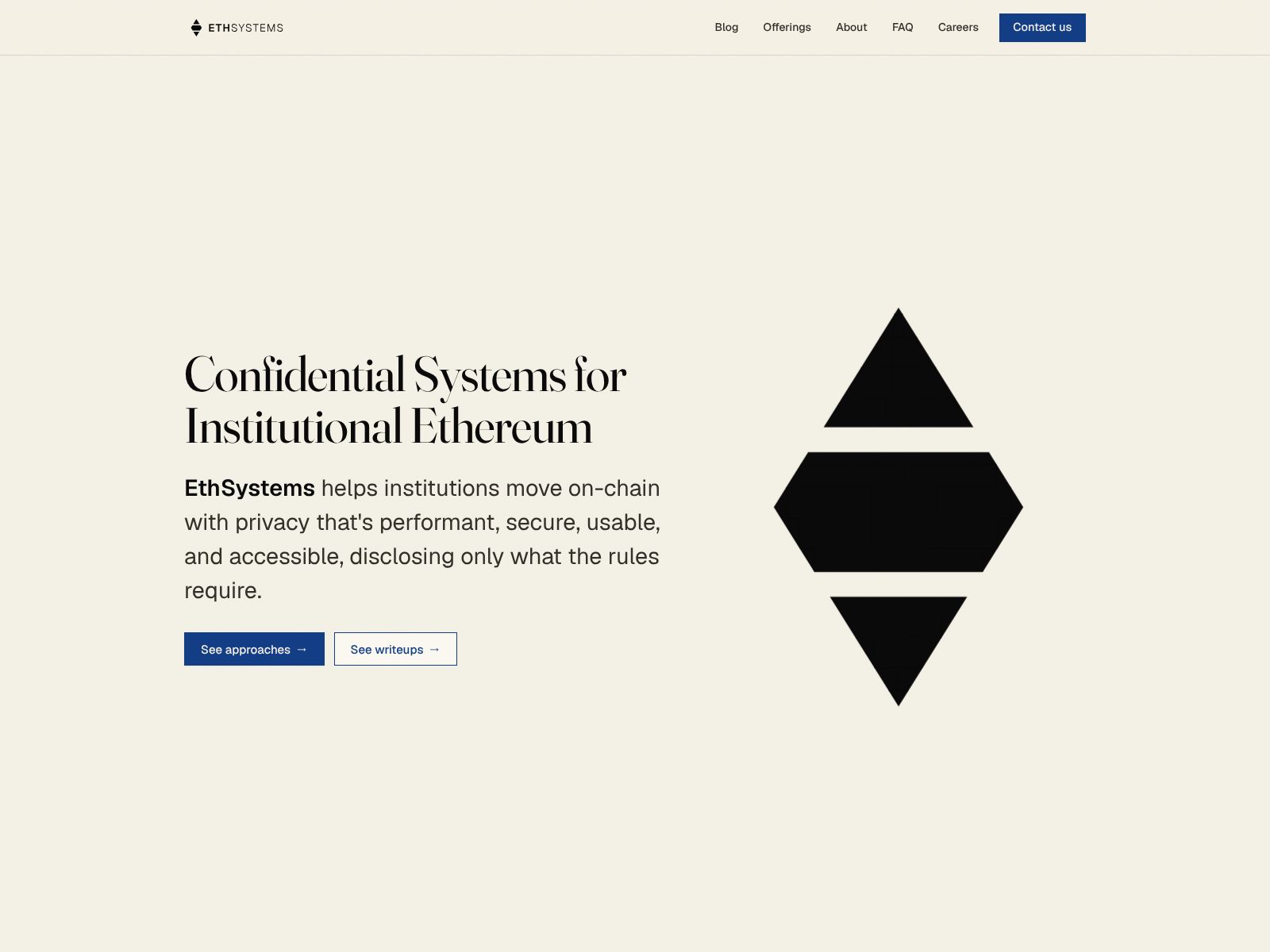
EthSystems Review & Overview (Features, Pricing, & Alternatives)
If you are an institution exploring Ethereum, you likely care about three things: security, privacy, and performance. You also need the experience to put everything together so it actually works for your users and your compliance team. That combination is rare. EthSystems focuses on exactly this: helping institutions adopt Ethereum with privacy and performance built in, without making your workflows harder or riskier.
In this review, I’ll walk you through what EthSystems does, the kinds of features and services you can expect, how to think about pricing, and which alternatives you might compare. I’ll keep the language simple and practical so you can quickly decide if EthSystems is a good fit for your team and roadmap.
Note: This overview is based on publicly available information and the company’s stated focus on bringing institutions onto Ethereum in a performant, secure, usable, and accessible way. If you’re scoping a project, you should contact the team at ethsystems.org to confirm details for your specific needs.
What does EthSystems do?
EthSystems helps institutions build and launch on Ethereum. The team focuses on privacy, security, and performance, and works to make your solution usable and accessible for real users. In short: they guide, design, engineer, and support Ethereum-based systems tailored to institutional requirements.
EthSystems Features
Below are the types of capabilities you can expect when working with a specialized Ethereum engineering and research partner like EthSystems.
- Institutional onboarding to Ethereum – Practical guidance to plan your move onto Ethereum, align stakeholders, and define the right architecture. This includes use case scoping, risk analysis, and a roadmap that fits your compliance and operational needs.
- Privacy-first design – Your data needs are front and center. Expect help selecting and implementing privacy patterns appropriate to your case (for example, minimizing on-chain exposure, permissioning, encryption, and where suitable, advanced techniques like zero-knowledge proofs). The goal is privacy without sacrificing usability.
- Performance engineering – Tuning your stack for throughput and latency that meets business expectations. This can include choosing the right networks (Ethereum mainnet vs. suitable L2s), optimizing contracts and off-chain components, and setting clear SLOs for end-to-end performance.
- Security-by-default – Architecture reviews, threat modeling, key management guidance, and secure development practices. While third-party audits are often part of the journey, you also want a team that designs for security from the start and coordinates with auditors effectively.
- Usability and accessibility – Making complex blockchain experiences clear for non-crypto users. This can include wallet abstraction approaches, better onboarding flows, human-readable error handling, and attention to accessibility standards so all users can succeed.
- Protocol and infrastructure integration – Connecting your systems to Ethereum clients, nodes, APIs, and indexers; choosing reliable infrastructure; and planning for redundancy, monitoring, and disaster recovery. The outcome is a production-grade setup your operations team can trust.
- Compliance alignment – Mapping data flows and controls to your regulatory context (for example, data minimization, audit trails, and governance processes). The emphasis is on practical, explainable privacy that complies with policy while remaining user-friendly.
- Prototyping and proof-of-concepts – Fast, focused experiments to validate feasibility and risks before you commit to full-scale build. PoCs reduce uncertainty and create shared understanding between business, legal, and engineering teams.
- End-to-end delivery – From initial discovery to deployment, testing, documentation, and handover. If needed, this can include training for your developers and operations staff so you can own and evolve the system over time.
- Ongoing support and evolution – As Ethereum and its scaling layers evolve, so will your requirements. A partner like EthSystems can help you plan updates, measure performance, and roll out improvements safely.
Because privacy, performance, and security are often at odds, the real value of a team like EthSystems is balancing trade-offs with you. You keep user privacy and regulatory comfort without giving up speed, user experience, or auditability.
Who is EthSystems best for?
- Financial institutions that need privacy-preserving workflows on Ethereum and clear control over data handling.
- Exchanges and fintechs moving from Web2 to Web3, who need strong security practices and a frictionless user experience.
- Enterprises and consortiums collaborating on shared data or assets, with strict compliance requirements.
- Public sector and NGOs exploring transparent but privacy-respecting systems to serve citizens or beneficiaries.
How an EthSystems engagement might work
Every project is different, but a typical path for institutional onboarding looks like this:
- 1) Discovery and fit – Define objectives, constraints, and success criteria. Identify the privacy and performance requirements that will guide all design decisions.
- 2) Architecture and risk analysis – Choose networks, data flows, and trust boundaries. Map threats and mitigations. Decide what belongs on-chain vs. off-chain for privacy, speed, and cost.
- 3) Prototype or PoC – Build a minimal version to prove key assumptions. Test performance, user flows, and privacy protections. Adjust based on findings.
- 4) Implementation and integration – Develop smart contracts and backend services, integrate wallets and infrastructure, and prepare for audits. Build observability from day one.
- 5) Launch and handover – Deploy to production with proper monitoring, incident runbooks, and governance. Train your team and plan for updates as requirements or regulations evolve.
This approach helps you avoid big-bang risk, while giving stakeholders confidence at each step.
EthSystems Pricing
EthSystems does not publish public pricing, and that’s typical for engineering and research firms handling complex, custom institutional projects. Expect engagement-based pricing that reflects team composition, duration, scope, and risk.
Here are the factors that usually drive cost:
- Scope and complexity – The number of features, integrations, and privacy constraints. Systems that mix on-chain, off-chain, and advanced privacy techniques take more design and testing effort.
- Security depth – The level of threat modeling, internal reviews, and coordination with external auditors. High-assurance systems require more cycles and specialized expertise.
- Performance requirements – If you need specific throughput or latency targets, the engineering and benchmarking time increases, especially for high-volume use cases.
- Regulatory requirements – Extra design and documentation to meet compliance and governance needs impact timeline and cost.
- Support model – Ongoing maintenance, training, and SLAs after launch add predictable recurring costs.
Common pricing models you may encounter:
- Fixed-scope project – A defined deliverable at a set price, usually after a detailed scoping phase. Works best for clear requirements and shorter timelines.
- Time and materials – Flexible resourcing billed monthly based on hours and roles. Good when requirements may change or you want to iterate based on findings.
- Retainer for support – Post-launch coverage with agreed response times, periodic upgrades, and advisory hours.
How to budget and reduce surprises:
- Start with a paid discovery or PoC to validate assumptions and refine estimates.
- Prioritize your must-haves (privacy guarantees, performance targets) and defer nice-to-haves.
- Ask for clear milestones, deliverables, and success criteria tied to payments.
- Define your audit strategy early so the timeline includes lead time for reviews and fixes.
- Decide whether to build internal capacity; training now can lower long-term vendor spend.
If you need a ballpark before engaging, share a short brief covering your objective, user flows, privacy constraints, performance targets, integrations, and timeline. A team like EthSystems can then suggest a phased plan with indicative ranges.
EthSystems Top Competitors
When choosing a partner, it helps to compare different strengths and focus areas. Below are well-known organizations you might evaluate alongside EthSystems. Each brings its own balance of enterprise delivery, security, research depth, and ecosystem reach.
- ConsenSys – A major Ethereum company offering enterprise services, tooling, and networks, along with consulting and privacy-aware solutions. Strong for large-scale deployments and access to a broad product suite.
- Nethermind – An Ethereum R&D and engineering firm known for client development and protocol expertise, plus consulting for enterprises and ecosystems.
- ChainSafe – A protocol engineering and product company with experience across Ethereum clients, storage, and multi-chain projects, offering consulting and delivery services.
- OpenZeppelin – Security-focused engineering, audits, and operational tooling for smart contracts. A strong choice if your priority is secure contracts and ongoing security practices.
- Trail of Bits – A respected security firm with cryptography and smart contract auditing expertise. Ideal for high-assurance reviews and threat modeling.
- Least Authority – A privacy-centric security firm that conducts audits and reviews for systems requiring robust privacy guarantees.
- EY Blockchain – Enterprise consulting with blockchain offerings and privacy-aware approaches tailored to corporate environments and compliance needs.
- Deloitte or Accenture (Blockchain practices) – Large consulting firms with broad transformation capabilities and integration experience across legacy systems.
- Quantstamp / ConsenSys Diligence – Specialized smart contract auditing providers you can pair with an engineering partner for stronger overall assurance.
- Infrastructure providers (Infura, Alchemy, Blockdaemon) – Not direct competitors, but relevant alternatives for the node and API layer of your stack. You’ll compare them when planning production infrastructure.
How to compare these options:
- Match their track record to your use case (finance, public sector, exchange, etc.).
- Ask how they handle privacy trade-offs without breaking UX or performance.
- Request an architecture sketch and threat model in the proposal phase.
- Clarify who writes the code, who audits it, and how delivery is documented.
- Ensure they can coordinate with your legal, compliance, and security teams.
Why privacy, performance, security, and usability must be designed together
It’s tempting to treat these as separate workstreams. In practice, they are tightly linked:
- Privacy vs. UX – Privacy controls that are hard to understand lead to mistakes. You want privacy that feels invisible to users.
- Performance vs. compliance – Cutting corners for speed can undermine auditability. You need clear data flows that are fast and explainable.
- Security vs. accessibility – Strong defenses must still support assistive technologies and inclusive design. Security that blocks users isn’t secure in practice.
A partner like EthSystems focuses on these trade-offs from day one, so you don’t ship a system that’s secure but unusable, or fast but non-compliant.
Common pitfalls EthSystems helps you avoid
- Overexposing data on-chain – Not everything belongs on a public ledger. Good design keeps sensitive data off-chain, with verifiable links or proofs.
- Undefined key management – You need clear ownership, rotation, recovery, and HSM or secure enclave strategies. Don’t leave keys as an afterthought.
- Unclear threat models – Without an explicit model, you can’t prioritize defenses. A written threat model informs design, testing, and audits.
- Premature scaling decisions – Choose the right network and scaling strategy after measuring your real workloads and UX needs.
- Compliance gaps – Decide early how you’ll demonstrate privacy and security controls to auditors and regulators.
What a strong deliverable looks like
When you work with an engineering and research firm focused on institutional needs, expect deliverables that your whole organization can use:
- An architecture document that explains the why, not just the what.
- A threat model and privacy impact summary that non-engineers can understand.
- Code and infrastructure that are observable, testable, and maintainable.
- Runbooks, diagrams, and checklists your ops team can follow.
- Training materials or sessions so your staff can take ownership post-launch.
Questions to ask EthSystems (or any alternative)
- How do you balance privacy with usability in our specific workflow?
- What are the main security threats for our use case, and how will we mitigate them?
- Which networks or scaling options do you recommend, and why?
- What performance targets can we expect, and how will you measure them?
- How will you involve our legal and compliance teams in the design process?
- What does a typical PoC look like, and how quickly can we run one?
- How do you handle audits and ongoing maintenance after launch?
When EthSystems is a good fit
- You have explicit privacy and compliance requirements and need a practical approach to meet them without blocking UX.
- You want a partner who will design for performance and security from the start, not bolt them on at the end.
- Your team wants clarity and documentation, not just code, so you can continue evolving the system.
When to consider alternatives
- You already have a strong in-house Ethereum team and only need a security audit (then a pure auditing firm may be sufficient).
- You’re looking for generalized IT transformation without a strong blockchain component (a big consulting firm could be a better match).
- Your scope is limited to infrastructure provisioning (an infrastructure provider may be all you need initially).
Wrapping Up
If you’re an institution moving into Ethereum, you face real-world trade-offs: keep data private, keep systems secure, keep performance high, and make the experience easy for users. EthSystems positions itself squarely at this intersection. They help you plan, build, and launch with privacy and performance embedded from day one, while staying usable and accessible for your stakeholders.
There are many capable firms in the Ethereum ecosystem, and which one you choose should reflect your priorities, timelines, and internal capacity. If privacy is non-negotiable, performance matters, and you want a partner comfortable with compliance and production operations, EthSystems is well worth a conversation.
To learn more or start scoping your project, visit ethsystems.org. Bring a brief describing your goals, privacy constraints, expected scale, and timeline. With the right plan and the right partner, your team can deliver on Ethereum with confidence—without sacrificing the privacy, security, and usability your users expect.