


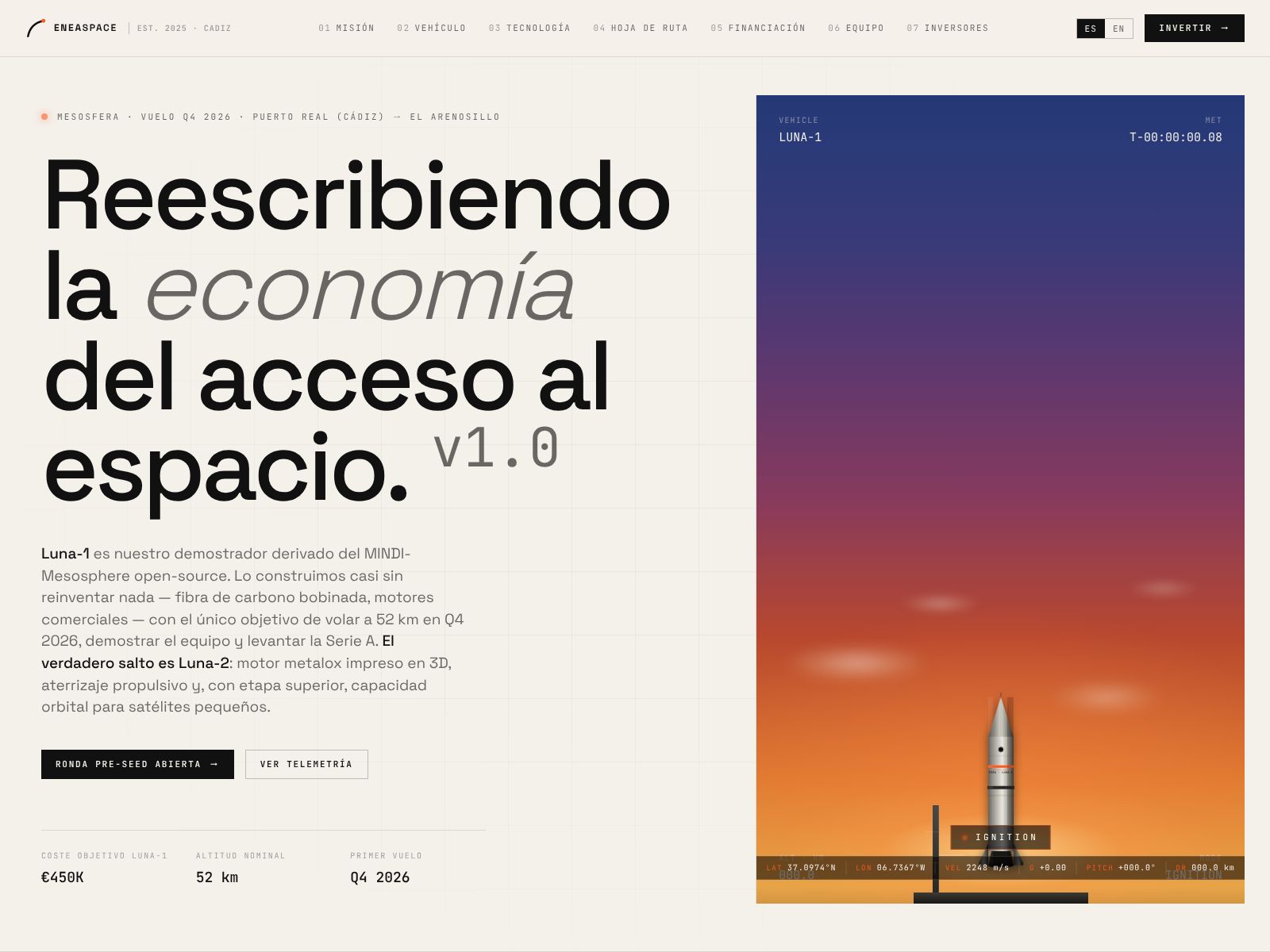
If you follow new launch startups, you know how quickly the small-space scene is changing. Costs are coming down, manufacturing is getting smarter, and teams are moving faster. Eneas Space, an open-source rocketry startup based in Puerto Real (Cádiz, Spain), is one of the most interesting new names to watch. They are building Luna-1, a sub-orbital sounding rocket, and planning Luna-2, a reusable small-satellite launcher with an aggressively low target price. In this review, I’ll walk you through what Eneas Space does, what makes them different, how their roadmap might affect your mission, and where they fit among competitors.
Eneas Space is building low-cost rockets in Spain. Their first system, Luna-1, is a two-stage sub-orbital rocket designed to carry scientific payloads to about 52 km. Their longer-term system, Luna-2, aims to place 1–50 kg small satellites into low Earth orbit using a reusable first stage and a 3D-printed methalox engine. They use an open-source approach and focus on manufacturing speed and affordability.
Eneas Space is early, but their approach has several clear features that may matter to you and your team:
Luna-1 is derived from the open-source MINDI-Mesosphere design developed by UC Berkeley’s STAR club. This matters because it gives the team a proven baseline to iterate from, and it brings transparency to the engineering choices behind the rocket. If you’re a university or a research lab, an open-source foundation can simplify integration and verification. It also encourages community contributions and peer review, which can be valuable for reliability and education.
Luna-1 is a two-stage vehicle designed to reach around 52 km. The planned launch site is El Arenosillo (INTA) in Spain, with a target flight in Q4 2026. The mission goal is to demonstrate end-to-end performance at a fraction of traditional costs: in-house manufacturing, flight, recovery, and scientific payload operations. If you need atmospheric research, near-space testing, or sensor validation, this is the mission profile you’d look at first.
Eneas Space is explicit about affordability. They’re trying to prove that you can manufacture and fly capable rockets for much less, without compromising essential safety. That focus shows up in their open-source heritage, planned use of additive manufacturing, and a tight early-stage budget. If your team is price-sensitive or you’re doing iterative experiments, this emphasis can be a major advantage.
Luna-2 is the long-term play: a vertical takeoff, vertical landing (VTVL) launcher with a 3D-printed metalox (methane + oxygen) engine. The plan includes a reusable first stage and an expendable upper stage to keep complexity manageable while still opening the LEO market. The target payload focus is cubesats and small demonstrators in the 1–50 kg range. If successful, this would serve a slice of the market that many European launchers don’t price-access well today.
Eneas Space targets approximately €30,000 per Luna-2 launch. That is a bold target and, if achieved, would dramatically lower the barrier to orbit for small missions. It’s an aspiration tied to aggressive manufacturing efficiencies and reusability. As with any target price, treat it as preliminary until the vehicle is operational, but it’s a clear signal of their strategy.
Based in Puerto Real (Cádiz), Eneas Space works within the Andalusian aerospace cluster. Proximity to suppliers, talent, and test infrastructure can shorten lead times and reduce costs. For you, this may mean faster scheduling, clearer logistics, and better regional access if you’re in Europe.
Spain’s El Arenosillo test range has a long history of scientific campaigns. Using a known range can help with safety, regulatory compliance, and operations planning. If your team is new to flight campaigns, working at a range with established procedures can make mission planning more predictable.
Luna-1 is meant to prove not just flight, but the entire stack: manufacturing, launch operations, recovery, and payload handling. This end-to-end mindset is important for reliability and for building repeatable processes you can count on when you’re booking future flights.
From the start, the team is prioritizing recovery—both for cost reasons and for learning speed. Recovered hardware gives faster feedback loops. That can help the launch cadence and improve reliability quickly, which matters if you plan multiple campaigns.
Eneas Space is raising a €450K pre-seed round to fund Luna-1’s first flight. This is important context as you evaluate schedule risk and capacity. It’s a lean budget and an early phase, so expect iterative progress and milestones as funding grows.
You’ll get the most value from Eneas Space if you need low-cost access to near space in the short term and potentially low-cost LEO access later. Typical users include:
If you’re a cubesat team in the 1–50 kg range, Luna-2 is the long-term target to watch. For sub-orbital science, Luna-1 is the near-term opportunity.
Eneas Space is open about cost goals but is still pre-revenue and in development. Here’s what you should know:
Because Eneas Space is raising a pre-seed round to fund its first flight, final pricing and availability timelines will likely evolve. If price is your primary driver, stay close to their roadmap announcements and ask for indicative quotes early.
Here’s a straightforward look at strengths and trade-offs you should weigh:
If you need a flight-proven provider right now, you may look at more mature companies. If you’re comfortable working with an emerging team to reduce costs and shape interfaces, Eneas Space could be a compelling fit.
Depending on whether you need sub-orbital or orbital delivery, your alternatives will differ. Here are top competitors and substitutes to consider:
PLD Space develops MIURA 1 (sub-orbital) and MIURA 5 (orbital). They are further along in development and operations and serve similar markets geographically. If you want a Spanish or European provider with an established track, PLD Space is a close comparison. Pricing may be higher, and their architectures are not open-source.
Isar Aerospace is building Spectrum, an orbital small-sat launcher. If you need LEO access and want a European company with significant funding and industrial backing, Isar is a strong option. They do not focus on sub-orbital science flights, so your use case matters.
RFA One targets the small-satellite segment with an orbital launcher. They emphasize cost-competitiveness and European access. If your timeline demands an orbital ride with a provider pursuing frequent launches, RFA is worth including in your trade study.
Orbex Prime is an orbital micro-launcher under development with a focus on environmental performance and European spaceport access. If sustainability and UK/Scottish launch operations appeal to you, this is a relevant comparison.
Skyrora is developing a family of launchers, including Skyrora XL for orbital missions, with incremental sub-orbital test flights. They’re another European option bridging sub-orbital tests and orbital ambitions.
Rocket Lab’s Electron is a flight-proven orbital small-sat launcher with regular cadence. If you need reliability now and can handle non-European logistics and pricing at a more established-market level, Rocket Lab is a practical benchmark.
Depending on your experiment, you might compare with established European sounding rocket campaigns run through national agencies or range operators (for example, campaigns at Andøya or El Arenosillo). These can offer mature operations but often at higher costs and less flexibility for smaller teams.
For certain experiments, stratospheric balloons can be a cost-effective substitute for sub-orbital flights. They provide long-duration exposure and gentler environments, but they do not replicate rocket ascent dynamics, microgravity profiles, or recovery scenarios the same way.
Choose your alternative based on the mission: sub-orbital science versus orbital deployment, budget sensitivity, acceptable schedule risk, and preferred geography.
Even before Luna-2, there are several practical use cases your team can map to Luna-1 and to Eneas Space’s early capabilities:
Measure pressure, temperature, chemistry, or radiation up to ~52 km. Validate atmospheric models or calibrate instruments prior to a larger scientific campaign.
Test IMUs, star trackers (with relevant conditions), radios, or flight software under real ascent profiles and vibration loads.
Evaluate coatings, thermal protection concepts, or small structures under ascent heating and cold soak at altitude.
Qualify packaging, mounts, and mechanical interfaces for your payload. Learn recovery constraints you’ll face on larger missions.
Give student teams a flight environment with a clear, open-source documentation trail, helping them learn integration and test best practices.
Because Eneas Space emphasizes open-source designs, you can expect clearer interface documents as development matures. While exact specs will evolve, you can prepare by defining:
Ask the team about standard payload bays, mounting rails, and any provided avionics or power. If they offer a reference payload adapter or sample interface control document (ICD), use it to accelerate your design.
Eneas Space is still early-stage. That means you should plan for:
First-flight targets can shift as testing reveals new work. Build flexibility into your timeline and have a backup plan if your campaign is time-critical.
The team is raising a €450K pre-seed round. As they secure funding, capacity and timelines will evolve. Stay in close contact for updates on milestones like hot-fires, stage tests, and range bookings.
Expect incremental upgrades to propulsion, structures, GNC, and recovery systems. This is normal and healthy, but it means payload interfaces may refine over time.
On the positive side, open-source roots and a transparent roadmap can make technical due diligence easier. You can ask deeper questions, review documentation as it’s published, and align your design to the latest interfaces.
The long-term plan for Luna-2 borrows inspiration from Relativity Space’s additive manufacturing philosophy: 3D-printing major components to simplify supply chains and accelerate iteration. For you, that can mean:
Combined with reusability on the first stage, this approach supports the aggressive price target. It’s not a guarantee of performance or cost, but it aligns with industry trends that have already delivered gains elsewhere.
If you’re considering Eneas Space for your payload or simply tracking their progress, keep an eye on these milestones:
As these milestones are met, your confidence in schedule and performance should increase. If you need a slot, engage early to understand queue dynamics and integration lead times.
If you’re interested, here’s a simple checklist to guide first conversations:
You can also request examples of previous tests or open-source documentation that show how they’re validating key systems. For a first project, start with a constrained-scope payload to de-risk your schedule and learn their processes.
The target is Q4 2026 from El Arenosillo (INTA) in Spain. As with any first flight, timing depends on successful testing and program milestones.
Approximately 52 km, which is suitable for many sub-orbital science and technology experiments.
Luna-1 includes a focus on recovery to validate end-to-end capability and learn for future reusability. Luna-2 is planned as a reusable VTVL system with an expendable upper stage.
For Luna-2, Eneas Space targets around €30,000 per launch (forward-looking target). Luna-1 pricing is not publicly disclosed; contact the team for current details and availability.
Sub-orbital scientific payloads for Luna-1; 1–50 kg cubesats and demonstrators for Luna-2.
The team is based in Puerto Real (Cádiz, Spain), within the Andalusian aerospace cluster. Luna-1 flights are planned from El Arenosillo (INTA).
Choose Eneas Space if you want to:
If you need immediate, flight-proven orbital access at a set cadence, you should balance Eneas Space with more mature providers. But if you can collaborate early, accept development risk, and value affordability, Eneas Space could be a strong strategic partner.
This approach helps you capture cost savings while keeping your mission reliable.
Reusability and additive manufacturing are not just buzzwords. They can reduce waste, shorten supply chains, and open space access to more researchers and small companies. Eneas Space’s Luna-2 plan blends both ideas: a reusable first stage with a 3D-printed methalox engine. If they hit even part of their cost target, it could push competitors to improve price and access across Europe. That’s good for you and for the broader community.
Eneas Space is a young, ambitious startup with a simple promise: make access to near space and, later, low Earth orbit dramatically more affordable. Their first step is Luna-1, a sub-orbital, two-stage rocket slated to fly to about 52 km from El Arenosillo (INTA) in Q4 2026, with an end-to-end focus on manufacturing, flight, recovery, and scientific payloads. Their longer-term play is Luna-2, a reusable VTVL launcher with a 3D-printed methalox engine and an expendable upper stage, targeting 1–50 kg payloads at a bold price point of around €30,000 per launch.
If you’re a university team, a research group, or a startup looking for affordable, European-based access to flight environments, Eneas Space is worth a close look. The program is early, so you’ll need to plan for schedule and development risk. But the upside—especially on cost and openness—could be significant. As always, match your mission needs with the provider’s maturity, ask for current technical documentation, and keep a backup plan if timing is critical.
To learn more or to follow their progress, visit Eneas Space at https://www.eneaspace.com. If you have a payload in mind, reach out early, share your constraints, and see how their roadmap can align with your goals. With the right approach, you can turn early-stage collaboration into a cost-effective and educational flight campaign that sets up your next mission.
