
DrifteoNo Logo Placeholder
PropTech

Drifteo

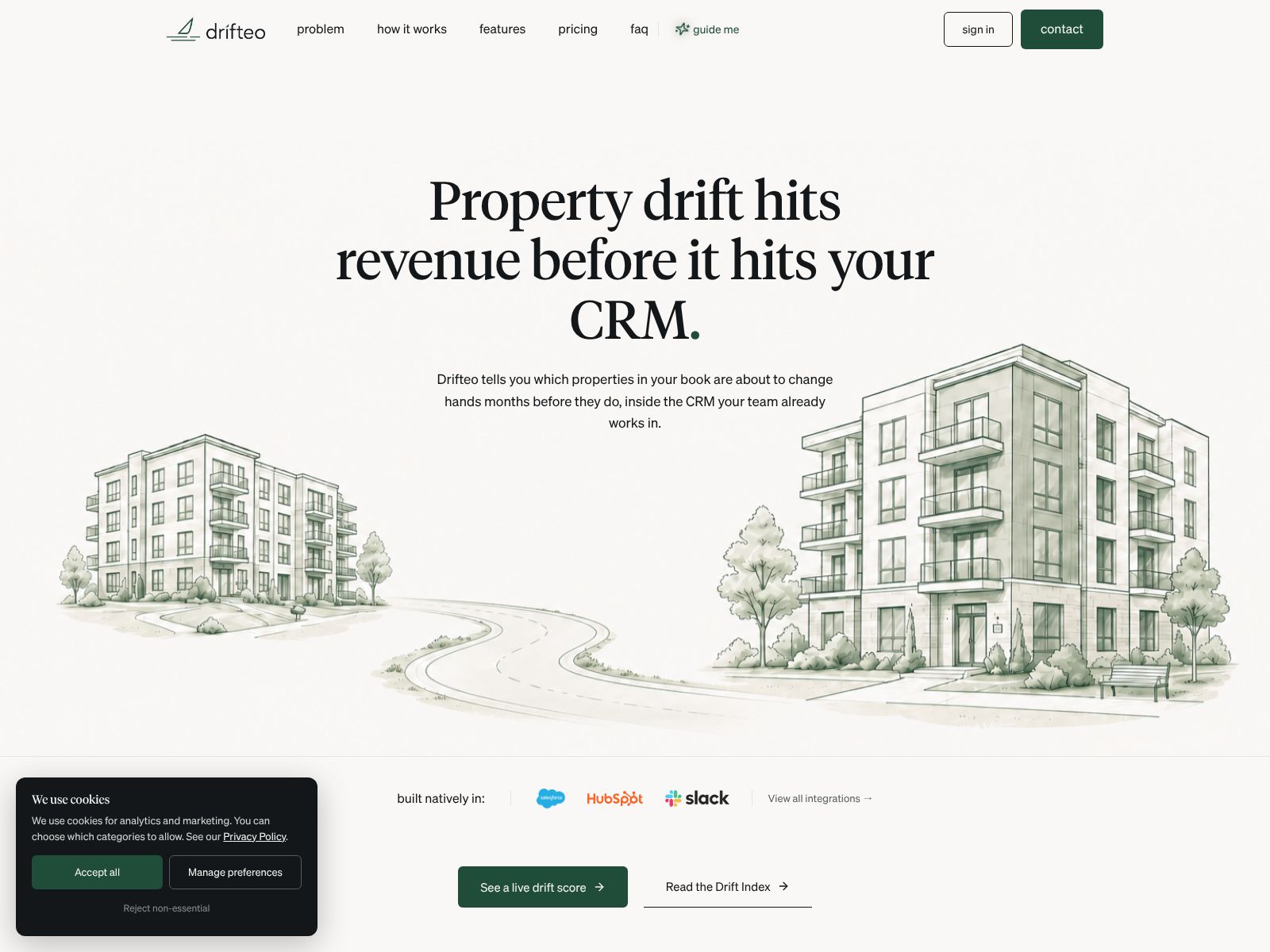
Drifteo is a Wilmington, NC–based B2B platform for multifamily real estate software vendors that detects property ownership and management changes before they erode revenue. Its Drift Signals and Drift Score flag at‑risk accounts 3–9 months in advance and surface risk directly inside Salesforce and HubSpot workflows, so revenue teams can act in time. Founded in 2026 by revenue leader Matt Childs, Drifteo draws on deep GTM experience to stop churn caused by property changes.

More About Drifteo

Founded:
Total Funding:
$500,000.00
Funding Stage:
Seed
Industry:
PropTech
In-Depth Description:
Drifteo is a B2B software company based in Wilmington, North Carolina, that helps multifamily real estate software vendors detect property ownership and management changes before they erode revenue. When a property changes hands, the incoming owner or manager often re-evaluates every vendor contract. Property changes are one of the leading causes of unexpected churn for vendors serving the multifamily industry. Drifteo surfaces these changes early through Drift Signals and a Drift Score, giving revenue teams a 3–9 month window to act before a contract is at risk. The platform integrates natively into Salesforce and HubSpot, surfacing risk directly inside existing CRM workflows. Drifteo was founded in 2026 by Matt Childs, who spent his career in revenue leadership, from SDR through leading Revenue Operations & Strategy, overseeing sales organizations moving hundreds of millions of dollars. That experience shaped Drifteo's core insight into how property changes quietly erode recurring revenue.
Drifteo

Drifteo Review & Overview

If you sell software or services to multifamily property owners and managers, you already know one quiet truth: property changes can silently erode your recurring revenue. A building switches owners. A management company takes over. Suddenly, every vendor contract is under review—often before your team even knows it’s happening. That’s where Drifteo steps in. Drifteo helps you detect property ownership and management changes early, feed that intelligence straight into your CRM, and give your revenue team the lead time to protect renewals and expand accounts—with confidence and focus.

In this review, I’ll walk you through what Drifteo does, how it works, the core features that matter most, where it fits in your go-to-market stack, and the alternatives you might compare it against. By the end, you’ll have a clear sense of whether Drifteo can help your team reduce churn, prioritize outreach, and build a more predictable, less surprising revenue motion in the multifamily space.

What does Drifteo do?

Drifteo alerts your revenue team when a property in your book of business has changed owners or managers and scores the risk so you know which accounts to prioritize. It integrates directly with Salesforce and HubSpot so the right people see the right risks inside the tools they already use.

Who is Drifteo?

Drifteo is a B2B software company based in Wilmington, North Carolina. It was founded in 2026 by Matt Childs, a veteran revenue leader who’s led teams from SDR all the way through Revenue Operations & Strategy. After watching property changes repeatedly trigger surprise churn in multifamily, he built Drifteo to bring those changes to the surface—early enough for teams to act.

Why property changes drive surprise churn

If you sell to multifamily, property transitions aren’t just a data point—they’re a churn engine. Here’s why they matter:

  • New decision-makers reset the vendor landscape. Incoming owners and managers review every contract to align with their playbooks and preferred stacks.
  • Budgets are reallocated. Even top-performing tools can be paused or replaced during an overhaul.
  • Contacts go dark. Your champion may leave or lose authority, and your team may not notice until it’s renewal season.
  • Timing is everything. If you learn about a change too late, you’re negotiating from behind—or discovering lost revenue after the fact.

Drifteo is designed to give you that missing time. With an early warning window of 3–9 months, the platform shifts you from reactive to proactive—so renewals feel planned, not panicked.

Drifteo Features

Here’s a closer look at the core building blocks of Drifteo and how they translate into action for your team.

1) Drift Signals: Early alerts on property ownership and management changes

Drifteo’s core capability is detecting changes that matter for your book: who owns a property, who manages it, and when that shifts. These Drift Signals are designed to be both timely and relevant to revenue—so they show up when you need them, connected to the accounts you care about.

  • Surface critical change events for properties tied to your customers and target accounts.
  • Get notified before those changes show up in your renewal pipeline or churn report.
  • Focus on signal over noise, so your team isn’t overwhelmed with irrelevant updates.

2) Drift Score: Prioritize risk and action

Not every change event carries the same urgency. Drifteo assigns a Drift Score to help you quickly identify which accounts are at highest risk and which deserve immediate attention. The scoring simplifies triage for Customer Success, Sales, and RevOps so they can take the next best step, fast.

  • See an at-a-glance view of where risk is accumulating across your customer base.
  • Sort and prioritize outreach based on potential impact and timing.
  • Align teams around one simple, consistent risk signal.

3) A 3–9 month early-warning window

Drifteo’s promise is time—enough time to do something about risk. By surfacing change events months in advance, your team can:

  • Book on-site or virtual business reviews with new stakeholders.
  • Re-establish value with updated ROI narratives and property-level outcomes.
  • Navigate procurement early, not at the eleventh hour.
  • Protect the renewal, or expand before the review window closes.

4) Native CRM integrations: Salesforce and HubSpot

Drifteo integrates natively with Salesforce and HubSpot. That means your reps and CSMs see Drift Signals and Drift Scores directly inside existing accounts, properties, or related records. You avoid new tabs, extra logins, and adoption fights.

  • Sync risk indicators to the account or property records your team already works from.
  • Trigger tasks, playbooks, and workflows automatically based on Drift Signals.
  • Report on risk and outcomes using the fields and dashboards your leadership trusts.

5) Playbooks and workflows that turn signal into action

Signals only matter if they lead to action. Drifteo is built to fit the way revenue teams actually work. You can pair signals and scores with repeatable steps:

  • Task creation for the account owner, named CSM, or executive sponsor.
  • Automated sequences or outreach prompts aligned to the type of change.
  • Checklists for EBRs, new stakeholder mapping, and case study alignment.

6) Renewal protection and account prioritization

With many accounts in flight, prioritization is everything. Drifteo helps you:

  • Sort renewing accounts by Drift Score and renewal date.
  • Spot multi-property rollups where one change could cascade across your revenue.
  • Enable leadership to monitor exposure and intervene early.

7) Reporting and analytics

You can’t improve what you can’t measure. Drifteo makes it straightforward to quantify the impact of early detection:

  • Track save rates, renewal outcomes, and expansion results tied to Drift Signals.
  • View coverage across your book: how many properties are monitored and how many have changes in flight.
  • Analyze time-to-action from first signal to first touch, meeting, and decision.

8) Collaboration across Sales, CS, and RevOps

Property changes cut across new business and post-sale. Drifteo helps break down silos by sharing a common risk language (the Drift Score) and centralizing the when and where of change so teams can coordinate outreach, executive alignment, and messaging.

9) Setup and onboarding designed for fast time-to-value

Because Drifteo integrates with Salesforce and HubSpot, most teams can stand it up without a heavy IT lift. Typical onboarding steps include:

  • Connecting your CRM and mapping relevant fields (accounts, properties, renewals).
  • Aligning your customer list and target property set for monitoring.
  • Defining playbooks for high-, medium-, and low-risk signals.
  • Training CSMs and AEs on interpreting the Drift Score and next steps.

The goal is to get your first signals flowing into rep workflows quickly so you can protect near-term renewals while building longer-term coverage.

10) Pricing

Drifteo’s website focuses on the business value and integrations rather than listing public pricing. Given how usage can vary by account volume, property coverage, and team size, expect a quote-based model. The best step is to request a demo and bring clear numbers: customer count, property count under contract, average contract value, and renewal cadence. That context will help Drifteo tailor a plan and help you forecast ROI.

11) Support and customer success

Drifteo’s thesis is inherently revenue-operations focused, so expect an implementation approach that partners closely with RevOps and frontline managers. Look for:

  • Enablement for Sales and CS on messaging to new stakeholders.
  • Playbook templates for different change scenarios.
  • Help refining CRM fields and reports so leadership can see impact.

How teams use Drifteo day to day

Here’s how different roles typically put Drifteo to work.

Customer Success

  • Receive alerts when a property in your book changes ownership or management.
  • Immediately schedule a business review with new decision-makers.
  • Refresh value narratives with property-specific ROI, benchmarks, and case studies.
  • Log actions in CRM and track outcomes tied to the initial Drift Signal.

Sales (New Business and Expansion)

  • Identify expansion potential when a new manager consolidates tools across a portfolio.
  • Warm inbound to new stakeholders with a reference from existing success at sister properties.
  • Use the Drift Score to choose where to invest outreach capacity this week and this quarter.

RevOps

  • Map Drift Signals into CRM fields and objects that support your current process.
  • Automate tasks, sequences, and alerts to reduce manual effort and missed follow-ups.
  • Build dashboards that visualize coverage, risk exposure, and save rates.

Leadership

  • Quantify how much revenue sits behind property changes in the next 30/60/90 days.
  • Direct executive outreach on the highest-exposure accounts.
  • Guide headcount and capacity planning around predictable, measurable risk.

What we like about Drifteo

  • It solves a specific, painful problem in multifamily that general churn tools miss.
  • It brings signal to where reps work—Salesforce and HubSpot—so it’s usable from day one.
  • The Drift Score standardizes risk language across teams.
  • The early-warning window is long enough to re-earn the business, not just react.
  • Measured impact is straightforward: renewal saves, churn reduction, expansion lift.

Potential considerations

  • It’s purpose-built for multifamily. If you don’t sell into that ecosystem, fit may be limited.
  • Value depends on coverage. Ensure the properties that matter most to you are monitored.
  • Best results require process alignment. Plan enablement and playbook adoption to convert signals into outcomes.

Drifteo vs. generic intent and success tools

It’s worth highlighting the difference between Drifteo and more general-purpose platforms. Generic intent data might show a company researching a category, and customer success tools might aggregate product usage health. Both are helpful, but neither specifically captures property ownership or management changes—the trigger that uniquely drives churn in multifamily. Drifteo fills that gap with “property-level transition” intelligence and turns it into renewal workflow inside the CRM.

Drifteo Top Competitors

Drifteo sits at the intersection of property intelligence and revenue operations. You’ll likely compare it against two types of alternatives:

1) Property data and ownership intelligence providers

These tools focus on property and portfolio information. They’re powerful for research, but they typically aren’t designed to pipe “renewal risk” signals into CRM workflows out of the box.

  • CoStar: Extensive commercial property data and research. Strong for market intelligence; not purpose-built for renewal risk workflows inside your CRM.
  • Yardi Matrix: Multifamily ownership and property data. Valuable for coverage and research; less oriented toward sales/CS task automation.
  • Reonomy (LightBox): Property intelligence and ownership insights. Great for prospecting and analysis; you’ll need custom process work to translate changes into renewal playbooks.
  • CoreLogic (property solutions): Deep real estate data services. Strong data backbone that may require integration work to drive day-to-day revenue actions.

When comparing, ask: Can these providers deliver near-real-time change alerts on my specific book, score the risk, and automatically kick off renewal workflows in Salesforce or HubSpot? If the answer is “not without heavy lifting,” Drifteo’s specialized approach may win on speed-to-value.

2) Customer success and renewal risk platforms

These platforms excel at product health, NPS, and success workflows—but they don’t usually detect property ownership/management transitions, which is the unique trigger Drifteo targets.

  • Gainsight: Enterprise CS platform with rich playbooks and analytics. Great for health scores and success process; you may still need Drifteo for property-change detection.
  • ChurnZero, Planhat, Catalyst, Vitally: Strong CS workflow tools for SMB to mid-market. Excellent for managing at-scale engagements; less focused on real estate transition signals.

In many cases, teams pair Drifteo with a CS platform: Drifteo supplies the “why now” signal, while the CS system manages ongoing relationship health and engagement cadence.

3) Revenue intelligence and intent data (adjacent)

It’s also common to see teams compare Drifteo with category-agnostic signal tools.

  • 6sense, Demandbase: Company-level intent insights for net-new pipeline. Useful for top-of-funnel; not tailored to property-level renewal risk.
  • ZoomInfo: Company and contact data enrichment. Helpful to identify new stakeholders; you’ll still need a property-change trigger.

These can complement Drifteo by helping you find new stakeholders once a property change is detected.

How to evaluate Drifteo in a demo

Go into your evaluation with a clear checklist and your actual data in hand. Here are practical questions and requests to make your demo time count:

  • Coverage: Can Drifteo monitor the specific properties behind my current book and top targets?
  • Signal speed: How quickly after a change will my team be alerted?
  • Accuracy: What guardrails or verification steps reduce false positives?
  • Scoring: How is the Drift Score calculated, and can we tune it to our business?
  • Workflows: Show end-to-end—from Drift Signal to task creation to rep follow-up—in Salesforce or HubSpot.
  • Playbooks: What recommended steps exist for ownership changes vs. management transitions vs. portfolio rollups?
  • Reporting: How do we attribute renewal saves and expansion wins to Drift Signals?
  • Security and governance: How are data access and permissions handled?
  • Time-to-value: What does week 1, week 4, and quarter 1 success look like?
  • Pricing and packaging: How does pricing scale with property coverage, user seats, or account volume?

ROI: Where the value shows up

Budget holders care about math, and Drifteo’s math is tangible. When you can see property changes 3–9 months before renewal, the outcomes compound:

  • Lower churn rate on at-risk renewals linked to property transitions.
  • Higher save rate with structured executive outreach and refreshed value proof.
  • Incremental expansion across newly consolidated portfolios or management groups.
  • Better capacity planning because risk is visible earlier in the quarter.

Even modest improvements in churn quickly pay for a specialized signal like Drifteo—especially if your average contract value is meaningful and your customer base includes multi-property portfolios where one change can ripple across multiple deals.

Implementation tips

To hit the ground running, align stakeholders and process before turning on the first signal:

  • Map ownership: Confirm which customers and properties must be in scope on day one.
  • Define playbooks: Draft three outreach sequences—executive alignment, value recap, and procurement prep.
  • Establish SLAs: Set time-to-first-touch goals for high- and medium-risk Drift Signals.
  • Enable reps: Run short, scenario-based training around new-stakeholder discovery and ROI storytelling.
  • Measure: Stand up a simple dashboard for signals, actions, and outcomes.

Who gets the most from Drifteo

Drifteo is best suited for:

  • Vendors selling into multifamily property owners and managers with recurring contracts.
  • Teams with meaningful renewal exposure tied to property-level decisions.
  • Organizations using Salesforce or HubSpot that want risk in the flow of work.
  • Leaders who want to move from reactive churn firefighting to proactive renewal strategy.

If you sell predominantly outside real estate or your churn drivers aren’t tied to property transitions, Drifteo may be more specialized than you need.

FAQs

Is Drifteo a CRM? No. Drifteo complements your CRM (Salesforce or HubSpot) by injecting property-change signals and risk scoring into existing records and workflows.

Does Drifteo replace a customer success platform? Not typically. Many teams use Drifteo alongside a CS platform. Drifteo flags the “why now” risk; your CS tool manages ongoing engagement, onboarding, and product health.

How fast can we see value? Because Drifteo integrates natively with CRMs, most teams can reach first signals and playbook actions within weeks, then expand coverage over the first quarter.

What about data accuracy? Any change-detection system should balance speed with accuracy. During evaluation, ask Drifteo about verification steps, confidence measures, and how false positives are minimized in your specific use case.

What sets Drifteo apart

The difference is focus. Many vendors can tell you interesting things about companies. Drifteo tells you the one thing that uniquely drives churn in multifamily—property ownership and management changes—and then makes it easy for your team to act inside the CRM you already live in. That keeps the signal both relevant and operational, which is where most data tools struggle.

Wrapping Up

Property transitions aren’t a niche problem in multifamily—they’re a structural part of how the market works. If you don’t see them coming, they turn into surprise churn. If you do, they become renewal opportunities and expansion springboards. Drifteo exists to put those changes on your radar early, score the risk, and embed the right next steps into your daily revenue motion.

If your team is on Salesforce or HubSpot and a meaningful portion of churn traces back to ownership or management shifts, Drifteo is worth a serious look. Go into a demo with a list of must-cover properties, your renewal calendar, and a few representative deals. Ask to see how a single Drift Signal becomes a task, a meeting with a new stakeholder, and—ideally—a saved renewal or an expansion. That’s the story Drifteo is built to tell.

To learn more or request a demo, visit the Drifteo website at drifteo.ai.