




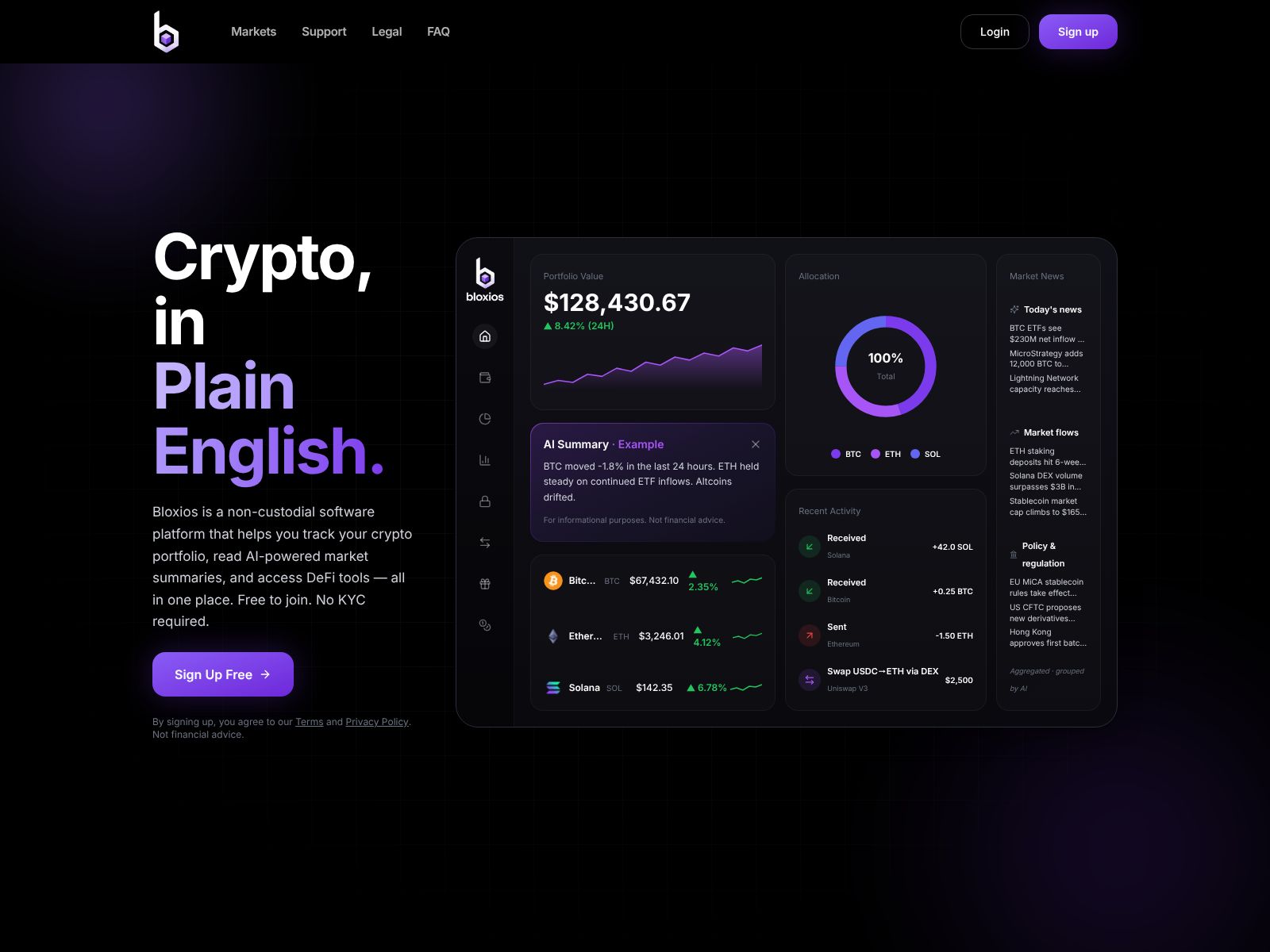
If you follow crypto markets, you know how hard it can be to keep track of your wallets, understand what’s moving, and decide which DeFi protocol to use next. Bloxios aims to simplify that. It brings your on-chain portfolio into one place, adds plain-English market intelligence powered by AI, and lets you route transactions into popular DeFi protocols through a clean, non-custodial interface. In this review, I’ll walk you through what Bloxios is, what it can and can’t do, who it’s for, how it compares to alternatives, and how to think about pricing and fit for your needs.
Before we dive in, a quick note on what Bloxios is not. Bloxios is a software tool. It is not a broker, dealer, exchange, money transmitter, custodian, or investment adviser. It does not hold user funds or give financial advice. You remain in control of your assets at all times through your own wallets when you interact with DeFi via Bloxios.
Bloxios lets you track crypto wallets across chains, understand your portfolio with clear analytics, read daily AI-powered market recaps, and route transactions to leading DeFi protocols — all without giving up control of your funds.
At a glance, Bloxios bundles four core capabilities into one platform:
Staying current in crypto can feel like drinking from a firehose. Hundreds of headlines, countless tweets, and price moves that don’t always make sense. Bloxios tackles this with AI-generated market recaps and news summaries that translate the day’s activity into clear, human-friendly language. The idea is simple: you get a condensed view of what moved, why it mattered, and what to watch next — without wading through jargon or spending hours on research.
Here’s why this matters for you and your team:
Bloxios is not offering investment advice here. It’s summarizing market activity and news to help you understand the landscape. You still control your decisions, strategy, and risk management.
Bloxios supports read-only, multi-chain wallet tracking. That means you can view holdings, balances, and positions from multiple addresses and networks in one dashboard. If your crypto footprint spans a few wallets across different chains, this alone can be a major time-saver.
Because tracking is read-only, you don’t need to move assets or share private keys. You simply point Bloxios to the addresses you want to track. This helps reduce operational risk while still giving you the clarity you need to manage your on-chain life.
Key benefits:
Numbers only help if they’re easy to understand. Bloxios provides diversification metrics and asset allocation views that show where your exposure sits across tokens, protocols, and categories. If you’re trying to avoid over-concentration or simply want a clean breakdown for reporting, these analytics are practical and straightforward.
What this looks like in practice:
Again, Bloxios isn’t telling you what to do. It’s surfacing the structure of your portfolio so you can make your own calls.
When you’re ready to act, Bloxios provides a non-custodial interface to route interactions to popular DeFi protocols. Today this includes Lido, Aave, Compound, Morpho, Pendle, and Rocket Pool. The platform is the software layer that helps you find and route a transaction, but it does not touch your funds. Execution happens through your own wallet, and you maintain full control.
Why this matters:
Example use cases:
As always with DeFi, you’re interacting with third-party protocols at your own risk. Bloxios provides a routing interface, not guarantees. Check protocol documentation, understand smart contract risks, and only proceed with what you’re comfortable signing and funding from your own wallet.
Bloxios emphasizes that it is a non-custodial software platform. That’s important. Because it never holds your funds, the platform avoids many of the counterparty risks that custodial services can introduce. You track wallets read-only, and when you take action in DeFi, you do so via your own wallet with your own approvals and signatures.
This design also helps team workflows. Whether you’re a solo user or part of a group that reviews activity collectively, you can keep operational control clear: analysis in Bloxios, decisions by your team, transactions signed only from the wallets you control.
To get started, you add the wallets you want to track. Bloxios then builds a view of your assets across supported chains. If you’re new to this, the big idea is that you don’t need to move anything. Bloxios watches what’s already there. If you later want to act on a position — stake, lend, borrow, claim rewards — you can route that action to the relevant DeFi protocol from within the interface and confirm it with your wallet.
This flow keeps setup simple and reduces friction. You’re not migrating accounts or exporting sensitive data. You’re consolidating visibility and optionally using Bloxios as a launchpad to protocols you trust.
Bloxios serves a few types of users particularly well:
If your main need is advanced trading tools, on-chain order flow dashboards, or deep research reports, you may still pair Bloxios with specialized tools. But as a daily driver for clarity, context, and controlled action, it’s designed to be approachable and efficient.
Strengths you’ll feel right away:
Limitations to keep in mind:
Because pricing can change, the best place to confirm current plans is the Bloxios website. When you evaluate pricing, consider how you and your team use the product today and where you expect your on-chain activity to go. A few practical tips:
If your organization needs custom reporting or enterprise controls, reach out to the Bloxios team directly. They can confirm what’s available and what’s on the roadmap.
No crypto tool exists in a vacuum. Here are well-known alternatives you might compare to Bloxios, along with how they typically differ. Your ideal stack may combine more than one of these, depending on what you need day to day.
Zapper is a long-standing portfolio dashboard and DeFi interaction hub. It shines in breadth of integrations and a familiar interface that many DeFi users already know. If your priority is an all-around dashboard with a strong community history, Zapper is a credible option. Compared to Bloxios, Zapper does portfolio tracking and DeFi interactions well, but it doesn’t focus as explicitly on daily AI market recaps in plain English. If you want a steady stream of contextual summaries baked into the same app you use to act, Bloxios may feel more consolidated.
Zerion blends a non-custodial wallet experience with portfolio management and DeFi access. It’s polished and mobile-friendly, with a focus on simplicity. If you want a wallet-first experience, Zerion is compelling. Bloxios, by contrast, positions itself as a read-only tracker plus analytics and AI insights, with routing to protocols when you’re ready to move. If you already have a preferred wallet and want a neutral dashboard with integrated market recaps, Bloxios is a clean fit.
DeBank offers detailed wallet analytics and a social layer for following addresses. Power users like its depth and the visibility it provides into on-chain behavior. If you want extensive address-level data and social discovery, DeBank is strong. Bloxios focuses more on clarity — allocating, diversifying, and summarizing the market each day — and then giving you a neutral path to established DeFi protocols.
CoinStats tracks portfolios across centralized exchanges and self-custody wallets, with budgeting and tax-friendly features. If you hold assets on CEXs alongside self-custody wallets, CoinStats helps you see everything in one place. Bloxios centers on on-chain, read-only tracking and DeFi routing. If the bulk of your activity is DeFi on self-custody wallets, Bloxios keeps things clean and aligned with that workflow.
Kubera is a broader personal finance dashboard. It tracks crypto alongside traditional assets like stocks, real estate, and bank accounts. If your goal is holistic net worth tracking, Kubera is hard to beat. But it’s not a DeFi routing hub. Bloxios is narrower by design: it’s focused on crypto portfolios and DeFi, paired with AI market context.
Rotki is an open-source, privacy-focused portfolio and accounting tool you run locally. If you want maximum data ownership and off-cloud processing, it’s a principled choice. Bloxios offers a hosted, user-friendly interface with AI insights and routing to protocols. If you prefer a managed platform and the convenience of integrated market summaries, Bloxios will feel lighter and faster to deploy.
Messari provides research, data feeds, and market intelligence for professional users. If you want in-depth reports and analytics, it’s excellent, but it’s not a personal portfolio dashboard or DeFi router. In practice, some teams pair Messari for research with a dashboard like Bloxios for daily portfolio visibility and execution routing.
Across these alternatives, you’ll notice a pattern. Many tools are great at tracking or great at DeFi interactions. Others excel at research or holistic finance. Bloxios combines a few things you don’t always get together:
If that blend matches how you work — quick context, clear holdings, and controlled action — Bloxios will feel purpose-built. If you need a more specialized tool for trading, social discovery, or multi-asset personal finance, consider pairing Bloxios with a niche alternative from the list above.
Bloxios brings order to an often messy crypto workflow. It pulls key parts of your daily routine — checking your balances, understanding your exposure, skimming the news, and deciding whether to act — into one calm, non-custodial workspace. You stay in control of your funds. You get AI-powered summaries to cut through noise. And when you want to use a DeFi protocol, you can route that action without leaving the platform.
Here’s the bottom line for you and your team:
It’s also worth restating the boundaries. Bloxios is a software tool, not a broker, dealer, exchange, money transmitter, custodian, or investment adviser. It provides information and interfaces, not financial advice. That clear separation is a strength if you prefer to keep ownership and responsibility where it belongs: with you.
As you evaluate whether Bloxios is right for you, consider your current tool stack. If you’re juggling multiple dashboards, news sources, and protocol UIs, Bloxios may replace a few tabs and save meaningful time. If you already live in a wallet-first app or need advanced trading features, you might still add Bloxios for its market insights and portfolio clarity, or stick with a specialized alternative.
On pricing, check the Bloxios website for the latest plans. Start small, validate coverage, and expand if the time savings and clarity justify it. In fast-moving markets, a calm, consistent workflow is a competitive advantage. Bloxios aims to provide exactly that — a steady daily rhythm for context, visibility, and action, with your keys and your funds staying with you at all times.
If that’s how you prefer to operate, Bloxios is well worth a closer look.
