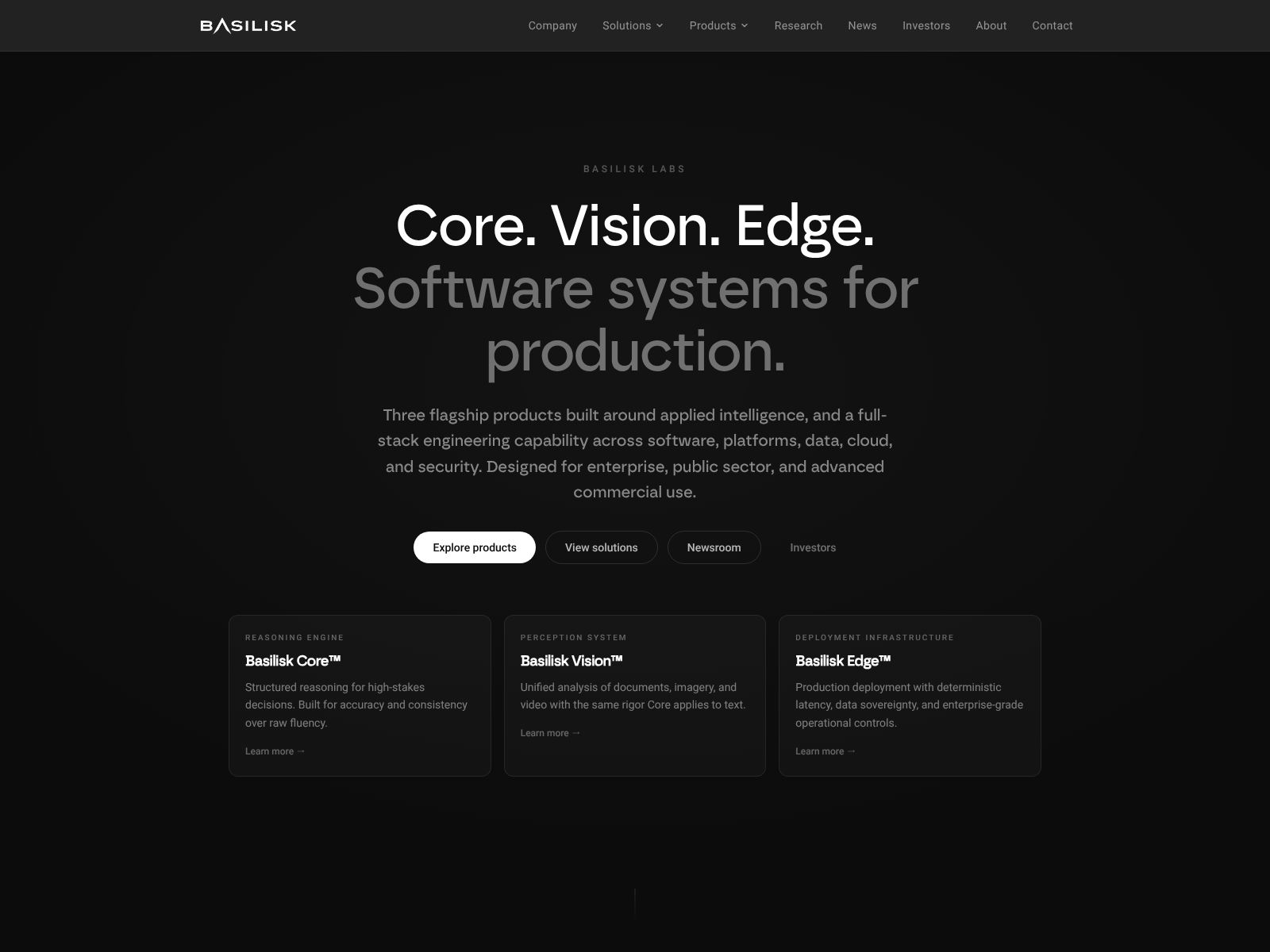
Basilisk Review & Overview
If you’re following the rapid progress in AI, you’ve probably noticed a new pattern: the most useful systems don’t just generate text or label images; they reason, perceive across different kinds of data, and scale cleanly inside large organizations. Basilisk is building exactly for that pattern. In this review and overview, I’ll walk you through what Basilisk is, what it does, how its feature set comes together, how to think about pricing and fit, and which alternatives you should compare it against if you’re evaluating enterprise-grade AI for your team.
Note: This article is based on publicly available, high-level information about Basilisk and general industry context. For the latest product specifics and pricing, contact Basilisk directly at the company site.
What does Basilisk do?
Basilisk is an AI company building an integrated intelligence platform for organizations. In plain terms, it offers three pillars that can work on their own or together: a foundation model built for strong reasoning, a multimodal system that can understand different types of input (like text and images), and the infrastructure that helps large organizations deploy these models safely and at scale.
Who is Basilisk for?
- Enterprises that need reliable reasoning over complex, cross-domain data.
- Teams that want one platform to handle text, images, and other modalities without stitching together multiple vendors.
- Leaders who care about governance, performance, and operational scale as much as raw model capabilities.
- Builders who want modular products they can adopt step-by-step and then compound over time.
Why Basilisk matters now
Modern AI adoption is shifting from narrow demos to real production systems. You and your team likely need three things to make AI work well in production:
- Reliable reasoning: not just fluent text, but careful, step-by-step analysis and decision support.
- Multimodal perception: the ability to read documents, charts, images, or other media together.
- Operational fit: controls for privacy, security, observability, and cost management.
Most vendors are strong in one or two of these areas. Basilisk is positioning to meet all three, with products that are valuable separately and even more valuable together. If they can execute, that integrated approach can cut vendor complexity and reduce the glue code you maintain internally.
Basilisk Features?
1) A foundation model optimized for reasoning
When people talk about “reasoning” in AI, they’re usually referring to models that do more than write or summarize—they break problems down, track constraints, evaluate options, and produce defensible outcomes. A foundation model optimized for reasoning aims to:
- Work through complex instructions with fewer errors.
- Handle multi-step tasks and chain-of-thought style decompositions (internally, even if not exposed).
- Stay consistent across longer contexts and more complicated prompts.
In enterprise settings, reasoning often shows up in tasks like financial analysis, due diligence, root-cause analysis, planning, experiment design, and compliance reviews. If Basilisk’s foundation model matches its intent, you should expect better performance on these high-cognition workloads compared with models trained mainly for conversational fluency.
2) Multimodal, cross-domain perception
Real-world work rarely lives in just one medium. Your team may need to parse a PDF, cross-check it against dashboards, and then summarize findings into a presentation with charts and images. A multimodal system with cross-domain perception supports this by:
- Accepting different inputs like text and images, and potentially other modalities.
- Linking information between modalities (for example, connecting chart patterns to narrative text).
- Producing outputs that reflect a combined understanding, not just siloed analysis.
This is useful across many domains—operations, marketing, research, design, and customer support. The promise here is that you can stop shuffling data between point tools and instead make the model the place where your information converges.
3) Infrastructure for institutional scale
Great model quality isn’t enough on its own. If your organization can’t deploy the model safely at scale, you won’t ship. Basilisk emphasizes the infrastructure layer, which in an enterprise context typically includes:
- Deployment options to match your constraints (cloud, VPC, and potentially on-prem depending on enterprise requirements).
- Security and governance features (role-based access, auditability, data handling controls) suitable for regulated environments.
- Observability and operations (usage monitoring, cost controls, logging) so you can run AI like any other critical workload.
- Integration capabilities (APIs, SDKs, connectors) to bring models to your data and applications.
Even if you don’t need every control on day one, a strong infrastructure layer is what lets you scale from a pilot to a production rollout without re-platforming later.
4) Modular products that compound
One of Basilisk’s core ideas is modularity with compounding value. You can adopt the reasoning model alone, or the multimodal system alone, or the infrastructure components alone. Over time, you combine them. The benefits of this approach include:
- Lower switching costs: start small, expand later.
- Tighter integration: features are designed to work together natively.
- Less glue code: fewer brittle integrations across multiple vendors.
For your team, that means you can validate value quickly (e.g., run a reasoning-heavy pilot in one workflow) and then stack in multimodal capabilities and stronger governance without swapping platforms.
5) Enterprise posture and collaboration
Because Basilisk targets institutional scale, you can expect a focus on topics that matter to enterprise buyers—things like reliability, support, and collaboration with your internal stakeholders. While specifics always vary by vendor, companies in this category typically emphasize:
- Clear support channels for pilots and production.
- Engagement with security and compliance teams during evaluation.
- Guidance on best practices for prompt design, evaluation, and rollout.
If your organization is at the early stage of AI adoption, this kind of partnership can be as important as the model itself.
Example use cases to consider
- Knowledge-heavy workflows: policy analysis, risk reviews, competitive research, and investigative reporting where reasoning is more important than speed.
- Cross-media reporting: merging text, charts, and images into single outputs (e.g., investment memos, QA summaries, or design reviews).
- Operational intelligence: extracting signals across tickets, documents, and dashboards to recommend actions.
- Institutional deployment: bringing AI to multiple teams with shared governance and uniform observability.
Basilisk Pricing
As of writing, Basilisk does not list public pricing details in the information available to us. That’s common for enterprise-focused AI vendors, where pricing depends on usage patterns, deployment choices, support levels, and any custom integrations. Expect one or more of the following models when you talk to sales:
- Usage-based pricing: pay per token or per inference minute with volume discounts.
- Tiered plans: development, pilot, and enterprise tiers with different quotas and features.
- Committed contracts: annual commitments for predictable costs and commercial support.
- Private deployment premiums: higher rates for VPC or on-prem options, if available.
Advice for your evaluation:
- Model your expected token usage early, including peak and average loads.
- Ask about observability and cost controls to prevent runaway spend.
- Clarify data handling terms and any extra costs for private deployments.
- Request a pilot or proof-of-concept with clear success metrics before scaling.
Implementation and onboarding
If you’re planning an evaluation, organize it into a few clear steps to reduce risk and accelerate learning:
- Define one high-value, reasoning-heavy workflow and a second, multimodal workflow. Keep each pilot small but realistic.
- Set success metrics that matter to the business (e.g., time saved, error rate reduced, or quality lift on a scored rubric).
- Map your data access needs and privacy rules up front. Involve security and data owners early to avoid late-stage blockers.
- Build a short feedback loop with real users. Weekly feedback beats a month of isolated testing.
- Plan the handoff from pilot to production. Document what would need to change in infra, monitoring, and governance to ship broadly.
Strengths and trade-offs
Where Basilisk is likely strong
- Reasoning-first model approach: Good fit if your value depends on analysis and planning, not just fluent text.
- Multimodal breadth: Useful if your inputs span text, images, and other media.
- Enterprise deployment focus: Important if you need governance, observability, and scalability from the start.
- Modularity with compounding value: Start with one piece and expand without re-platforming.
Potential trade-offs to consider
- Newer platform risk: As with any emerging vendor, you’ll want to validate maturity, support, and roadmap fit.
- Pricing clarity: Enterprise pricing can vary widely; get detailed quotes tied to real workloads.
- Ecosystem size: Larger incumbents may have more third-party integrations; weigh this against Basilisk’s integrated design.
- Feature specificity: Verify that must-haves like data residency, red-teaming controls, or custom guardrails meet your standards.
Basilisk Top Competitors
If you’re evaluating Basilisk, here are the main categories and players to compare against. Each brings different strengths—model quality, tooling, deployment options, or ecosystem.
OpenAI
- What to know: Leading general-purpose models, including reasoning-focused offerings and strong multimodal capabilities.
- Strengths: Model quality, broad tooling ecosystem, frequent updates, hosted and enterprise options via partners.
- Consider if: You want state-of-the-art model performance and a large ecosystem, and you’re comfortable with a more general platform.
Anthropic (Claude)
- What to know: High-quality language models with strong instruction-following and safety focus; advancing multimodal features.
- Strengths: Reliable text performance, long context windows, enterprise adoption.
- Consider if: You prioritize careful behavior, long-context reasoning, and strong enterprise posture.
Google (DeepMind) Gemini
- What to know: End-to-end multimodal models integrated across Google Cloud services.
- Strengths: Native multimodality, deep integration with Google’s data and developer tooling, scalable infrastructure.
- Consider if: You operate heavily on Google Cloud or prioritize deep multimodal workflows at scale.
Cohere
- What to know: Enterprise LLMs and retrieval tools designed for private data and production deployments.
- Strengths: Enterprise focus, developer-friendly APIs, retrieval-augmented generation patterns.
- Consider if: You want a strong enterprise NLP stack and a vendor focused on business data use cases.
Meta Llama ecosystem (open source)
- What to know: Open models you can self-host or run via managed services; broad community support.
- Strengths: Flexibility, cost control, customization, and on-prem potential.
- Consider if: You need maximum control, can invest in MLOps, and want to tune models to your domain.
Mistral
- What to know: Efficient, high-quality open and commercial models with strong performance per token.
- Strengths: Lightweight deployment, cost efficiency, growing enterprise traction.
- Consider if: You value efficiency and hybrid open/commercial options with good text performance.
AWS Bedrock, Azure OpenAI, Google Vertex AI
- What to know: Managed platforms offering access to multiple models, governance, and enterprise-grade infrastructure.
- Strengths: Security, compliance tooling, deep integration with cloud services and existing data stacks.
- Consider if: You want a single pane of glass on your preferred cloud with multiple model choices.
Databricks Mosaic AI, Snowflake Cortex, IBM watsonx, NVIDIA NIM/NeMo
- What to know: Data and AI platforms focused on enterprise scale, model deployment, and integration with core data workflows.
- Strengths: Data-native operations, governance alignment, and MLOps consistency.
- Consider if: Your AI work lives close to your lakehouse/warehouse or you need a heavy emphasis on MLOps.
How to evaluate Basilisk vs alternatives
As you compare Basilisk with more general providers or open-source stacks, use criteria that align to both your day-one pilot and your year-two operating model:
- Reasoning performance on your tasks: Run side-by-side evaluations on real prompts and real documents. Score for accuracy, completeness, and consistency.
- Multimodal depth: If you need images plus text (and potentially other modalities), test integrated workflows—not just isolated capabilities.
- Latency and throughput: Check performance at your target concurrency and document sizes, not just small demos.
- Context handling and retrieval: Measure how well the system uses long contexts and retrieval from your knowledge bases.
- Governance fit: Confirm access controls, audit trails, data retention options, and red-teaming/guardrail features meet your standards.
- Deployment pathways: Verify support for your required environment (cloud region, VPC, or other constraints) and understand operational overhead.
- Total cost of ownership: Include model usage, infrastructure, engineering time, and vendor support in your projections.
- Vendor partnership: Evaluate responsiveness, roadmap alignment, and willingness to support your specific domain needs.
Sample evaluation plan (30–60 days)
- Week 1: Select two high-value workflows (one reasoning-heavy, one multimodal). Define success metrics and compile test data.
- Week 2: Integrate the API or deployment option. Set up observability for latency, errors, and cost; establish a simple evaluation rubric.
- Weeks 3–4: Run controlled tests and A/B comparisons against your incumbent solution or a benchmark model. Collect real user feedback weekly.
- Week 5: Harden security controls, confirm data handling posture, and run a limited-scope production pilot with a defined user group.
- Week 6: Review results, cost projections, and any gaps. Decide on scale-up, additional pilots, or adjustments.
FAQs
Is Basilisk only for large enterprises?
Not necessarily. The company’s emphasis is on institutional scale, but its modular approach suggests you can start with a smaller scope. If you’re a mid-size team with complex workflows, you may still be a good fit—especially if reasoning quality and multimodal support are key needs.
Can you use pieces of the platform without committing to the whole stack?
Yes—that’s a core part of Basilisk’s positioning. You can adopt one product (such as the reasoning model or the multimodal system) and later add infrastructure features as you scale.
What about data privacy and security?
For any enterprise AI platform, this is a must-discuss area. Confirm data retention, training data usage, encryption, access controls, and deployment options with the vendor. If you operate in regulated industries, include your security and legal teams early in the evaluation.
How does Basilisk compare to open-source models?
Open-source models give you maximum control and customization but require more engineering and MLOps investment. Basilisk is building an integrated platform aimed at high reasoning quality and operational scale. Your choice comes down to control versus time-to-value and where your team wants to invest.
Who’s behind Basilisk?
Basilisk Labs Inc. is a Delaware C-Corp headquartered in New York City. The company’s public positioning centers on building a reasoning-optimized foundation model, a multimodal system, and the institutional infrastructure to deploy them. If you’re evaluating for your organization, ask about the team’s background, reference customers, and roadmap to understand how their expertise maps to your use cases.
When to choose Basilisk
Pick Basilisk if the following sound like you:
- Your workflows depend on careful, multi-step reasoning—not just summarization or chat.
- You need cross-domain perception across text and images (and possibly more) in unified workflows.
- You want to avoid stitching multiple vendors and prefer a modular platform that composes cleanly.
- Enterprise-grade deployment, governance, and observability are must-haves, not nice-to-haves.
When to consider alternatives
Consider alternatives if:
- You primarily need casual chat or basic summarization and can use a mainstream hosted model with minimal integration.
- You have a strong preference for a specific cloud-managed ecosystem (e.g., you want all-in on AWS, Azure, or Google Cloud with their native AI suites).
- You require extreme customization and are ready to invest heavily in open-source fine-tuning and MLOps.
Practical tips for a smooth rollout
- Start with one or two tasks that have clear business impact and well-defined ground truth for evaluation.
- Build a small, cross-functional squad (engineering, data, operations, and a domain expert) to run the pilot.
- Instrument everything: latency, token usage, errors, user feedback. Treat your AI pilot like a product, not a demo.
- Create a red/amber/green decision gate at 30 and 60 days to keep momentum and avoid pilot sprawl.
- Document learnings and playbooks so other teams can replicate success without reinventing the wheel.
Wrapping Up
Basilisk is aiming at a clear need in today’s AI landscape: a platform that blends strong reasoning, multimodal perception, and enterprise-grade deployment into a modular, compounding system. If your organization relies on high-cognition work and cross-domain data, that approach can simplify your stack and improve outcomes over piecemeal tools.
As with any emerging vendor, your best next step is hands-on validation. Stand up a small pilot, measure real impact, and compare results against incumbent options and leading alternatives like OpenAI, Anthropic, Google’s Gemini, and enterprise AI platforms on your cloud of choice. Pay special attention to governance fit, cost predictability, and support responsiveness—those are the levers that determine whether an impressive demo becomes a durable production capability.
If you need an AI partner that prioritizes reasoning quality, multimodal understanding, and institutional scale, Basilisk is worth serious consideration. Start small, evaluate rigorously, and scale what works.