




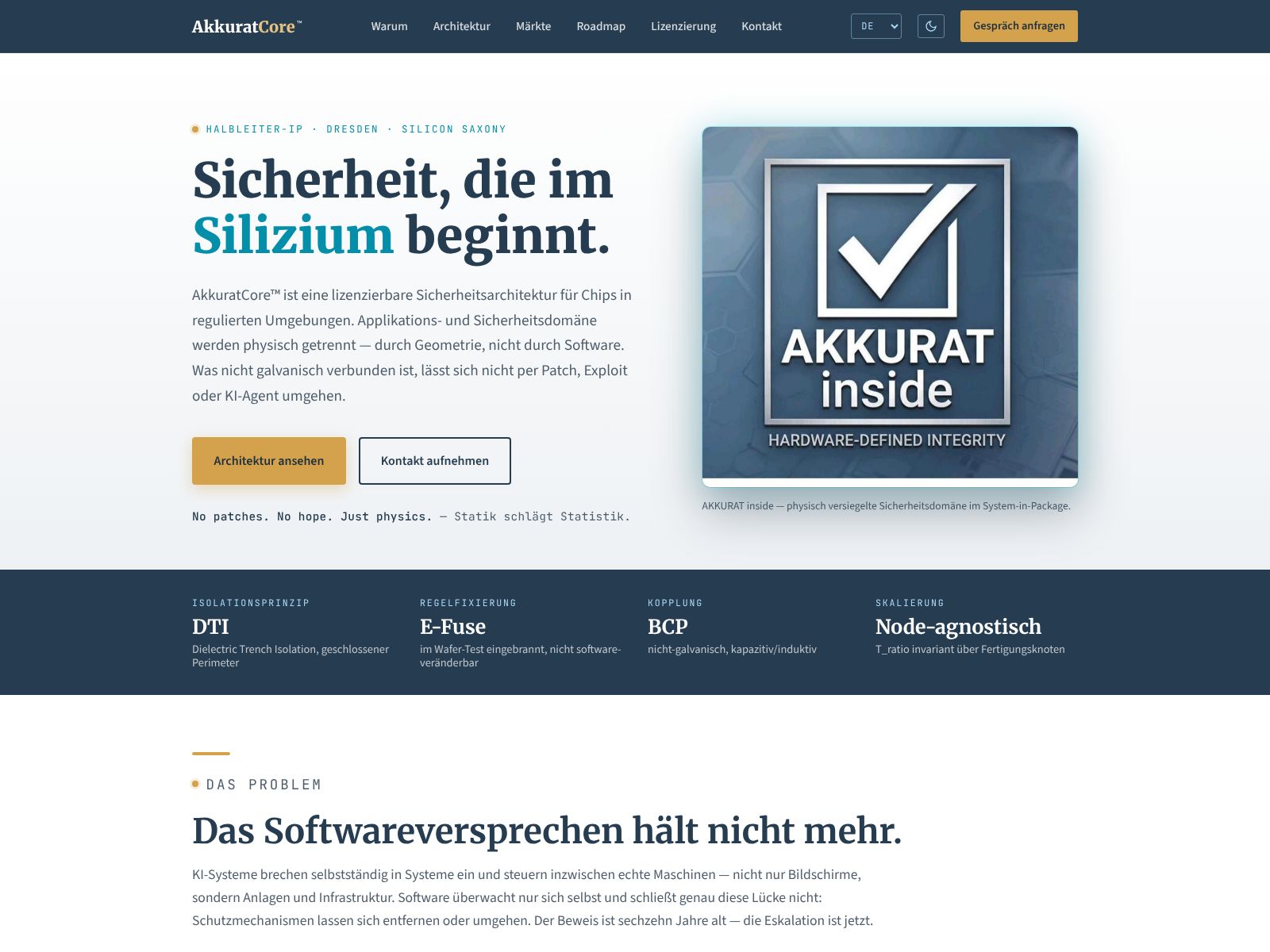
If your team builds silicon for critical systems, you already know the limits of software-only security. Patches never end, attackers move faster than certification cycles, and auditors increasingly ask for hardware proof, not promises. AkkuratCore is a new kind of semiconductor IP that leans into that reality. Instead of trusting privilege rings, hypervisors, or constant updates, it enforces separation and policy physically, in silicon geometry. In this review and overview, I’ll walk you through what AkkuratCore is, how it works at a high level, where it fits, what you should expect from pricing, and which alternatives to consider alongside it.
Based in Dresden, Germany—right in the heart of Silicon Saxony—AkkuratCore operates with a traditional IP licensing model. You license the architecture, integrate it into your own chip, and manufacture as usual. There’s no wafer capex or foundry lock-in, and the company is positioning itself squarely at the intersection of European regulatory push (NIS2, EU Cyber Resilience Act) and markets where physical assurance is becoming mandatory: critical infrastructure, smart-meter gateways, automotive ECUs, industrial automation, and the edge of AI-agent hardware.
AkkuratCore provides a licensable security architecture for system-on-chips that physically separates application and security domains. Instead of relying on software to keep secrets safe, it uses three on-silicon mechanisms—dielectric trench isolation, one-time fuses that lock rules permanently, and non-galvanic boundary crossings—to enforce which parts of a chip can ever interact and how. In short: it builds a physical wall between “what runs your app” and “what protects your system,” then locks the doors and controls the intercom.
The promise of AkkuratCore is simple to say and nontrivial to execute: use silicon geometry and irreversible rules to keep a security domain unreachably separate from the rest of the chip while still enabling strictly controlled, auditable communication. Here’s how that maps into practical features your team can evaluate.
AkkuratCore’s core idea is to divide the chip into at least two domains: a security domain (for trust anchors, keys, policy engines, attestation, etc.) and an application domain (for OS, user code, AI workloads, controls). The separation is achieved not just by logic design but by how the chip is physically laid out. The goal is to make accidental coupling and deliberate bypass paths infeasible by construction, not merely unlikely under software assumptions.
DTI is the physical moat. Trenches of dielectric material isolate regions on the die so that transistors in one region are not electrically coupled to transistors in the other. This is a long-standing technique in semiconductor manufacturing; AkkuratCore repurposes it as a security primitive.
Policies and boundary rules are set and then permanently locked via e-fuses. Once blown, they cannot be reversed. This prevents a malicious update, debug mode, or manufacturing misstep from undoing the separation or altering inter-domain access control after bring-up.
The two domains still need to communicate. AkkuratCore uses non-galvanic crossing—no direct metal wires carrying DC current between the security and application domains. Think capacitive, inductive, or similarly decoupled coupling, with strict protocolization.
AkkuratCore emphasizes that its physical assurances scale with process nodes. The “security ratio” (a conceptual measure of physical separation relative to device geometries) is designed to remain robust as you move from mature nodes to advanced nodes. For you, that means the architecture aims to keep its strength even as transistors shrink.
Traditional secure design often relies on probabilistic models: the chance that randomization or obfuscation holds, that certain attacks are too costly, or that software isolation remains intact. AkkuratCore’s pitch is to replace those with physically enforced boundaries and one-time locks so that the “proof” is less about statistics and more about geometry and fuses.
While certification outcomes depend on your complete product, AkkuratCore’s approach aligns with the trend regulators and notified bodies prefer: demonstrable, tamper-evident boundaries and restricted attack surfaces. Combining DTI, e-fuse locks, and non-galvanic crossings helps you explain and show why an exploit in the application domain cannot reach roots of trust or credential stores.
AkkuratCore is licensed IP, not a fab. You bring it into your RTL-to-GDS flow, place the security and application domains per guidance, wire up boundary crossings, and bake fuse controls into your provisioning steps. In practice, the heavy lifting is in physical design, security architecture, and test development.
Any physical isolation carries overhead. Trenches take area, non-galvanic crossings can gate bandwidth, and duplicated resources in the secure domain add transistors. That said, these costs buy you something software typically can’t: a simpler threat model and clearer evidence. If your volumes are high, the OPEX saved in field incidents, certification friction, and patching can outweigh silicon overhead.
One of the practical upsides of fuse-locked policy is operational calm. Once devices leave the factory, the rules of your boundaries aren’t subject to change by field updates. That can de-risk OTA frameworks and reduce the blast radius of software bugs. On the flip side, your operations team needs a careful RMA and forensic plan, because post-mortem introspection into the secure domain should remain impossible by design.
AkkuratCore targets markets where tamper resistance and auditability are essential: KRITIS-classified infrastructure, energy metering, automotive, industrial controls, and AI-edge systems managing sensitive data or autonomy signals. The company holds an active German utility model (DPMA) with a European patent application filed and lists Dennemeyer & Associates as IP counsel—useful context for OEMs who care about IP pedigree and freedom-to-operate checks.
AkkuratCore follows a conventional semiconductor IP licensing model. That typically means a combination of one-time license fees and per-unit royalties, plus design-in support. Because there’s no manufacturing, it’s structurally a high-margin business, which usually translates to responsive support for integration and audits.
If you’re exploring AkkuratCore, you’ll likely compare it against three broad categories: CPU-based isolation (TEEs), root-of-trust IP blocks with on-chip firewalls, and PUF/key-management solutions. Each solves overlapping but different pieces of the problem. Here are notable options and how they stack up conceptually.
Arm TrustZone splits a CPU into Secure and Normal worlds with monitor-mode transitions, supported by Arm’s Platform Security Architecture and companion IP like CryptoCell for cryptography.
Rambus offers configurable roots of trust with secure boot, key storage, tamper protections, and isolation features, integrating as IP into SoCs.
Synopsys provides secure enclave IP, ARC processors with SecureShield, and system security IP including interconnect firewalls.
Secure-IC delivers RoT IP cores, attack detection, and secure services for embedded SoCs, often with formal threat modeling support.
A modular RoT IP offering secure boot, key storage, and crypto accelerators with configurable isolation and lifecycle control.
PUF-based IP derives unique device keys from silicon characteristics, removing the need for injected secrets and aiding secure identity.
Many SoCs deploy AXI/APB firewalls and secure NoC features to isolate masters/slaves and enforce policy in hardware.
Off-chip security chips store keys, perform crypto, and attest the host across an external interface (I2C, SPI).
Larger semiconductor houses sometimes build bespoke physical separations and analog-hardened interfaces.
Where does AkkuratCore sit? It’s most distinct from the TEE/RoT crowd in that it makes the physical boundary the first-class security primitive. It can complement many of the above—pairing a physically separated security domain with a robust root of trust and PUF-derived keys makes sense in high-assurance designs. If your audits and markets demand hardware evidence and you’re comfortable paying some area and planning overhead, AkkuratCore becomes compelling.
AkkuratCore takes a refreshing, back-to-basics stance: if you don’t want your application world to touch your security world, don’t connect them. Carve the die with dielectric trenches, cross the gap only through non-galvanic channels, and lock the rules with one-time fuses. That shifts your argument from “our software is strong” to “our silicon doesn’t let software try.” For European OEMs facing NIS2 and the Cyber Resilience Act, that’s a powerful audit story.
Is it for everyone? No. If you’re shipping cost-sensitive consumer IoT with modest risk, conventional TEEs and interconnect firewalls may be “good enough” and faster to integrate. If you need maximum post-deployment flexibility, one-way fuse locks might feel too rigid. And if your physical design team is stretched thin, you’ll need vendor support and schedule room to get the floorplan and crossings right.
But if you build KRITIS-class systems, smart-meter gateways, automotive ECUs, industrial controls, or AI agents that handle sensitive decisions, the math changes. A smaller, better-defined attack surface and stronger audit evidence can beat the marginal mm² and an extra week of floorplanning. The technology aligns with modern certification expectations and fits naturally into a semiconductors-as-licensed-IP business model—no fab, no capex, and the freedom to choose your node while keeping a consistent level of physical assurance.
Before you decide, consider asking the AkkuratCore team the following:
If you want to move security from a patch treadmill to a physical boundary, AkkuratCore is worth a serious look. The company is rooted in Europe’s biggest semiconductor cluster, Silicon Saxony, and operates with a familiar IP licensing model that should fit most SoC business plans. For more details or to engage their team, you can visit the official site at akkuratcore.com.
Bottom line: AkkuratCore won’t eliminate the need for good software, but it can change the rules of engagement by making some classes of software attack irrelevant to your most sensitive secrets. In a world where regulators demand proof and attackers search for soft boundaries, that’s a strong proposition.
