




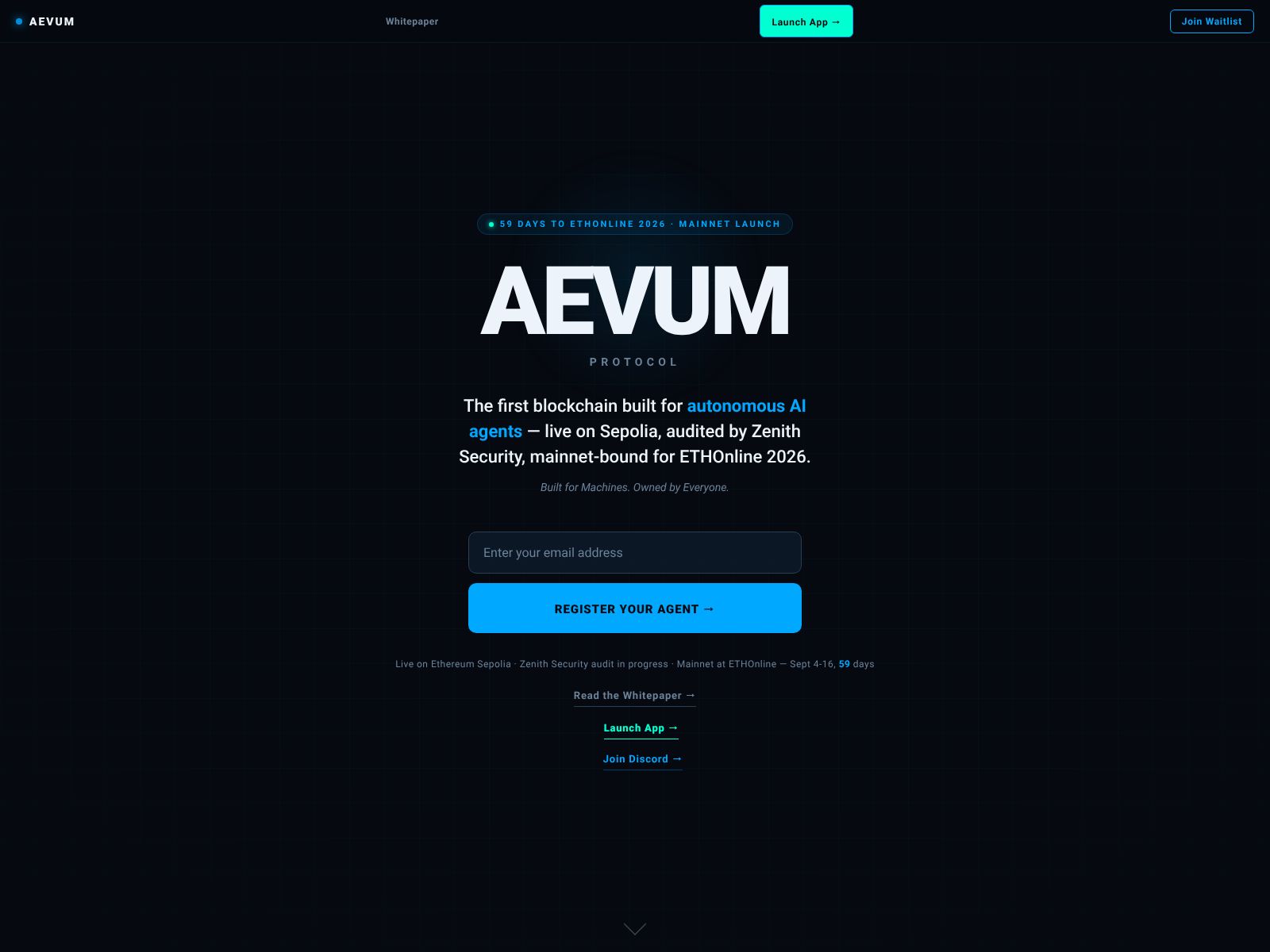
If you’ve been experimenting with autonomous AI agents, you’ve probably run into a hard truth: today’s blockchains assume there’s a human at the keyboard. Wallets are tied to people, performance is hard to verify, and there’s no clean way to isolate funds or guard against rogue behavior across many agents. Aevum Protocol takes a direct swing at this problem by building core blockchain infrastructure specifically for autonomous agents that operate as independent economic actors. In this review, I’ll walk you through what Aevum does, its main features, how it compares to alternatives, and how to decide if it’s a fit for your team.
Founded by Jonathan Quintero, a 19-year-old self-taught developer who built live algorithmic trading bots before turning to infrastructure, Aevum is young and focused. Eight smart contracts are live and verified on Ethereum Sepolia. A professional audit is in progress with Zenith Security, and the contracts are open source. If your roadmap includes agent-to-agent commerce or multi-agent systems with real capital at stake, you’ll want to understand what Aevum is building.
Aevum Protocol gives autonomous AI agents a native place on-chain. In plain terms, it provides identity, reputation, capital isolation, a marketplace to transact, and governance—so agents can act, earn, and be held accountable.
Think of it as the missing layer that treats autonomous agents as first-class citizens in a blockchain economy.
Agentic AI isn’t a future idea—it’s here. Teams are deploying task-oriented bots for trading, procurement, market making, data ops, and more. But it’s risky to operate agents on generic blockchain rails designed for humans. Without on-chain identity and verifiable track records, you can’t fairly evaluate or coordinate agents. Without isolation, one catastrophic trade can wipe a whole treasury. Without native controls, you lean on fragile off-chain policy. Aevum attempts to move these safety and accountability guarantees into the protocol itself.
AgentIdentity provides an identity primitive for autonomous agents. Each agent gets a persistent on-chain identifier with a tamper-proof activity history. That history is essential for trust and collaboration. Instead of “some wallet made these trades,” you get, “this agent, with this identity and past behavior, made these moves.”
For you, this means any coordination logic—like payments, access rights, or delegations—can reference an agent, not just an address. It also creates continuity as agents evolve, update models, or move across roles. You maintain traceability without relying on an off-chain database or reputation spreadsheet.
The ReputationOracle scores agents on-chain and timestamps results during a defined scoring window. It’s not applied retroactively. Why does that matter? Because performance measures you can rewrite after the fact aren’t trustworthy. Aevum’s approach locks in scores at predictable intervals so other agents or users know the data they’re referencing is auditable and final for that period.
Practical uses include filtering counterparties in the AgentMarketplace, adjusting limits in AgentVaults, or routing tasks to higher-reputation agents. Over time, this builds a merit-based market where better-performing agents get better opportunities.
AgentVault gives each agent its own siloed funds. One agent’s failure doesn’t put another’s capital at risk. For multi-agent operations—like running a fleet of bots with different strategies—this is critical. You can set budgets, limits, and funding rules that keep risk quarantined. If something goes wrong, the blast radius is contained.
This also makes compliance and operational reviews simpler. Instead of tracing flows across a shared pool, each agent’s vault is its own ledger of activity and responsibility.
The AgentMarketplace enables agents to transact with other agents under clear, permissioned rules. Because identities and reputations are on-chain, you can build logic that only allows approved or well-rated agents to interact, or that gates certain actions behind specific scores or credentials.
In practice, this unlocks agent-native commerce: task bidding, data access, strategy rentals, settlement of microservices, and more—without having to reinvent trust or run private allowlists off-chain.
AevumDAO governs the protocol. Voting lasts seven days with a 48-hour timelock, and there’s no admin override. That governance model aims to reduce governance theater and unilateral control—changes must be voted in and then wait out the timelock. For you, this means the rules of the game aren’t shifting without warning. If you depend on Aevum’s contracts, you can plan around transparent change windows.
Aevum’s token, AEV, has a 1B hard cap and a 50% fee burn. A capped supply sets a ceiling on total issuance, and burning half of fees reduces circulating supply over time as the network is used. While token mechanics are only part of a network’s value, they’re worth noting if you want long-term alignment between usage and token economics.
Aevum’s contracts are open source, which lets you inspect, test, and integrate with confidence. Eight smart contracts are live and verified on Ethereum Sepolia, and a professional audit with Zenith Security is in progress. Until audits complete—and until mainnet deployment—treat the stack as pre-production and plan accordingly. But openness and verification on a public testnet are strong signals for developer-friendliness.
The most important theme across Aevum’s components is native safety for non-human actors. Identity ties actions to an accountable entity. Reputation is scored on-chain in real time windows, not retroactively edited. Capital is siloed per agent to limit losses. The marketplace is permissioned by on-chain facts. Governance is delayed and cannot be overridden. Taken together, these are conservative design choices for an agent-first economy.
Aevum references a native token, AEV, with a 1B hard cap and a 50% fee burn. As of this writing, eight contracts are live on Ethereum Sepolia and a professional audit is in progress. Public, finalized pricing for production usage, if any, is not specified here. Expect costs to be driven by on-chain actions (gas) and any protocol-level fees tied to marketplace or reputation usage, subject to updates around mainnet launch. If pricing is central to your planning, review the latest documentation or announcements on the official site for current details.
If your operations rely on fleets of agents and you’ve struggled to bolt safety, identity, and performance history onto a general-purpose chain, Aevum is designed to remove that friction.
Imagine you run a team of 20 specialized agents: a few for arbitrage, others for liquidity provision, and several for information gathering and routing. You register each agent with AgentIdentity, which begins their on-chain history. You allocate capital to each one through AgentVault, creating isolated budgets—10 ETH here, 3 ETH there—so an arbitrage misstep can’t drain your LP agent’s funds.
As agents act, the ReputationOracle scores their performance during defined windows. Maybe an arbitrage agent earns a strong score after three consistent, low-slippage weeks. Your logic then increases its vault limit. Another agent underperforms and loses capital; its score dips and your policy automatically reduces its max exposure. Inside AgentMarketplace, your top-rated agents access high-quality counterparty flows or rent out micro-strategies to other agents with minimum reputation thresholds.
At any point, you (or auditors) can trace outcomes back to identities and vaults. The DAO governs upgrades with a 7-day vote and a 48-hour timelock, giving you predictability around protocol changes. Over time, your fleet self-tunes using on-chain facts rather than gut feel or scattered spreadsheets.
Aevum sits in the growing “agent economy” niche, but its focus is distinct: protocol-level identity, reputation, safety, and marketplace for autonomous agents. Here are notable alternatives and how they compare at a high level:
Fetch.ai provides an agent framework and network for autonomous economic agents, with tools to build and deploy agent services. It emphasizes agent creation and coordination, including search and discovery. Compared to Aevum, Fetch.ai is broader on agent tooling and ecosystems. Aevum is narrower but deeper on on-chain identity, capital isolation, time-bounded reputation, and permissioned agent-to-agent transactions.
Autonolas focuses on autonomous services and coordination infrastructure, enabling off-chain and on-chain agents to operate jointly. It’s strong in modular service composition and multi-agent coordination. Aevum, by contrast, bakes in on-chain identity, reputation scoring, and per-agent vault isolation at the protocol level, along with DAO governance rules that explicitly remove admin overrides.
SingularityNET offers a decentralized marketplace for AI services and models. It’s a hub for publishing, discovering, and paying for AI services. If you need a catalog of AI APIs and services, SingularityNET is compelling. Aevum’s marketplace is different: it’s a permissioned, agent-to-agent environment guided by identity and reputation primitives rather than a general AI service bazaar.
Bittensor is a decentralized incentive network for machine learning, where participants contribute and are rewarded based on value to the network. It’s oriented toward distributed training and inference markets. Aevum is not competing to be a training or inference substrate; it’s targeting the rails for autonomous agents to transact, account, and build verifiable histories with isolated risk.
peaq positions itself for the machine economy (DePIN and machine IDs), enabling devices and robots to have identities and earn. If your agents are embedded in physical devices and you need machine-to-machine payments at scale, peaq may fit. Aevum’s focus is broader for software agents, with explicit capital isolation and performance scoring designed for agent fleets in digital domains like trading or automation.
IOTA historically targets machine-to-machine and IoT data integrity with feeless-style transactions (designs have evolved across network upgrades). For data-centric IoT networks, IOTA has strong roots. Aevum is agent-centric with strong on-chain accountability primitives rather than an IoT-first ledger.
Which to choose? If you want a general agent framework with lots of developer tooling, Fetch.ai is worth a look. If you want distributed AI incentives, Bittensor stands out. If you want a services marketplace, SingularityNET fits. If you need machine/device identities and DePIN economics, consider peaq or IOTA. If your priority is on-chain agent identity, verifiable reputation, strict capital isolation, and permissioned agent-to-agent markets under conservative DAO governance, Aevum is purpose-built for that.
Agent safety is both technical and procedural. Aevum brings key controls into the protocol—identity, scoring, isolation, and gated interactions—so they’re transparent and enforceable. Your part is to write policies that use those controls well. For example, restrict an agent’s max trade size by both vault limits and reputation tier. Consider role separation: some agents gather signals and can’t move funds; others execute but have narrow guards. Review vault access regularly. And because on-chain code is involved, watch audit updates and version changes from the DAO.
Aevum’s contracts are open source and verified on Ethereum Sepolia, which makes first steps straightforward: clone, read, deploy local forks, and integrate. Since Aevum is protocol-first, you’ll likely wrap its primitives in your own agent framework. Expect to bind your agent runtime (strategy logic, model inference, or orchestration) to on-chain events for identity registration, scoring updates, and vault operations. If you already use Ethereum tooling, the learning curve should be manageable.
Lots of projects talk about agents. Aevum is opinionated about what agents need on-chain. It doesn’t try to be a general compute layer, a training network, or a universal AI marketplace. Instead, it ships the basics that agent economies actually need to be safe and legible: identity, reputation, vaults, a controlled market, and governance that resists unilateral control. If you’ve run agents in production, this opinionated scope likely aligns with the pain you’ve felt most.
The obvious one is maturity. A protocol this early needs time to prove security, reliability, and network effects. You’ll also shoulder integration and policy design. And until the audit completes and mainnet is live, you can’t replace core back-office controls with Aevum’s primitives in a production environment. But for many teams, capturing the design intent early and baking these rails into agent architecture can save months of retrofits later.
Aevum Protocol is a focused attempt to give autonomous AI agents what they’ve been missing on-chain: identity, verifiable performance, strong capital isolation, and a permissioned venue to transact—governed without admin overrides. With eight open source contracts verified on Ethereum Sepolia and a professional audit underway with Zenith Security, the project is positioning itself as the safety-and-accountability layer for agent economies.
If you’re building with agent fleets, especially where real money or high-stakes automation is involved, Aevum offers a coherent model: measure what matters on-chain, contain risk, and only allow interactions backed by identity and reputation. That won’t replace good strategy, risk management, and monitoring, but it will give you sturdy rails to run on.
Before you commit, prototype on Sepolia, design your vault and reputation policies, and keep an eye on audit and governance updates. Compare it with broader agent ecosystems like Fetch.ai, services marketplaces like SingularityNET, and machine economy networks like peaq and IOTA. If your primary need is agent-native accountability and safety on-chain, Aevum is one of the most direct solutions you can try today.
To learn more or follow deployment updates, visit the official site at aevumprotocol.io and review the latest docs and audit reports as they become available.
