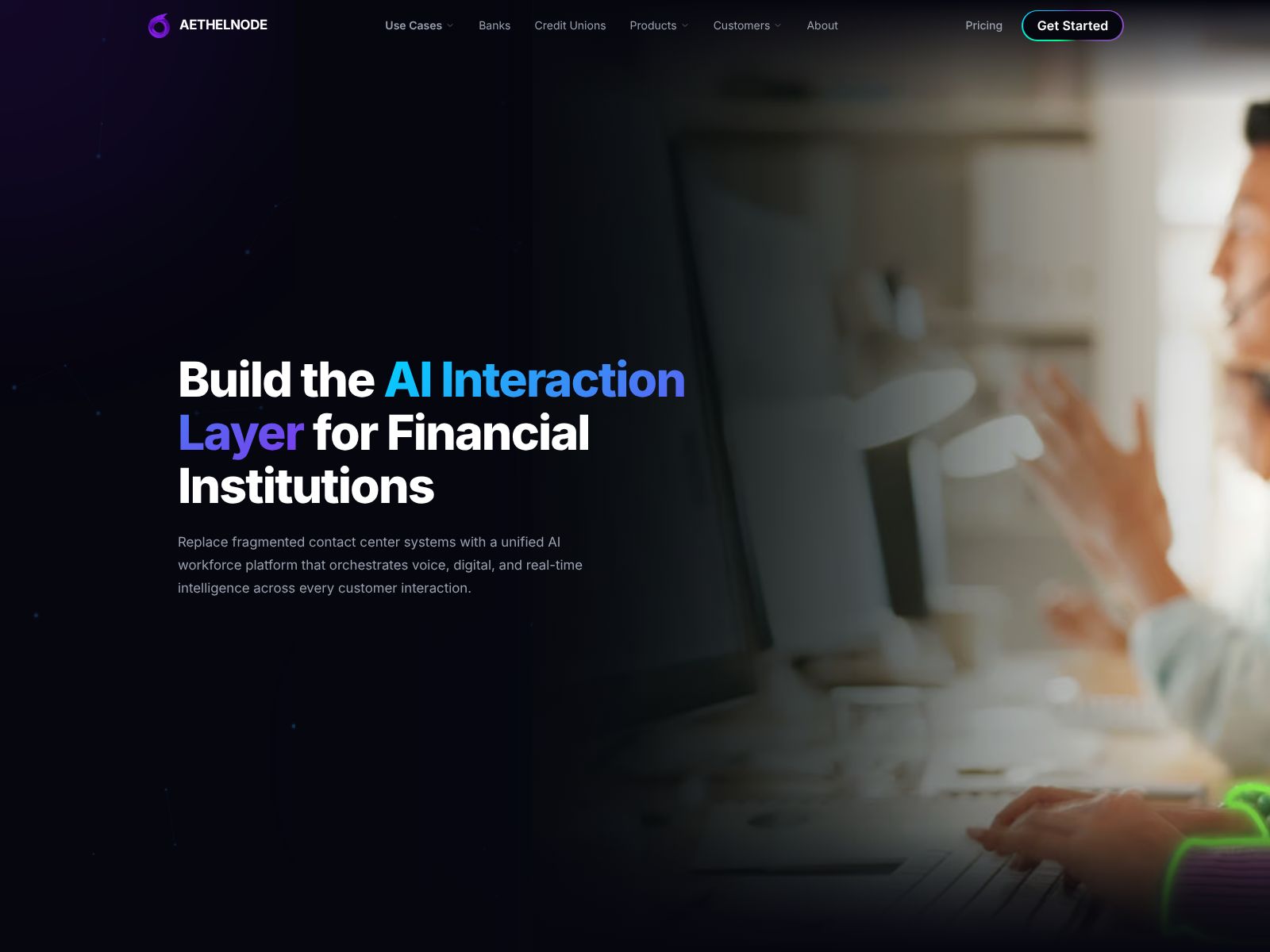
aethelnode Review (Features, Pricing, & Alternatives)
If you lead customer operations, product, or technology at a bank, credit union, insurer, or fintech, you are likely under pressure to serve customers faster, reduce cost to serve, and modernize your contact channels. aethelnode positions itself right at that intersection. It blends AI agents, real-time decisioning, and multi-channel orchestration so your customers can get help across voice, web, and messaging, and your teams can act on decisions instantly. In this review, I’ll walk you through what aethelnode does in plain language, highlight its core features, discuss who it’s for, outline likely pricing considerations, and compare it with top alternatives you may already be evaluating.
As a quick note: this overview is based on the company’s stated focus as an AI-powered interaction infrastructure platform for financial institutions. Always confirm details, packaging, and SLAs directly with the vendor.
What does aethelnode do?
aethelnode helps financial institutions run smarter customer interactions. It uses AI to answer questions, make decisions in real time, and connect those decisions to actions across voice, digital, and messaging channels. The goal: faster service, fewer handoffs, and more consistent outcomes for your customers and teams.
aethelnode Features
Here are the core capabilities you should expect from aethelnode, based on its positioning as an AI-powered interaction infrastructure platform for financial institutions:
-
AI agents for customer and employee support
- Customer-facing agents: Handle routine requests (balances, payments, transactions), guide next steps, and escalate to humans when needed.
- Agent-assist bots: Whisper suggestions, summarize context, and surface next-best actions to your live agents in real time.
- Process-aware behavior: Use context from accounts, entitlements, and recent activity to personalize responses.
-
Real-time decision engine
- Evaluate customer context and business rules on the fly to choose the best response or action.
- Blend rules with machine learning to improve decisions as outcomes are observed.
- Support next-best-action use cases such as resolving service requests, offering payment plans, or guiding authentication flows.
-
Multi-channel interaction unification
- One brain across voice, web chat, mobile app, and messaging platforms (e.g., SMS, WhatsApp, social DMs).
- Shared context and session state so a customer can start in one channel and continue in another without repeating themselves.
- Consistent intents, policies, and experiences no matter how customers reach you.
-
Orchestration, routing, and handoff
- Route interactions based on intent, value, or risk—either to AI or to the right human team.
- Seamless handoffs include full context, transcripts, and recommended next steps.
- Trigger downstream workflows (tickets, cases, payments, or account updates) from within the interaction.
-
Data and system integrations
- Connect to cores, CRMs, servicing platforms, decision hubs, and knowledge bases to ground AI responses in facts.
- Use APIs and events to fetch balances, validate identity, or submit forms without forcing the customer to switch channels.
- Unify identity and context to keep responses accurate and compliant.
-
Analytics and closed-loop learning
- Measure intent volumes, containment rates, handle times, and CSAT/quality signals across channels.
- Identify high-friction journeys and policies that need updates.
- Feed results back into decision strategies and agent prompts to improve over time.
-
Controls, governance, and human-in-the-loop
- Set guardrails for what AI can say or do; require approvals for sensitive actions.
- Offer supervised workflows where staff can review, edit, or approve AI-suggested actions.
- Provide auditability for decisions and interactions to support internal review processes.
-
Scalability and reliability
- Designed to handle high volumes with predictable performance across peak periods.
- Channel failover and monitoring so customers stay connected even under stress.
- Capacity planning and throughput visibility for operations leads.
-
Developer tooling and configuration
- Intent and flow builders to design journeys without heavy code.
- APIs, SDKs, and webhooks to extend, embed, and automate.
- Versioning, testing, and rollout controls for safe change management.
How this comes together in practice:
- A customer messages your bank about a suspicious charge. The AI agent verifies basic identity signals, checks recent transactions, evaluates risk rules in the decision engine, and either resolves the case (if low risk) or escalates with full context to a fraud specialist.
- In the call center, an agent gets real-time prompts with verified account details, likely intents, and recommended actions based on policy. After the call, aethelnode can summarize the interaction and file the right disposition codes.
- Marketing or service teams roll out a new policy change. You update a single decision strategy and relevant prompts. The change applies consistently across voice, chat, and messaging the same day.
Why this matters: you reduce effort for customers and agents, shorten time-to-resolution, and make decisions more consistent—all of which support higher satisfaction and lower costs.
aethelnode Top Competitors
If you are evaluating aethelnode, you will likely compare it to platforms that unify AI, decisioning, and multi-channel orchestration. Here are notable players you may include in your short list. Each offers different strengths; your best fit depends on your use cases, scale, and stack.
- Kore.ai – Broad conversational AI suite for customer and agent-facing bots across voice and digital channels, with robust tooling and enterprise deployments in financial services.
- Kasisto (KAI) – Banking-focused conversational AI known for domain-specific intents and digital assistant experiences for retail and business banking.
- Cognigy – Low-code platform for voice and chat automation with orchestration and agent handoff features.
- Genesys Cloud CX – Full contact center platform with AI, routing, and analytics; strong if you want a single vendor for telephony plus AI.
- NICE CXone – Contact center suite with AI-driven analytics and automation; often chosen for large-scale operations.
- Twilio Flex (with AI stack) – Highly customizable contact center platform; good for teams that want to compose their own experience and embed AI via APIs.
- Pega (Customer Decision Hub & Customer Service) – Strong in real-time decisioning and next-best-action; relevant if you already use Pega for workflows and policy.
- Interactions – Conversational AI for complex voice use cases; often used for high-stakes IVR automation.
- Glia – Digital customer service platform focused on web/app engagements, co-browsing, and on-screen guidance.
- LivePerson – Messaging-first customer engagement with AI and agent assist; useful for brands leaning into asynchronous channels.
- Ada and boost.ai – No/low-code chat automation focused on quick deployment and business ownership of intents.
- Nuance (Microsoft) – Voice and biometrics heritage with tools for IVR, agent assist, and omnichannel AI.
- Personetics – Focused on personalized banking insights and guidance; complementary if your priority is proactive financial wellness.
How to narrow the field quickly:
- If you need deep decisioning and next-best-action, consider aethelnode, Pega, or platforms that integrate closely with your existing decision hubs.
- If telephony modernization is the driver, evaluate contact-center-native suites like Genesys or NICE and confirm how AI policy and knowledge stay consistent across channels.
- If you want fast time-to-value on digital channels, look at Ada/boost.ai/Cognigy and assess long-term extensibility compared with an interaction infrastructure approach.
- If you expect heavy customization with internal engineering, compare aethelnode’s APIs and governance with Twilio Flex’s composability.
Pricing
aethelnode serves financial institutions and appears positioned for enterprise deployments. While public pricing is not listed at the time of writing, here are common pricing patterns for platforms in this category and what you should expect to drive cost:
- Usage-based elements – Charges by monthly active users, interaction volumes, minutes (for voice), messages, or API calls.
- Tiered features – Core automation vs. advanced decisioning, analytics, and governance may be bundled in higher tiers.
- Channel add-ons – Voice, messaging connectors, and telephony often come with separate or pass-through costs.
- Environment and support – Sandbox, high-availability/DR, dedicated environments, premium support, and SLAs can influence pricing.
- Professional services – Discovery, design, integrations, and change management are typical line items for launch and expansion.
Budgeting tips:
- Model costs per resolved interaction across channels to compare apples-to-apples with your current spend.
- Account for knowledge management, identity, and data platform dependencies you will need to keep answers accurate and safe.
- Plan for an initial build phase plus a continuous optimization phase; the second phase is where ROI compounds.
For an accurate quote and packaging details, contact aethelnode directly via aethelnode.com.
Who is aethelnode best for?
aethelnode is designed for financial institutions that want to unify customer service, decisioning, and execution across channels. It is a stronger fit if you:
- Need AI across voice and digital with shared policy and context.
- Have complex decisions that depend on rules, risk, and customer data.
- Want to improve both self-service and agent-assist outcomes.
- Value governance, audit trails, and predictable change management.
- Plan to integrate with existing cores, CRMs, and case systems rather than rip-and-replace.
Teams that might find more value elsewhere:
- Very small organizations looking for a simple FAQ bot on one channel.
- Companies whose main need is a new telephony stack without broader AI policy unification.
Benefits you can expect
- Higher containment and faster resolution – AI handles more tasks end-to-end; agents focus on exceptions.
- Consistent decisions – Policies are applied the same way across channels and teams.
- Lower cost-to-serve – Automation and better routing reduce handle time and rework.
- Better customer experience – Less repetition, clearer next steps, and faster outcomes.
- Scalable growth – New products and policies can roll out once and appear everywhere.
Implementation overview
Rolling out interaction infrastructure is not just an IT project; it is an operating model shift. A practical path looks like this:
- Discovery and prioritization – Identify top intents by volume and value (e.g., authentication, card management, payments). Define success metrics and guardrails.
- Data and integration design – Map the systems of record you need (accounts, entitlements, cases) and how the AI will read/write safely.
- Conversation and decision design – Create intents, flows, and decision strategies that reflect policy. Decide when to escalate and how to present context to humans.
- Channel rollout – Start with one or two channels, measure, then expand. Reuse the same brains; don’t fork logic.
- Agent-assist first – Early wins and trust often come from augmenting agents before full automation of complex flows.
- Governance and QA – Set review cycles, prompt and policy testing, and monitoring for drift or regressions.
- Continuous optimization – Use analytics to find friction, refine prompts and rules, and add automations where data is strong.
Risk and governance considerations
Financial institutions operate under strict expectations for accuracy, fairness, privacy, and explainability. As you assess aethelnode or any AI interaction platform, make sure you can:
- Control what AI can do and when human approval is required.
- Ground responses in validated data, not assumptions.
- Explain why a decision was made and reproduce it in audit scenarios.
- Red-team prompts and flows to avoid edge-case failures and leakage of sensitive information.
- Monitor for performance drift and ensure updates go through change control.
Measuring ROI
Set clear before/after baselines and track:
- Self-service containment rate by intent and channel.
- Average handle time and first contact resolution.
- Case rework and escalations per thousand interactions.
- Deflection from high-cost to low-cost channels with no CX penalty.
- Revenue enablement where relevant (e.g., payment plans set up, onboarding completion).
Tie gains to cost-of-service models and staffing plans so savings are realized, not just modeled.
What makes aethelnode different?
Three things stand out in the way aethelnode frames its value:
- Interaction infrastructure mindset – Instead of a bot for each channel, it aims to unify AI, decisioning, and orchestration so changes propagate everywhere.
- Decisions plus execution – The promise is not only to decide what should happen but also to trigger the right actions through your systems.
- Financial-services focus – Prioritizes the needs of regulated organizations that care about governance, context, and long-term value, not just quick replies.
Questions to ask the vendor
- Which core banking, CRM, and servicing systems do you have reference integrations for today?
- How do you combine rules and machine learning in the decision engine, and how are changes governed?
- What human-in-the-loop controls exist for sensitive actions and responses?
- How is context shared across channels and preserved through handoffs?
- What analytics are available out of the box, and can we export detailed event data?
- What are the main drivers of price, and how do you meter usage across voice and messaging?
- What does a typical timeline look like for first value and for enterprise rollout?
Sample use cases
- Fraud concerns and dispute intake – Verify identity signals, capture details, check recent activity, and either resolve or route with full context to a fraud specialist.
- Payments and due date help – Offer options based on account status and risk; set up plans or escalate for review when needed.
- Card management – Activate, lock/unlock, set travel notices, and replace cards across channels with instant confirmation.
- Onboarding and KYC steps – Guide document submission, validate data, and complete forms without channel switching.
- Agent assist during complex calls – Summarize, suggest actions, and auto-complete after-call work to boost productivity.
Pros and cons
Every platform has trade-offs. Here’s a balanced view to help you decide:
- Pros
- Unified brain across voice and digital reduces duplication and policy drift.
- Real-time decisioning aligns responses with rules and risk appetite.
- Designed for enterprise scale and governance needs common in financial services.
- Cons
- Requires thoughtful integration and change management to unlock full value.
- May be more than you need if your goal is a simple single-channel bot.
- Enterprise pricing and procurement may lengthen time-to-contract compared to lightweight tools.
How to choose between aethelnode and alternatives
Use this quick checklist to compare options:
- Channels – Does it support your current and near-term channels with shared logic?
- Decisioning – Can it operationalize your policies and learn from outcomes?
- Integrations – Are the connectors and APIs mature for your core stack?
- Governance – Do you get the guardrails, approvals, auditability, and version control you need?
- Analytics – Can you measure impact and export data to your lakehouse/BI tools?
- Time-to-value – How fast to first use case, and how quickly can you scale?
- Total cost – Consider licenses, usage, services, and internal staffing to build and run it.
Customer and team impact
What your customers feel:
- They get answers faster, in the channel they prefer.
- They do not have to repeat themselves when they switch channels or get escalated.
- They see clear next steps and outcomes they can trust.
What your teams experience:
- Agents spend more time resolving and less time searching and summarizing.
- Operations leaders gain visibility into intent volumes, bottlenecks, and outcomes.
- Product and policy teams ship changes once and see them applied everywhere.
Change management tips
- Start with one or two high-value intents and celebrate early wins to build momentum.
- Involve compliance and risk partners from day one so guardrails are co-designed, not bolted on.
- Give agents a say—agent assist can act as a proving ground for prompts, knowledge, and decisions.
- Assign a product owner for “conversational experiences” empowered to prioritize improvements.
- Set weekly or biweekly optimization rituals to keep learning loops tight.
What to prepare before vendor conversations
- A prioritized list of intents and the systems each depends on.
- Policies that must be enforced (auth thresholds, dispute windows, payment rules).
- Sample transcripts or chat logs showing real customer language.
- Success metrics and guardrails (e.g., containment targets, escalation limits).
- Stakeholders and approvers for a pilot (CX, ops, legal, risk, IT).
Wrapping Up
aethelnode aims to be more than a chatbot. It presents itself as interaction infrastructure for financial institutions: AI agents plus a real-time decision engine and multi-channel orchestration that unify voice, digital, and messaging. If your goals include consistent decisions, faster resolutions, and lower cost-to-serve across channels, this approach is worth serious consideration.
Compared with point solutions, the promise is a single brain that learns once and acts everywhere, with the governance you need to operate in a regulated environment. The trade-off is that realizing the full benefit requires thoughtful integration and ongoing optimization—work that pays back as volumes grow and policies change.
Your next step: shortlist aethelnode alongside two or three competitors that match your stack and priorities, run a focused pilot on high-value intents, and measure outcomes against a clear baseline. If the data shows strong containment, faster handling, and consistent decisions, you will have a repeatable engine to scale service quality and efficiency across your channels.
Learn more or contact the vendor at aethelnode.com.