


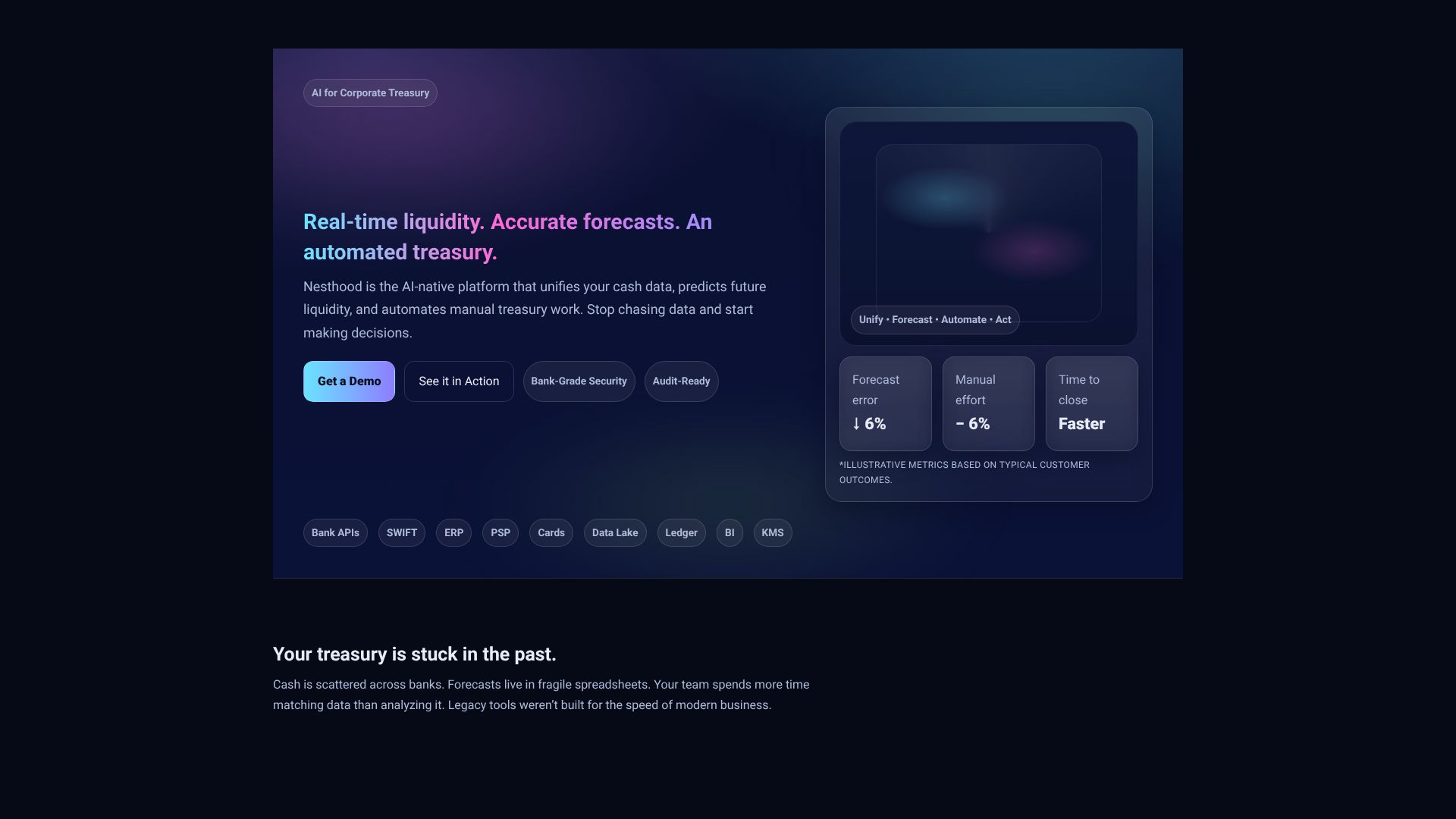
Navigating cash, liquidity, and payments across dozens of banks, PSPs, cards, ERPs, and ledgers is hard enough; doing it in real time, with confidence, and at enterprise scale is harder still. That’s the gap Nesthood aims to close. Built as an AI-native treasury platform, Nesthood consolidates fragmented financial data into a single source of truth, then layers explainable forecasting, instant what-if scenarios, continuous reconciliation, and AI guardrails on top. The result is a finance command center where you can see where your cash is, anticipate where it’s going, and automate the routine work required to keep cash operations fast and accurate.
While legacy treasury systems were designed around periodic batch uploads and manual spreadsheet gymnastics, Nesthood assumes an always-on world. Data flows continuously from banks, ERPs, PSPs, cards, ledgers, and analytics platforms; models update as new signals arrive; and a conversational copilot lets you ask questions, run reports, and execute governed tasks without hopping between tools. It is a modern interpretation of treasury: one system of record for cash and liquidity, backed by AI that explains its reasoning and enforces policy, so teams can move faster without losing control.
Who benefits most? Any finance team responsible for managing cash and liquidity across multiple systems or entities, especially those that need precise forecasts, diligent reconciliation, and strong controls around payments and approvals. If you’ve outgrown spreadsheet-led forecasting, if reconciling transactions drains hours daily, or if you want to detect anomalies before they turn into losses, Nesthood offers a comprehensive, AI-driven approach. On pricing, Nesthood does not publicly list plans; like many enterprise platforms, costs typically depend on scope, usage, and integration needs, so an informed conversation with the vendor is the best way to estimate TCO. If you’re evaluating modern alternatives to legacy treasury management, Nesthood stands out for its focus on real-time data, explainability, and automated guardrails.
Nesthood shows you where your cash is right now, predicts where it will be next, and automates routine treasury work so your team can move faster and make better decisions.
• Real-time visibility into cash across banks, ERPs, PSPs, cards, ledgers, and data platforms, providing one place to see balances, movements, and exposure as they change
• A single source of truth created by normalizing data from all connected sources, reducing the breakage and rework that come from inconsistent formats and duplicated records
• Explainable liquidity forecasts that show the drivers behind predicted inflows and outflows, helping teams understand why a number moved and what it depends on
• Instant “what-if” scenarios that let you test decisions before you make them, such as the impact of shifting payment terms, delaying a noncritical spend, or changing settlement timing
• Continuous reconciliation with 24/7 transaction matching, so data discrepancies are surfaced and resolved as they occur rather than at end-of-period crunch time
• AI-driven guardrails that flag anomalies and payment risks, enabling earlier detection of suspicious patterns, unusual counterparties, or unexpected transaction behaviors
• A conversational copilot that allows users to ask questions about cash, run reports, and execute authorized tasks with policy control and full logging of prompts, suggestions, and actions
• Automated workflows that remove manual steps from everyday treasury operations, including routine reporting, variance explanations, approvals, and exception handling
• Policy control layered into every action proposed by the copilot, ensuring suggestions follow defined approval matrices, thresholds, and segregation-of-duties requirements
• End-to-end logging for auditability, capturing who asked for what, why a recommendation was made, and how the final action was executed, creating a complete trail for reviewers
• Data normalization and enrichment that harmonize counterparty names, transaction descriptions, and reference IDs, improving match rates and reducing manual investigations
• Forecast variance tracking that helps teams compare actuals against prior estimates and then refine assumptions or data sources to improve accuracy over time
• Rolling cash positioning that updates as new transactions land, keeping near-term visibility sharp and helping with day-to-day funding decisions and sweeps
• Bank, ERP, PSP, card, ledger, and analytics integrations designed to keep data fresh while minimizing manual exports, email attachments, and spreadsheet imports
• Centralized reporting that consolidates key treasury metrics, from available cash and expected liquidity to reconciliation status and anomaly flags, giving stakeholders a shared view
• Drill-through analytics from a top-level dashboard into accounts, entities, or transaction-level details, so you can move quickly from “what happened” to “why it happened”
• Scenario explanations that show exactly which drivers (collections, payouts, ad spend, payroll, refunds, chargebacks, settlement delays, or one-off items) move the forecast line
• Flexible time horizons that support near-term cash positioning and longer-range liquidity planning, keeping both operations and planning use cases in one system
• Transaction matching that continuously pairs bank activity to expected entries from ERPs, PSPs, and ledgers, decreasing open items and shortening month-end close effort
• Alerting and notifications that bring attention to exceptions, such as unusual payment sizes, out-of-policy requests, reconciliation breaks, or forecast deviations
• Report scheduling that sends stakeholders refreshed views on a set cadence, such as daily cash positions, weekly liquidity projections, or month-to-date variance summaries
• Role-aware experiences tailored for finance leadership, treasury operators, controllers, and FP&A partners, aligning the surface area of the platform with each user’s job to be done
• Data-lineage transparency that ties a forecast or reconciliation outcome back to its underlying sources, drivers, and assumptions, supporting clear reviews and approvals
• Payment risk checks that help identify anomalies before funds move, improving protection against misdirected or fraudulent transactions while reducing false positives
• Collaborative workflows where comments, flags, and resolution notes live next to the data, reducing side-channel threads and accelerating the pace of decision-making
• Sandbox testing for scenarios and workflow changes, allowing teams to validate the impact of new rules or assumptions before promoting them to live operations
• Reconciliation health indicators that show overall match rates, stale items, and top break causes, turning reconciliation from a periodic scramble into a steady, measured process
• Cash concentration insights that reveal where cash is over- or under-allocated, helping teams plan inter-account movements and align balances to upcoming needs
• Policy-aware task execution through the copilot, so even quick actions—like generating a report or preparing a payment file—respect permissions, thresholds, and approval chains
• Continuous improvement loops where users can accept, adjust, or reject suggested matches or forecasts, feeding signals back into the system to refine future recommendations
• Governance built into user interactions, from query to recommendation to action, with every step recorded and attributable for audit and compliance reviews
• Streamlined close support as reconciliations stay current, variance explanations are captured as they happen, and final reporting is generated from a consistent data foundation
• Built-in context for cash questions, enabling natural-language queries like “Show today’s cash by entity” or “Explain the change in next week’s forecast vs last week’s run”
• Out-of-the-box templates for common treasury analyses—cash position snapshots, week-over-week liquidity views, risk flags, and reconciliation status—accelerating time to insight
• Operational resilience aided by around-the-clock transaction processing and monitoring, so teams can rely on consistent updates in high-volume or multi-time-zone environments
• A pragmatic path to modernization, replacing scattered spreadsheets and scripts with a single platform that scales as your transaction volume, entity count, and data footprint grow
• Human-in-the-loop controls that keep experts firmly in charge: the AI proposes and prioritizes, but your policies, approvals, and final decisions decide what ships
• Practical adoption support through conversational workflows that feel like an assistant for the team, lowering the learning curve and increasing daily engagement
• A focus on clarity and trust: forecasts that can be explained, reconciliations that are always current, and actions that are never opaque, ensuring stakeholders have confidence in the numbers
• Kyriba — a mature enterprise treasury management platform spanning cash, liquidity, payments, and risk; often a benchmark for large, complex organizations with established processes
• GTreasury — broad treasury functionality with cash and risk modules; frequently considered by enterprises replacing legacy systems or unifying disconnected tooling
• Trovata — modern cash management and forecasting focused on bank connectivity, search, and analytics; a strong option for data-driven cash visibility and projections
• Modern Treasury — payments operations and ledger infrastructure with workflow, reconciliation, and approval layers; relevant where payment orchestration and controls anchor the use case
• Coupa Treasury (formerly BELLIN) — treasury capabilities integrated into a broader spend management suite; attractive to teams seeking deeper alignment with procurement and AP
• HighRadius — cash forecasting, receivables, and autonomy solutions; useful where forecasting leans heavily on AR and collections dynamics
• CashAnalytics — forecasting and reporting for mid-market and enterprise finance teams; often a fit when the priority is analytics-driven visibility and variance explanation
• FinLync — connectivity and real-time treasury solutions emphasizing direct bank APIs and ERP-native experiences
• Tesorio — AR automation and cash flow forecasting centered on collections performance; compelling when optimizing DSO and receivables-driven cash timing
• Agicap — cash management and forecasting commonly used by mid-market and growth-stage companies looking to centralize visibility and plan short- to mid-term liquidity
For finance teams, the biggest promise of AI is not just better predictions—it’s better operations. Nesthood addresses both. It unifies data from banks, ERPs, PSPs, cards, ledgers, and analytics platforms into a single source of truth, then brings explainable forecasting, instant scenario planning, continuous reconciliation, and policy-aware automation to daily cash work. The conversational copilot provides speed without sacrificing control: users can ask questions in plain language, run reports, and execute tasks within guardrails, with every step logged for review. This combination—always-fresh data, transparent intelligence, and automated guardrails—pushes treasury beyond static spreadsheets and intermittent batch updates into a continuous, governed flow.
If you are evaluating options, consider how each solution handles four practical questions. First, can it ingest, normalize, and reconcile all the places your cash data lives, without constant manual maintenance. Second, does it explain its forecasts and recommendations clearly enough that your team, auditors, and leadership will trust the numbers. Third, can it scale operationally as transaction volumes, entities, and data sources expand. Fourth, does it embed policy at the point of action, so approvals and permissions are honored automatically rather than checked after the fact. Nesthood is designed with these questions in mind, aiming to reduce the time you spend wrangling data and increase the time you spend making high-quality decisions.
On pricing, the most accurate path is a direct conversation that maps scope to cost. Like other enterprise platforms, the total investment typically reflects the mix of modules, integration coverage, data volumes, and user roles you need. The more relevant comparison is value-for-time: if a platform can deliver real-time visibility, shorten close cycles, detect anomalies earlier, and lift forecast confidence, the return compounds across working capital, payment accuracy, and labor hours. Rather than chasing feature checklists, it pays to pilot real workflows—reconciling live transactions, testing scenario questions your CFO asks, and validating how policy controls behave when users try to act through the copilot.
Nesthood will resonate if you want a modern treasury core: one that brings live data together, explains its insights, and automates the busywork while keeping humans firmly in charge. Alternatives remain strong, especially for specific contexts—traditional TMS suites that match long-established processes, or specialized tools that emphasize connectivity, payments infrastructure, or AR-driven forecasting. Your best-fit choice comes down to where your complexity lives and which capabilities you need most on day one. If clarity, speed, and control are your priorities, Nesthood is well worth a close look. To learn more or see it in action, visit nesthood.com and ask for a walkthrough focused on your data sources, your policies, and the decisions your team makes every week.
