


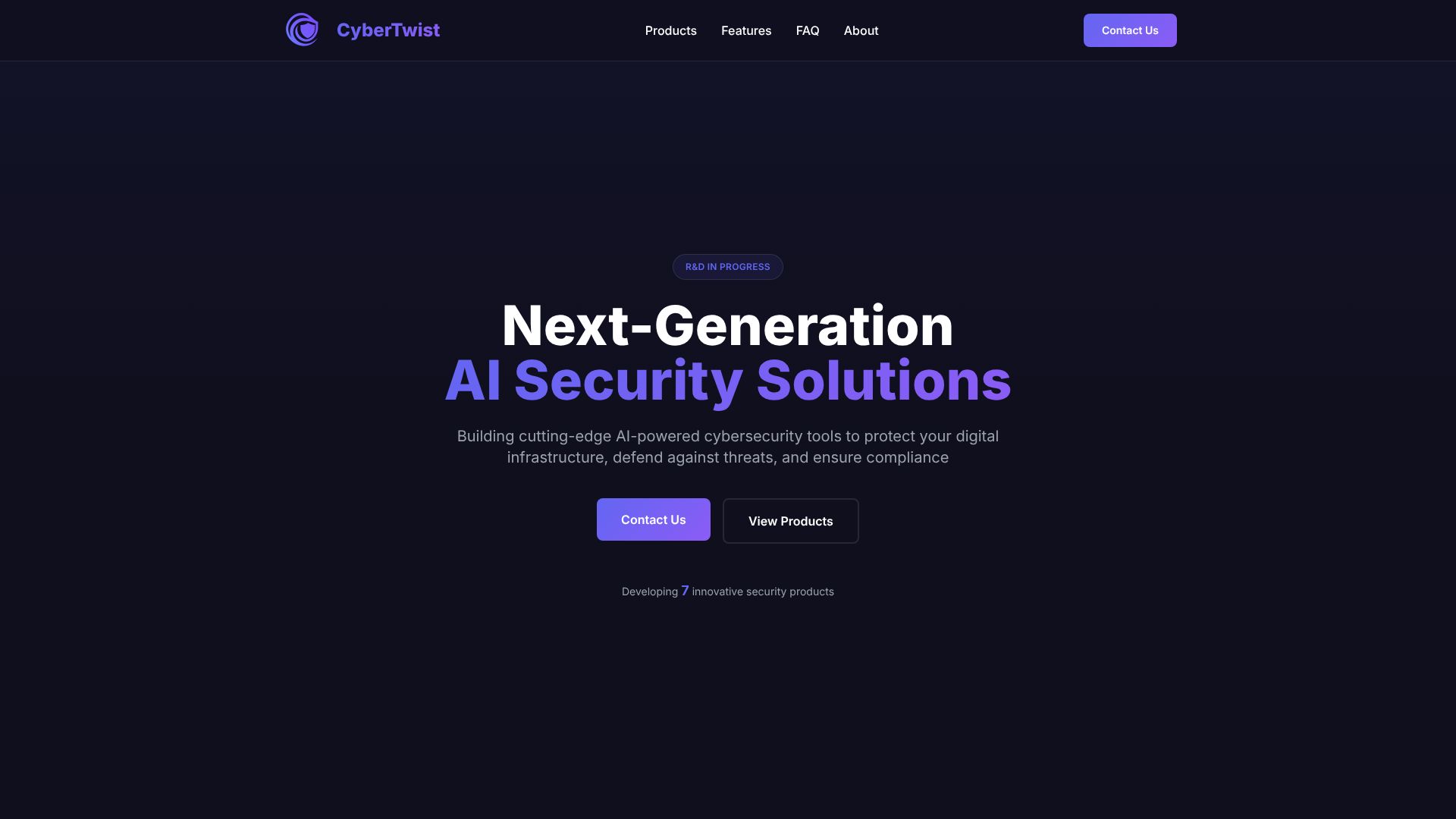
Cybersecurity buyers rarely need more tools—they need the right partner to turn policies into practice, turn risk into prioritized action, and turn security spending into measurable resilience. CyberTwist enters that picture as a Florida-based, privately held firm founded in 2025 that blends secure software development with hands-on cybersecurity consulting. If you’re looking at CyberTwist, you’re likely weighing whether a specialized partner can accelerate your roadmap faster than a big platform sale or an endless stream of piecemeal audits. In this review, we cover what CyberTwist does in plain language, where its approach fits, the types of features and services you can expect, how pricing typically works for boutique consultancies, which alternatives you might compare, and how to evaluate fit so your security investments land in the win column.
CyberTwist LLC focuses on cyber resilience, digital risk management, and data protection for startups through established enterprises. The company develops secure software solutions and provides professional consulting, anchoring its value in pragmatic execution over jargon. If you need a blended team that can help you design, test, and ship secure applications while also maturing governance and risk processes, CyberTwist aims to meet you at that intersection.
CyberTwist helps organizations build and protect software and data, combining secure software development with practical cybersecurity consulting to reduce risk and improve resilience.
Early-stage startups needing a security foundation that won’t slow shipping velocity but still satisfies investor, customer, or compliance expectations. Teams modernizing legacy systems and needing clear, engineering-friendly security guidance. Cloud-native companies that want secure-by-design patterns applied across their CI/CD and infrastructure. Regulated businesses that must prove sound data protection without building a large internal security team. Leaders who prefer a hands-on partner that can both advise and implement with measurable outcomes.
• Secure software development support that brings security into design and code review from the start rather than as a late-stage gate.
• Threat modeling sessions that map how your systems could be attacked and which controls provide the biggest reduction in real risk.
• Application security reviews for web, mobile, and API workloads, emphasizing reproducible findings, developer-ready fixes, and retest validation.
• Penetration testing tailored to product and business goals, from feature-focused assessments to broader adversarial testing in pre-production environments.
• Cloud security architecture guidance that codifies guardrails, least privilege, and identity boundaries for AWS, Azure, or GCP estates.
• DevSecOps enablement that embeds checks into CI/CD so security is enforced by automation rather than after-the-fact.\n• Vulnerability management process design that shifts organizations from ticket backlogs to risk-based remediation with SLAs and success metrics.
• Data protection consulting that helps classify data, apply encryption and key management, and set access policies tied to business use cases.
• Digital risk management that clarifies your crown jewels, critical vendors, and the probable attack paths that matter most to your operations.
• Incident readiness and playbooks that align roles, communications, evidence handling, and tabletop-tested workflows before an incident hits.
• Compliance program buildout that maps practical controls to standards such as SOC 2, ISO 27001, HIPAA, PCI DSS, and relevant state or sector rules.
• Security awareness tuned to your environment, emphasizing behavior change and role-specific micro-learnings for devs, admins, and business users.
• Virtual CISO advisory that provides executive-level guidance, board communication, roadmap prioritization, and budget strategy without full-time headcount.
• Product security governance that defines policies, decision rights, and secure SDLC checkpoints so security scales with your product pipeline.
• Privacy-by-design collaboration that brings data minimization, purpose limitation, and transparent collection practices into product requirements.
• Third-party and SaaS risk assessments that evaluate suppliers against your real exposure and put compensating controls in writing.
• Security metrics and reporting that show progress in terms of risk reduction, time-to-remediate, coverage, and business impact rather than vanity counts.
• Hands-on engineering assistance to implement guardrails, IaC baselines, and lightweight patterns that reduce friction for your developers.
• Playbook automation that integrates scanners, ticketing, chat, and secrets management to shorten the loop from detection to validated fix.
• Executive-ready deliverables—roadmaps, capability maturity baselines, and board summaries that anchor decisions to clear tradeoffs and outcomes.
• Discovery: short working sessions to clarify business objectives, critical assets, and current constraints so recommendations match reality.
• Baseline assessment: a practical snapshot of where you stand across people, process, and technology, scoped to your top priorities.
• Prioritized roadmap: a sequence of achievable steps, with owner, timeline, and expected outcome for each item—no vague wish lists.
• Quick wins first: early action on no-regret moves (for example, hardening identity, eliminating high-risk misconfigurations, and closing trivial findings).
• Enablement: pairing with engineers and operations so new controls and guardrails are understood, automated, and adopted.
• Retesting and validation: verify fixes, reduce false positives, and document improvements for leadership and customers.
• Iterate and scale: extend patterns across teams and services, add depth where risk remains highest, and measure results over time.
• Faster, safer releases by baking controls into CI/CD and code review, reducing late-stage rework and go-live delays.
• Meaningful risk reduction by focusing on the assets and attack paths that could materially hurt the business.
• Clear accountability through documented owners, SLAs, and playbooks that specify who does what, when, and how.
• Measurable progress with metrics tied to fix velocity, coverage, and risk exposure rather than endless finding counts.
• Lower operational friction as security policies become reusable patterns and automation, not ad hoc exceptions.
• Improved customer and auditor confidence via evidence-backed controls and repeatable, right-sized processes.
For boutique security partners like CyberTwist, pricing is typically scope-driven and quote-based rather than standardized subscription tiers. Because work often blends advisory and hands-on engineering, costs are anchored to the outcomes you want, the complexity of your environment, and the cadence of ongoing support. Instead of trying to compare sticker prices across vastly different scopes, it’s more practical to define a crisp outcome, limit initial scope to a few high-impact deliverables, and expand from there once the value is proven.
• Fixed-scope assessments: short, well-bounded efforts such as a focused application review or a baseline controls assessment are commonly priced as a fixed fee aligned to artifacts delivered and retest support.
• Retainer or subscription advisory: recurring time for virtual CISO guidance, roadmap execution, and on-call consults is often priced monthly or quarterly, with a set number of hours and SLAs for response.
• Project milestones: secure software buildouts, cloud architecture hardening, or program implementations may be structured as milestones with acceptance criteria and timelines.
• Outcome-based work: some clients prefer pricing mapped to measurable objectives—such as hardening coverage achieved, controls implemented, or time-to-remediate improvements—so spend aligns with visible results.
To budget effectively, start with the minimum viable scope that proves impact, such as creating an application security baseline with CI checks and a remediated retest. That single thread often reveals where to extend, what to pause, and how to harmonize security with delivery speed. If you need an exact quote, your fastest path is to share your goals and constraints directly with CyberTwist at thecybertwist.com; expect a tailored proposal rather than generic packages.
• Blended capability across secure software and consulting means fewer handoffs and better alignment between advice and implementation.
• Pragmatic, outcome-first posture favors changes that teams can actually adopt over exhaustive theory or policy documents that sit on a shelf.
• Boutique agility allows faster iteration and more tailored engagement than large, product-led vendors or purely audit-focused firms.
• U.S.-based, privately held structure can simplify vendor onboarding, data residency discussions, and customer trust narratives for many organizations.
• Emphasis on developer experience and automation keeps the runbook lightweight and repeatable rather than burdensome.
• You are about to ship a major product release and need a rapid, high-signal security review that doesn’t derail the launch.
• You want to move from ad hoc fixes to a simple, enforceable secure SDLC with CI checks and a clear definition of done.
• You must satisfy SOC 2 or ISO 27001 requirements without building a large internal security function immediately.
• You need to harden a cloud environment with opinionated, code-first guardrails and evidence you can show customers or auditors.
• You want incident readiness that’s practical: roles, runbooks, comms templates, and realistic tabletop scenarios.
• Ask for an initial discovery conversation anchored to one or two business outcomes and request a draft roadmap with measurable milestones.
• Request sample deliverables so you can see whether reports, playbooks, and code artifacts are actionable for your teams.
• Confirm retest and validation are included so you can measure improvements, not just receive a list of findings.
• Ensure developer enablement is part of the plan—brown-bag sessions, code clinics, and PR review patterns often decide adoption success.
• Align on metrics before kickoff: risk reduction goals, time-to-remediate targets, coverage percentages, and quality gates in CI/CD.
• Clarify communication cadence and stakeholders so issues are unblocked quickly and decisions don’t stall.
• SOC 2: define and implement controls tied to Trust Services Criteria, gather evidence, and ready your team for audit with minimal disruption.
• ISO 27001: establish an ISMS with risk treatment plans, policy sets, and continuous improvement loops calibrated to real risks.
• HIPAA: safeguard PHI with access controls, audit trails, data handling procedures, and vendor oversight that maps to your actual workflows.
• PCI DSS: scope reduction, segmentation, and controls that reduce audit fatigue and keep cardholder data protected.
• NIST-aligned controls: map practical actions to common frameworks so leadership can see progress in a language auditors recognize.
• Before/after snapshots for critical services, showing reduced attack surface and fewer high-severity issues in retests.
• Time-to-remediate reductions, especially for recurring defect types that were previously trapped in backlogs.
• Increased automated coverage in CI/CD: percentage of repos with enforced checks, policy-as-code adoption, and secrets scanning with gating.
• Incident readiness maturity: runbook completeness, role clarity, and outcomes from table-top exercises.
• Fewer production security incidents or reduced blast radius due to identity hardening and segmentation.
• NCC Group
• Bishop Fox
• Trail of Bits
• Praetorian
• Synopsys Software Integrity Group
• Veracode
• Checkmarx
• Snyk
• Rapid7
• Tenable
• Mandiant (Google Cloud)
• CrowdStrike
• Sophos
• Trend Micro
• Check Point Software
• Fortinet
• Secureworks
• Arctic Wolf
Large platform vendors pair software with services, which is powerful if you plan to standardize on their stack and have the staff to run it. However, those engagements sometimes prioritize tool adoption over tailored process change. Pure-play testing firms excel at deep technical audits, yet can underinvest in ongoing enablement and program buildout. Boutique partners like CyberTwist often fill the gap by keeping scope tight, moving quickly from assessment to implementation, and focusing on artifacts your teams can actually maintain. If you need enterprise-scale breadth across dozens of security domains, a larger provider may be a better fit. If your priority is to secure specific products, pipelines, or cloud estates with minimal ceremony and strong developer alignment, a focused partner can be the faster path to real results.
• Concern: “We can’t slow down delivery.” Response: Adopt incremental controls in CI that eliminate trivial classes of defects without blocking every build; start with non-gating checks and graduate to gating once false positives are tuned down.
• Concern: “We already have scanners.” Response: Scanners find issues; programs fix them. The gap is triage, prioritization, ownership, and retest validation—areas where process and enablement matter more than tools.
• Concern: “We’re too early-stage.” Response: A lightweight baseline and a few opinionated patterns can prevent future rework and reduce customer-churn risk when security questionnaires arrive.
• Concern: “Audit season is coming.” Response: Focus on the controls that provide both audit evidence and risk reduction—access management, logging, change control, and data handling—then backfill paperwork from the actual practices.
• Choose a flagship service or product as the pilot to keep scope focused and create a repeatable model for other teams.
• Nominate a product owner and a security champion so decision-making stays tight and blockers are resolved quickly.
• Agree on a weekly touchpoint, a living action log, and a single source of truth for artifacts to minimize context switching.
• Schedule a retest date at kickoff so remediation has urgency and outcomes are measured, not assumed.
• Capture lessons learned and templatize successful patterns (IaC modules, CI jobs, runbooks) for reuse across the organization.
• Boutique capacity means schedules can be tighter—book early if you have hard release dates.
• Quote-based pricing requires a clear scope; vague objectives can slow proposal turnaround.
• If you need 24x7 fully managed SOC operations or global-scale staffing, a larger MSSP may be more suitable.
• Weeks 1–2: discovery, threat modeling for a key service, and a baseline review of CI/CD and cloud identity posture; draft an outcome-driven roadmap with two immediate quick wins.
• Weeks 3–6: implement guardrails for identity and secrets, turn on low-friction CI checks for critical repos, and address top-severity findings with developer pairing and retest on the same branch.
• Weeks 7–10: expand coverage to adjacent services, automate policy-as-code where practical, and finalize incident playbooks with a tabletop exercise.
• Weeks 11–12: produce executive-ready metrics and a next-quarter plan that balances product delivery with incremental risk reduction.
Security investments yield the highest ROI when made at integration points: a new product module, a pipeline rework, a cloud migration, or a compliance push. That’s when patterns are still fluid and teams are willing to adopt better defaults. If your organization is sitting at one of those junctures, a smaller, hands-on partner can help you set the tone and implant guardrails before complexity hardens. The payoff is fewer emergencies, smoother audits, and a culture where security accelerates delivery instead of blocking it.
CyberTwist focuses on a simple, powerful promise: build and protect software and data with practical steps that teams can sustain. If your organization wants fewer slides and more working guardrails—threat models that lead to changes in code, reviews that reduce defect classes, and playbooks that actually guide response—this approach is well worth a look. As with any security partner, the key is fit: define the outcomes you want, set a tight initial scope, and insist on retest validation with metrics that matter to your business. For many startups and growing companies, that recipe delivers visible, durable improvements without slowing the roadmap.
If you’re ready to explore whether CyberTwist matches your goals, the fastest next step is a short discovery conversation with your objectives in hand. You can learn more or request a tailored proposal at thecybertwist.com. Even a small, well-scoped engagement—like hardening identity and embedding a few CI checks—can set the foundation for a more resilient product and a calmer on-call life. That’s the kind of security investment teams feel every day, and the kind customers and auditors notice when it matters most.
