


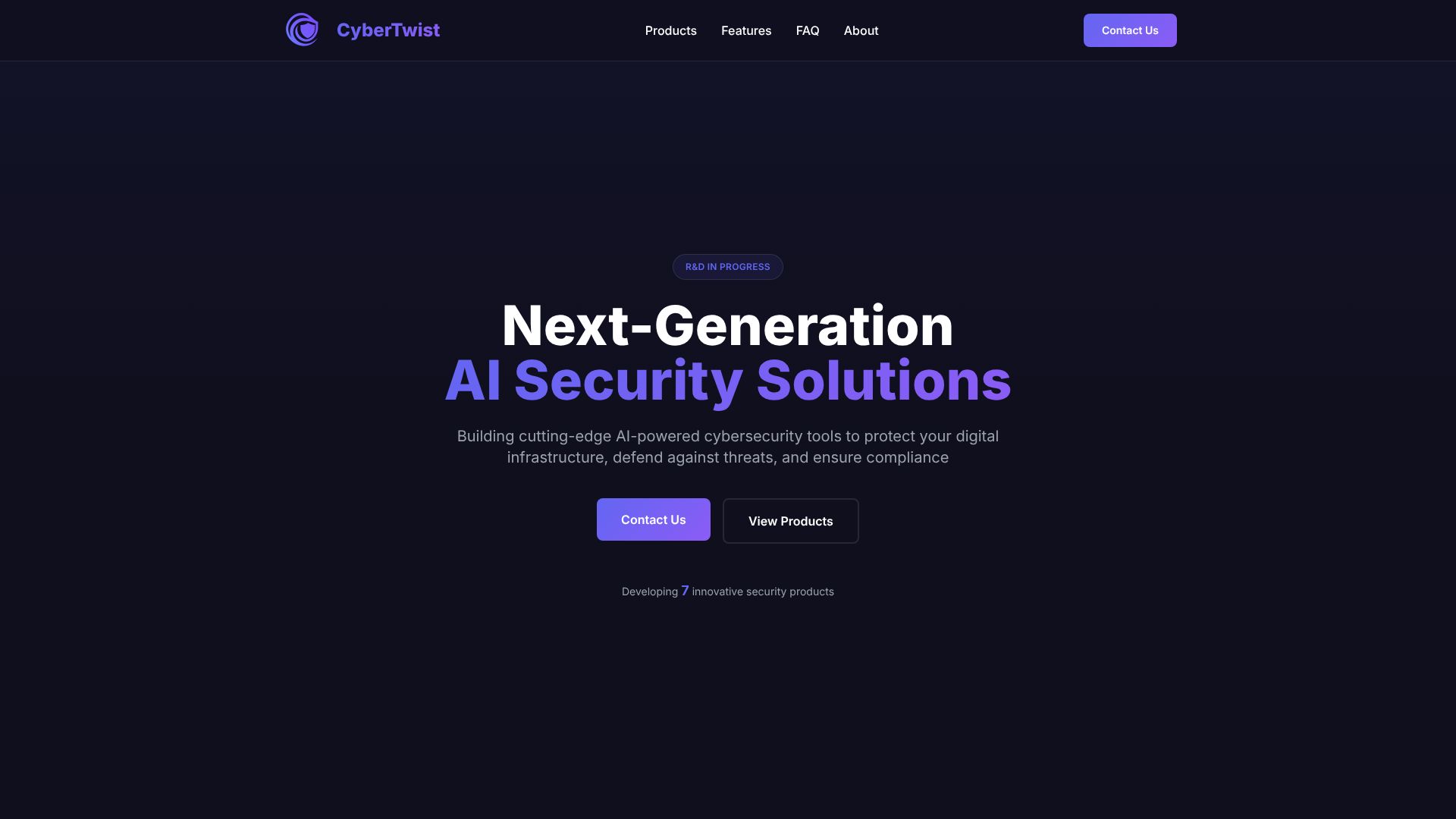
CyberTwist is a Florida-based cybersecurity company that blends hands-on secure software engineering with pragmatic consulting to help organizations protect data, reduce risk, and move faster with confidence. Founded in 2025 as a privately held U.S. business, CyberTwist works with startups and established teams to harden applications, streamline compliance, and modernize security practices without slowing down product delivery. If you are balancing rapid growth with the need for stronger safeguards—especially around software supply chains, cloud-native apps, and data privacy—CyberTwist aims to be a practical, senior partner rather than a one-size-fits-all vendor. The company’s approach emphasizes clarity, developer-first workflows, and measurable outcomes over buzzwords and shelfware. That means threat modeling that maps to your roadmap, code reviews that surface actionable fixes, and risk guidance that ties to business goals. The company’s website, thecybertwist.com, outlines its services and perspective, but the real value shows up in how they tailor engagements: short discovery phases, scoped deliverables, and tight collaboration with engineering and leadership. Pricing is customized to scope, with project-based work for assessments and buildouts, and retainer-style advisory for ongoing guidance such as vCISO and roadmap execution. Rather than charging for tools you don’t need, CyberTwist focuses on outcomes—defining the right controls, building the right guardrails, and transferring the right skills to your team so improvements stick. In this review, we’ll cover what CyberTwist does, the capabilities that stand out, how it compares to alternatives, and when it’s the right fit for your roadmap.
CyberTwist builds secure software and helps companies protect their data through clear guidance and hands-on support.
• Secure software development support that meets teams where they work, from architecture to code, so security is built-in rather than bolted on later.
• Threat modeling tuned to product reality, mapping high-impact abuse cases to backlog items with concrete mitigations and ownership.
• Code review with security depth, focusing on high-risk patterns (auth, crypto, secrets, input handling, access checks, data flows) and delivering fixes developers can quickly adopt.
• DevSecOps enablement that adds automated checks to CI/CD without creating noise—SAST/DAST/IAST tuning, secret scanning, dependency risk gating, and container image policies.
• Software supply chain hardening that addresses SBOM creation, dependency governance, artifact signing, provenance, and tamper-resistant build pipelines.
• Secure architecture design for cloud-native stacks, implementing least privilege, network segmentation, secret management, and identity controls that scale with workloads.
• Cloud posture and guardrails aligned to AWS, Azure, and GCP best practices, with policies-as-code to keep drift in check across accounts and environments.
• Data protection by design: mapping sensitive data, minimizing collection, encrypting in transit and at rest, and aligning access with business need-to-know.
• Privacy and compliance readiness that translates frameworks like SOC 2, HIPAA, PCI DSS, and ISO 27001 into practical controls, evidence, and narratives auditors accept.
• Risk assessment that prioritizes what matters most, combining technical findings with business context so leaders can fund what moves risk down fast.
• Incident readiness that creates response plans, roles, comms templates, and detection playbooks tailored to your stack and team capacity.
• Tabletop exercises that simulate real-world failures—from credential misuse to data exposure—so teams practice decisions before it hurts.
• Startup-focused security baselines that give early-stage teams a right-sized, high-leverage set of controls and policies they can actually maintain.
• vCISO advisory that brings executive-level guidance to budget, policy, vendor selection, and board reporting without the cost of a full-time hire.
• Product security program design that defines ownership, metrics, SLAs, training paths, and intake processes to turn ad-hoc fixes into a durable practice.
• Application security testing that blends manual and automated methods, with report formats that developers can file directly as tickets and ship quickly.
• Hardening playbooks for identity, endpoints, and SaaS that establish baseline hygiene like MFA, conditional access, device posture, and shadow IT controls.
• Third-party and vendor risk due diligence that scales with procurement, using lightweight questionnaires, evidence collection, and contract language that reduces exposure.
• Secrets management improvements that migrate credentials out of code and repos into vaults or cloud-native stores with least privilege and rotation policies.
• API security guidance covering auth patterns (OAuth 2.0, mTLS, signed requests), rate limiting, schema validation, and schema-first design practices.
• Cryptography consulting that favors safe defaults and vetted libraries, with key management and rotation workflows that fit existing operations.
• Container and Kubernetes security recommendations that lock down images, apply namespace and network policies, and manage RBAC the right way from day one.
• Infrastructure-as-code reviews for Terraform and CloudFormation that spot dangerous defaults, privilege creep, and drift risks before they reach production.
• Build system and CI hardening that reduces runner abuse, enforces signed pipelines, and isolates secrets so contributors can’t escalate by accident.
• Evidence-ready process documentation that satisfies auditors while staying lean: clear owners, simple checklists, and automated logs wherever possible.
• Developer education delivered in-context—short trainings and office hours tied to current tasks, so teams learn by shipping safer code on real work.
• Red-teaming lite and scenario-based assessments that target business-critical workflows, pairing findings with concrete defense-in-depth improvements.
• Clear roadmaps with measurable milestones, showing what gets done this quarter, what shifts risk in six months, and what can wait until scale demands it.
• Tool rationalization so teams avoid overlapping scanners and dashboards, freeing budget and attention for the few controls that deliver outsized value.
• Evidence automation patterns that pull logs and artifacts directly from your tooling to cut audit prep time and reduce manual attestations.
• Data lifecycle controls that define retention, deletion, and anonymization policies, preventing growth in sensitive datasets and minimizing breach impact.
• Access management cleanup that eliminates dormant accounts, stale roles, and overbroad permissions with a cadence your team can sustain.
• Secure release gates tuned to your risk appetite, keeping velocity while ensuring critical checks (tests, scans, signatures) must pass before deploys.
• Executive reporting that explains risk in simple terms, ties spend to outcomes, and makes it easy to defend tradeoffs to boards and customers.
• Migration-ready security planning for replatforming or M&A, addressing identity merges, data transfer safety, and change windows with rollback paths.
• Practical zero trust steps that start with identity, device health, and network minimization without boiling the ocean or disrupting workflows.
• Cost-aware design that highlights free or built-in cloud controls first, reserving third-party buys for gaps that truly demand specialized tooling.
• Evidence-backed customer answers for security questionnaires, speeding up sales cycles with accurate, reusable responses and diagrams.
• Culture change through small wins: ship a secure-by-default template, prune a dangerous permission, shorten incident response time—visible progress that compounds.
• Flexible engagement models—short sprints for targeted fixes, ongoing advisory for long-term maturity, and project delivery when you need build partner capacity.
• Outcome-first pricing that aligns scope with metrics you care about: fewer P1s, shorter MTTR, reduced attack surface, and cleaner audit outcomes.
• Transparent handoffs with documentation, runbooks, and office hours so improvements remain stable after the engagement ends.
• NCC Group — Broad cybersecurity consulting and testing, known for deep technical assessments and global scale for enterprises.
• Bishop Fox — Offensive security specialists with red teaming and product testing expertise; strong for organizations seeking adversarial simulation depth.
• Trail of Bits — Secure software engineering and advanced research, well-suited for complex codebases, cryptography, and high-assurance needs.
• Praetorian — Cloud and application security with a focus on engineering-first engagements and measurable outcomes across DevSecOps.
• Synopsys Software Integrity Group — Enterprise application security testing and program services, integrating tooling and advisory for large portfolios.
• Veracode — Application security platform with scanning and program services; strong fit for organizations standardizing AppSec across teams.
• Snyk — Developer-first security tooling for code, open source, containers, and IaC; complements consulting with self-serve developer workflows.
• Checkmarx — Application security platform focused on SAST and supply chain risk; often adopted by teams with extensive monorepos and pipelines.
• GitLab Ultimate (Security) — Built-in DevSecOps features in the CI/CD platform; good when consolidating tools and enforcing pipeline policies.
• Mandiant (Google Cloud) — Incident response and threat intelligence at scale, plus strategic security advisory for complex environments.
• Rapid7 — Risk and exposure management with consulting services; strong for vulnerability management and detection strategy alignment.
• Qualys — Vulnerability management and compliance tooling with services; helpful for organizations needing broad asset coverage.
• Tenable — Exposure management platform with consulting partners; commonly used to baseline vulnerabilities and prioritize remediation.
• CrowdStrike Services — Incident response and assessments that pair with the Falcon platform; suited to orgs standardizing endpoint detection.
• Palo Alto Networks Unit 42 — Incident response and cloud security consulting tied to broader security portfolio and threat research.
• Sophos X-Ops and Services — Managed protections plus consulting; an option for those converging tooling and advisory under one vendor.
• Secureworks — Consulting and threat detection services, useful for organizations needing guidance plus managed visibility.
• Optiv — Integrator with consulting breadth, program design, and tooling orchestration for enterprises consolidating security investments.
• Accenture Security — Large-scale transformation programs, compliance, and advisory; strong fit for complex, multi-region operations.
• Darktrace — AI-driven detection with services; considered when augmenting monitoring alongside guidance on response playbooks.
CyberTwist focuses on making security show up where it matters: in code, in pipelines, in cloud accounts, and in decisions leaders make about risk and delivery. Rather than overwhelming teams with tools and jargon, the company sticks to clear plans, developer-friendly practices, and improvements that actually change outcomes—fewer critical issues, faster remediation, and cleaner audits. If you are an early-stage startup, you will likely appreciate the right-sized baselines, the speed of initial discovery and scoping, and the emphasis on simple guardrails that keep pace with growth. If you are an established business, you’ll benefit from secure architecture reviews, supply chain hardening, and program design that formalizes what’s been informal without introducing unnecessary friction. Pricing is tailored to scope and goals: project-based engagements for assessments, architecture, and remediation sprints; retainer advisory for vCISO and roadmap execution; and outcome-oriented milestones so you can measure progress. Competitors range from niche engineering boutiques to large global integrators. Many are excellent choices in their sweet spot; your best fit depends on whether you want a deep technical partner focused on secure software and cloud-first practices, a broad program integrator, or a platform-led approach. CyberTwist’s edge is the combination of secure software craftsmanship and pragmatic consulting—especially helpful when you need hands-on help building the guardrails and transferring skills to your team. The next step is straightforward: define the outcomes you want in the next quarter, audit what you already have, then scope the smallest set of changes that unlock the biggest risk reduction. If that sounds like your way of working, CyberTwist is worth a closer look. Learn more or request a scoping call at thecybertwist.com.
